
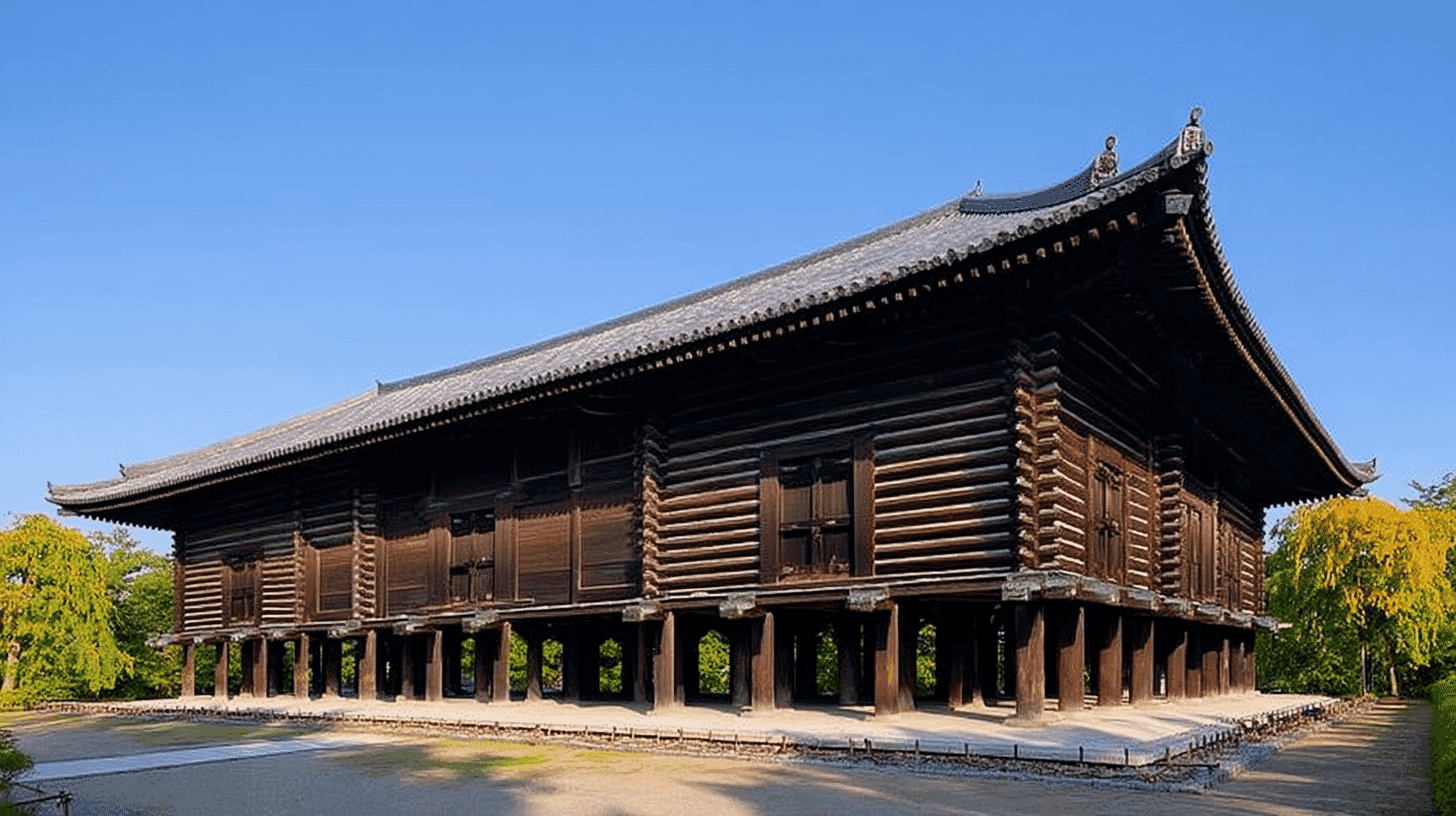
A Storehouse of about 756, National Treasure since 1997
The Shosoin Repository (正倉院正倉, Shosoin Shoso) is a Nara-period storehouse at Zoshi-cho, Nara City, Nara Prefecture, made a National Treasure in 1997, on 19 May, when it was also listed as an Important Cultural Property. The quantity is one building: nine bays along the front, three bays deep, single storey, raised-floor azekura construction, hipped roof, tiled. It belongs to the state, under the Imperial Household Agency.
The Agency for Cultural Affairs dates the building thus: the Shosoin stands northwest of the Great Buddha Hall of Todaiji and originally belonged to that temple. The storehouse is thought to have been built around 756, the year Empress Komyo presented the possessions of the late Emperor Shomu to Todaiji.
The same date for both designations reflects the fact that the building, under the Imperial Household Agency, had never been designated a cultural property. When designation came in 1997, listing as an Important Cultural Property and elevation to National Treasure were made on the same day.
What a Shoso Was: A Storehouse in Every District
The Agency's commentary begins from the name itself.
In antiquity, under the ritsuryo system, a shoso was established in each district to hold the tax grain of the province. Many storehouses were built as shoso, differing in structure according to what they held, among them azekura, plank-walled and round-log types, and distinguished also by standard.
A shoso, then, is not a proper name but a class of storehouse set up across the country under the ritsuryo system. The name Shosoin likewise derives from a common noun for the compound in which such storehouses stood.
Ancient temples, holding extensive estates alongside the main buildings of their precincts such as sutra repositories, also had many storehouses on their grounds, as the provinces did. Several survive, and most are of azekura construction.
The Twin-Storehouse Form: The Heart of the Citation
The reasons are set out in two sentences. The first concerns architectural history.
The Shosoin Repository is a storehouse built within Todaiji, among the largest azekura buildings of the Nara period to survive, and as the only azekura building preserving the twin-storehouse form it is recognised as of extremely high value in the architectural history of Japan.
The twin-storehouse form sets two storehouses side by side and closes the space between them. The building has three chambers, north, middle and south; the north and south are azekura, the middle is plank-walled. It is thought that two azekura storehouses stood first and the space between them was walled with planks to make the middle chamber. That arrangement is what the Agency means by the only azekura building preserving the twin-storehouse form.
The second sentence concerns cultural history: as the sole surviving structure that conveys the character of the shoso, an institution of particular importance in the politics and economy of the Nara period, it holds extremely important significance in the cultural history of Japan.
Azekura construction stacks timbers of triangular section in interlocking courses, and it is often said that the wood swells and shrinks with humidity, regulating conditions within. The Agency's commentary does not make that claim, and this article does not assert it.
A Long Storehouse on Raised Floors
Nine bays along the front, three bays deep, on a raised floor, facing east, under a hipped roof of formal tile.
A raised floor lifts the building clear of the ground, used in storehouses to keep out damp and rodents. The space beneath the Shosoin is high enough to stand in, with heavy columns ranged across it. Seen from outside, the lower half of the building is open framing.
The azekura walls of the north and south chambers are built from timbers of triangular section laid horizontally, their ends projecting alternately at the corners to give the distinctive profile. The middle chamber is plank-walled, with boards dropped between the columns. One building therefore carries two kinds of wall, and the difference in texture is visible from outside.
The treasures were moved to reinforced concrete stores during the Showa period, and the Shosoin is preserved as a building. Repairs including a complete re-roofing were carried out between 2011 and 2014.
Visiting
The grounds around the Shosoin are open free of charge on weekdays from 10:00 a.m. to 3:00 p.m., closed on Saturdays, Sundays, public holidays and over the New Year. The Imperial Household Agency's Shosoin office administers it and the schedule can change, so check before travelling.
Only the exterior grounds are open; the interior cannot be entered. Visitors view the east face of the building from outside a fence. The azekura walls and the columns beneath the raised floor can be studied well enough from there.
The treasures themselves are shown each autumn at the Nara National Museum in the Shosoin exhibition, which runs about two weeks from late October into early November with a different selection each year. Seeing them requires a separate trip timed to the exhibition.
From JR Nara Station or Kintetsu Nara Station take a bus to the Imakoji stop and walk about five minutes. The site lies northwest of the Great Buddha Hall of Todaiji, about ten minutes on foot from the hall.
Q&A
- When was the Shosoin built and designated?
- The Agency for Cultural Affairs dates it to around 756, the year Empress Komyo presented Emperor Shomu's possessions to Todaiji. It was designated both an Important Cultural Property and a National Treasure on 19 May 1997, the same date because the building, under the Imperial Household Agency, had never been designated before.
- What is a shoso?
- A storehouse established in each district under the ritsuryo system to hold the tax grain of the province. It is a class of building rather than a proper name, and included azekura, plank-walled and round-log types. The name Shosoin likewise derives from a common noun for a compound of such storehouses.
- Why was the Shosoin designated a National Treasure?
- The Agency finds it among the largest surviving Nara-period azekura buildings and the only one preserving the twin-storehouse form, of extremely high value in architectural history. It also cites its significance as the sole surviving structure conveying the character of the shoso, an institution of particular importance in Nara-period government and economy.
- What is the twin-storehouse form?
- Two storehouses set side by side with the space between them closed. The building has north, middle and south chambers; north and south are azekura and the middle is plank-walled. Two azekura storehouses are thought to have stood first, with the space between them later walled in planks.
- Can the Shosoin be visited, and can the treasures be seen?
- The grounds are open free of charge on weekdays from 10:00 a.m. to 3:00 p.m., with the interior closed; visitors view the east face from outside a fence. The treasures are shown each autumn at the Nara National Museum, so seeing them requires a separate trip timed to that exhibition.
Basic Information
| Name | Shosoin Repository (正倉院正倉, Shosoin Shoso) |
|---|---|
| Location | 129 Zoshi-cho, Nara City, Nara Prefecture |
| Designation | National Treasure (structure); component of the World Heritage site Historic Monuments of Ancient Nara |
| Year Designated | 1997 (19 May), Important Cultural Property and National Treasure on the same date |
| Quantity | 1 building |
| Dimensions | 9 bays along the front, 3 bays deep, single storey, raised-floor azekura, hipped roof, tiled. Three chambers, north, middle and south; north and south in azekura, middle plank-walled. Faces east. Built about 756 |
| Owner | The state, under the Imperial Household Agency |
| Public Access | Grounds open free on weekdays from 10:00 a.m. to 3:00 p.m., closed weekends, holidays and the New Year. Interior closed |
References
- Cultural Heritage Online: Shosoin Repository
- https://bunka.nii.ac.jp/heritages/detail/201499
- Imperial Household Agency: Shosoin
- https://shosoin.kunaicho.go.jp/
- Imperial Household Agency: outline of the Shosoin
- https://www.kunaicho.go.jp/culture/shosoin/shosoin.html
- Nara National Museum
- https://www.narahaku.go.jp/
Last verified: 2026.09.03