
One Hanging, National Treasure since 1952
Surviving Fragments of the Tenjukoku Embroidery (天寿国繡帳残闕, Tenjukoku Shucho Zanketsu) is an Asuka-period craft object owned by Chuguji in Nara Prefecture, made an Important Cultural Property on 29 March 1952 and designated a National Treasure on the same day.
Both steps fall on one date. Among the properties covered here, this is the first case in which the two listings share a day.
The quantity is one hanging, measuring 88.8 centimetres high and 82.7 centimetres wide. The address field in the Agency's database is blank, the third such case after the Hosoge sutra box and the red-laced armour.
Asuka Work and a Kamakura Copy Together
Cloth of two ages sits within one frame.
The Agency records that the differences in ground fabric and embroidery arise because the work had decayed badly by the Kamakura period and parts were copied afresh.
Asuka-period portions and Kamakura replacements stand side by side. Both the backing cloth and the stitching differ for that reason.
The assessment applies to a part only: the embroidery on the purple gauze ground is of the greatest value as the oldest embroidery to survive.
What is called oldest is the purple gauze portion, not the whole.
At Sofukuji Daiyuhoden, style and date divided between the lower and upper storeys. That division runs vertically. Here Asuka and Kamakura sit side by side within one frame.
Arranged Together, Yet the Design Does Not Continue
How the mounting was done is recorded.
Fragments embroidered on three kinds of ground cloth, purple gauze, purple twill and plain white silk, were gathered and set in a frame.
It continues: they divide into upper, middle and lower registers, each register divided left and right, but the ground cloths are mixed and the design does not continue.
They are set out in three registers and halved across. The fabrics are mixed, however, and the picture does not run on.
Of the original: from the surviving fragments it is difficult to infer the original size or composition.
Two hangings were originally made, and part of them survives. How much of the two remains is not known. What is not known is written down as such.
Even the Direction of the Twist Is Recorded
Technique is set down separately for each ground.
On the purple gauze, the embroidery uses thread with a left-hand twist, worked in back stitch, the needle running in nearly parallel lines.
On the purple twill, the thread has a loose right-hand twist, the outlines in back stitch and couching, the surfaces in flat stitch, darning stitch and shaded stitch.
The two directions of twist are written down separately. Which way the thread was spun is part of the record.
The Nagamitsu naginata has three peg holes; the red-laced armour has its helmet rivets in twenty-four rows. Those are records of number.
This is a record of direction, and the difference in twist also helps separate the Asuka work from the Kamakura.
Seeing It
The hanging belongs to Chuguji. It is a temple holding, not kept on permanent display; embroidered cloth is vulnerable to light and shown only briefly.
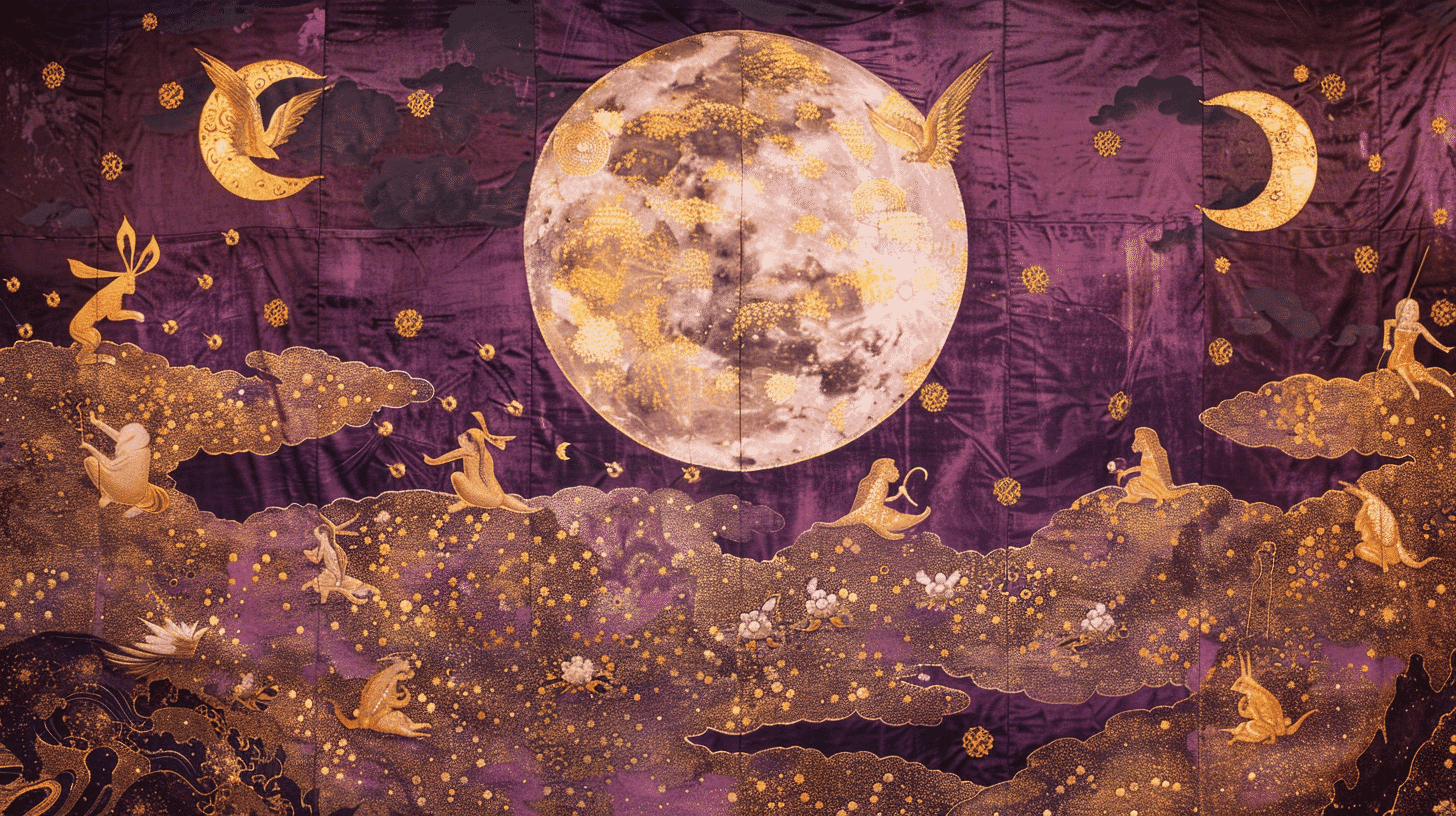
The imagery is described closely. On the purple gauze appear men in narrow-sleeved robes and men in wide-hemmed garments, a woman with a shawl over her dress, a phoenix, a hare in the moon, and a tortoise shape bearing written characters.
Characters sit inside the tortoise shapes. Two more such tortoises with characters appear on the purple twill.
On the plain white silk are a bell tower with ridge-end ornaments under a hip-and-gable roof and a monk striking the bell, a hall and pavilion with men and women, a monk reading sutras, and four Buddhist figures.
The surviving imagery is said to show the dress of the Asuka period. Exhibition plans can change, so check before travelling.
Q&A
- When was it designated?
- It became an Important Cultural Property on 29 March 1952 and a National Treasure on the same day, a case of both steps sharing one date. The quantity is one hanging and the owner Chuguji.
- Is it all Asuka-period work?
- No. The Agency records that the work had decayed badly by the Kamakura period and parts were copied afresh, so Asuka portions and Kamakura replacements stand together.
- How is it mounted?
- The Agency records three registers, each divided left and right, but notes that the ground cloths are mixed and the design does not continue. The pieces are arranged without the picture running on.
- How large was it originally?
- Not known. The Agency records that from the surviving fragments it is difficult to infer the original size or composition. Two hangings were made, and part of them survives.
- What is valued in it?
- The Agency records that the embroidery on the purple gauze ground is of the greatest value as the oldest embroidery to survive. What is called oldest is that portion, not the whole.
Basic Information
| Name | Surviving Fragments of the Tenjukoku Embroidery (天寿国繡帳残闕, Tenjukoku Shucho Zanketsu) |
|---|---|
| Location | The address field in the Agency's database is blank; the owner is given as Chuguji |
| Designation | National Treasure (craft); the earlier listing and the designation fall on one date |
| Year Designated | 1952 (29 March), Important Cultural Property and National Treasure |
| Quantity | 1 hanging |
| Dimensions | 88.8 centimetres high and 82.7 centimetres wide. Fragments embroidered on 3 kinds of ground cloth, purple gauze, purple twill and plain white silk, are gathered in a frame. They divide into 3 registers, each halved left and right, but the design does not continue. Parts were copied afresh in the Kamakura period. The period is Asuka |
| Owner | Chuguji |
| Public Access | A temple holding, not on permanent display; embroidered cloth is vulnerable to light and shown only briefly |
References
- Cultural Heritage Online: the surviving Tenjukoku embroidery
- https://bunka.nii.ac.jp/db/heritages/detail/197390
- Chuguji official site
- https://www.chuguji.jp/
- Nara National Museum
- https://www.narahaku.go.jp/
- Agency for Cultural Affairs, National Cultural Properties Database
- https://kunishitei.bunka.go.jp/
Last verified: 2026.09.06