
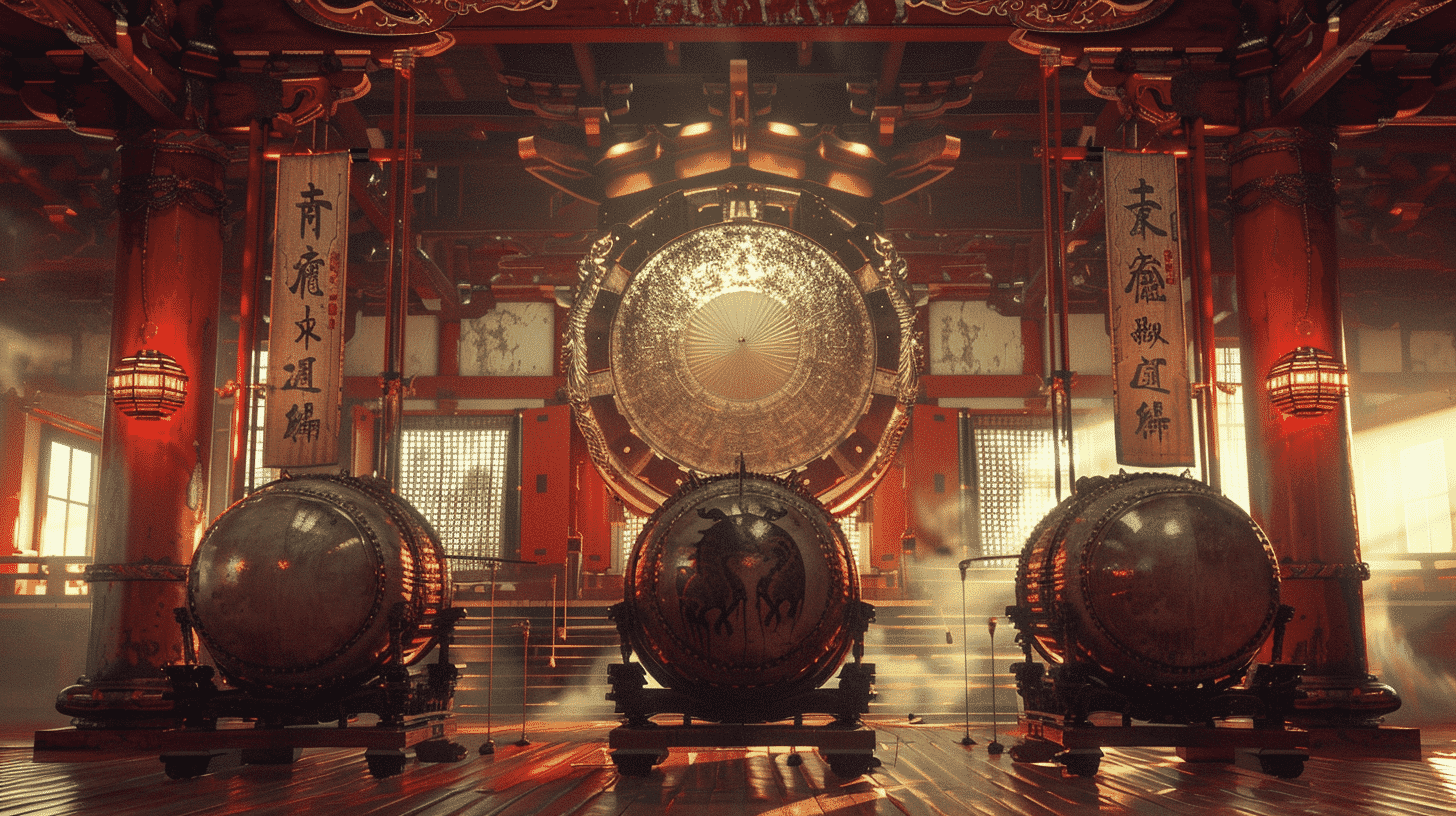
A Pair of Drums, National Treasure since 2020
Dadaiko, a Pair of Great Ceremonial Drums (鼉太鼓, Dadaiko) are Kamakura-period craft objects owned by Kasuga Taisha in Nara Prefecture, made an Important Cultural Property on 27 March 1901 and designated a National Treasure on 30 September 2020. The designation number is 00257.
One hundred and nineteen years separate the two listings, the longest span met here. The previous longest was the hundred and nine years of the Five Wisdom Buddhas.
27 March 1901 is the day of the gilded bronze staff head. That object waited eighty years for its designation; these drums waited a hundred and nineteen.
The Quantity Is Written as One Pair
The way of counting differs from the rest.
The quantity field reads one pair, written in Chinese numerals with the measure word for a pair.
Properties covered here have been counted in buildings, figures, blades, scrolls, boxes, towers, pieces, suits, hangings, mirrors, flat objects, staff heads and sets, all in arabic numerals.
Here the numeral is Chinese and two things are counted as one.
At Kirishima Jingu, three buildings joined by their roofs were counted as one structure. Those form a single body.
Here two separate drums are counted together as a pair.
A Pair, and Yet the Two Differ
They make a pair, but they are not two of the same thing.
The Agency records clouds below on both, and above, twin dragons on one and a phoenix on the other, applied in separate wood and set to face each other.
The cloud pattern below is shared. Above, one carries dragons and the other a phoenix.
Of the summits: each is cut through in the form of flames, with a halo of gold or of silver set in it, rayed.
Gold or silver, the record says, which reads as one of each across the two.
The three swords at Kasuga Taisha were designated as separate properties. Here one property holds two drums whose designs do not match.
The Dimensions Field Is Empty and the Commentary Describes the Form
Where the information sits has changed places.
The fields for dimensions and for form are both empty.
The commentary, however, describes the form closely. A large drum stands at the centre, it begins, with a flame-shaped surround set about it.
The surround is of jointed cypress, carved on both faces, hollowed at the centre to the shape of the drum and edged with a band of beading. The base is wooden, with a vermilion-lacquered railing running round it.
With the Lotus Sutra scroll at Zentsuji, nearly every field was empty and the commentary was one sentence. With the Engishiki, the date field was empty and a clue survived in the notes.
Here the field for form stands empty while the commentary does its work. What is written has moved from one place to another.
Seeing Them
The drums belong to Kasuga Taisha. The field for prefecture gives Nara and the address field is blank, the twentieth such case.
The carving is assessed: the flame-shaped surrounds spread widely to left and right with a strong roundness, and the dragons, phoenix, clouds and flames are all carved in thick relief, giving a powerful form.
The record closes by calling them an example of the earliest Kamakura period retaining the feeling of the Heian, and material of the greatest value.
Kamakura work that keeps the feeling of the age before. At the Kozanji Buddha hall, a slight difference in width was read as a sign of the age to come.
That looks forward; this looks back. Kasuga Taisha also owns the three swords covered here. The drums are a shrine holding, not kept on permanent display. Check before travelling.
Q&A
- When were the drums designated?
- They became an Important Cultural Property on 27 March 1901 and a National Treasure on 30 September 2020, a hundred and nineteen years apart and the longest span met here.
- How is the quantity written?
- As one pair, in Chinese numerals, with the measure word for a pair. Other properties are counted in arabic numerals as one building, one blade and so on.
- Are the two drums alike?
- No. The Agency records twin dragons on one and a phoenix on the other, and haloes of gold or of silver at their summits. A pair whose designs do not match.
- What are their dimensions?
- None are recorded. The fields for dimensions and for form are both empty, though the commentary describes the form closely.
- What is valued in them?
- The Agency calls them an example of the earliest Kamakura period retaining the feeling of the Heian, and material of the greatest value.
Basic Information
| Name | Dadaiko, a Pair of Great Ceremonial Drums (鼉太鼓); the quantity is written in Chinese numerals as one pair |
|---|---|
| Location | The field for prefecture gives Nara; the address field is blank and the owner is given as Kasuga Taisha |
| Designation | National Treasure (craft), designation no. 00257 |
| Year Designated | 1901 (27 March), Important Cultural Property; 2020 (30 September), National Treasure |
| Quantity | 1 pair |
| Dimensions | The fields for dimensions and for form are both empty. By the commentary, a large drum stands at the centre with a flame-shaped surround of jointed cypress about it; above, one carries twin dragons and the other a phoenix, with a halo of gold or of silver at the summit and a vermilion-lacquered railing round the base. The period is Kamakura |
| Owner | Kasuga Taisha |
| Public Access | A shrine holding, not on permanent display |
References
- Agency for Cultural Affairs database: the great ceremonial drums
- https://kunishitei.bunka.go.jp/heritage/detail/201/5383
- Kasuga Taisha official site
- https://www.kasugataisha.or.jp/
- Kasuga Taisha: the treasure hall
- https://www.kasugataisha.or.jp/museum/
- Agency for Cultural Affairs, National Cultural Properties Database
- https://kunishitei.bunka.go.jp/
Last verified: 2026.09.06