
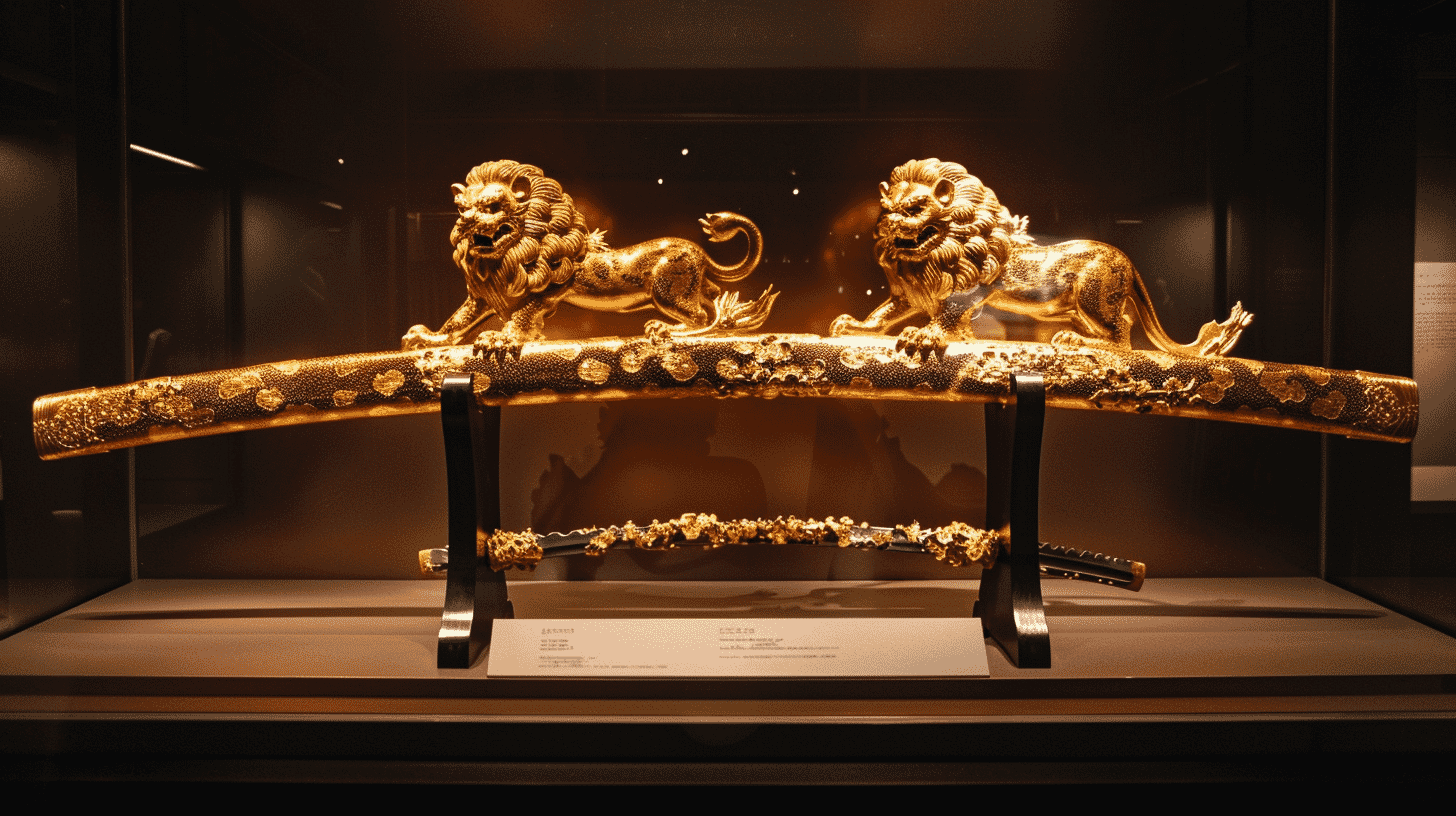
One Sword, National Treasure since 1956
Kenukigata Tachi Sword with Lions on Dense Gold Ground (沃懸地獅子文毛抜形太刀, Ikakeji Shishimon Kenukigata Tachi), the blade unsigned, is a Kamakura-period craft object owned by Kasuga Taisha in Nara Prefecture, made an Important Cultural Property on 6 November 1941 and designated a National Treasure on 28 June 1956. The quantity is one sword and the designation number 00191.
It measures 98.4 centimetres overall, with a scabbard of 78.5 centimetres and a hilt of 19.4 centimetres. The address field in the Agency's database is blank, the nineteenth such case.
The hilt at 19.4 centimetres matches exactly the hilt of the ring-pommel sword at Omura Shrine. Two swords of different owner and different period agree in that one figure.
Three Swords in Sequence, One Listed Far Earlier
Three swords at Kasuga Taisha run consecutively in the numbering.
This one is 00191, the wood-sorrel chain sword 00192, and the flat-inlay chain sword 00193.
All three became National Treasures on 28 June 1956, the same day.
Their earlier listings do not agree. For 00192 and 00193 that step also falls on 28 June 1956, while this one was listed on 6 November 1941.
This sword became an Important Cultural Property fifteen years earlier, and then all three were designated together.
The two Senjuji halls and the two Kushihiki suits shared both dates. Among these three, only the later step falls together.
The Record Explains Where the Name Comes From
Why the sword is called what it is appears in the commentary.
The type takes its name, the record says, from the long tweezer-shaped hilt ornament set at the centre of the grip, following the making of an older kind of sword.
A slender ornament shaped like a pair of tweezers sits at the middle of the hilt, and the type is named for it.
With the Lotus Sutra scroll at Zentsuji, the method of making was itself the name, though the record did not explain the derivation.
The by-names of the white-laced and red-laced armours also have origins, in a colour and in the shape of a fitting.
Here the record itself sets out where the name comes from, using the word for an appellation.
Gilding and Silvering Divided by Part
Two kinds of plating are used across one mounting.
Of the main fittings: the cap, the rim, the flower-shaped cord ring, the mouthpiece, the hanger fittings, the collar and the chape are all gilded.
The hilt ornaments with their pierced heart shapes, and the retaining collars, are silvered. The tip fitting on the scabbard is silvered as well.
The larger fittings take gold, the ornaments and collars silver. Colour divides by part.
With the Hosoge sutra box, flowers and rings were in gold and leaves and stems in silver. With the plover chest, gold and green gold divided within one metal.
Here the plating metal itself divides. The guard is pierced in a mallow shape and gilded, and the larger washer is pierced with four lobes and hearts, also gilded.
Seeing It
The sword belongs to Kasuga Taisha. The field for prefecture gives Nara and the address field is blank.
The lions are counted: the scabbard is of gold ground, with three lions rendered in outline across front and back.
Of what survives: the hanging leather is recorded as fragmentary.
On the flat-inlay chain sword the quail-grain hanging cord is fragmentary; on the wood-sorrel chain sword the fittings are complete. Across three swords, three states of survival.
The assessment reads that swords of this type surviving today are exceedingly rare and that the work is fine. It is a shrine holding, not kept on permanent display. Check before travelling.
Q&A
- When was the sword designated?
- It became an Important Cultural Property on 6 November 1941 and a National Treasure on 28 June 1956. The quantity is one sword and the designation number 00191.
- How does it differ from the shrine's other swords?
- All three became National Treasures on one day, but their earlier listings differ. Numbers 00192 and 00193 were listed in 1956; this one fifteen years before, in 1941.
- What does the type name mean?
- The Agency records that the type is named for the long tweezer-shaped ornament set at the centre of the grip. The record itself explains the derivation.
- Is the plating uniform?
- No. The main fittings are gilded, while the hilt ornaments, the retaining collars and the scabbard's tip fitting are silvered. Colour divides by part.
- What is valued in it?
- The Agency records that swords of this type surviving today are exceedingly rare and that the work is fine, naming both the scarcity of the type and the quality of the making.
Basic Information
| Name | Kenukigata Tachi Sword with Lions on Dense Gold Ground (沃懸地獅子文毛抜形太刀), the blade unsigned; consecutive with 00192 and 00193 at the same shrine |
|---|---|
| Location | The field for prefecture gives Nara; the address field is blank and the owner is given as Kasuga Taisha |
| Designation | National Treasure (craft), designation no. 00191 |
| Year Designated | 1941 (6 November), Important Cultural Property; 1956 (28 June), National Treasure |
| Quantity | 1 sword |
| Dimensions | 98.4 centimetres overall, with a scabbard of 78.5 centimetres and a hilt of 19.4 centimetres. The hilt is covered in white ray skin with a gilt bronze rim and a large tweezer-shaped ornament at its centre. The scabbard is of gold ground with 3 lions in outline, and its hanging leather is fragmentary. The main fittings are gilded and the ornaments silvered. The period is Kamakura |
| Owner | Kasuga Taisha |
| Public Access | A shrine holding, not on permanent display |
References
- Agency for Cultural Affairs database: the lion-motif sword
- https://kunishitei.bunka.go.jp/heritage/detail/201/482
- Agency for Cultural Affairs database: the wood-sorrel chain sword, 00192
- https://kunishitei.bunka.go.jp/heritage/detail/201/483
- Kasuga Taisha official site
- https://www.kasugataisha.or.jp/
- Kasuga Taisha: the treasure hall
- https://www.kasugataisha.or.jp/museum/
Last verified: 2026.09.06