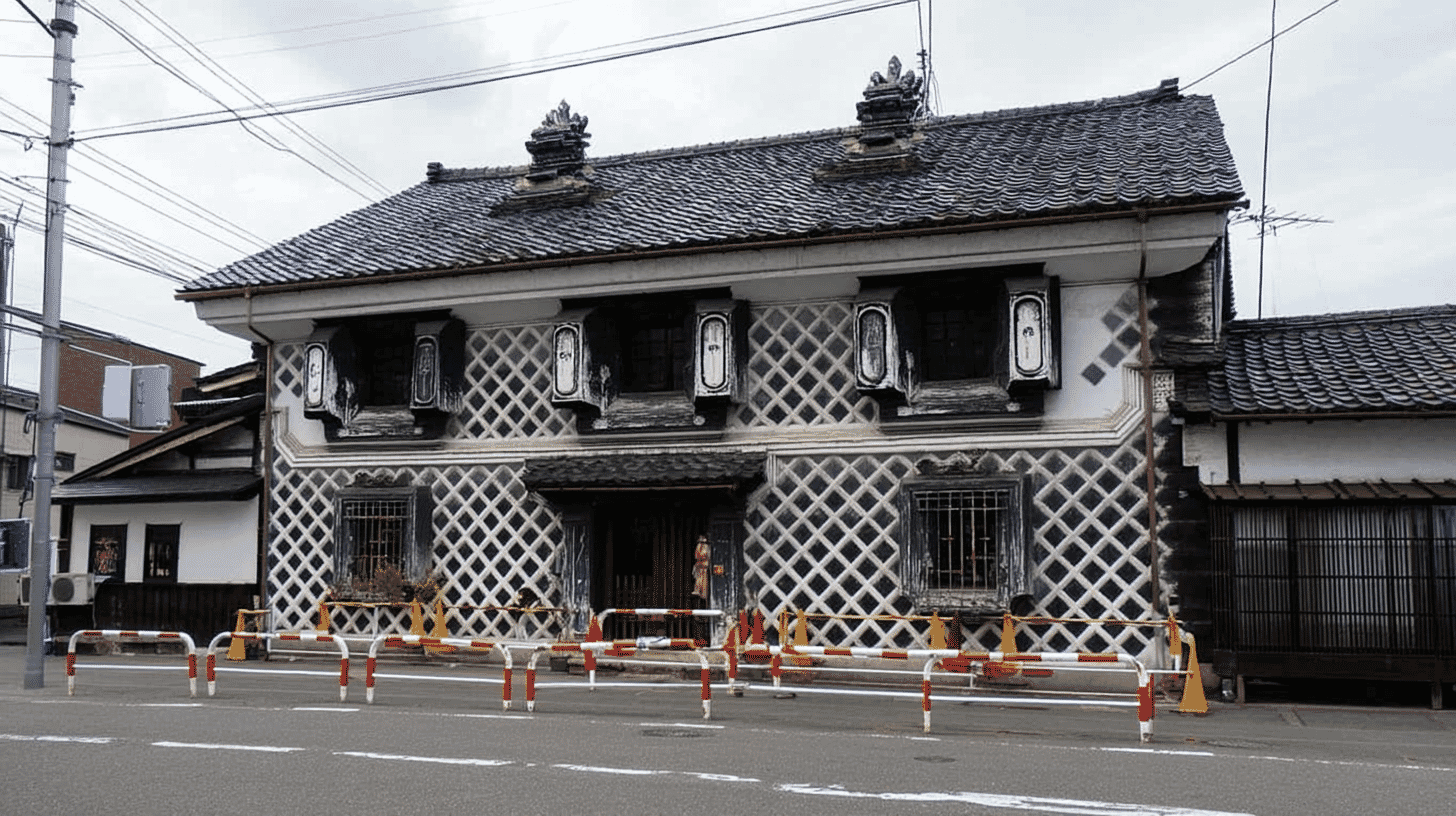
Araso Misegura: A 120-Year-Old Merchant Storehouse in Niigata's Historic Post Town

Discover Araso Misegura, a registered tangible cultural property in Tainai City, Niigata. This Meiji-era merchant storehouse features traditional namako-kabe walls and represents 200 years of commercial history.

A Hidden Gem of Meiji Architecture: Araso Misegura

Standing proudly on what was once the bustling Yonezawa Kaido highway, the Araso Misegura represents one of northern Niigata Prefecture's finest examples of traditional merchant architecture. This two-story earthen storehouse, built in 1901 during the Meiji period, was designated as a Registered Tangible Cultural Property by Japan's Agency for Cultural Affairs in 2017, recognizing its exceptional historical and architectural value.

The storehouse belongs to the Araso company, a remarkable enterprise that traces its origins to 1824 when founder Arakawa-ya Soshiro established the business in Nakajo, then a thriving post town. Over two centuries, the company has evolved from sake wholesaling, paper trading, and money exchange to its current role in office equipment and IT services, yet the historic buildings remain as powerful testaments to Nakajo's prosperous past.

The Art of the Misegura: Where Commerce Meets Craftsmanship

The term "misegura" (見世蔵) refers to a specialized type of storehouse that combined retail space with storage functions, a clever architectural solution that emerged during the Edo period. Unlike purely utilitarian warehouses, misegura were designed with customer interaction in mind, featuring more generous openings and refined interior layouts while maintaining the fire-resistant properties essential for protecting valuable merchandise.

Araso Misegura exemplifies this building type with its impressive dimensions of 10 meters in length and 4.6 meters in width, providing a building area of 46 square meters spread across two floors. The structure demonstrates the sophisticated fireproofing techniques that made earthen storehouses indispensable in an era when urban fires posed constant threats to businesses and communities.

Architectural Highlights and Cultural Significance

What makes Araso Misegura particularly notable is its masterful combination of practical design and aesthetic refinement. The building's gable ends feature double-leaf doors with four-tiered hanging plaster work (kakeko-nuri), a technique that provided both security and visual appeal. Inside, a substantial central pillar measuring one shaku (approximately 30 centimeters) square supports the structure with impressive solidity.

The first floor's side walls showcase the distinctive "namako-kabe" (海鼠壁) pattern, one of the most recognizable features of traditional Japanese storehouse architecture. This technique involves setting flat tiles against the wall surface and applying raised plaster in a distinctive pattern between them. The curved plaster ridges resemble sea cucumbers (namako), giving the style its evocative name. Beyond its decorative appeal, namako-kabe provides excellent protection against rain, wind, and fire.

The second floor's north-facing facade presents three sets of black lacquer-coated double windows that open onto the street below. These elegant windows create a sense of dignified formality that contributes significantly to the historic streetscape, evoking the commercial prosperity that once characterized this important highway junction.

The Rich History of Nakajo: A Crossroads of Commerce

To fully appreciate Araso Misegura, one must understand the historical context of its location. During the Edo period, Nakajo served as a vital junction where the Yonezawa Kaido (the road connecting to Yonezawa in present-day Yamagata Prefecture) met with the Ushu Hama Kaido coastal route. This strategic position transformed the town into a bustling post station where travelers, merchants, and goods from across the region converged.

The Araso business was established here in 1824 (Bunsei 7) by Arakawa-ya Soshiro, whose name lives on in the company's shortened form. The enterprise prospered through sake wholesaling, paper trading, and money exchange, activities that required secure storage facilities for valuable commodities. The construction of the misegura in 1901 reflects the continued commercial success of the business into the Meiji period, when traditional Japanese architecture was being adapted to meet modern commercial needs.

Understanding Dozo-zukuri: The Science of Fire-Resistant Architecture

Araso Misegura belongs to the broader tradition of "dozo-zukuri" (土蔵造り), the Japanese technique of creating fire-resistant buildings using thick earthen walls finished with plaster. This building method evolved over centuries, reaching its highest refinement during the Edo period when frequent urban fires made fireproofing an essential consideration for any valuable property.

The construction begins with a wooden frame, around which craftsmen weave a lattice of bamboo strips and rice straw rope. Multiple layers of earth are then applied, each allowed to dry thoroughly before the next is added. The final exterior receives a coating of shikkui (漆喰), a lime-based plaster that provides waterproofing and a distinctive white appearance. The resulting walls, often 30 centimeters or more in thickness, offer remarkable insulation and fire resistance.

Beyond fire protection, dozo-zukuri buildings maintain stable interior temperatures and humidity levels, making them ideal for storing sensitive goods. Even today, many sake breweries, miso manufacturers, and artisan workshops continue to use traditional storehouses for their superior preservation qualities.

Visiting Araso Misegura: What to Expect

While Araso Misegura remains a working commercial property rather than a public museum, visitors to Tainai City can appreciate its magnificent exterior from the street. The building stands as part of a larger complex that includes the Araso Main Building (店舗兼主屋), also designated as a Registered Tangible Cultural Property. Dating from 1824, this main building represents one of Tainai City's oldest surviving machiya (traditional townhouse) structures.

The surrounding Honmachi district retains echoes of its post-town heritage, with traditional architecture visible among more recent developments. Photography enthusiasts will find particularly rewarding subjects in the contrast between the storehouse's dignified black and white facade and the contemporary streetscape around it.

Nearby Attractions: Exploring Tainai City's Cultural Treasures

A visit to Araso Misegura can be combined with exploration of other significant cultural sites in Tainai City and the surrounding region.

Oppoji Temple (乙宝寺), located approximately 15 minutes by car from JR Nakajo Station, stands as one of Niigata Prefecture's most important historical temples. Founded in 736 by imperial decree of Emperor Shomu, the temple houses what is said to be the left eye of the Buddha. Its magnificent three-story pagoda, constructed in 1620, is designated as a National Important Cultural Property and represents outstanding pure Japanese architectural style. The temple grounds also feature the sacred spring "Dokkon-sui," associated with the Buddhist monk Kukai.

The Okuyamaso Castle Ruins (奥山荘城館遺跡), designated as a National Historic Site, offers insights into the medieval period when this region was dominated by powerful local clans. The Okuyamaso History Museum provides context for understanding the area's complex political history.

For nature enthusiasts, the Tainai Gorge offers spectacular scenery throughout the year, with autumn foliage being particularly celebrated. The gorge extends 20 kilometers along the Tainai River, which originates in the Iide Mountain Range.

The Best Time to Visit

Tainai City offers distinct experiences across all seasons. Spring brings the renowned Tulip Festival in early May, when vast fields of colorful blooms create spectacular displays near the coast. The area around Nakajo is pleasant for walking during the mild spring and autumn months.

Summer visitors can enjoy the Tainai Gorge area's cooler temperatures, while winter brings opportunities for skiing at Tainai Ski Resort and the chance to see the region's characteristic heavy snowfall that historically shaped local architecture and culture.

The monthly "Rokusai-ichi" market, held on days with 3 and 8 in the date at Kumano Wakamiya Shrine, continues a tradition of local commerce that connects directly to the town's heritage as a commercial center.

📍 Plan Your Visit to Niigata
Find tours, activities & transport passes near Arasomi Sekura
[ Sado Island & Echigo-Yuzawa Ski Resort Tours ]

Q&A

QCan visitors enter Araso Misegura?
AAraso Misegura is a working commercial property and not generally open for public tours. However, the exterior can be appreciated from the public street, and the distinctive namako-kabe walls and black lacquer windows are fully visible from outside.
QHow do I reach Tainai City from Tokyo?
ATake the Joetsu Shinkansen to Niigata Station (approximately 2 hours), then transfer to the JR Uetsu Main Line bound for Murakami or Akita. JR Nakajo Station is about 35 minutes from Niigata. By car, the Nihonkai Tohoku Expressway provides convenient access via the Nakajo IC exit.
QWhat is namako-kabe and why is it significant?
ANamako-kabe is a traditional Japanese wall construction technique using flat tiles set in a grid pattern with raised plaster applied between them. The distinctive appearance resembles sea cucumbers (namako), hence the name. This method provides excellent protection against fire, rain, and wind while creating a striking visual effect that has become emblematic of traditional Japanese merchant architecture.
QWhat other registered cultural properties are nearby?
AThe Araso complex includes multiple registered properties, including the main shop building (店舗兼主屋) from 1824 and an inner storehouse (内蔵). The area also features the nationally designated Important Cultural Property three-story pagoda at Oppoji Temple.
QIs there parking available for visitors?
AWhile Araso Misegura does not have dedicated tourist parking, JR Nakajo Station is within walking distance of the Honmachi area. Visitors with cars can use nearby public parking facilities or coin parking lots in the town center.

Basic Information

Name Araso Misegura (荒惣見世蔵)
Designation Registered Tangible Cultural Property (Building)
Registration Date October 27, 2017
Construction Period Meiji Era (1901)
Building Type Dozo-zukuri (earthen storehouse construction), 2 stories, tile roof
Building Area 46 square meters
Dimensions Length: 10m, Width: 4.6m
Address 28 Honmachi, Tainai City, Niigata Prefecture 959-2645
Access Approximately 5 minutes walk from JR Nakajo Station (Uetsu Main Line)
Architectural Features Namako-kabe walls, black lacquer windows, four-tiered kakeko-nuri doors

References

Cultural Heritage Online - Araso Misegura
https://bunka.nii.ac.jp/heritages/detail/256555
Cultural Heritage Online - Araso Main Building
https://bunka.nii.ac.jp/heritages/detail/222824
Araso Company - Mypl Shibata-Tainai-Seiro
https://shibata-niigata.mypl.net/shop/00000355620/
Niigata Nippo - Araso 200th Anniversary Article
https://www.niigata-nippo.co.jp/articles/-/536592
Niigata Tourism Navi - Oppoji Temple
https://niigata-kankou.or.jp/spot/7285
Wikipedia - Tainai City
https://ja.wikipedia.org/wiki/%E8%83%8E%E5%86%85%E5%B8%82
Wikipedia - Dozo (Earthen Storehouse)
https://ja.wikipedia.org/wiki/土蔵

Last verified: 2026.01.02

Nearby heritages
