
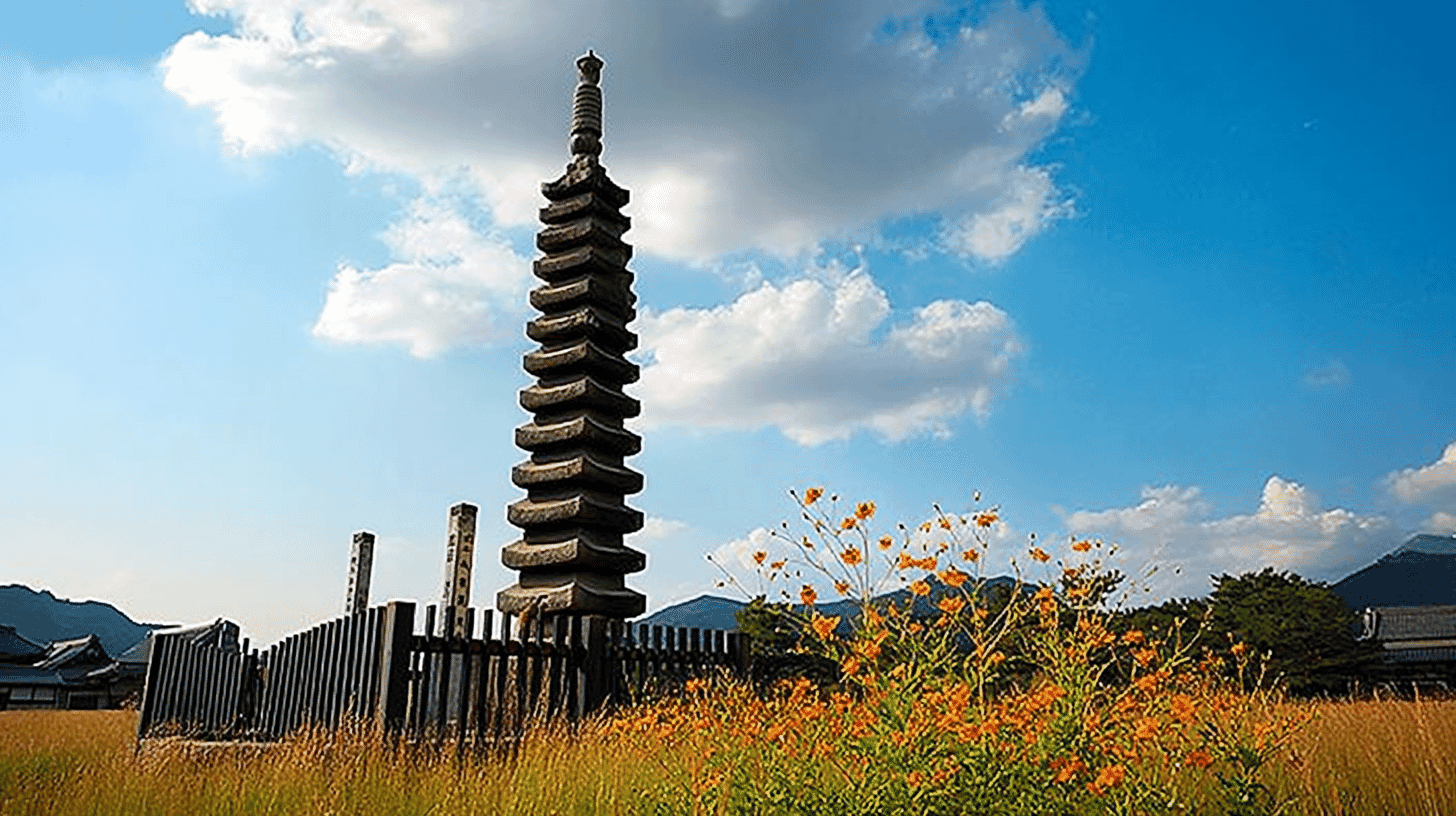
One Pagoda, an Important Cultural Property since 1954
Nine-Storied Stone Pagoda at Notsu, Usuki (九重塔, Kyuju-no-to) stands at 3089 Nakababa, Oji, Notsu-machi, Usuki City, Oita Prefecture, an early Kamakura structure listed as an Important Cultural Property on 17 September 1954. The listing is as an Important Cultural Property, not a National Treasure.
The quantity is one, the same measure word used for the Myooin pagoda, the crystal stupas, the iron pagoda and the lacquered dais.
The date field gives 1267, in the early Kamakura period.
The Owner Is Recorded Two Ways, as a Hamlet and as Named People
Whose it is depends on which record you read.
Cultural Heritage Online gives the owner as a hamlet: the name of the settlement itself.
This site's record instead names one person and adds twenty-five others.
Twenty-six people in common, taken together.
At the Chikugo lift bridge, two local authorities shared ownership. At the Fukuda residence, the owner field was empty.
Here twenty-six individuals hold the pagoda in common, and one record sums that up as the name of their hamlet. The same arrangement is written once as a community and once as a count of people.
What Is Missing Is Written into the Structural Field
A lost part is recorded among the structure itself.
The structural field reads: a stone pagoda of nine storeys, lacking its finial.
The finial is the metal element set at the top of a pagoda. Its absence is added in brackets.
With the cherry-laced armour, two plates were noted as lost within the commentary. With the lion-motif sword, a strap survived only in part.
Those appear in commentary or in the field for form. Here the absence is built into the structural description itself.
A pagoda of nine storeys, recorded as standing without its top.
The Notes Field Copies the Date Carved on the Stone
Characters cut into the pagoda are quoted in the record.
The notes field records an inscription giving the year, the cyclical sign for it, and the eighth day of the fourth month.
The year corresponds to 1267. The date is given both by era name and by the sexagenary cycle.
The 1267 in the date field comes from this inscription. The Kuwanomidera and Raigoji main halls were dated by ranges. Here the day itself is known.
That makes five uses of the notes field: a colophon for the Engishiki, a Chinese era name for the biography of Huineng, a tradition of ownership for the porcelain inkstone, a find-spot for the gilded mirror, and an inscription here.
The commentary field is empty, the second such case after the Kuwanomidera main hall. What the object is must be read from the structural and notes fields.
Visiting
The pagoda stands at 3089 Nakababa, Oji, Notsu-machi, Usuki City, Oita Prefecture. An outdoor stone structure recorded down to the lot number.
Other Important Cultural Properties are called nine-storied pagodas too. Cultural Heritage Online lists several, each attached to a temple.
Those carry a temple's name before them. This one is recorded as a nine-storied pagoda and nothing more.
Three main halls share the name Raigoji Hondo, none of them carrying a location. Here the name carries nothing at all.
It is a stone pagoda in the open, and its exterior can be seen on approach. As something held in common by the local community, care for the surroundings is asked of visitors. Check before travelling.
Q&A
- When was the pagoda listed?
- On 17 September 1954, as an Important Cultural Property rather than a National Treasure. The quantity is one.
- Who owns it?
- The records differ. Cultural Heritage Online names the hamlet; this site's record names one person and twenty-five others. Twenty-six people hold it in common.
- Does it survive complete?
- No. The structural field reads that it is a stone pagoda of nine storeys lacking its finial, the metal element set at the top.
- When was it made?
- The notes field records an inscription dating it to the eighth day of the fourth month of a year corresponding to 1267. The day itself is known.
- Are there other pagodas of this name?
- Yes. Several nine-storied pagodas are Important Cultural Properties, each carrying a temple's name. This one is recorded with no such prefix.
Basic Information
| Name | Nine-Storied Stone Pagoda at Notsu, Usuki (九重塔, Kyuju-no-to); the record gives no temple name or other prefix |
|---|---|
| Location | 3089 Nakababa, Oji, Notsu-machi, Usuki City, Oita Prefecture |
| Designation | Important Cultural Property (structure, pre-modern); not a National Treasure |
| Year Designated | 1954 (17 September), Important Cultural Property |
| Quantity | 1 pagoda |
| Dimensions | The structural field reads that it is a stone pagoda of 9 storeys lacking its finial, so the absence is built into the structural description. The notes field records an inscription dated to a year corresponding to 1267, and the date field gives the early Kamakura period. The commentary field is empty |
| Owner | Cultural Heritage Online names the hamlet; this site's record names 1 person and 25 others |
| Public Access | An outdoor stone pagoda whose exterior can be seen on approach |
References
- Cultural Heritage Online: the nine-storied pagoda
- https://bunka.nii.ac.jp/heritages/detail/148811
- Usuki City: history
- https://www.city.usuki.oita.jp/docs/2014021300153/
- Usuki City tourism association
- https://www.usuki-kanko.com/
- Agency for Cultural Affairs, National Cultural Properties Database
- https://kunishitei.bunka.go.jp/
Last verified: 2026.09.10