
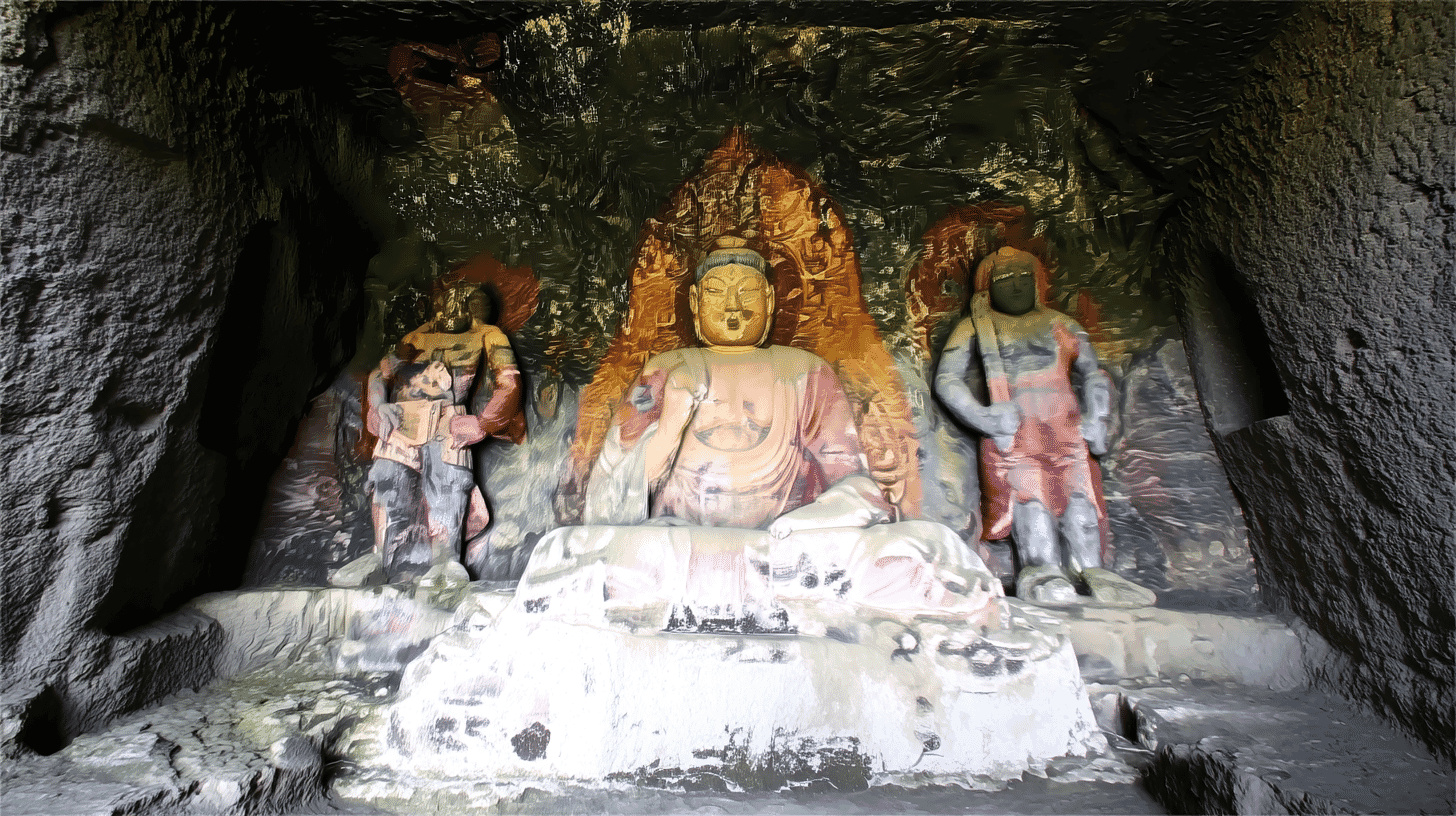
Ogata Miyasako East Stone Buddhas: Five Figures Cut into a Cliff
The Ogata Miyasako East Stone Buddhas (緒方宮迫東石仏, Ogata Miyasako Higashi Sekibutsu) are a group of Buddhist figures carved into a rock face in Ogata-machi, Bungo-Ono City, Oita Prefecture, thought to date from the late Heian period, and were designated a national Historic Site in 1934.
Carvings of this kind are called magaibutsu: images cut directly into a natural cliff rather than set up as freestanding statues. The east group lies about 200 metres northeast of the Ogata Miyasako West Stone Buddhas, a separate Historic Site, and the two sites together make up the carvings of Miyasako.
According to Bungo-Ono City, the Ogata Miyasako East Stone Buddhas are centred on Dainichi Nyorai, the cosmic Buddha of esoteric Buddhism. Fudo Myoo and Bishamonten flank him, and a pair of Kongo Rikishi, the muscular guardian kings usually found at temple gates, stand at the two ends. Five figures form a single composition.
The designation date is 22 January 1934. The Agency for Cultural Affairs lists the criterion as a site of a temple or shrine, or another site connected with worship. In other words, what is protected is a place of religious practice, not a sculpture as an art object.
History and Why It Is Protected
Tradition credits the carvings to Ogata Koreyoshi, head of the Ogami warrior clan of Bungo province in the late Heian period and a figure in the wars between the Taira and Minamoto. His estates are said to have included this area. No inscription naming a patron has been found, so his role remains a matter of tradition.
Worship at the rock face did not stop when the Heian period ended. The city notes that during the Edo period the central figure was venerated as Yakushi, the Buddha of healing, and that local people regarded the site as a guardian of cattle, leading their oxen here to pray. That the cosmic Dainichi was taken for Yakushi says a lot: for farmers, the carvings mattered as protectors of health and livestock more than as points of doctrine.
Images believed to date from the Heian period, followed by centuries of continuous local worship, are the core of the site's value as a place of faith.
What to Look For
The Bungo-Ono Geopark explains that the Miyasako carvings are cut into welded tuff, rock formed when a pyroclastic flow from Mount Aso cooled about 90,000 years ago. The region has so many cliff carvings because sculptors could choose sections of this rock without columnar jointing, which were relatively easy to work.
Start with Dainichi at the centre, then move outward to Fudo and Bishamonten, and finally to the guardian figures at the edges. The arrangement transfers the layout of a temple altar onto an open cliff, and it only makes sense when you see all five together.
The west group, by contrast, is a triad of Amida, Shaka and Yakushi, which the city describes as retaining vivid colour. Because the two compositions are so different, visit both in one trip and compare two sets of carvings attributed to the same period.
Tuff weathers easily and fine surface detail is fragile. Do not touch the figures, and keep an eye on the condition of the rock as you look.
Visiting the Ogata Miyasako East Stone Buddhas
The site is in Ogata-machi, Bungo-Ono City, about 200 metres northeast of the west group in Kudochi. The nearest station is Ogata on the JR Hohi Line, about 2.6 kilometres to the northeast in a straight line on the map. Walking takes a while, so a car or taxi is the practical choice.
The carvings are on an open rock face, and the city's official page gives no hours or fees. The Geopark guide warns visitors to take care on the stone steps up to the carvings; after rain they can be slippery, so wear sturdy shoes.
There is no published rule on photography. The carvings are still an object of local devotion, so hold off on photos when someone is praying. Questions about visiting can be directed to the cultural properties section of Bungo-Ono City.
- 📍 Plan Your Visit to Oita
- Find tours, activities & transport passes near Ogata Miyasako East Stone Buddhas
- [ Beppu Hell Tour & Yufuin Onsen Hot Springs ]
Q&A
- Who made the Ogata Miyasako East Stone Buddhas, and when?
- They are thought to date from the late Heian period. Tradition attributes them to the warrior Ogata Koreyoshi, but no inscription confirms this.
- Which figures are carved in the Ogata Miyasako East Stone Buddhas?
- Dainichi Nyorai in the centre, flanked by Fudo Myoo and Bishamonten, with a guardian Kongo Rikishi at each end: five figures in all. In the Edo period the central figure was worshipped as Yakushi.
- What kind of cultural property are the Ogata Miyasako East Stone Buddhas?
- They were designated a national Historic Site on 22 January 1934, protected as a site of worship rather than as sculpture.
- How do I get to the Ogata Miyasako East Stone Buddhas?
- The site is about 2.6 kilometres from Ogata Station on the JR Hohi Line in a straight line, and about 200 metres northeast of the west group. A car or taxi is the practical option.
- Is there an admission fee for the Ogata Miyasako East Stone Buddhas?
- The city's official page lists no fee. The carvings are on an outdoor rock face reached by stone steps. Check current conditions with Bungo-Ono City's cultural properties section.
Basic Information
| Name | Ogata Miyasako East Stone Buddhas |
|---|---|
| Location | Ogata-machi, Bungo-Ono City, Oita Prefecture |
| Designation | Historic Site |
| Year Designated | Designated 1934/01/22 (Showa 9) |
| Quantity | 5 figures carved in the rock face |
| Dimensions | Not listed in the Agency for Cultural Affairs database |
| Owner | Not listed in the Agency for Cultural Affairs database |
| Public Access | Outdoor rock face. No official hours or fees published |
References
- Agency for Cultural Affairs, Database of National Cultural Properties: Ogata Miyasako East Stone Buddhas
- https://kunishitei.bunka.go.jp/bsys/maindetails/401/3388
- Bungo-Ono City: National Historic Sites
- https://www.bungo-ohno.jp/docs/2015030100048/
- Bungo-Ono Geopark: Highlights, Theme C
- https://www.bungo-ohno.com/geosaite/page_3/
Last verified: 2026.09.27