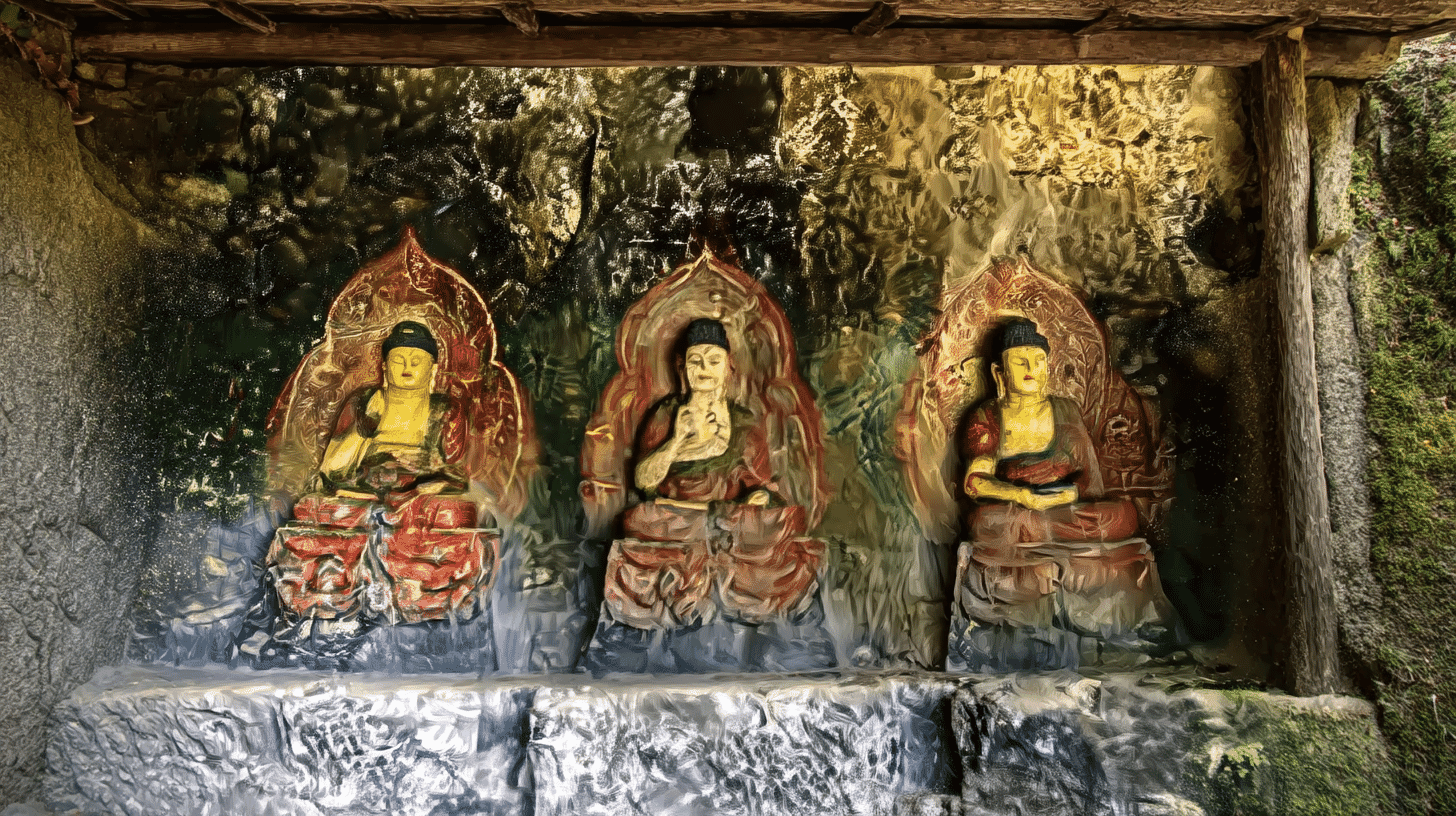
Ogata Miyasako Nishi Sekibutsu: Ancient Stone Buddhas Hidden in Oita's Volcanic Landscape
Nestled in the verdant hills of Bungo Ohno City in Oita Prefecture, the Ogata Miyasako Nishi Sekibutsu stands as a remarkable testament to Buddhist devotion during Japan's Heian period. This National Historic Site, designated in 1934, features three magnificent Buddha statues carved directly into volcanic rock formed by ancient eruptions of Mount Aso. While the famous Harajiri Falls—often called "Japan's Niagara"—draws crowds just a short distance away, these serene stone Buddhas remain one of the region's most rewarding hidden treasures.
What is a Magaibutsu? Understanding Japan's Cliff-Carved Buddhas
Magaibutsu (磨崖仏) refers to Buddhist images carved directly into natural rock faces or cliff sides. Unlike portable statues, these sacred carvings become inseparable from the landscape itself, creating a profound connection between spiritual devotion and the natural world. Oita Prefecture is renowned throughout Japan as a treasure trove of magaibutsu, with over 70 significant sites scattered across the region. This remarkable concentration stems from the area's abundant welded tuff—volcanic rock formed when the pyroclastic flows from Mount Aso's massive eruptions approximately 90,000 years ago cooled and solidified. This stone proved ideal for carving: soft enough to work yet durable enough to withstand centuries of weathering.
The Three Buddhas: A Unique Arrangement
The Ogata Miyasako Nishi Sekibutsu features three Buddha statues arranged in a distinctive manner that sets it apart from conventional Buddhist iconography. At the center sits Shaka Nyorai (Shakyamuni Buddha), flanked by Amida Nyorai (Amitabha Buddha) on the left and Yakushi Nyorai (Medicine Buddha) on the right. Each statue stands approximately 1.45 meters tall.
What makes this arrangement particularly noteworthy is that rather than following the traditional "sanzon" (三尊) triad format—where a central deity is typically larger and more prominent than its attendants—all three Buddhas here are depicted as equals in both size and prominence. This egalitarian arrangement is quite rare in Japanese Buddhist art and carries profound symbolic meaning.
According to local belief, each Buddha governs a different temporal realm: Shaka Nyorai presides over the past, Yakushi Nyorai watches over the present and offers healing in this world, while Amida Nyorai guides souls to paradise in the future. Together, they offer devotees protection and blessings across all of time.
Historical Significance: The Legacy of Ogata Saburo Koreyoshi
The creation of these stone Buddhas is traditionally attributed to the patronage of Ogata Saburo Koreyoshi, a powerful warrior chieftain of the Bungo Ogata clan who ruled this region during the late Heian period. The Ogata clan was a branch of the influential Ooga (大神) clan, who held sway over much of Bungo Province (present-day Oita Prefecture). Koreyoshi himself gained fame for his participation in the Genpei War, the epic civil conflict that shaped medieval Japan.
The commissioning of magaibutsu was a common practice among regional lords of this era, serving both as expressions of personal piety and as symbols of their authority and benevolence toward local communities. The investment required to carve such elaborate images into stone demonstrated wealth, power, and devotion simultaneously.
Why Was This Site Designated a National Historic Site?
The Japanese government designated Ogata Miyasako Nishi Sekibutsu as a National Historic Site on January 22, 1934, recognizing its exceptional cultural and historical value. Several factors contributed to this designation.
The site preserves authentic examples of late Heian to early Kamakura period Buddhist sculpture, offering invaluable insights into regional artistic traditions and religious practices of the era. The unusual equal arrangement of the three Buddhas represents a distinctive local interpretation of Buddhist iconography rarely found elsewhere in Japan. Furthermore, visible traces of the original polychrome painting remain on the statues, providing rare evidence of how such sculptures were originally intended to appear. The carvings also demonstrate the sophisticated techniques developed by local stone craftsmen who learned to work with the volcanic tuff unique to this region.
Visiting Ogata Miyasako Nishi Sekibutsu: What to Expect
Reaching the stone Buddhas requires a short but rewarding journey. From the main road, a path leads approximately 200 meters up stone steps and gentle slopes through forested terrain. The approach itself becomes part of the experience, as the natural surroundings gradually prepare visitors for their encounter with the sacred images.
The Buddhas are sheltered beneath a protective covering structure that shields them from the elements while still allowing visitors clear views. The cliff face where they are carved forms a shallow cave-like alcove, creating an intimate atmosphere that encourages quiet contemplation. The site is free to enter and features a small offering box for those who wish to make donations.
Visitors often remark on the gentle, approachable expressions of the Buddha images—a quality that distinguishes them from the more formal, imposing style associated with major temple sculptures. This warmth reflects the folk Buddhist traditions of rural Japan, where devotion was deeply interwoven with daily agricultural life.
Nearby Attractions: Creating a Complete Journey
The Ogata Miyasako Nishi Sekibutsu is ideally positioned for combining with other remarkable attractions in the area. Just 500 meters away stands the Ogata Miyasako Higashi Sekibutsu (East Stone Buddha), another National Historic Site featuring a different arrangement of magaibutsu that makes for an enlightening comparison.
Approximately 680 meters from the stone Buddhas, Harajiri Falls awaits. This magnificent 120-meter-wide, 20-meter-high waterfall dramatically erupts in the middle of peaceful farmland, earning it the nickname "Japan's Niagara" or "Oriental Niagara." The waterfall formed from the same Aso volcanic activity that created the rock for the magaibutsu, connecting these sites through deep geological time. A roadside station (Michi-no-Eki) at Harajiri Falls offers local products, refreshments, and information.
The broader Bungo Ohno region is part of the Oita Bungo Ohno Geopark, recognized for its extraordinary volcanic landscapes, and lies within the Sobo-Katamuki-Okue UNESCO Biosphere Reserve. For those interested in Japanese Buddhist heritage, the area hosts numerous other magaibutsu sites, including the spectacular Fukou-ji Temple with one of Japan's largest cliff-carved Buddha images.
Practical Tips for Visitors
The path to the stone Buddhas involves some climbing, so comfortable walking shoes are recommended. The site can be visited year-round, though spring and autumn offer the most pleasant weather conditions. There is limited parking available along the main road near the entrance path.
For those without private transportation, the site can be reached by taxi from Ogata Station on the JR Hohi Line, approximately 3 kilometers away. Some visitors hire taxis for a combined tour of nearby attractions including the East Stone Buddha and Harajiri Falls.
As this is a sacred site that remains important to local communities, visitors are encouraged to observe quiet, respectful behavior. Photography is generally permitted, but please be mindful of other visitors seeking contemplative experiences.
- 📍 Plan Your Visit to Oita
- Find tours, activities & transport passes near Ogata Miyasako West Stone Buddha
- [ Beppu Hell Tour & Yufuin Onsen Hot Springs ]
Q&A
- Is there an admission fee to visit Ogata Miyasako Nishi Sekibutsu?
- No, admission is free. There is a small donation box at the site for those who wish to contribute to its maintenance and preservation.
- Can I visit both the East and West stone Buddhas in one trip?
- Yes, the two sites are only about 500 meters apart and can easily be visited together. Combining both gives you a more complete understanding of the region's magaibutsu traditions.
- Is the site accessible for visitors with mobility limitations?
- The path involves climbing approximately 200 meters of steps and slopes, which may be challenging for those with mobility issues. Unfortunately, there is no barrier-free access to the stone Buddhas themselves.
- What is the best time of year to visit?
- Spring (April-May) and autumn (October-November) offer comfortable temperatures and beautiful natural scenery. If combining with Harajiri Falls, the falls are particularly impressive after rainfall or during the rainy season in June.
- Are there English explanations at the site?
- Signage at the site is primarily in Japanese. We recommend researching the site beforehand or using a translation app to enhance your understanding during the visit.
Basic Information
| Official Name | Ogata Miyasako Nishi Sekibutsu (緒方宮迫西石仏) |
|---|---|
| Designation | National Historic Site (designated January 22, 1934) |
| Era | Late Heian Period (late 12th century) |
| Buddha Statues | Shaka Nyorai (center), Amida Nyorai (left), Yakushi Nyorai (right) |
| Statue Height | Approximately 1.45 meters each |
| Material | Welded tuff (volcanic rock from Aso pyroclastic flow) |
| Address | Kutochi 38-3, Ogata-cho, Bungo Ohno City, Oita Prefecture, Japan |
| Coordinates | 32°57'41.9"N, 131°27'27.6"E |
| Access | Approximately 3km from JR Ogata Station (taxi recommended); about 680m from Harajiri Falls |
| Admission | Free |
| Parking | Available (roadside) |
| Contact | Bungo Ohno Tourism Association: 0974-27-4215 |
References
- 緒方宮迫西石仏 - Wikipedia
- https://ja.wikipedia.org/wiki/%E7%B7%92%E6%96%B9%E5%AE%AE%E8%BF%AB%E8%A5%BF%E7%9F%B3%E4%BB%8F
- 国指定史跡 | 豊後大野市
- https://www.bungo-ohno.jp/docs/2015030100048/
- 観光スポット紹介 宮迫東・西石仏 - 豊後大野市観光協会
- https://sato-no-tabi.jp/news/20250912spot-ogata/
- 緒方宮迫西石仏 | iナビおおいた
- https://i-oita.net/bungo-ohno/spot/9802/
- みどころ紹介 -C 石への祈り- | おおいた豊後大野ジオパーク
- https://www.bungo-ohno.com/geosaite/page_3/
- 緒方宮迫西石仏 | 大分県の観光情報公式サイト
- https://www.visit-oita.jp/spots/detail/6495
- 原尻の滝 | たびらい
- https://www.tabirai.net/sightseeing/column/0008401.aspx
Last verified: 2026.01.28
Nearby heritages
- Ogata Miyasako East Stone Buddha
- Bungo-Ono City
- Ogata River and Rural Landscape of the Ogata Basin
- Bungo-Ono City, Oita Prefecture
- Former Ogata Village Office
- 574 Baba Kashiwagi, Ogata-cho, Bungo-Ono City, Oita Prefecture
- Ozaki Stone Bath
- Actual measurement 77.6㎡ out of 895 sqm in Ogatacho, Bungo-Ono City
- Bat Falls
- Bungo-Ono City
- Aso Pyroclastic Flow Deposits in Taketa
- Taketa City, Oita Prefecture
- Oka Castle Ruins
- Taketa City, Taketa-cho and Kaikai
- Wakamiya Iji Sasamuta Stone Arch Bridge
- 1504-1 Sasamuta, Hasada, Taketa City, Oita Prefecture
- Graveyard of the Nakagawa Family, Lords of the Oka Domain
- Taketa City Oaza Kai, Oaza Irita, Kusumi Town, Bungo-Ono City Terahara
- Sato Family Main House
- 102-2 Takedacho, Taketa City, Oita Prefecture, etc.