
Ogata Miyasako Higashi Stone Buddhas: A Hidden Gem of Heian Era Buddhist Art
Nestled in the verdant hills of Bungo-Ono City in Oita Prefecture, the Ogata Miyasako Higashi Stone Buddhas (緒方宮迫東石仏) stand as silent witnesses to nearly a thousand years of Japanese spiritual devotion. Designated as a National Historic Site in 1934, these remarkable cliff carvings—known as magaibutsu in Japanese—offer visitors a rare glimpse into the sophisticated Buddhist artistry of the late Heian period (794-1185).
Unlike the more famous Usuki Stone Buddhas, which draw crowds of tourists, these hidden treasures remain wonderfully peaceful, allowing visitors to experience an authentic spiritual atmosphere that has changed little since medieval times.
What Makes These Stone Buddhas Special?
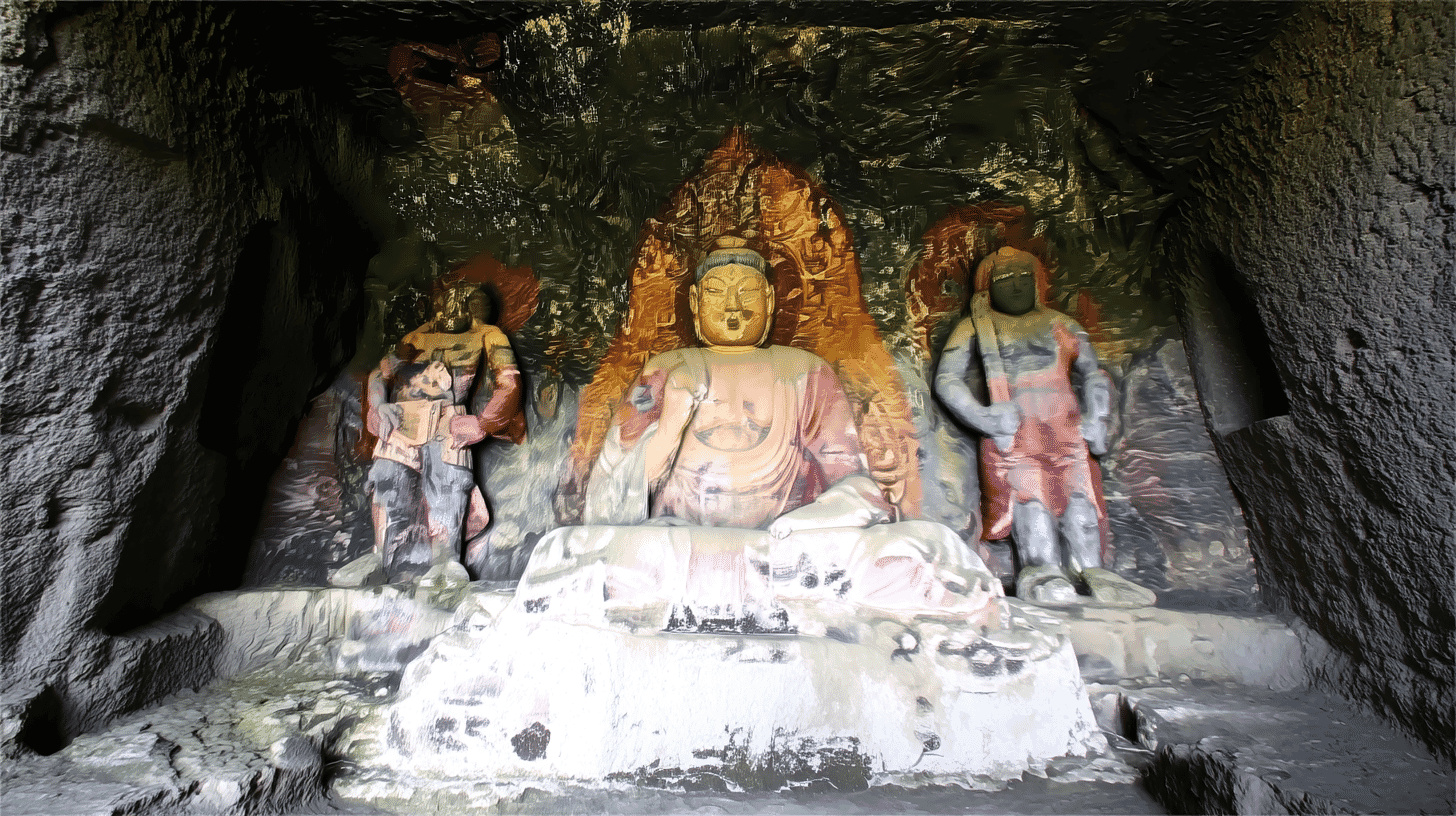
The Ogata Miyasako Higashi Stone Buddhas represent one of the finest examples of late Heian period cliff sculpture in Japan. What sets them apart is not merely their age, but the remarkable completeness of the composition and the preservation of their original polychrome coloring.
The main ensemble features five impressive figures carved in high relief into the volcanic rock face. At the center sits a majestic Dainichi Nyorai (Cosmic Buddha), measuring an impressive 2.65 meters in height. Flanking this central deity are Fudō Myōō (the Immovable Wisdom King) on the right and Jikokuten (one of the Four Heavenly Kings) on the left. Completing the sacred tableau, fierce Niō guardian figures—in their characteristic A-gyō (mouth open) and Un-gyō (mouth closed) poses—stand sentinel on the outer walls of the rock shelter.
Traces of vermillion red and golden yellow pigments still cling to the carved surfaces, offering tantalizing hints of how brilliantly colorful these figures must have appeared to medieval worshippers.
A Warrior's Legacy: The Historical Significance
The creation of these stone Buddhas is traditionally attributed to Ogata Koreyoshi (緒方惟栄), one of the most fascinating figures of the Genpei War period. Known as Ogata Saburō, he was the powerful lord of Ogata Manor and a legendary warrior who would become an ally of the tragic hero Minamoto no Yoshitsune.
According to local tradition, Koreyoshi commissioned these cliff carvings during the late Heian to early Kamakura period as an expression of his Buddhist faith and perhaps as a prayer for success in the turbulent times ahead. The manor he controlled encompassed this entire region, and his influence can still be felt in the numerous historical sites that bear his name.
Interestingly, by the Edo period, the central figure had come to be worshipped as Yakushi Nyorai (the Medicine Buddha), as evidenced by a stone lantern dated 1839 (Tenpō 10) inscribed with a dedication for the "First Yakushi" festival. The statue was also revered as a protector of cattle—a reminder of how Buddhist figures were often adapted to serve the practical spiritual needs of farming communities.
Geological Wonder: Art Carved from Volcanic Fire
The canvas for these masterpieces is itself a geological marvel. The rock face into which the Buddhas are carved is welded tuff—volcanic ash that was superheated and compressed during the catastrophic eruption of Mount Aso approximately 90,000 years ago. This massive pyroclastic flow covered much of what is now the Bungo-Ono region, creating the distinctive landscape that characterizes the area today.
The welded tuff proved to be an ideal medium for carving. Relatively soft when freshly exposed, it hardens with weathering, allowing for detailed sculptural work that then becomes more durable over time. This same volcanic material can be seen throughout the Bungo-Ono Geopark, including at the spectacular Harajiri Falls nearby.
Two additional cliff-carved pagodas (makai hōtō) stand adjacent to the Buddha figures, though these date from the early Muromachi period, several centuries after the original carvings were made.
Visiting Tips and Highlights
The stone Buddhas are located on the southern slope of a small hill, about 100 meters from the parking area. A protective shelter now shields the carvings from the elements, ensuring their preservation for future generations while still allowing visitors to appreciate them up close.
For the complete experience, visitors should plan to see both the East and West Stone Buddhas, which are separated by approximately 500 meters. The West Stone Buddhas feature a different but equally impressive trio of seated Buddhas—Shaka Nyorai (Shakyamuni), Amida Nyorai, and Yakushi Nyorai—arranged in an unusual equal-height composition rather than the typical hierarchical arrangement.
The best times to visit are during spring when the surrounding hills are alive with fresh greenery, or autumn when the foliage transforms into brilliant reds and golds. The quiet atmosphere is best enjoyed on weekday mornings, when you may find yourself alone with these ancient guardians.
Nearby Attractions Worth Exploring
The Ogata region of Bungo-Ono City offers numerous other attractions that pair wonderfully with a visit to the stone Buddhas.
Harajiri Falls, just a short drive away, is often called the "Niagara of the East." This dramatic waterfall spans 120 meters wide and drops 20 meters, emerging unexpectedly in the middle of peaceful rice paddies. Listed among Japan's 100 Most Beautiful Waterfalls, it's an essential stop.
The entire Bungo-Ono area is recognized as a UNESCO Global Geopark, offering hiking trails, stone bridges, and unique geological formations. The region is also famous for its tulip festival in spring, when hundreds of thousands of flowers bloom near Harajiri Falls.
For those interested in stone Buddha art, the nearby Usuki Stone Buddhas (a National Treasure) and the Inukai Stone Buddha (also a National Historic Site) make excellent additions to an itinerary focused on Oita's remarkable magaibutsu heritage.
- 📍 Plan Your Visit to Oita
- Find tours, activities & transport passes near Ogata Miyasako East Stone Buddha
- [ Beppu Hell Tour & Yufuin Onsen Hot Springs ]
Q&A
- How do I get to Ogata Miyasako Higashi Stone Buddhas?
- From JR Ogata Station, the site is approximately 30 minutes on foot or 7 minutes by car. By car from Oita City, take the Oita Expressway to the Oita Mera IC and drive approximately 42 km south. A free parking area with space for about 10 vehicles is available near the stone Buddhas.
- Is there an admission fee?
- No, viewing the Ogata Miyasako Higashi Stone Buddhas is free of charge. The site is open year-round, though there are no lighting facilities for nighttime viewing.
- What is the difference between the East and West Stone Buddhas?
- The East Stone Buddhas feature a five-figure composition centered on Dainichi Nyorai with guardian deities, while the West Stone Buddhas display three seated Buddhas (Shaka, Amida, and Yakushi) arranged equally. Both sites are National Historic Sites and were designated on the same date in 1934. They are about 500 meters apart and can be visited together.
- Are there English explanations available at the site?
- Signage at the site is primarily in Japanese. We recommend researching the historical background beforehand or using a translation app during your visit. The Bungo-Ono City Tourism Association may also provide English materials upon request.
- Can visitors with mobility challenges access the site?
- The path from the parking area to the stone Buddhas involves some stairs and uneven terrain. While the distance is only about 100 meters, those with mobility challenges should be prepared for stone steps. Please exercise caution, especially in wet weather.
Basic Information
| Name | Ogata Miyasako Higashi Sekibutsu (緒方宮迫東石仏) |
|---|---|
| Cultural Property Designation | National Historic Site (designated January 22, 1934) |
| Era | Late Heian Period (main statues); Early Muromachi Period (cliff pagodas) |
| Main Statue | Dainichi Nyorai seated figure, height 2.65m |
| Address | Kuchichi, Ogata-machi, Bungo-Ono City, Oita Prefecture (大分県豊後大野市緒方町久土知) |
| Access | 30 minutes walk from JR Ogata Station; 42 km from Oita Mera IC |
| Parking | Free parking available (approximately 10 spaces) |
| Admission | Free |
| Contact | Bungo-Ono City Cultural Properties Division: 0974-42-4141 |
| Coordinates | 32.963417°N, 131.458556°E |
References
- 緒方宮迫東石仏 - Wikipedia
- https://ja.wikipedia.org/wiki/%E7%B7%92%E6%96%B9%E5%AE%AE%E8%BF%AB%E6%9D%B1%E7%9F%B3%E4%BB%8F
- 緒方宮迫東石仏 - 文化遺産オンライン
- https://bunka.nii.ac.jp/heritages/detail/212030
- 緒方宮迫東石仏 - ニッポン旅マガジン
- https://tabi-mag.jp/ot0713/
- 国指定史跡 - 豊後大野市公式サイト
- https://www.bungo-ohno.jp/docs/2015030100048/
- みどころ紹介 - おおいた豊後大野ジオパーク
- https://www.bungo-ohno.com/geosaite/page_3/
- 緒方惟栄 - Wikipedia
- https://ja.wikipedia.org/wiki/%E7%B7%92%E6%96%B9%E6%83%9F%E6%A0%84
Last verified: 2026.01.28