
Cast in 1209, National Treasure since 1953
The Kei Gong with Peacock Design (孔雀文磬, Kujakumon Kei) is a Kamakura-period gong shown at the treasure hall of Usa Jingu in Usa City, Oita Prefecture, designated a National Treasure in 1953, on 31 March. It had become an Important Cultural Property on 30 April 1935. The quantity is one piece, the category applied arts, and the designation number 00113. The Agency for Cultural Affairs gives the year as 1209.
A kei is a Buddhist implement hung on a frame beside the officiant at a service and struck between stages of the ritual. It is a thing to hang and strike, not an ornament or a hanging. Its ancestor is a stone percussion instrument of ancient China, later cast in metal.
The designated name carries the inscription within it: bearing the inscription that it was cast for the golden hall of Mirokuji on the fifth day of the eighth month of the third year of Jogen by the priest Sukekiyo. The inscription is part of the name because it fixes both the year and the history of the piece.
What the Agency Values
The Agency writes: the form is grave and imposing, and the ornament and inscription show the height of the spatula-pressed technique. The relief is thick and heavy, and the flanking arcs are drawn in compared with the central one, marks that show the character of the Kamakura period well. As a dated piece of known history it is valuable as a standard of reference.
Standard of reference is where the assessment turns. Because the year and the history are fixed by the inscription, the piece serves as a measure against which undated gongs can be placed. Oita Prefecture likewise notes that its date of making and its donor are largely clear, so that it is valuable as historical evidence.
The spatula-pressed technique forms the ornament by pressing a spatula into the mould. The Agency calls the result the height of that technique.
The stylistic marker cited is the drawing-in of the flanking arcs against the central one. The proportion of the arcs is read as an indicator of period.
Front and Back Are Arranged Differently
The Agency's description of material and form sets out the difference between the two faces.
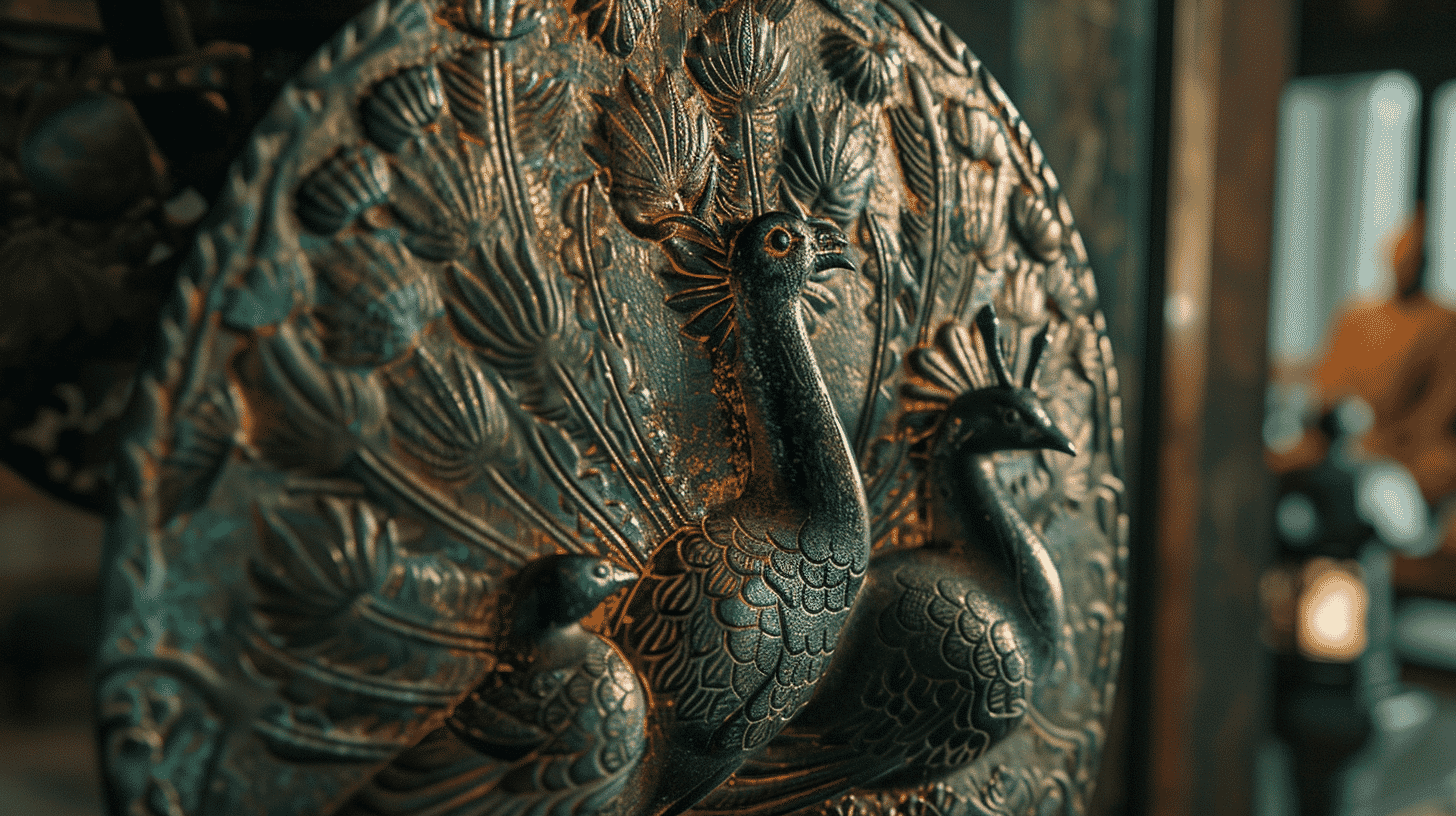
Cast bronze, low and broad in its peaked form, the shoulders opening widely to either side, the rim broad and thick for a heavy effect. The front carries a grave, thickly modelled striking boss at the centre, with slightly smaller peacocks cast to either side by the same spatula technique. The back is plain, with a striking boss of the same diameter as the front and the inscription cast in relief across it in a bold hand.
Peacocks in front, inscription behind. The striking boss is where the beater falls, and it sits at the same place and the same size on both faces. What flanks it is ornament on one side and writing on the other.
The piece measures 28.8 centimetres across the shoulders, 34.1 centimetres across the skirt, 12.9 centimetres high, with a rim 0.7 to 0.9 centimetres thick, and weighs 1,118 grams. The skirt is wider than the shoulders, and it is not a thing held in the hand.
What the Inscription Records
The text on the back records the casting on the fifth day of the eighth month of the third year of Jogen, for the golden hall of Mirokuji, the piece having been sent from the capital, by the priest Sukekiyo.
The third year of Jogen is 1209, and the day of casting is given. The golden hall of Mirokuji is where it was placed; the note that it came from the capital records how it arrived; Sukekiyo is the donor.
Year of casting, hall of deposit, route of arrival and donor all sit within one inscription. That density is why the Agency calls it a dated piece of known history and a standard of reference.
Mirokuji was the temple attached to Usa Jingu. The piece is treated under a shrine, but it began as a temple implement, a survival from the era when the two were combined.
Seeing It
The Agency's database records the owner as a private individual and leaves the holding institution field blank. It is a National Treasure in private hands, shown at the treasure hall of Usa Jingu.
Oita Prefecture records that it is displayed at that treasure hall. Opening days there can be limited, however, so check the shrine's information before travelling. It is sometimes lent to museums outside the prefecture.
Oita Prefecture counts it as one of the three National Treasures within the prefecture, the others being the main hall of Usa Jingu and the great hall of Fukiji.
From Usa Station on the JR Nippo Main Line the bus takes about ten minutes to the Usa Hachiman stop.
Q&A
- What is a kei?
- A Buddhist implement hung on a frame beside the officiant at a service and struck between stages of the ritual. Its ancestor is a stone percussion instrument of ancient China, later cast in metal. It is hung and struck, not worn or draped.
- When was this one designated?
- It became an Important Cultural Property on 30 April 1935 and a National Treasure in 1953, on 31 March. It is listed as one piece in the applied arts category under designation number 00113, with the year given as 1209.
- Why was it designated?
- The Agency cites the grave form, the ornament and inscription showing the height of the spatula-pressed technique, and stylistic marks of the Kamakura period such as the drawing-in of the flanking arcs, concluding that as a dated piece of known history it is valuable as a standard of reference.
- What does the inscription say?
- That the piece was cast on the fifth day of the eighth month of 1209, for the golden hall of Mirokuji, having been sent from the capital, by the priest Sukekiyo. Year of casting, hall of deposit, route of arrival and donor all sit within one text.
- Can it be seen?
- The Agency records the owner as a private individual, and the piece is shown at the treasure hall of Usa Jingu. Opening days there can be limited and it is sometimes lent outside the prefecture, so check the shrine's information before travelling.
Basic Information
| Name | Kei Gong with Peacock Design (孔雀文磬, Kujakumon Kei); the designated name includes the inscription naming Mirokuji and the priest Sukekiyo |
|---|---|
| Location | Minami-Usa, Usa City, Oita Prefecture (treasure hall of Usa Jingu) |
| Designation | National Treasure (applied arts), designation no. 00113 |
| Year Designated | 1935 (30 April), Important Cultural Property; 1953 (31 March), National Treasure |
| Quantity | 1 piece |
| Dimensions | 28.8 cm across the shoulders, 34.1 cm across the skirt, 12.9 cm high, rim 0.7 to 0.9 cm thick, weight 1,118 g. Cast bronze, low and broad in its peaked form; peacocks flank the striking boss on the front, the back plain apart from the inscription. Made 1209 |
| Owner | A private individual (as recorded by the Agency) |
| Public Access | Shown at the treasure hall of Usa Jingu. Opening days can be limited, and it is sometimes lent outside the prefecture |
References
- Agency for Cultural Affairs, National Cultural Properties Database: the Kei Gong with Peacock Design
- https://kunishitei.bunka.go.jp/bsys/maindetails/201/406
- Oita Prefecture digital archive: the Kei Gong with Peacock Design
- https://www.pref.oita.jp/site/archive/200680.html
- Usa Jingu 1300th anniversary: the cultural properties of Usa Jingu
- https://www.millennium-roman.jp/usajingu1300/history/cultural_property/
- Usa tourism association: Usa Jingu
- https://www.usa-kanko.jp/pages/116/
Last verified: 2026.09.04