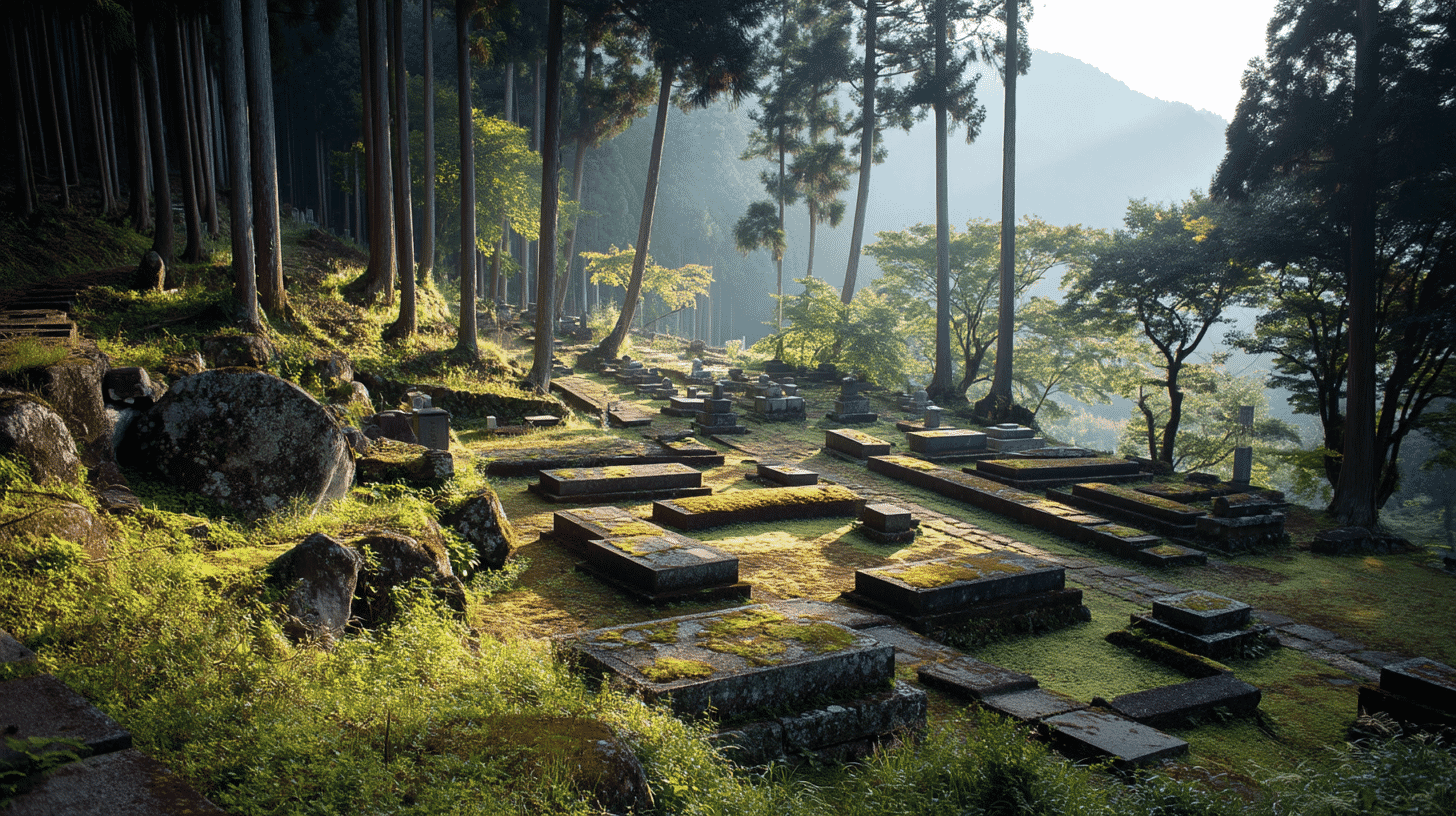
Shimofuji Christian Cemetery: A Window into Japan's Hidden Christian Past
Nestled on a quiet hillside in Usuki City, Oita Prefecture, lies one of Japan's most significant religious heritage sites—the Shimofuji Christian Cemetery (下藤キリシタン墓地). Designated as a National Historic Site, this remarkable burial ground represents the first complete Kirishitan cemetery ever discovered in Japan, offering an unprecedented glimpse into the lives and faith of Japan's early Christians during the tumultuous late 16th and early 17th centuries.
While famous destinations like Nagasaki draw attention for their Christian heritage, Shimofuji offers something uniquely authentic: an untouched time capsule where Western Catholic burial traditions merged with Japanese culture over four centuries ago. For travelers seeking meaningful encounters with Japan's complex religious history, this hidden gem in rural Oita delivers an experience that cannot be found anywhere else.
The Historical Significance: Why This Cemetery Matters
The Shimofuji Christian Cemetery holds immense archaeological and historical importance as the first Kirishitan burial ground discovered in complete, undisturbed condition anywhere in Japan. While other Christian-related sites have been excavated throughout the country, none had preserved both the surface grave markers and underground burial structures intact until the Shimofuji discovery.
Archaeological investigations conducted between 2010 and 2015 by the Usuki City Board of Education revealed 66 Christian graves, along with the remains of a small chapel, a circular stone plaza likely used for religious gatherings, and stone-paved pathways connecting these sacred spaces. The cemetery was established around 1579 by a local Christian leader known by his baptismal name "Rian" (リアン), who funded its construction to provide a proper burial ground for the Christian community of the Nozu region.
What makes this site particularly valuable is the clear evidence of European Catholic burial traditions adapted to Japanese soil. The deceased were interred with their heads facing west—toward Jerusalem and the setting sun—following the Catholic custom that believers would rise facing east at the resurrection. This deliberate orientation, combined with the systematic layout of graves and the presence of Christian symbols, confirms that the community actively practiced their faith according to Western traditions while living under the watchful eyes of authorities who would eventually persecute them.
The Grave of Jochin: A Martyr's Memorial
Among the most poignant discoveries at Shimofuji is the gravestone of Jochin (常珎), believed to be one of Bungo Province's first Christian martyrs. The half-cylindrical stone marker, measuring 59cm in length and 52.5cm in width, bears a Greek cross within a circle and the baptismal name "Jochin" carved beneath it.
According to the historical records of Jesuit missionary Luis Frois, Jochin was originally from Yufuin and worked as a swordsmith. When the missionaries were forced to leave Bungo, they entrusted him with the responsibility of teaching doctrine to non-believers and encouraging fellow Christians. In 1589, following the anti-Christian edict issued by warlord Toyotomi Hideyoshi and the subsequent persecution by Lord Otomo Yoshimune, Jochin was executed for his faith—becoming one of the first martyrs in the region.
The gravestone was discovered in 1956 by local resident Iwao Aoyama on a slope near the cemetery. Though weathered and partially damaged by centuries of exposure, this humble stone marker stands as a powerful testament to the courage of Japan's early Christians who chose faith over life itself.
Architectural Features: European Traditions on Japanese Soil
The cemetery's layout and construction demonstrate a fascinating synthesis of Western religious practices and local Japanese craftsmanship. The grave markers are primarily constructed from Aso welite tuff, a volcanic stone common to the Kyushu region, shaped into rectangular arrangements that served as surface markers for the burials below.
Excavations revealed four distinct types of grave marker construction: some using repurposed Buddhist stone pagoda fragments laid flat; others featuring stone enclosures filled with river pebbles; simple stone slabs placed directly on the ground; and unique arrangements combining pebble mounds with central stone placements. Many markers incorporated fragments from Buddhist five-tiered pagodas (五輪塔) and other religious stone structures—a striking detail that suggests the community may have repurposed abandoned Buddhist monuments during their conversion to Christianity.
Underground investigations of several graves uncovered wooden coffin traces and iron nails, confirming that the deceased were buried in extended supine positions within coffins—another Western practice distinct from the cremation common in Buddhist Japan. The systematic east-west orientation of all graves demonstrates the community's commitment to following Catholic burial traditions with remarkable consistency.
The Story of Rian: Founder and Faithful Leader
The establishment and organization of Shimofuji Christian Cemetery cannot be understood without knowing the remarkable story of Rian, whose Japanese name was Rian (理庵) according to historical land records. Rian was baptized in 1578, becoming one of the first Christians in the Nozu district, and quickly rose to become the spiritual leader of the local Christian community.
Jesuit records describe Rian as "a manager or steward of all the towns and villages in that region"—a position of considerable influence that he used to promote Christianity among his people. Around 1579, he built a church on his property and established "a large and well-organized cemetery" nearby for Christian burials. He is credited with bringing at least 113 family members and servants into the faith.
When the Shimazu clan invaded in 1586, Rian led approximately 300 Christians—and later 3,000 to 4,000 refugees—to take shelter in Nabeta Castle, famously allowing only Christians to join the defense. Even after the fall of the Otomo clan and subsequent changes in regional governance, Rian maintained his leadership role, earning respect even from the non-Christian administrators who appreciated his integrity and skill.
Visiting Today: What to Expect
Today, the Shimofuji Christian Cemetery has been carefully preserved and reburied after archaeological documentation to protect its integrity for future generations. Visitors can walk the grounds where stone markers are visible and read informational panels explaining the site's significance. A small shelter houses the famous Jochin gravestone, allowing close observation of this precious artifact.
One modern enhancement particularly worth noting is the "Street Museum" virtual reality application available for smartphones. By downloading the app and visiting the site, travelers can experience an augmented reality recreation of how the cemetery appeared during its active period, seeing the graves, chapel, and gathering spaces as the Kirishitan community would have known them.
The site maintains a contemplative atmosphere appropriate to its sacred purpose. Unlike more developed tourist attractions, Shimofuji offers an intimate encounter with history—a chance to stand where persecuted believers once gathered to honor their dead and strengthen their faith in the face of danger.
Surrounding Attractions: Exploring Usuki's Christian Heritage
Shimofuji is part of the "Usuki Prayer Corridor" (うすき祈りの回廊), a pilgrimage route connecting multiple spiritual sites in the region. Nearby attractions that complement a visit include:
The Terakoji Cliff Cross (寺小路磨崖クルス), located approximately one kilometer away, features a rare rock-carved cross that survived the persecution era. The Nozu Lourdes Hill offers a modern Catholic pilgrimage site with beautiful views. For those interested in the broader context of Usuki's religious heritage, the famous Usuki Stone Buddhas (臼杵磨崖仏)—National Treasures representing the pinnacle of medieval Buddhist art—demonstrate the region's deep spiritual traditions that predated and coexisted with Christianity.
The Kichiroku Land theme park, dedicated to the legendary trickster figure Kichiroku, provides a lighter contrast and makes an excellent family-friendly stop with restroom facilities conveniently close to the cemetery site.
Practical Information for Visitors
The cemetery is located in a rural area with limited public transportation, making private vehicle access most convenient. From central Nozu, follow signs toward Kichiroku Land, then continue past the theme park entrance to reach the cemetery parking area. A short walk from the parking lot leads to the historic site.
The terrain includes some unpaved paths and slight elevation changes, so comfortable walking shoes are recommended. During summer months, insect repellent is advisable, and the site can become overgrown with vegetation. The most pleasant visiting conditions occur in spring and autumn when temperatures are moderate and the surrounding landscape shows seasonal beauty.
There are no admission fees or operating hours, as the site is open public land. However, visitors should approach with appropriate respect for what remains an active ancestral burial ground for local families whose graves from later periods surround the Kirishitan section.
- 📍 Plan Your Visit to Oita
- Find tours, activities & transport passes near Shimofuji Christian Cemetery
- [ Beppu Hell Tour & Yufuin Onsen Hot Springs ]
Q&A
- Why is the Shimofuji Christian Cemetery considered so important?
- It is the first complete Kirishitan cemetery discovered in Japan with both surface markers and underground burial structures intact. The site provides invaluable evidence of how European Catholic burial traditions were practiced in 16th-century Japan, including the westward orientation of graves and use of wooden coffins—practices otherwise undocumented in such complete form.
- Can I see the actual graves during my visit?
- The excavated graves have been reburied for preservation, but surface markers remain visible. The Jochin gravestone is displayed in a protective shelter on-site. Visitors can also use the "Street Museum" smartphone app to view augmented reality recreations of the historical cemetery layout.
- Is the site accessible by public transportation?
- Public transportation options are limited in this rural area. The most practical approach is by car. From JR Usuki Station, the site is approximately 25-30 minutes by vehicle. Taxi services are available from the station, though advance booking is recommended.
- Are there English explanations available at the site?
- Information panels are primarily in Japanese, though some basic English information may be available. The Street Museum VR app offers an enhanced experience. Visitors interested in detailed historical context may wish to research in advance or arrange for a local guide through the Usuki Tourism Association.
- What is the connection to the "Hidden Christians" of Nagasaki?
- Shimofuji represents an earlier phase of Christian history in Japan—the period of open missionary activity before the severe persecutions began. While Nagasaki's "Hidden Christians" maintained secret faith through centuries of prohibition, Shimofuji shows how Christianity was practiced openly in Bungo Province before the 1612 ban. Both sites together tell the complete story of Japanese Christianity.
Basic Information
| Official Name | Shimofuji Christian Cemetery (下藤キリシタン墓地) |
|---|---|
| Designation | National Historic Site (国指定史跡), designated 2017 |
| Historical Period | Late 16th to early 17th century (ca. 1579-1612) |
| Address | Hara, Nozu-machi, Usuki City, Oita Prefecture (大分県臼杵市野津町大字原) |
| Access | Approximately 25-30 minutes by car from JR Usuki Station |
| Admission | Free |
| Parking | Available (open space adjacent to site; limited large vehicle access) |
| Facilities | No on-site restrooms (nearest facilities at Nozu Town Office "Yururu" or Kichiroku Land) |
| VR Experience | Street Museum smartphone app available |
| Contact | Usuki City Board of Education, Culture Division |
References
- Shimofuji Christian Cemetery | Usuki Prayer Corridor (Official Tourism Site)
- https://www.usuki-kanko.com/pilgrimage/archives/pilgrimage_spot/下藤キリシタン墓地
- Shimofuji Christian Cemetery Archaeological Survey Report (Usuki City Board of Education, 2016)
- https://www.city.usuki.oita.jp/docs/2022121900036/file_contents/kirisitann.pdf
- Shimofuji Christian Cemetery | Catholic Diocese of Oita
- https://oita-catholic.jp/pages/121/
Last verified: 2026.01.28