
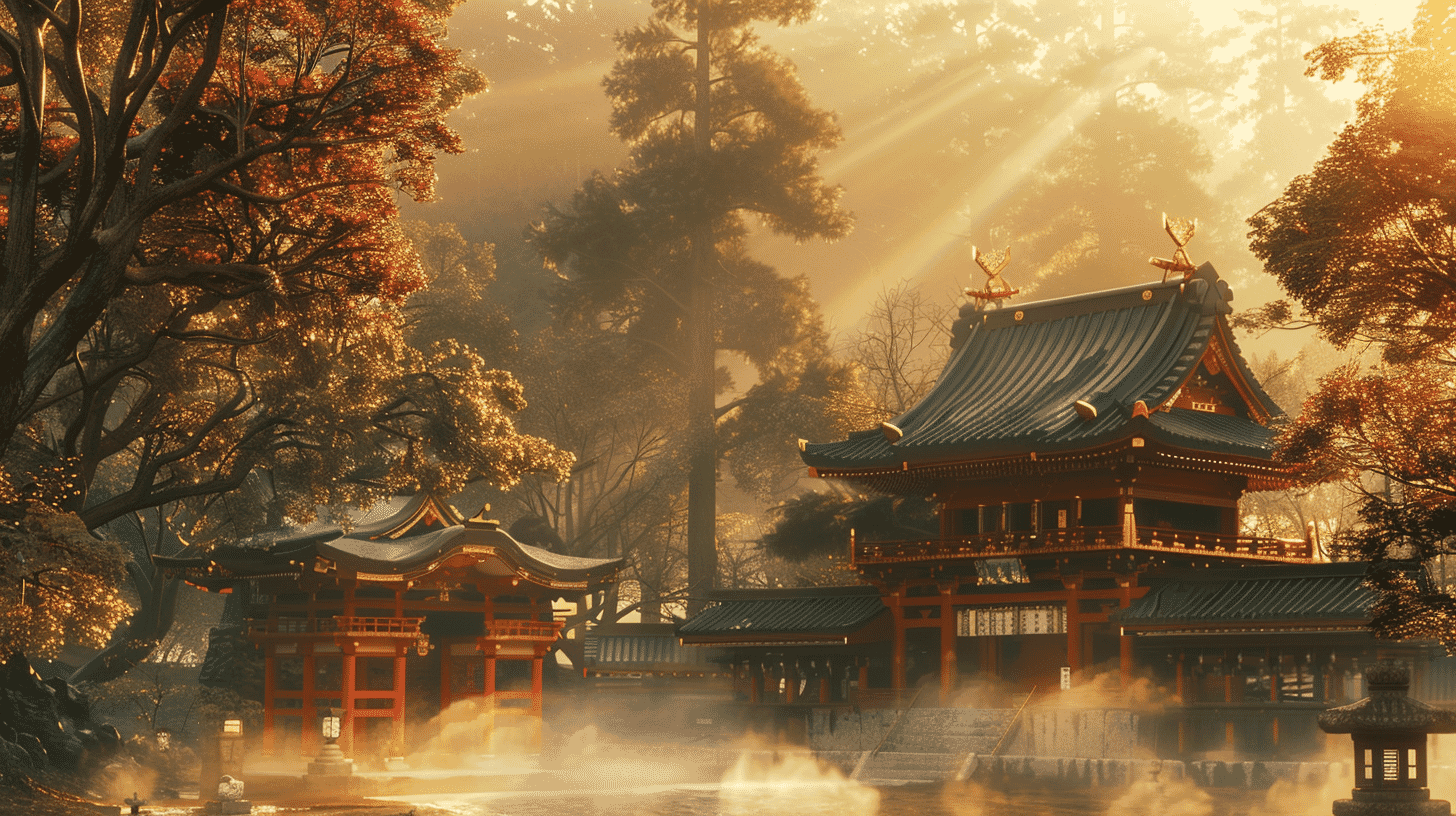
Built between 1855 and 1861, National Treasure since 1952
Usa Shrine Main Hall (宇佐神宮本殿, Usa Jingu Honden) stands at Minami-Usa, Usa City, Oita Prefecture, and was designated a National Treasure in 1952, on 22 November. In 1907, on 27 May, it had been listed as a specially protected structure under the old preservation law. The quantity is three buildings: the first, second and third sanctuaries. It belongs to Usa Jingu.
The Agency for Cultural Affairs records the arrangement and the dates. The main hall faces south, with the first through third sanctuaries ranged from east to west, and the present buildings were all raised between 1855 and 1861.
The founding of each sanctuary is much older. Usa Jingu gives 725 for the first, 733 for the second and 823 for the third. About eleven hundred years separate the founding dates from the buildings now standing, and the two should not be confused.
Hachiman Style: An M-Shaped Roof in Profile
The Agency explains the form: two gabled buildings are set one behind the other, with a large gutter laid in the valley between them. This form preserves an older manner and is valuable as a typical example of what is called the Hachiman style.
Two gabled buildings set front and back give a roofline of two peaks, with a gutter in the valley to carry off rainwater. Seen from the side the roof reads as the letter M.
The rear building is called the inner hall and the front the outer hall. A curtained dais stands in the inner hall and a seat in the outer, and the deity is said to occupy the front hall by day and the rear by night. Two buildings forming one sanctuary corresponds to that division between day and night seats.
When the Agency finds that the form preserves an older manner, it is because this composition is the type of the Hachiman shrine sanctuary. The name Hachiman style itself comes from its occurrence at Hachiman shrines.
Three Buildings Side by Side
The three stand from the viewer's left as first, second and third sanctuaries. They are much of a size, all with cypress bark roofs, white walls and red-lacquered columns.
The first enshrines Hachiman Okami, the second Hime Okami and the third Empress Jingu. That the first sanctuary, holding the principal deity, stands at the end rather than the centre differs from the usual arrangement.
Before the hall stands the south middle tower gate. Worship is offered from before that gate, and the sanctuaries cannot ordinarily be approached closely. Taking in all three at once is difficult, and a model at the Oita Prefectural Museum of History shows the whole.
On the dates of building, Usa Jingu gives 1855 to 1861 while the prefectural record gives 1855 to 1862. The Agency gives 1861, and this article follows the Agency.
Maintaining the Cypress Bark
Cypress bark roofing lasts about forty years. At Usa Jingu, rethatching and repair of the main hall were carried out over two and a half years, from September 2012 to March 2015.
Before that, major repairs were made in 1963 and 1964. The buildings themselves remain as raised between 1855 and 1861; these works are repairs to them.
In October 2015 the shrine held the imperial envoy festival, observed once in ten years, at which a messenger of the emperor is sent to the rites.
Visiting
The main hall stands in the upper shrine, and worship is offered from before the south middle tower gate. At Usa Jingu the form is two bows, four claps and one bow, offered to each sanctuary in turn from the first.
Apart from special viewings, close approach to the sanctuaries is not offered. From some positions at the gate part of the hall can be seen.
The precinct also holds the west great gate and the Kurehashi bridge. The west great gate is thought to date from the Bunroku era, 1592 to 1596. The Kurehashi is a roofed sacred bridge on the west approach, designated by Oita Prefecture. Both carry designations separate from the main hall.
From Usa Station on the JR Nippo Main Line the bus takes about ten minutes to the Usa Hachiman stop. By car it is about ten minutes from the Usa interchange on the Higashi-Kyushu Expressway.
Q&A
- When was the Usa Jingu main hall built and designated?
- The Agency for Cultural Affairs records that all three sanctuaries were raised between 1855 and 1861. The hall was listed as a specially protected structure on 27 May 1907 and designated a National Treasure in 1952, on 22 November. The quantity is three buildings.
- What is the Hachiman style?
- Two gabled buildings set one behind the other with a large gutter in the valley between them, so that the roof reads as the letter M in profile. The rear is the inner hall and the front the outer, and the deity is said to occupy the front by day and the rear by night. The Agency calls it a typical example preserving an older manner.
- What are the three sanctuaries and how are they arranged?
- From the viewer's left, the first enshrines Hachiman Okami, the second Hime Okami and the third Empress Jingu. They are much of a size, with cypress bark roofs, white walls and red-lacquered columns. The first, holding the principal deity, stands at the end rather than the centre, unlike the usual arrangement.
- Are the founding dates the same as the dates of the buildings?
- No. Usa Jingu gives 725 for the founding of the first sanctuary, 733 for the second and 823 for the third. The present buildings date from 1855 to 1861, about eleven hundred years later.
- Can the main hall be seen closely?
- Apart from special viewings, close approach is not offered. Worship is from before the south middle tower gate, two bows, four claps and one bow, to each sanctuary in turn. Taking in all three at once is difficult, and a model at the Oita Prefectural Museum of History shows the whole.
Basic Information
| Name | Usa Shrine Main Hall (宇佐神宮本殿, Usa Jingu Honden) |
|---|---|
| Location | 2859 Minami-Usa, Usa City, Oita Prefecture |
| Designation | National Treasure (structure); the Kurehashi bridge and the timber torii are Oita Prefecture cultural properties |
| Year Designated | 1907 (27 May), specially protected structure; 1952 (22 November), National Treasure |
| Quantity | 3 buildings (first, second and third sanctuaries) |
| Dimensions | Hachiman style: 2 gabled buildings set front and back with a large gutter in the valley between. All 3 much of a size, cypress bark roofs, white walls, red-lacquered columns. Facing south, ranged east to west. Built 1855 to 1861 |
| Owner | Usa Jingu |
| Public Access | Worship from before the south middle tower gate. Apart from special viewings, close approach is not offered |
References
- Cultural Heritage Online: Usa Jingu main hall, first sanctuary
- https://online.bunka.go.jp/heritages/detail/187746
- Cultural Heritage Online: Usa Jingu main hall, second sanctuary
- https://bunka.nii.ac.jp/heritages/detail/124607
- Oita cultural properties illustrated: Usa Jingu main hall
- https://oita-digitalzukan.jp/cultural_property/Usa-Jingu-Honden/
- Usa Jingu official site
- https://www.usajinguu.com/
Last verified: 2026.09.03
Cultural Treasures in the Same Area
All are within walking distance in the same area, so we recommend visiting them together.
- Usa Shrine Main Hall (Second Hall) 0.00 km
- Usa Shrine Main Hall (Third Hall) 0.01 km
- Usa Shrine Main Hall (First Hall) 0.01 km