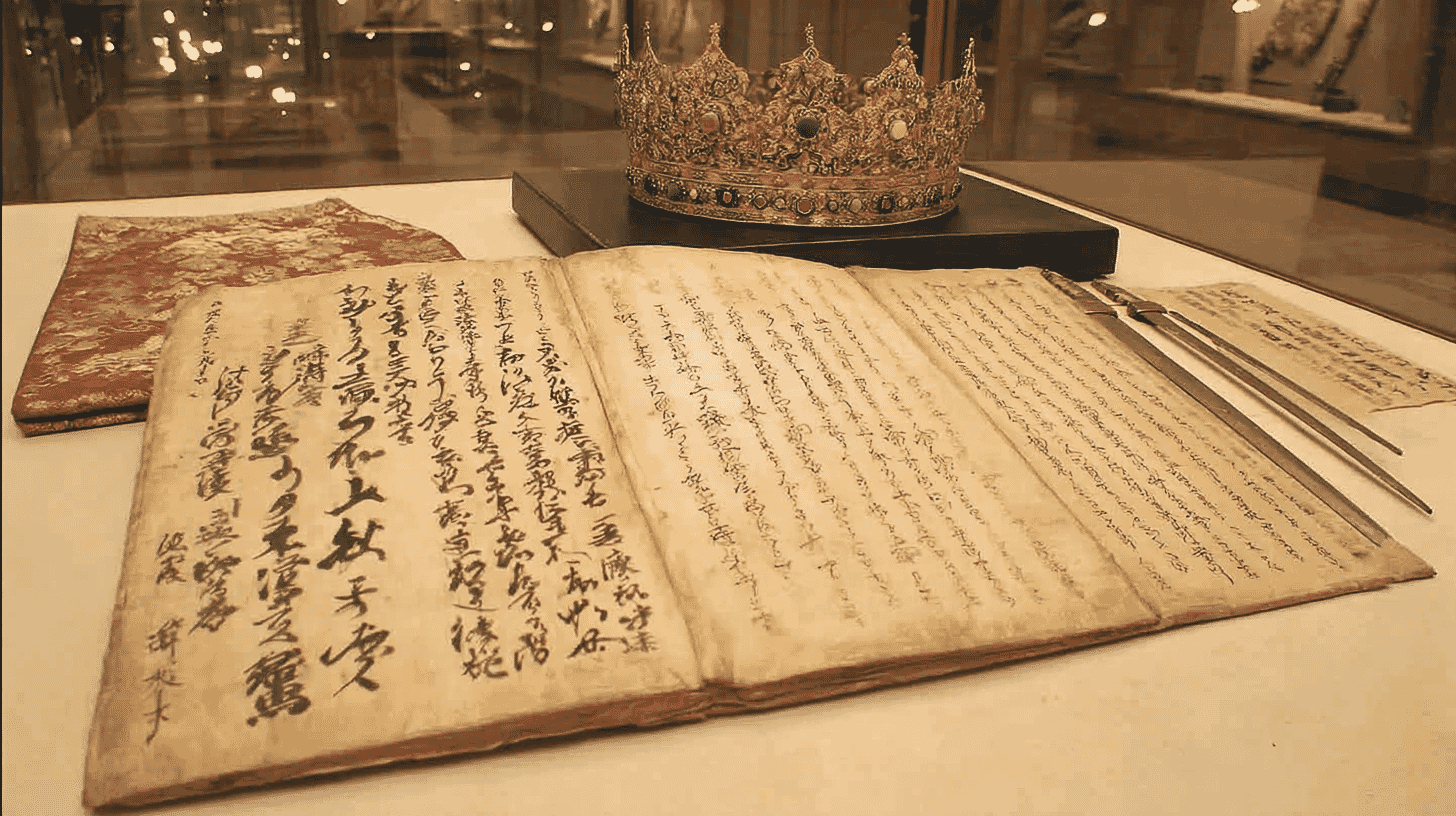
Documents Related to the Kings of the Ryukyu Kingdom, the Sho Family: Okinawa's Priceless National Treasure
Imagine holding the only surviving crown of a kingdom that once stood at the crossroads of East and Southeast Asia — a jeweled masterpiece that adorned the heads of rulers who traded with China, Japan, Korea, and lands as far as Siam and Malacca. This is not a legend; it is reality. The crown, along with over 1,200 other extraordinary objects, forms the collection known as the "Documents Related to the Kings of the Ryukyu Kingdom, the Sho Family" (琉球国王尚家関係資料), one of the most remarkable National Treasures in all of Japan.
Designated as a National Treasure in 2006, this collection is the foremost surviving record of the Ryukyu Kingdom — a once-independent island nation that flourished in what is now Okinawa Prefecture. For international visitors seeking an experience far removed from the temples of Kyoto or the skyscrapers of Tokyo, this collection offers an intimate encounter with a kingdom whose culture was shaped by the currents of the entire Asia-Pacific world.
The Ryukyu Kingdom and the Sho Dynasty
To fully appreciate this National Treasure, it helps to understand the kingdom from which it came. The Ryukyu Kingdom was an independent state centered on the island of Okinawa, with its capital at Shuri Castle in present-day Naha. At its peak, the kingdom controlled a chain of islands stretching from Amami in the north to Miyako and Yaeyama in the south.
The collection is connected to the Second Sho Dynasty, which began in 1470 when Sho En ascended to the throne. For the next four centuries — through 19 generations of kings ending with Sho Tai — the Sho family presided over a realm that served as a vital trade hub linking China, Japan, Korea, and Southeast Asia. The kingdom maintained a tributary relationship with the Chinese emperor, who formally invested each Ryukyu king through elaborate investiture ceremonies known as sakuho (冊封). At the same time, from 1609 onward, the kingdom existed under the influence of Japan's Satsuma domain.
This dual position gave rise to a uniquely hybrid culture — one that blended Chinese court protocols, Japanese artistic traditions, and indigenous Okinawan sensibilities into something entirely its own. In 1879, the Meiji government dissolved the Ryukyu Kingdom and incorporated it into Japan as Okinawa Prefecture. King Sho Tai was forced to relocate to Tokyo, and the royal family was granted the title of Marquis. It was the 22nd head of the Sho family, Sho Hiroshi, who in 1995 and 1996 donated the family's inherited cultural treasures to the city of Naha — ensuring that these irreplaceable artifacts would be preserved and shared with the public.
What the Collection Contains
The National Treasure comprises a total of 1,251 items, broadly divided into two categories: 85 art and craft objects and 1,166 historical documents and records.
Art and Craft Objects (85 Items)
The art and craft objects are items that were used in royal ceremonies and court life, spanning the 16th through 19th centuries. Among the most celebrated pieces are:
- The Royal Crown (Gyoku-kan / Tama-no-Okammuri): This is the crown worn by the Ryukyu king during formal state occasions. Fashioned in the style of the Chinese pibianmao (皮弁冠), it is adorned with an array of precious gemstones. In 1755, the crown was redesigned to feature 12 ridges and 266 jewels — placing it on par with the Chinese emperor's own ceremonial headpiece. It is the only surviving Ryukyu royal crown in existence.
- Royal Ceremonial Robes (O-Shozoku): The collection includes the only known surviving set of Ryukyu king's ceremonial garments, including a stunning red brocade robe featuring dragon and cloud motifs. Approximately 60 pieces of royal and aristocratic garments are included, showcasing the brilliant colors and intricate techniques of Ryukyu textile arts, including the famed bingata dyeing technique.
- Three Legendary Swords: The collection contains three storied swords that were treasured by the royal family for centuries. The Chiyoganemaru (千代金丸) features a gold-sheathed scabbard and bears the inscription "Taisei" (大世), linked to King Sho Taikyu. Legend holds that this blade was wielded by the last king of the northern Sanpei kingdom before his defeat by Sho Hashi in 1416. The Jikanemaru (治金丸) is a black-lacquered short sword reportedly presented to King Sho Shin by a chieftain of Miyako Island. The Chatan Nakiri (北谷菜切) is adorned with an exquisite mother-of-pearl inlaid scabbard.
- Lacquerware and Furnishings: The collection also includes lacquered boxes, containers with fine maki-e and mother-of-pearl (raden) decoration, ceramics, and metalwork — all reflecting the refined material culture of the Ryukyu court.
Documents and Records (1,166 Items)
The historical documents span from the late 17th century to the Meiji 30s (approximately the 1890s), covering over 300 years of Ryukyu history. The documents encompass royal family records, investiture (sakuho) ceremony materials, tribute mission reports (shinko), records of diplomatic vessels (sekko-sen), and documents relating to the kingdom's relationship with the Satsuma domain. Also included are the miezu-cho (御絵図帳), pattern books that served as textile design references for orders placed with weavers across the islands. Tragically, much of the Sho family's original archive was lost — some destroyed in the Great Kanto Earthquake of 1923, and more during the Battle of Okinawa in 1945. What survives, however, constitutes the single most important documentary source for the history of the Ryukyu Kingdom.
Why It Was Designated a National Treasure
The collection was first partially recognized in 2002, when the 85 art and craft items were designated as an Important Cultural Property under the name "Heirlooms of King Sho of Ryukyu" (琉球王尚家伝来品). In 2006, the scope was expanded to include the historical documents and records, and the entire collection of 1,251 items was elevated to National Treasure status — making it the first National Treasure designation in Okinawa Prefecture's history.
The designation reflects several extraordinary qualities. First, these are the sole surviving items from the Ryukyu royal household. No other collection preserves Ryukyu royal regalia in such breadth and quality. Second, the art and craft objects represent the finest examples of Ryukyu craftsmanship — a tradition that uniquely blended Chinese, Japanese, and Southeast Asian influences. Third, the documents are an irreplaceable primary source for understanding the political, diplomatic, and cultural history of the Ryukyu Kingdom. Taken together, the collection forms the most comprehensive and authoritative body of material relating to the Ryukyu kings and their era.
Highlights and Must-See Items
For visitors, several items in the collection stand out as truly unforgettable experiences:
The Royal Crown is perhaps the single most iconic object. Its intricate gemstone settings — featuring an array of colored stones including crystal, agate, and glass beads — create a visual impression that is both majestic and distinctly different from any Japanese imperial crown. Seeing this crown in person conveys the sovereign dignity of the Ryukyu kings in a way no photograph can fully capture.
The three legendary swords each carry centuries of legend and lore. The gold-adorned Chiyoganemaru, with its unique single-handed grip style that differs from standard Japanese sword construction, illustrates how Ryukyu craftsmen adapted mainland Japanese weaponry to their own aesthetic. The swords are not merely beautiful; they are tangible connections to named historical figures and specific events in Ryukyu history.
The royal garments offer an extraordinary window into the textile arts for which the Ryukyu Islands remain celebrated. The bingata-dyed fabrics, with their vivid colors and bold motifs drawn from nature, showcase a dyeing tradition that is recognized today as one of Japan's premier craft arts.
The miezu-cho pattern books are especially fascinating for textile enthusiasts. These books, containing hand-painted textile designs on Japanese paper, served as the visual language through which the royal court communicated its aesthetic preferences to weavers throughout the islands.
Where to See the Collection
The collection was previously housed at the Naha City Museum of History (那覇市歴史博物館), located on the 4th floor of the Palette Kumoji building in central Naha, which closed its doors on August 31, 2025. The museum's holdings — including this National Treasure — are being transferred to a new museum facility currently under construction at the historic Nakagusuku Udun site near Shuri Castle. The new museum is scheduled to open in late 2026 or afterward.
In the interim, the Naha City Museum of History continues to maintain its digital museum online, allowing visitors to explore images and information about the collection remotely. Certain items from the collection are also periodically loaned to other institutions for special exhibitions, so it is worth checking current exhibition schedules at major museums.
When the new museum at the Nakagusuku Udun site opens, the experience will be even more meaningful: visitors will be able to view these royal treasures in the historic Shuri district — the very heart of the old Ryukyu Kingdom, steps away from Shuri Castle itself.
Surrounding Attractions
A visit to this collection pairs beautifully with other cultural experiences in Naha and the Shuri district:
- Shuri Castle (首里城): A UNESCO World Heritage Site and the former seat of the Ryukyu kings. Though the main hall was tragically destroyed by fire in 2019, reconstruction is underway and the castle grounds, gates, and surrounding structures remain open and deeply impressive.
- Shikinaen Garden (識名園): Another UNESCO World Heritage Site, this beautiful royal garden was used to entertain Chinese investiture envoys. Its tranquil ponds and traditional architecture offer a peaceful complement to the museum experience.
- Tsuboya Pottery District (壺屋やちむん通り): A charming neighborhood of pottery workshops and galleries, where visitors can experience Okinawa's living ceramic tradition firsthand.
- Kokusai Street (国際通り): Naha's vibrant main shopping and entertainment street, offering Okinawan cuisine, crafts, and local culture.
- Okinawa Prefectural Museum & Art Museum (沖縄県立博物館・美術館): A comprehensive museum offering broader context on Okinawan history and culture, an excellent complement to the focused Sho family collection.
- 📍 Plan Your Visit to Okinawa
- Find tours, activities & transport passes near Materials Related to the Sho Dynasty of the Ryukyu Kingdom
- [ Churaumi Aquarium & Shuri Castle Okinawa Tours ]
Q&A
- Where can I see the National Treasure "Documents Related to the Kings of the Ryukyu Kingdom, the Sho Family" right now?
- The former Naha City Museum of History at Palette Kumoji closed on August 31, 2025. The collection is being transferred to a new museum at the Nakagusuku Udun site near Shuri Castle, expected to open in late 2026 or later. In the meantime, you can explore the collection through the museum's online digital museum, and some items may be on loan at other institutions for special exhibitions.
- Is the royal crown (Gyoku-kan) always on display?
- At the former museum, the actual crown was displayed only during special exhibition periods, typically for a few weeks in spring and autumn, due to conservation requirements. Between these periods, a high-quality replica was shown. Display policies at the upcoming new museum have not yet been announced — please check the museum website for the latest schedule.
- Is English signage or interpretation available?
- The former Naha City Museum of History provided English-language exhibit labels and descriptions. The online digital museum also offers some bilingual content. Details about language support at the new museum will be available closer to its opening date.
- How does this collection relate to Shuri Castle?
- The Sho family resided at Shuri Castle during their reign as kings of the Ryukyu Kingdom. The items in this collection were used in court ceremonies and governmental administration conducted from the castle. With the new museum being built at the Nakagusuku Udun site adjacent to Shuri Castle, visitors will be able to experience both the castle and the royal treasures in their original historic setting.
- What makes this National Treasure different from other Japanese National Treasures?
- Unlike most Japanese National Treasures, which reflect mainland Japanese culture, this collection documents the distinct culture of the Ryukyu Kingdom — a maritime trading state that blended Chinese, Japanese, and Southeast Asian influences into its own unique civilization. The royal crown, modeled on Chinese imperial headwear, and the swords with their unique Ryukyu-style mountings, are unlike anything found elsewhere in Japan.
Basic Information
| Official Name | 琉球国王尚家関係資料 (Ryūkyū Kokuō Shō-ke Kankei Shiryō / Documents Related to the Kings of the Ryukyu Kingdom, the Sho Family) |
|---|---|
| Designation | National Treasure (国宝) |
| Category | Historical Materials (歴史資料) |
| Number of Items | 1,251 items (85 art/craft objects + 1,166 documents/records) |
| Period | Second Sho Dynasty to Meiji era (15th–19th centuries) |
| National Treasure Designation Date | June 9, 2006 (additional items added July 23, 2019) |
| Repository | Naha City Museum of History (那覇市歴史博物館) — currently in transition to a new facility at the Nakagusuku Udun site, Shuri, Naha |
| Address (Former Location) | Palette Kumoji 4F, 1-1-1 Kumoji, Naha, Okinawa 900-0015 |
| New Museum (Planned) | Nakagusuku Udun site, near Shuri Castle, Naha — opening expected late 2026 or later |
| Contact | Naha City Museum of History: TEL 098-869-5266 (Weekdays 10:00–17:00) |
| Website | https://www.rekishi-archive.city.naha.okinawa.jp/ |
References
- 琉球国王尚家関係資料 — 文化遺産データベース
- https://bunka.nii.ac.jp/db/heritages/detail/202833
- 琉球国王尚家関係資料(那覇市) — 住友財団
- https://www.sumitomo.or.jp/html/culja/culja21/jp21048.htm
- 国宝-歴史|琉球国王尚家関係資料 — WANDER 国宝
- https://wanderkokuho.com/201-10718/
- 那覇市歴史博物館 — Wikipedia
- https://ja.wikipedia.org/wiki/那覇市歴史博物館
- 皮弁冠 — Wikipedia
- https://ja.wikipedia.org/wiki/皮弁冠
- 千代金丸 — Wikipedia
- https://ja.wikipedia.org/wiki/千代金丸
- 治金丸 — Wikipedia
- https://ja.wikipedia.org/wiki/治金丸
- 那覇市歴史博物館|那覇市公式ホームページ
- https://www.city.naha.okinawa.jp/shisetsu/bunkasisetu/hakubutukan.html
- 金装宝剣拵(号 千代金丸) — 那覇市歴史博物館 デジタルミュージアム
- https://www.rekishi-archive.city.naha.okinawa.jp/digital-museum/2/109782
- 那覇市歴史博物館 — おきなわ物語
- https://www.okinawastory.jp/spot/600003010
- 中城御殿 — Wikipedia
- https://ja.wikipedia.org/wiki/中城御殿
Last verified: 2026.02.08
Nearby heritages
- Materials Related to the Ie Udun Family
- Palette Kumoji 4th floor, 1-1-1 Kumoji, Naha City, Okinawa Prefecture
- Parantu in Miyakojima
- Hirara Shimajiri, Uenohara, Miyakojima City
- Former Sogenji Temple First Gate and Stone Wall
- 9-1 Tomari 1-chome, Naha City, Okinawa Prefecture
- Arakaki Family Residence (Tsuboya, Naha City, Okinawa
- 28-32 Tsuboya 1-chome, Naha City, Okinawa Prefecture
- Temple Bell (former Engakuji Temple Inner Bell)
- Okinawa Prefectural Museum and Art Museum, 3-1-1 Omoromachi, Naha City, Okinawa Prefecture
- Imperial Admonition of Ming Koso (addressed to Shoshin, King
- Okinawa Prefectural Museum and Art Museum, 3-1-1 Omoromachi, Naha City, Okinawa Prefecture
- Temple Bell (former Engakuji Temple Tower Bell)
- Okinawa Prefectural Museum and Art Museum, 3-1-1 Omoromachi, Naha City, Okinawa Prefecture
- Mixed Test Collection〈Kenkun〉
- Okinawa Prefectural Museum and Art Museum, 3-1-1 Omoromachi, Naha City, Okinawa Prefecture
- Temple Bell (former Bell in Front of Engakuji Temple)
- Okinawa Prefectural Museum and Art Museum, 3-1-1 Omoromachi, Naha City, Okinawa Prefecture
- Bronze Bell (former Shuri Castle Main Hall Bell)
- Okinawa Prefectural Museum and Art Museum, 3-1-1 Omoromachi, Naha City, Okinawa Prefecture