
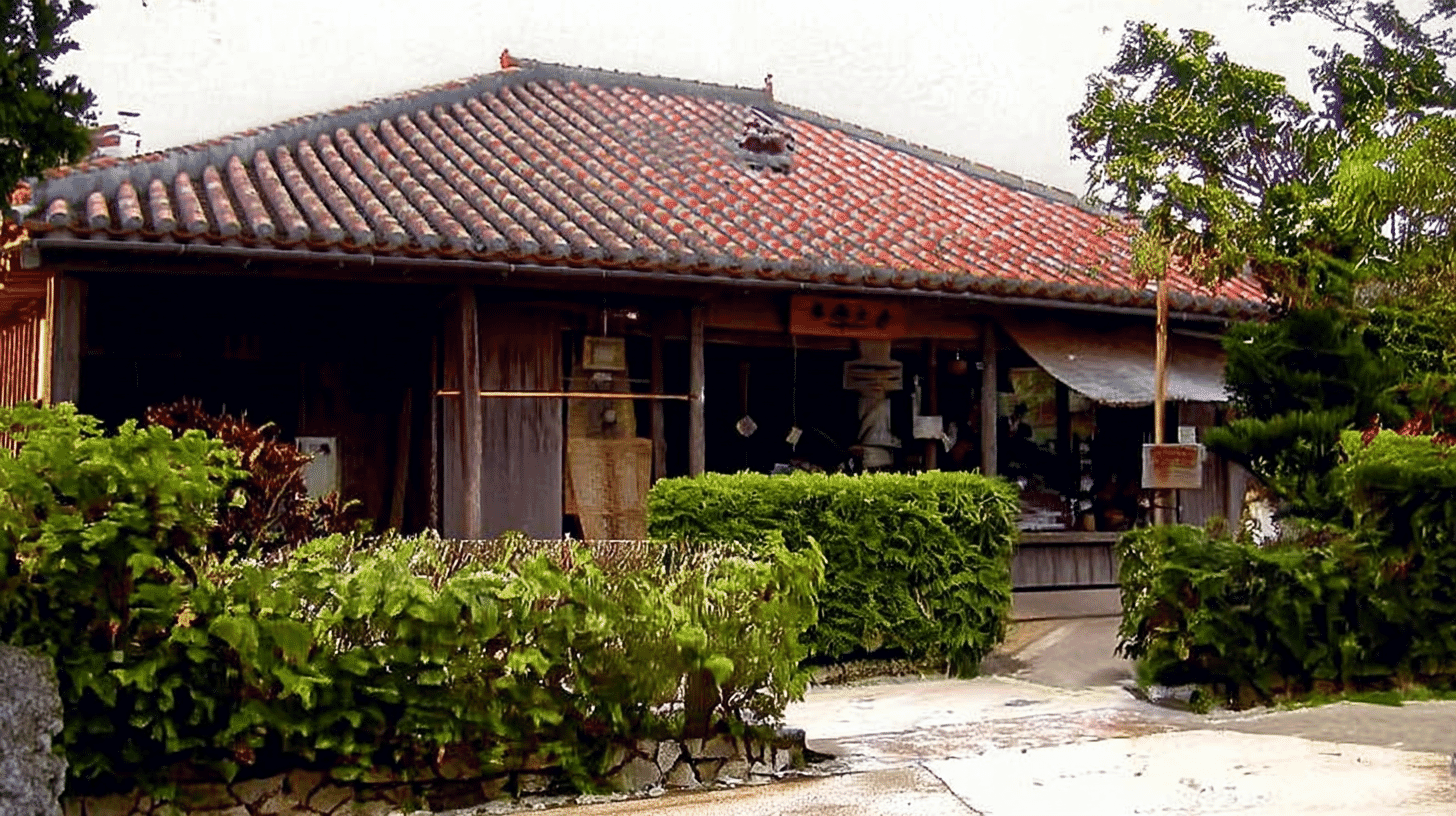
A Traditional Okinawan House, Registered in 2008
Okinawa World Former Kamisato Family Residence Main Building (おきなわワールド旧上里家住宅主屋, read Uezato) stands at 1384 and adjacent lots, Maekawa, Tamagusuku, Nanjo City, Okinawa Prefecture, entered on the national register of tangible cultural properties on 18 April 2008. The quantity is one building: timber, single storey, tiled roof, with a footprint of 127 square metres. The owner is the Nanto Corporation.
The Agency for Cultural Affairs gives the date in three parts: early Showa, about 1934, moved in 1995. The year of building is an estimate, and the year of relocation is set down separately.
The house was moved to its present site in 1995. Where it stands now is not where it was built, and the Agency does not record where it came from.
Four Rooms at the Front, Three Behind
The Agency describes the plan precisely. The house measures 12 metres along and 7.6 metres deep, hipped and roofed in heavy tile, single storey in timber.
Along the front on the east, from the north, come the first room, the second room, a boarded room and the earthen-floored kitchen; on the west side lie three rear rooms.
Four spaces along the front and three behind. The first and second rooms are the formal rooms, numbered from the north. The boarded room is floored in planks and the kitchen has no raised floor at all.
East is the front and west the back. The formal rooms come first along the front, with the first room at the northern end.
The Deep Eaves Run Round All but One Face
For what marks an Okinawan house, the Agency points to the amahaji, the projecting eaves.
A veranda runs from the north face as far as the boarded room on the east, and the amahaji is carried round all four sides except the west face of the first rear room, giving the house the make of a traditional Okinawan dwelling.
The amahaji is a deep eave hung along the outside of the building, making a sheltered half-outdoor space beneath and protecting walls and openings from hard sun and rain.
It runs round all four sides, save the west face of the first rear room alone. The house is not wrapped uniformly; one face is treated differently. That the Agency troubles to name that face is worth attention.
The veranda runs from the north face to the boarded room on the east. Veranda and eaves each cover their own stretch.
A House That Was Moved
The building was relocated in 1995. Registration followed thirteen years later, in 2008.
A house that has been moved loses its relation to the ground it stood on and to the settlement around it. The building survives; its connection to its place does not. Okinawan houses are usually thought of together with their enclosing walls, stone banks and trees, so the point is worth holding in mind.
The owner is the Nanto Corporation. A private company owns the house and shows it within its own grounds, which puts it on a different footing from properties held by shrines, temples or local authorities.
The Agency's related entries list the former Kyan, Taba and Irei family houses at the same site. Several houses were moved to one place and each registered separately.
Visiting
The house stands within the grounds of Okinawa World, so a visit follows the opening hours and admission of the facility.
Hours and charges may change, so check the facility's information before travelling.
What repays looking at is the plan and the eaves: the relation between the four rooms along the front and the three behind, and the one face from which the amahaji is absent. Walking round the outside also gives a sense of the 12 by 7.6 metres.
The site is at 1384 and adjacent lots, Maekawa, Tamagusuku, Nanjo City, Okinawa Prefecture.
Q&A
- When was the house registered?
- On 18 April 2008, on the national register of tangible cultural properties, as one building of timber, single storey, tiled, with a footprint of 127 square metres, owned by the Nanto Corporation.
- When was it built?
- The Agency for Cultural Affairs gives the date in three parts: early Showa, about 1934, moved in 1995. The year of building is an estimate, with the relocation set down separately. Where it stands now is not where it was built.
- How is it planned?
- The Agency records the first room, the second room, a boarded room and the earthen-floored kitchen ranged from the north along the front on the east, with three rear rooms on the west side. Four spaces along the front and three behind, east being the front and west the back.
- What is the amahaji?
- A deep eave hung along the outside of the building, making a sheltered half-outdoor space beneath and protecting walls and openings from hard sun and rain. The Agency records it as carried round all four sides except the west face of the first rear room, naming the one face left out.
- Can it be visited?
- It stands within the grounds of Okinawa World, so a visit follows the facility's opening hours and admission. Hours and charges may change, so check the facility's information before travelling.
Basic Information
| Name | Okinawa World Former Kamisato Family Residence Main Building (おきなわワールド旧上里家住宅主屋) |
|---|---|
| Location | 1384 and adjacent lots, Maekawa, Tamagusuku, Nanjo City, Okinawa Prefecture |
| Designation | Registered Tangible Cultural Property (structure) |
| Year Designated | 2008 (18 April), registered |
| Quantity | 1 building |
| Dimensions | Timber, single storey, tiled roof, footprint 127 square metres. 12 metres along and 7.6 metres deep, hipped and roofed in heavy tile. Along the front on the east, from the north, the first room, the second room, a boarded room and the earthen-floored kitchen, with 3 rear rooms on the west. The amahaji runs round all 4 sides except the west face of the first rear room. Built about 1934, moved 1995 |
| Owner | Nanto Corporation |
| Public Access | Within the grounds of Okinawa World; a visit follows the facility's hours and admission |
References
- Cultural Heritage Online: Okinawa World former Kamisato family residence main building
- https://bunka.nii.ac.jp/heritages/detail/187063
- Okinawa World: cultural properties
- https://www.gyokusendo.co.jp/okinawaworld/culturalproperties/
- Agency for Cultural Affairs: registered tangible cultural properties (structures)
- https://www.bunka.go.jp/seisaku/bunkazai/shokai/yukei_kenzobutsu/toroku_yukei.html
- Agency for Cultural Affairs, National Cultural Properties Database
- https://kunishitei.bunka.go.jp/
Last verified: 2026.09.04