
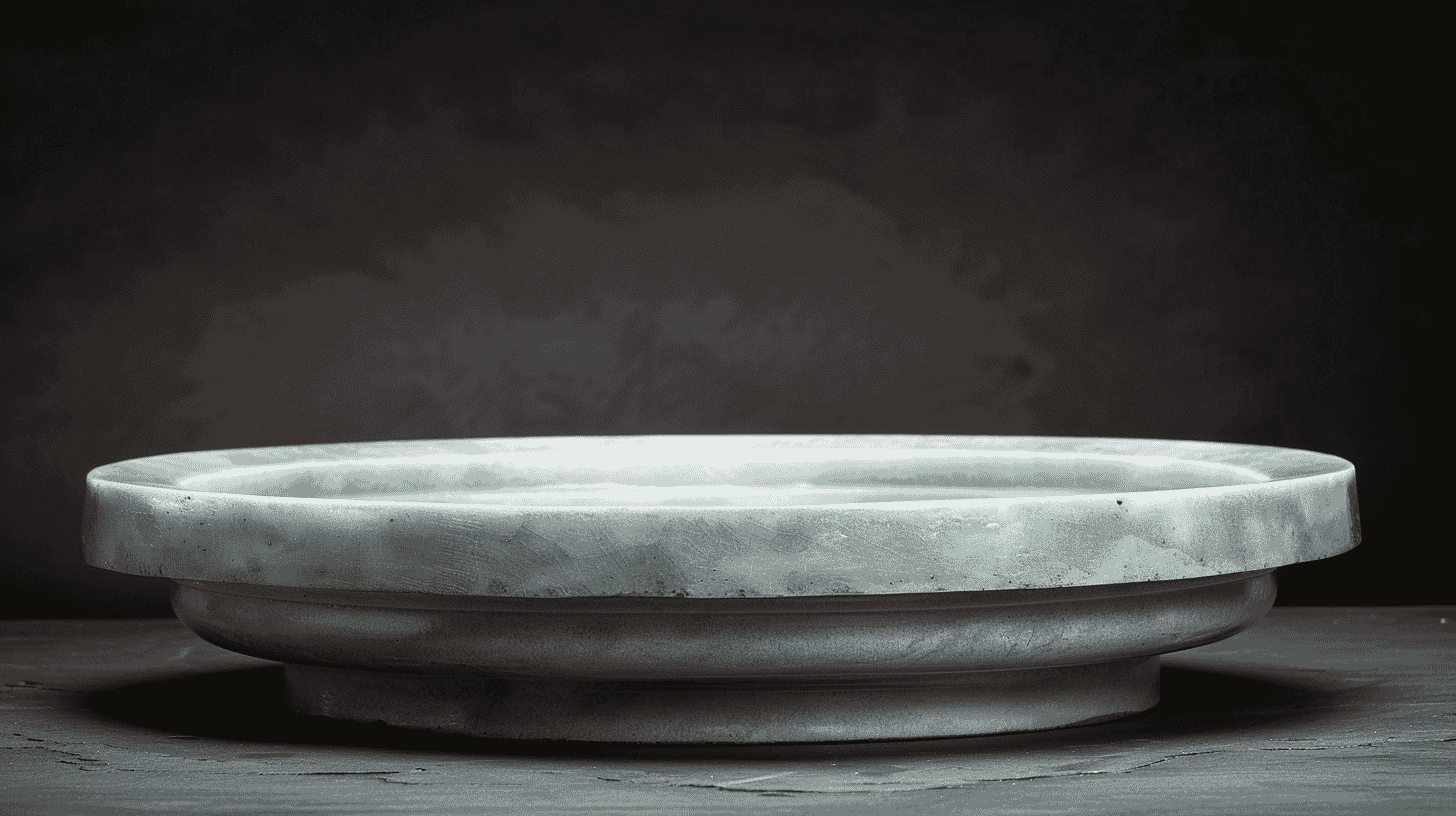
One Inkstone, National Treasure since 1953
Round Inkstone in Bluish-White Porcelain (青白磁円硯, Seihakuji Enken) is a craft object owned by Domyoji Tenmangu in Osaka Prefecture, made an Important Cultural Property on 9 June 1951 and designated a National Treasure on 31 March 1953. The quantity is one inkstone.
Both dates are exactly those of the rhinoceros-horn knife and the ivory comb at the same shrine. All three belong to a group described as six surviving objects.
It measures 27.0 centimetres across and 6.4 centimetres high. The address field in the Agency's database is blank, the eighteenth such case.
Six Objects Sharing One Number by Branch
The designation number takes a form not met before.
This inkstone carries number 00106, branch 02.
Under the same 00106 stand the ivory sceptre as branch 01 and a mirror as branch 06.
The six objects share one number, divided by branch. Every property covered here so far has carried branch 00.
At Aoi Aso Shrine, five buildings were counted separately; at Kirishima Jingu, three were gathered as one. Those turn on the count.
Here the division runs through the numbering itself. The grouping shows in the shape of the number.
The Country Field Reads Japan, the Text Says Tang
The fields and the description do not agree.
The country field gives Japan and the period field the Heian. The sceptre and the mirror under the same number carry the same two entries.
The field for form, however, closes by calling the piece a rare survival of bluish-white porcelain made in the Tang period.
The Tang is a Chinese period. The country field says Japan while the description says Chinese work.
The commentary itself allows the mixture: of the six objects, it says, some were carried over from Tang China and some made in Japan.
Registering the six together has left the country and period fields uniform, so that individual origins are not reflected. With the biography of Huineng and the gilded bronze staff head, the country field read China plainly.
Twenty Feet, Their Lower Parts Long Since Lost
Form and loss are written in one breath.
A round inkstone hollowed at the centre, with a water well around it and twenty feet set on the body, of which the lower parts have long since been lost.
Twenty feet, and then the loss.
Long since, the record says. When is not given, but the damage is marked as not recent.
With the ivory comb, beads in dyed horn were noted as having fallen away by now. With the engraved mirror at Suijinja, marks of a fire remained.
Here the timing of the loss is given a wide margin. The glazing is recorded closely too: white glaze covers the outer rim, while the grinding surface, the well and the underside beneath them are left unglazed.
Seeing It
The inkstone belongs to Domyoji Tenmangu. The field for prefecture gives Osaka and the address field is blank.
The field for supplementary notes reads that the piece is held by tradition to have belonged to Sugawara no Michizane.
With the Engishiki, that field carried the date of a colophon; with the biography of Huineng, a date under a Chinese era name. Here it carries the provenance.
The body is described as a hard porcelain close to pure white.
Of the same six objects, the rhinoceros-horn knife and the ivory comb have already been covered. This is a shrine holding, not kept on permanent display. Check before travelling.
Q&A
- When was the inkstone designated?
- It became an Important Cultural Property on 9 June 1951 and a National Treasure on 31 March 1953. The knife and the comb of the same group carry both dates.
- Why does the number have a branch?
- Because the six objects share one number, 00106, divided by branch. This inkstone is branch 02, the ivory sceptre 01 and the mirror 06.
- Where was it made?
- The country field gives Japan and the period the Heian, while the field for form calls it a rare survival of porcelain made in the Tang period. The fields and the description do not agree.
- Is anything missing?
- Yes. The Agency records twenty feet set on the body, of which the lower parts have long since been lost. When they were lost is not stated.
- How did it come down?
- The notes field records it as held by tradition to have belonged to Sugawara no Michizane, and the commentary describes the group as passing to the abbess of his family temple.
Basic Information
| Name | Round Inkstone in Bluish-White Porcelain (青白磁円硯, Seihakuji Enken); six objects share designation number 00106 by branch |
|---|---|
| Location | The field for prefecture gives Osaka; the address field is blank and the owner is given as Domyoji Tenmangu |
| Designation | National Treasure (craft), designation no. 00106, branch 02 |
| Year Designated | 1951 (9 June), Important Cultural Property; 1953 (31 March), National Treasure |
| Quantity | 1 inkstone |
| Dimensions | 27.0 centimetres across and 6.4 centimetres high. A round inkstone hollowed at the centre with a water well around it and 20 feet on the body, the lower parts of which have long since been lost. The body is a hard porcelain close to pure white, with white glaze on the outer rim and the grinding surface and well left unglazed. The country field reads Japan and the period field the Heian, while the field for form gives the work as Tang |
| Owner | Domyoji Tenmangu |
| Public Access | A shrine holding, not on permanent display |
References
- Agency for Cultural Affairs database: the porcelain inkstone
- https://kunishitei.bunka.go.jp/heritage/detail/201/397
- Agency for Cultural Affairs database: the ivory sceptre, branch 01 of the same number
- https://kunishitei.bunka.go.jp/heritage/detail/201/398
- Domyoji Tenmangu: treasures
- https://www.domyojitenmangu.com/treasure.html
- Fujiidera City: nationally designated cultural properties
- https://www.city.fujiidera.lg.jp/soshiki/kyoikuiinkai/bunkazaihogo/fuziiderasinositeibunnkazai/kunifusiteibunkazai/1387694428536.html
Last verified: 2026.09.06