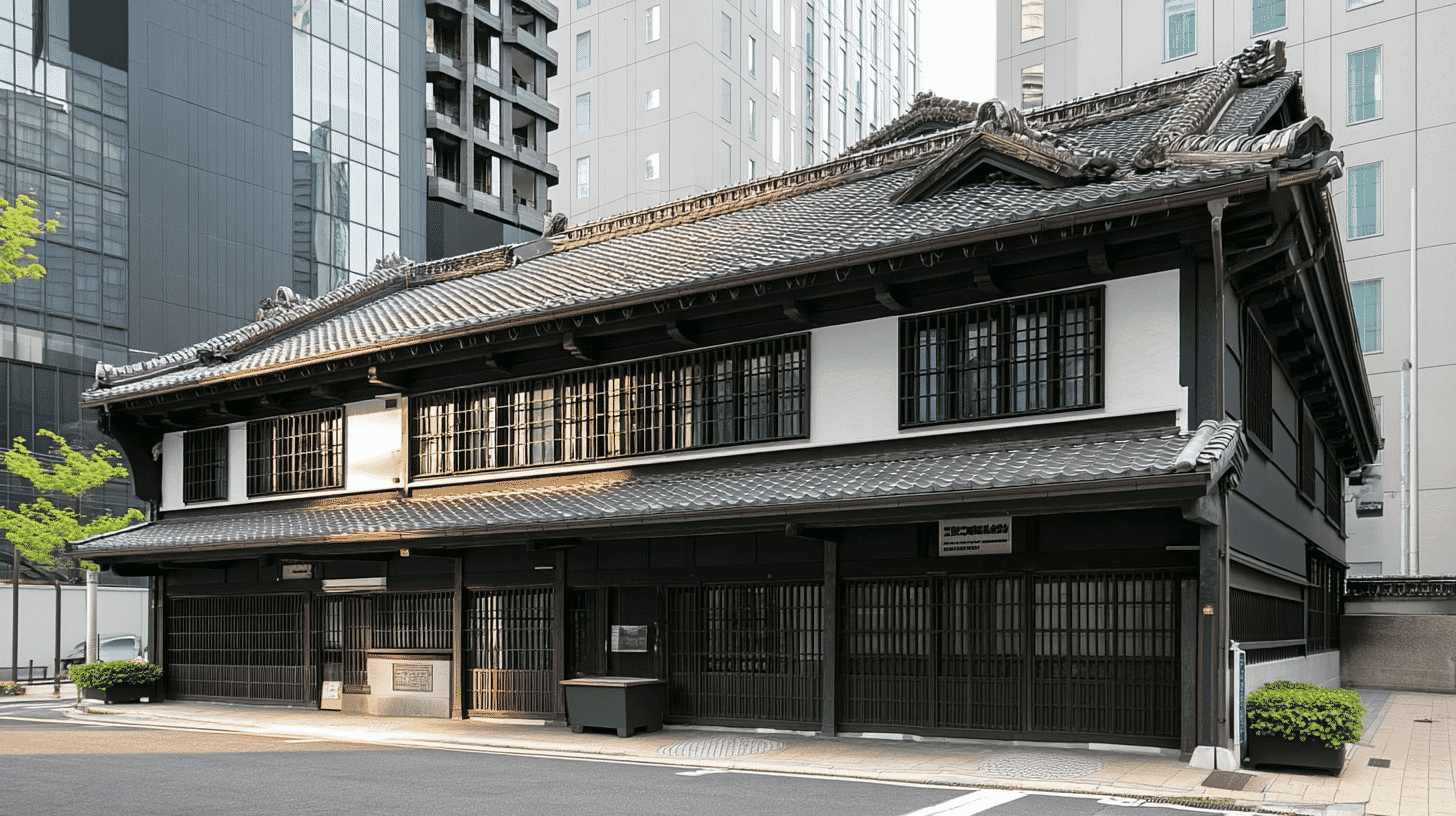
Former Konishi Family Residence: A Meiji-Era Merchant House Treasure in Osaka's Historic Pharmacy District

Discover the Former Konishi Family Residence (Kyu-Konishi-ke Jutaku), an Important Cultural Property in Osaka's Doshomachi district. This 1903 merchant house features traditional machiya architecture, kura storehouses, and offers a rare glimpse into Meiji-era pharmaceutical merchant life. Free guided tours available by reservation.

A Hidden Architectural Gem in Modern Osaka

Walking along the bustling Sakai-suji street in central Osaka, visitors are often stopped in their tracks by an unexpected sight: a magnificent black wooden structure standing defiantly among towering glass and steel office buildings. This is the Former Konishi Family Residence (旧小西家住宅), one of the finest surviving examples of Meiji-era merchant architecture in Japan and a designated Important Cultural Property that offers an authentic window into the prosperous world of Osaka's legendary pharmaceutical merchants.

Completed in 1903 after three years of meticulous construction, this remarkable building has survived earthquakes, air raids, and the relentless march of urban development. Today, it stands as a testament to the refined taste and commercial success of the Konishi family, whose pharmaceutical business would eventually evolve into Konishi Co., Ltd., the company famous for its "Bond" brand of adhesives.

The History of the Konishi Family and Doshomachi

The story of the Konishi family begins in 1856 when the founder, Gisuke Konishi I, left Kyoto and established himself in Osaka's Doshomachi district under the trade name "Konishi-ya" as a pharmaceutical merchant. This district, known as the "Medicine Town" of Japan, had been the center of the nation's pharmaceutical trade since the Edo period, with merchants supplying medicines throughout the country.

By 1870, the business had grown significantly, and in 1900, the second-generation Gisuke commissioned the construction of a new combined residence and business headquarters worthy of the family's elevated status. The project took three years to complete, using only the finest materials available, including premium tsuga (hemlock) wood throughout the structure.

The residence served as both the family home and company headquarters until 1994, and family members continued to reside there until 1971. The building survived the devastating Osaka air raids of 1945, making it the largest remaining traditional merchant house in the Senba district that escaped wartime destruction.

Why It Was Designated an Important Cultural Property

In June 2001, the Former Konishi Family Residence received designation as a national Important Cultural Property by the Minister of Education, Culture, Sports, Science and Technology. This prestigious recognition was granted based on several significant factors.

First, the residence represents the culmination of traditional Osaka machiya (townhouse) architecture from the Meiji period. Its "omoteya-zukuri" (front-house style) design, where the commercial front section is separated from the residential quarters by an inner courtyard, exemplifies the sophisticated urban living arrangements developed by Osaka's merchant class over centuries.

Second, the preservation of the entire compound, including the main house, the Costume Storehouse (Isho-gura), and the Two-Story Storehouse (Nikai-gura), provides an exceptionally complete picture of a major merchant establishment from the late Meiji period. Few such comprehensive examples survive in modern Japan.

Third, the quality of craftsmanship throughout the building is remarkable. From the intricate ranma (transom) carvings to the sophisticated layout of the tea ceremony room, every detail reflects the high standards expected by the prosperous pharmaceutical merchants of Doshomachi.

Architectural Highlights: The Main House

The main house faces Doshomachi-dori street with an impressive frontage of approximately 18 meters (about 26 meters in the original configuration before the 1911 road widening). The black-lacquered wooden exterior of the ground floor, lined with elegant lattice doors, contrasts beautifully with the white lime-plastered upper story, creating a visual harmony that has characterized Osaka merchant houses for centuries.

Originally, the main house included a three-story section, a distinctive feature of modern Osaka machiya architecture. However, following the 1923 Great Kanto Earthquake, the third floor was removed as a safety precaution, though the original staircase to this level still exists within the building.

Inside, visitors can explore the formal entrance hall with its impressive stepping stones, the Buddhist altar room, the master's private quarters, and an atmospheric kitchen featuring a massive kamado (traditional cooking stove) that once prepared meals for the approximately 50 family members, employees, and servants who lived and worked in the residence.

The building also features a charming inner courtyard garden with carefully placed stones and moss-covered grounds, providing natural light and ventilation to the interior rooms while offering a peaceful retreat from the commercial activities at the front of the building.

The Storehouses: Isho-gura and Nikai-gura

Behind the main house, across the inner garden, stand two remarkable storehouses that are equally important components of this cultural property.

The Costume Storehouse (Isho-gura / 衣装蔵) was constructed in 1912 following the 1911 road-widening project that claimed the western portion of the original property. Rising three stories with a total floor area of 45.9 square meters, this dozo-zukuri (earthen-walled storehouse) structure was built to house the family's valuable clothing, textiles, and other treasures. The thick earthen walls provided excellent protection against fire and theft, essential considerations for wealthy merchant families. For over a century, this storehouse preserved countless historical documents and artifacts that are now displayed in the museum.

The Two-Story Storehouse (Nikai-gura / 二階蔵), believed to have been constructed around 1903 contemporaneously with the main house, covers a floor area of 52.1 square meters. Also built in the traditional dozo-zukuri style with hon-kawara (standard ceramic tile) roofing, this storehouse served the daily commercial and domestic storage needs of the household.

Both storehouses exemplify the fireproof construction techniques developed over centuries by Japanese craftsmen, featuring thick earthen walls, small iron-barred windows, and heavy doors designed to seal completely in case of fire.

The Museum Experience

In November 2020, celebrating the 150th anniversary of Konishi Co., Ltd.'s founding, the Former Konishi Family Residence was renovated and opened to the public as a museum. After an investment of over 100 million yen and a year of careful restoration work, visitors can now experience this Important Cultural Property firsthand.

The museum features a housing exhibition zone where guests can walk through the preserved rooms of the main house, including the formal entrance, Buddhist altar room, and master's quarters. A separate exhibition zone, installed in the former shop area, displays historical artifacts, documents, and videos that tell the story of both the Konishi company and the Doshomachi pharmaceutical district.

One highlight is a detailed 1:35 scale model showing the residence as it appeared during the Taisho period, complete with the original third floor that was later removed. Visitors can also view a video presentation featuring footage of Osaka from the era when streetcars ran along Sakai-suji street.

Knowledgeable staff members from Konishi Co., Ltd. provide guided tours, explaining the history of the building, the traditions of Senba merchant life, and the evolution of the pharmaceutical trade in Doshomachi.

Exploring the Surrounding Area

The Former Konishi Family Residence is ideally located for exploring Osaka's rich pharmaceutical heritage and historic commercial district.

Just steps away is Sukunahikona Shrine, affectionately known as "Shinno-san," the guardian deity of medicine and health. This shrine has been the spiritual center of Doshomachi's pharmaceutical merchants since 1780, and its annual Shinno Festival (November 22-23) marks the traditional end of Osaka's festival calendar. The shrine's famous papier-mâché tiger charms (hariko no tora) have been distributed as talismans against illness since an 1822 cholera epidemic.

Adjacent to the shrine, the Kusuri no Doshomachi Museum offers free admission and presents over 300 years of pharmaceutical history through its collection of medicine containers, advertising materials, and historical documents.

The broader Doshomachi Museum Street features several corporate museums operated by major pharmaceutical companies, creating an unofficial walking course through Japan's pharmaceutical heritage.

For those interested in Osaka's financial history, the nearby Kitahama area was historically Japan's premier rice exchange and remains an important financial center, with handsome Meiji and Taisho-era buildings scattered among modern office towers.

Practical Information for Visitors

The Former Konishi Family Residence Museum offers free admission, making it an accessible destination for all visitors interested in Japanese architectural and commercial history. However, visits require advance reservation through the museum's online booking system.

Guided tours are conducted on Tuesdays and Fridays, with three time slots available each day: 10:00, 13:00, and 15:00. Each tour accommodates 1 to 8 visitors, ensuring an intimate and informative experience. Photography is permitted throughout the museum, though video recording is not allowed.

The building's location on Sakai-suji street provides excellent public transportation access. Visitors arriving by train will find the Osaka Metro Sakaisuji Line's Kitahama Station most convenient, with Exit 5 located just one minute's walk from the museum. The Keihan Railway's Kitahama Station is also accessible, approximately six minutes on foot from Exit 27.

📍 Plan Your Visit to Osaka
Find tours, activities & transport passes near Former Konishi Family Residence
[ USJ Tickets Osaka Castle & Dotonbori Food Tours ]

Q&A

QHow do I make a reservation to visit the Former Konishi Family Residence?
AReservations must be made through the official online booking system on the Konishi Co., Ltd. website. Walk-in visits are not accepted. Tours are available on Tuesdays and Fridays at 10:00, 13:00, and 15:00. For inquiries, you can contact Konishi's General Affairs Department at 06-6228-2847 during business hours (10:00-12:00 and 13:00-17:00, weekdays only).
QIs the museum accessible for visitors with mobility challenges?
AAs a preserved historic building from 1903, the Former Konishi Family Residence features traditional Japanese architecture including raised floors, step thresholds, and narrow passages that may present challenges for wheelchair users or visitors with limited mobility. Please contact the museum in advance to discuss your specific needs and any possible accommodations.
QAre English-language tours or materials available?
ATours are primarily conducted in Japanese by Konishi Co., Ltd. staff members. International visitors are welcome, and while formal English tours may not be regularly scheduled, the visual aspects of the architecture, artifacts, and video presentations provide a meaningful experience. Consider bringing a Japanese-speaking companion or using a translation app to enhance your visit.
QCan I visit the storehouses (Isho-gura and Nikai-gura)?
AThe standard museum tour focuses on the first floor of the main house and the exhibition areas. The storehouses and the second floor of the main house are generally not included in regular tours. However, during special events such as the annual Ikenchiku Festival (Living Architecture Museum Festival Osaka), additional areas may be opened to visitors.
QWhat is the connection between this residence and the "Bond" adhesive brand?
AThe Konishi family business, which began as a pharmaceutical merchant in 1870, gradually expanded into industrial chemicals and eventually developed synthetic adhesives after World War II. Konishi Co., Ltd., headquartered in Osaka, produces the well-known "Bond" brand of adhesives recognized throughout Japan. The Former Konishi Family Residence served as the company's headquarters until 1994, directly linking this historic building to one of Japan's most familiar consumer product brands.

Basic Information

Official Name Former Konishi Family Residence (旧小西家住宅 / Kyu-Konishi-ke Jutaku)
Cultural Property Designation Important Cultural Property (designated June 15, 2001)
Construction Year Main House: 1903 (Meiji 36) / Costume Storehouse: 1912 (Meiji 45) / Two-Story Storehouse: ca. 1903
Architectural Style Traditional Osaka Machiya (Omoteya-zukuri style)
Building Area Main House: 462.4 m² / Costume Storehouse: 45.9 m² / Two-Story Storehouse: 52.1 m²
Owner Konishi Co., Ltd.
Address 1-6-9 Doshomachi, Chuo-ku, Osaka City, Osaka Prefecture 541-0045
Admission Free (advance reservation required)
Tour Days Tuesdays and Fridays (excluding holidays, summer vacation period, and year-end/New Year holidays)
Tour Times 10:00, 13:00, 15:00
Access 1 minute walk from Exit 5, Kitahama Station (Osaka Metro Sakaisuji Line)
Telephone 06-6228-2847 (Konishi Co., Ltd. General Affairs Department)

References

Former Konishi Family Residence Main House - Cultural Heritage Online (Agency for Cultural Affairs)
https://bunka.nii.ac.jp/heritages/detail/176942
Former Konishi Family Residence Costume Storehouse - Cultural Heritage Online
https://bunka.nii.ac.jp/heritages/detail/191543
Former Konishi Family Residence Two-Story Storehouse - Cultural Heritage Online
https://bunka.nii.ac.jp/heritages/detail/124514
Former Konishi Family Residence Museum - Konishi Co., Ltd. Official Website
https://www.bond.co.jp/konishishiryoukan/
Former Konishi Family Residence Museum - Wikipedia
https://ja.wikipedia.org/wiki/旧小西家住宅史料館
Former Konishi Family Residence Museum - OSAKA-INFO (Osaka Convention & Tourism Bureau)
https://osaka-info.jp/spot/old-konishikike-jutaku/
Osaka Chushin - Former Konishi Family Residence
https://osaka-chushin.jp/spot/11329
Former Konishi Family Residence - Living Architecture Museum Festival Osaka
https://ikenchiku.jp/ikefes/旧小西家住宅史料館/

Last verified: 2026.01.02

Nearby heritages