
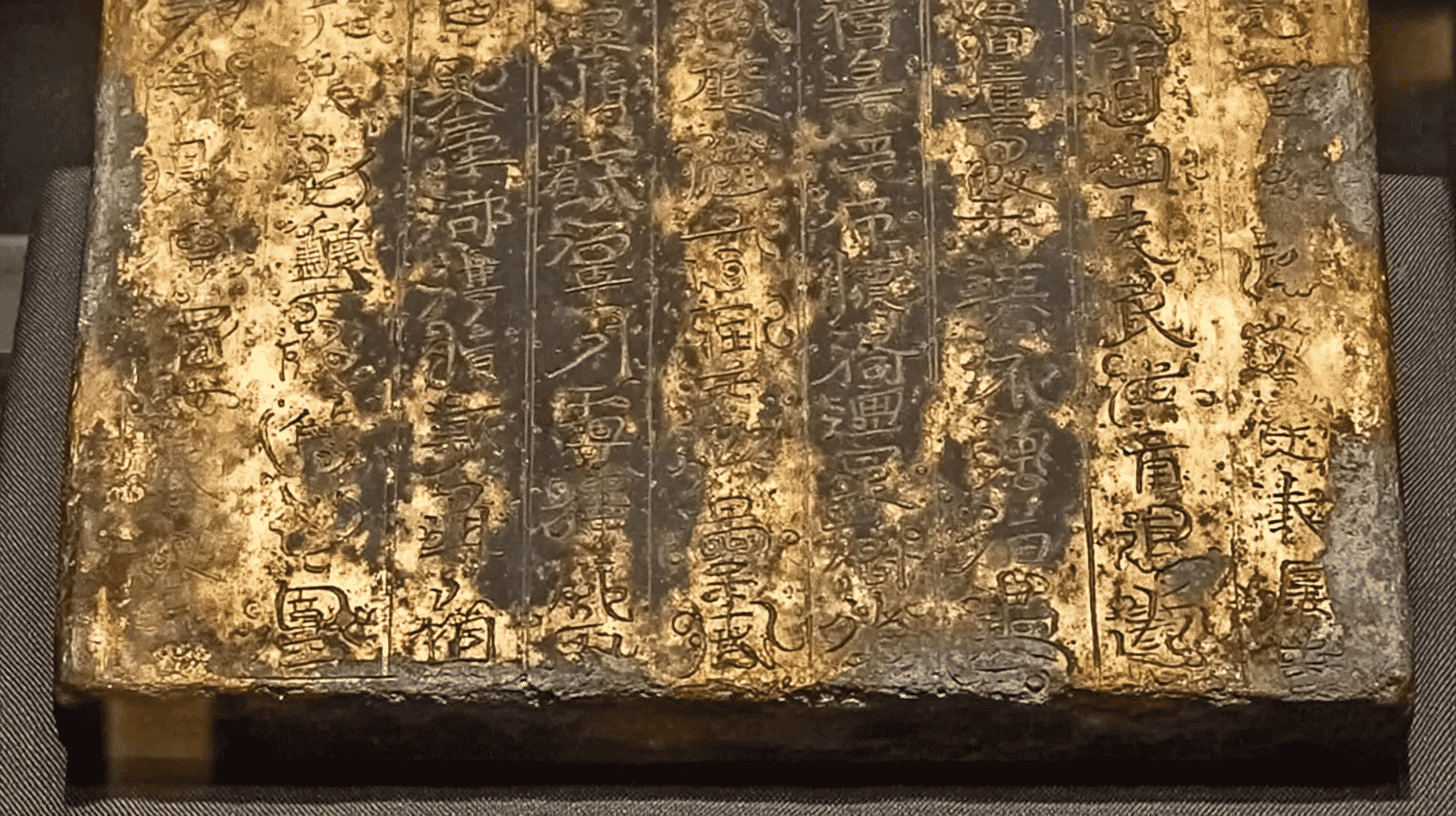
An Epitaph of 762, National Treasure since 1952
The Gilt-Bronze Epitaph of Ishikawa no Toshitari (金銅石川年足墓誌, Kondo Ishikawa Toshitari Boshi) is a Nara-period gilt bronze epitaph kept at the Osaka Museum of History, Otemae, Chuo Ward, Osaka City, designated a National Treasure in 1952, on 29 March. It had become an Important Cultural Property on 17 April 1911. The quantity is one plate, the category archaeological materials, and the designation number 00003.
The Agency for Cultural Affairs records the inscription and the find spot: bearing an inscription that the burial took place on the twenty-eighth day of the twelfth month of the sixth year of Tenpyo-hoji at the Sakatariyama grave in Shirakami district, Shimakami county, Settsu province; found at Magami, Takatsuki City, Osaka Prefecture. That year corresponds to 762, and both the year fields read 762.
The commentary is a single line: material of the Nara period. The low designation number, 00003, marks a very early entry among archaeological materials.
Lineage and Office in the Inscription
The inscription traces the lineage of the man buried back to its origin.
He is given as the tenth-generation descendant of Soga no Ishikawa no Sukune, son of Takenouchi no Sukune; the eldest son of Ishikawa no Iwatari of the third rank, controller of the left; and himself Toshitari, senior third rank, censor and concurrently head of the Bureau of Divinities. Founder, father and man are set out in three stages.
The year of death and the age reached are recorded. He died at his residence in the capital in the ninth month of that year, at seventy-five. The month of death and the month of burial are given separately: he died in the ninth month and was buried in the twelfth.
The place of burial is Sakatariyama in Shirakami district, Shimakami county, Settsu province. Magami in Takatsuki City, where the plate was found, is that place. The plate turned up at the very spot the inscription names.
The text closes with lines of mourning: a form to stand for a hundred generations, a canopy for a thousand years; the night chamber lies desolate, the pines and cypresses hold the mist; alas. Words of poetic lament follow the record of office.
Size and Material
According to the record of the replica held by the Tokyo National Museum, the original is gilt bronze, 29.6 centimetres high, 10.4 wide and 0.3 thick.
The proportion is roughly three to one, a narrow plate. At three millimetres thick it is closer to a sheet of metal than a board. The inscription is cut into this surface.
Gilt bronze is copper finished with gold plating. Characters are cut into copper and the surface gilded, so a material that resists decay carries a finish that also serves as ornament.
An epitaph is a plate recording a person's career and placed in the grave. The Copper Epitaph of Funashi Ogo of 668 is plain copper; this one is gilded. The same kind of object is finished differently.
A Replica Survives Separately
A replica of this epitaph exists and is held by the Tokyo National Museum.
The record of the replica carries the original's details alongside it: original found at Magami, Takatsuki City, Osaka Prefecture; original of the Nara period, the sixth year of Tenpyo-hoji, 762. The National Treasure is the original; the replica is not designated.
Searching Cultural Heritage Online for this epitaph can bring up the replica's record first. The original is at the Osaka Museum of History and the replica at the Tokyo National Museum, so tell them apart by location.
The replica's record transcribes the inscription in full and is more detailed than the record of the original. Which to consult depends on what is wanted.
Seeing It
The Osaka Museum of History keeps the epitaph. It is not necessarily on permanent display, and whether and when it is shown depends on the museum's programme.
Opening hours and admission may change, so check the museum's information before travelling. If the object itself is the purpose of the visit, confirm that it is on show.
Magami in Takatsuki City, where it was found, is in the same prefecture as the museum. Where the Copperplate Lotus Sutra and the Funashi Ogo epitaph are kept in prefectures away from their find spots, this one stays within Osaka.
The museum is about two minutes on foot from Tanimachi 4-chome Station on the Osaka Metro Tanimachi and Chuo lines.
Q&A
- When was the epitaph designated?
- It became an Important Cultural Property on 17 April 1911 and a National Treasure in 1952, on 29 March. It is listed as one plate in the category of archaeological materials under designation number 00003, dated to a year corresponding to 762.
- What does the inscription say?
- It gives him as the tenth-generation descendant of Soga no Ishikawa no Sukune, the eldest son of Ishikawa no Iwatari, and himself of senior third rank and head of the Bureau of Divinities. It records that he died at his residence in the capital in the ninth month at seventy-five and was buried in the twelfth at Sakatariyama in Settsu province.
- Where was it found?
- The Agency's note records it as found at Magami, Takatsuki City, Osaka Prefecture. That place is the Sakatariyama named as the burial site in the inscription, so the plate turned up at the very spot the text names.
- How large is it?
- According to the record of the replica at the Tokyo National Museum, the original is gilt bronze, 29.6 centimetres high, 10.4 wide and 0.3 thick. The proportion is roughly three to one, and at three millimetres it is closer to a sheet of metal than a board.
- There is a replica; how do the two differ?
- The Tokyo National Museum holds a replica, which is not designated; the National Treasure is the original. A search of Cultural Heritage Online can bring up the replica's record first, so tell them apart by location: original at the Osaka Museum of History, replica in Tokyo.
Basic Information
| Name | Gilt-Bronze Epitaph of Ishikawa no Toshitari (金銅石川年足墓誌, Kondo Ishikawa Toshitari Boshi) |
|---|---|
| Location | 4-1-32 Otemae, Chuo Ward, Osaka City, Osaka Prefecture (Osaka Museum of History) |
| Designation | National Treasure (archaeological materials), designation no. 00003 |
| Year Designated | 1911 (17 April), Important Cultural Property; 1952 (29 March), National Treasure |
| Quantity | 1 plate |
| Dimensions | Gilt bronze, 29.6 cm high, 10.4 cm wide, 0.3 cm thick (from the record of the replica at the Tokyo National Museum). The inscription records burial at the Sakatariyama grave in Shirakami district, Shimakami county, Settsu province. Found at Magami, Takatsuki City, Osaka Prefecture |
| Owner | Kept at the Osaka Museum of History |
| Public Access | Not necessarily on permanent display; whether and when it is shown depends on the museum's programme |
References
- Agency for Cultural Affairs, National Cultural Properties Database: the epitaph of Ishikawa no Toshitari
- https://kunishitei.bunka.go.jp/heritage/detail/201/835
- Cultural Heritage Online: replica of the epitaph of Ishikawa no Toshitari (Tokyo National Museum)
- https://bunka.nii.ac.jp/heritages/detail/496761
- Osaka Museum of History official site
- https://www.osakamushis.jp/
- Nara National Museum collection: the epitaph of Ishikawa no Toshitari
- https://www.narahaku.go.jp/collection/1191-0.html
Last verified: 2026.09.04