
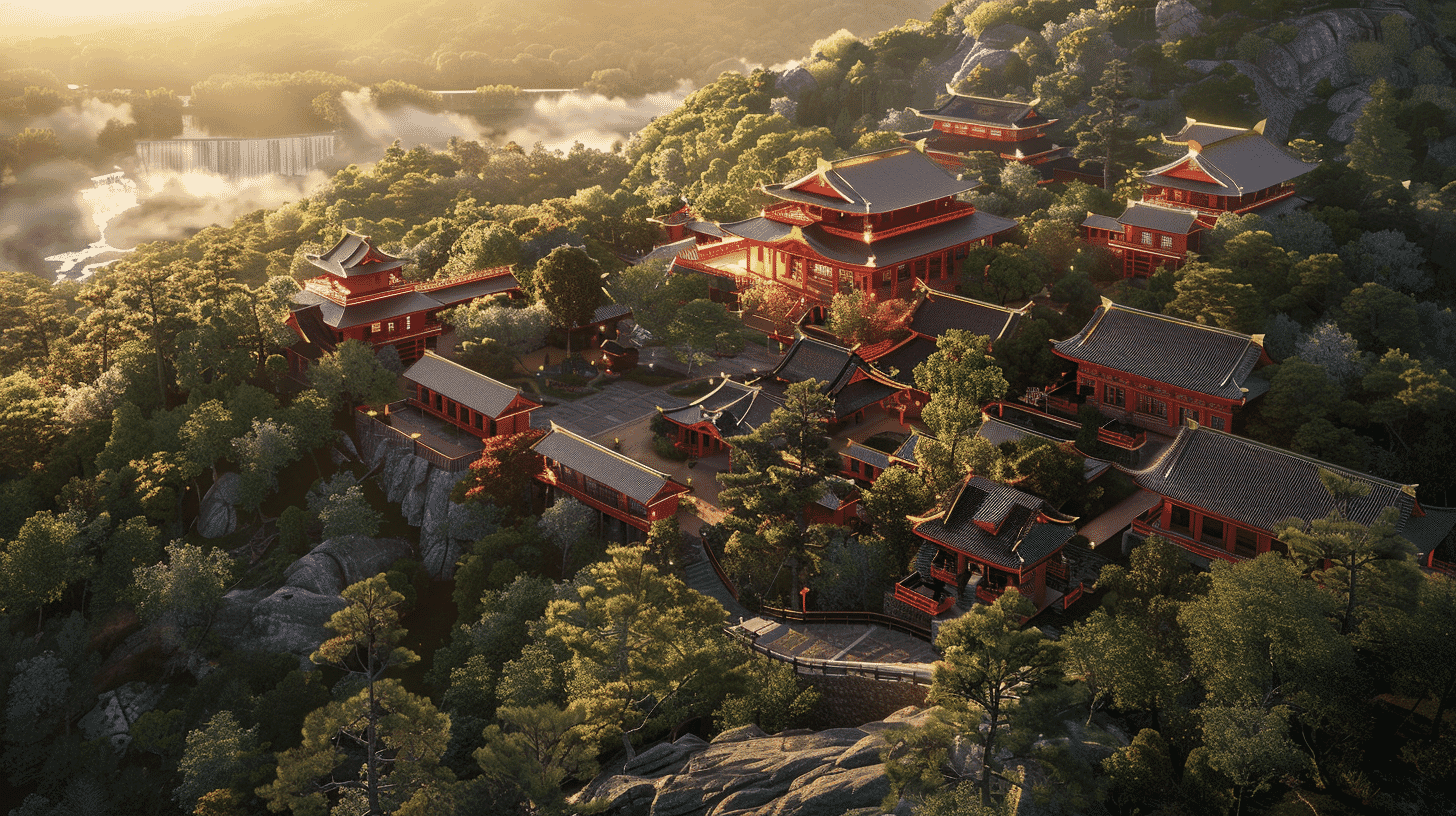
Ten National Treasures on the Summit of Otokoyama
Iwashimizu Hachiman Shrine Headquarters (石清水八幡宮本社, Iwashimizu Hachimangu Honsha) stands on the summit of Otokoyama at Yawatatakabo, Yawata City, Kyoto Prefecture, was built in 1634, and was designated a National Treasure on 9 February 2016. The quantity is ten buildings, with three ridge tablets registered as attached property.
The ten are the sanctuary, the inner fence, the offering hall with dance hall, the tower gate, the east gate, the west gate, three corridors (between the tower gate and the west gate, between the tower gate and the east gate, and at the rear) and the sanctuary of the auxiliary Takeuchi shrine.
Designation came in three stages. Eight buildings were listed as Important Cultural Properties on 28 December 1897; the inner fence and the Takeuchi sanctuary were added on 15 June 1967; and in 2016 all ten were raised together to National Treasure status. The precinct itself became a National Historic Site in 2012.
Otokoyama overlooks the point where the Katsura, Uji and Kizu rivers meet. It lies southwest of the old capital, the direction traditionally guarded against, paired with Enryakuji on the northeast.
Hachiman-zukuri: Why the Roofline Reads as an M
The designation turns on the form of the sanctuary. Hachiman-zukuri sets two gabled buildings, an inner and an outer hall, one behind the other and unites them. Seen from the side, the two roofs stand with a valley between them and the outline draws an M.
The sanctuary here runs about forty metres along the front. As a hachiman-zukuri sanctuary it is the oldest and the largest surviving. That alone fixes its place in architectural history, but the citation goes further.
Around the long sanctuary, the offering hall, dance hall and tower gate are enclosed by the inner fence and the corridors, and the whole is bound into a single tightly integrated space. The judgement describes a shrine of high resolution that keeps a solemn building form established in antiquity while carrying the full polychrome ornament of the early modern period.
A gutter runs in the valley between the inner and outer roofs, a member the form structurally requires. The gilded copper gutter said to have been given by Oda Nobunaga in 1580 is still in place after more than 440 years.
Why the Ten Count as One
The sanctuary alone is the oldest and largest hachiman-zukuri standing. A corridor alone is a long covered walk. Only with ten in view does the enclosed ritual space appear as one thing.
Pass the tower gate and the offering hall with dance hall stands ahead, with the sanctuary behind it. That axis is ringed by the inner fence from within and by three corridors from without. The east and west gates open at either side of the corridors, and the Takeuchi sanctuary stands close beside the main one. Where worshippers may stand, where the deity is seated and what divides the two are all settled by the arrangement of buildings.
The sequence of designations shows understanding deepening. Eight buildings in 1897, the inner fence and the Takeuchi sanctuary in 1967, all ten as National Treasures in 2016. The inner fence is a screen wall around the sanctuary and would be hard to call a building on its own. That it was added and finally raised to the same rank as the sanctuary means the act of enclosing became part of what was valued.
The building history runs as one campaign too. Oda Nobunaga repaired the halls in 1580, Toyotomi Hideyori restored the precinct in the Keicho era, and in 1634 the third shogun Tokugawa Iemitsu ordered the rebuilding that produced the present group. All ten belong to that Kan'ei campaign.
Looking for the Carvings
Colour is the first thing. Because the Hachiman deity came originally from Usa in Kyushu as a god of the sea, the halls are said to have been painted to recall the dragon palace beneath the waves. Repainting carried out over about eight years from 2004 has restored the colours of the original campaign.
Frog-leg struts and outer walls carry carvings of plants and animals. The elephant on the west side of the sanctuary was cut by an Edo craftsman working from written descriptions rather than a living animal, and it has paw pads like a cat. Squirrels among grapes stand for the increase of descendants, the squirrel's tail exaggerated because it was believed to cover its body when full. Deer leap among maples. These reward going close and reading them one at a time.
High on the west corridor, half hidden, is a carved monkey attributed to Hidari Jingoro. Known as the monkey with the nail, it is said to have slipped out at night to raid fields at the foot of the hill until a nail was driven into its right eye to hold it still. Look carefully and the mark can still be found.
A monument to Thomas Edison also stands in the precinct. In 1880 an assistant of Edison's collected bamboo from Otokoyama while searching for a filament material, and the bamboo is said to have burned for over a thousand hours. Ceremonies are held each year on Edison's birthday and the anniversary of his death.
Look up at the plaque on the first torii and the first character of Hachimangu is written as two doves facing each other, after the calligraphy of the early Edo shrine-priest Shokado Shojo. The dove is the messenger of the Hachiman deity, and the motif recurs throughout the precinct.
Visiting, and Getting Close to the Halls
Entering the precinct is free. Gates open from 5:30 a.m. to 6:30 p.m. between April and September, 6:00 a.m. to 6:00 p.m. in October, and 6:30 a.m. to 6:00 p.m. from November to March.
The front of the group and its colour can be seen from outside the tower gate. To go inside the inner fence and approach the sanctuary requires the shoden sanpai, the formal inner visit. It runs twice daily at 11:00 a.m. and 2:00 p.m. from 4 February to 31 December and takes about thirty minutes. The offering is 1,000 yen for high school students and above and 500 yen for primary and junior high school students. This is the way to see the elephant and the squirrels at close range. Follow the guidance given on the day regarding photography.
The Iwashimizu festival on 15 September is one of the three great imperial festivals of Japan, with the Kamo and Kasuga festivals. Rites begin in the sanctuary at 2:00 a.m., and some five hundred participants carry three portable shrines down from the summit to the lower shrine by torch and lantern light. The precinct is a different place that day.
From Iwashimizu-Hachimangu Station on the Keihan Main Line, the cable car takes about three minutes and the walk from the upper station about five. On foot the climb up the approach takes around thirty minutes.
- 📍 Plan Your Visit to Kyoto
- Find tours, activities & transport passes near Iwashimizu Hachiman Shrine Headquarters
- [ Kinkakuji Fushimi Inari & Kimono Rental ]
Q&A
- Which ten buildings of the Iwashimizu Hachiman Shrine Headquarters are National Treasures?
- The sanctuary, the inner fence, the offering hall with dance hall, the tower gate, the east gate, the west gate, three corridors and the sanctuary of the auxiliary Takeuchi shrine. They were designated on 9 February 2016 together with three ridge tablets as attached property, and all belong to the rebuilding of 1634.
- What is hachiman-zukuri?
- A form that sets two gabled buildings, an inner and an outer hall, one behind the other and unites them, so that from the side the two roofs read as an M with a valley between. The sanctuary at Iwashimizu runs about forty metres along the front and is the oldest and largest surviving example of the form.
- Why are the ten buildings registered as one item?
- Because they form one enclosed ritual space. The tower gate, offering hall and sanctuary make an axis ringed by the inner fence from within and three corridors from without, with the side gates and the Takeuchi sanctuary set among them. The arrangement itself settles where worshippers stand and what divides them from the deity.
- When was the Iwashimizu Hachiman Shrine Headquarters designated?
- In three stages. Eight buildings became Important Cultural Properties on 28 December 1897; the inner fence and the Takeuchi sanctuary were added on 15 June 1967; and all ten were raised to National Treasure status on 9 February 2016. The precinct became a National Historic Site in 2012.
- Can the sanctuary of the Iwashimizu Hachiman Shrine Headquarters be seen close up?
- Yes, through the formal inner visit, held at 11:00 a.m. and 2:00 p.m. from 4 February to 31 December and lasting about thirty minutes. The offering is 1,000 yen for high school students and above, 500 yen for younger students. Entering the precinct is free, and the front of the group can be seen from outside the tower gate.
Basic Information
| Name | Iwashimizu Hachiman Shrine Headquarters (石清水八幡宮本社, Iwashimizu Hachimangu Honsha) |
|---|---|
| Location | 30 Yawatatakabo, Yawata City, Kyoto Prefecture (summit of Otokoyama) |
| Designation | National Treasure (structure); the precinct is a National Historic Site |
| Year Designated | 9 February 2016 as National Treasures; 28 December 1897 for eight buildings as Important Cultural Properties; 15 June 1967 for the inner fence and Takeuchi sanctuary; 2012 for the precinct as a Historic Site |
| Quantity | 10 buildings (sanctuary, inner fence, offering hall with dance hall, tower gate, east gate, west gate, three corridors, Takeuchi sanctuary); 3 ridge tablets as attached property |
| Dimensions | Sanctuary: hachiman-zukuri, an inner and an outer gabled hall set one behind the other and united, about 40 m along the front. All built in 1634 |
| Owner | Iwashimizu Hachimangu |
| Public Access | Precinct free. Gates 5:30 a.m. to 6:30 p.m. April to September, 6:00 a.m. to 6:00 p.m. October, 6:30 a.m. to 6:00 p.m. November to March. Inner visit at 11:00 a.m. and 2:00 p.m., 4 February to 31 December, about 30 minutes, 1,000 yen for high school students and above, 500 yen for younger students |
References
- Cultural Heritage Online: Iwashimizu Hachimangu main shrine
- https://bunka.nii.ac.jp/heritages/detail/200919
- Yawata City: the main shrine of Iwashimizu Hachimangu designated a National Treasure
- https://www.city.yawata.kyoto.jp/0000000457.html
- Yawata City: Yawata Story, Iwashimizu Hachimangu
- https://www.city.yawata.kyoto.jp/yawata-story/introduction/introduction003.html
- Kyoto Prefecture, Yamashiro Regional Bureau: cultural properties of Yamashiro
- https://www.pref.kyoto.jp/kyotoyamashiro/treasure_8.html
- Iwashimizu Hachimangu official site
- https://iwashimizu.or.jp/
- Iwashimizu Hachimangu: about the shrine
- https://iwashimizu.or.jp/about/
Last verified: 2026.08.31
Cultural Treasures in the Same Area
All are within walking distance in the same area, so we recommend visiting them together.
- Iwashimizu Hachiman Shrine Headquarters Tower gate 0.00 km
- Iwashimizu Hachiman Shrine Headquarters Heiden and Maiden 0.01 km
- Iwashimizu Hachiman Shrine Headquarters Corridor (between the Tower Gate and the West Gate) 0.02 km
- Iwashimizu Hachiman Shrine Headquarters Corridor (between the Tower Gate and East Gate) 0.02 km
- Iwashimizu Hachiman Shrine Headquarters west gate 0.03 km
- Iwashimizu Hachiman Shrine Headquarters east gate 0.03 km
- Iwashimizu Hachiman Shrine Headquarters Main shrine 0.03 km
- Iwashimizu Hachiman Shrine Headquarters Corridor (back) 0.04 km
- Iwashimizu Hachiman Shrine Headquarters Zuirong 0.08 km
- Iwashimizu Hachiman Shrine Headquarters Main hall of the auxiliary shrine, Takeuchi Shrine 0.08 km