
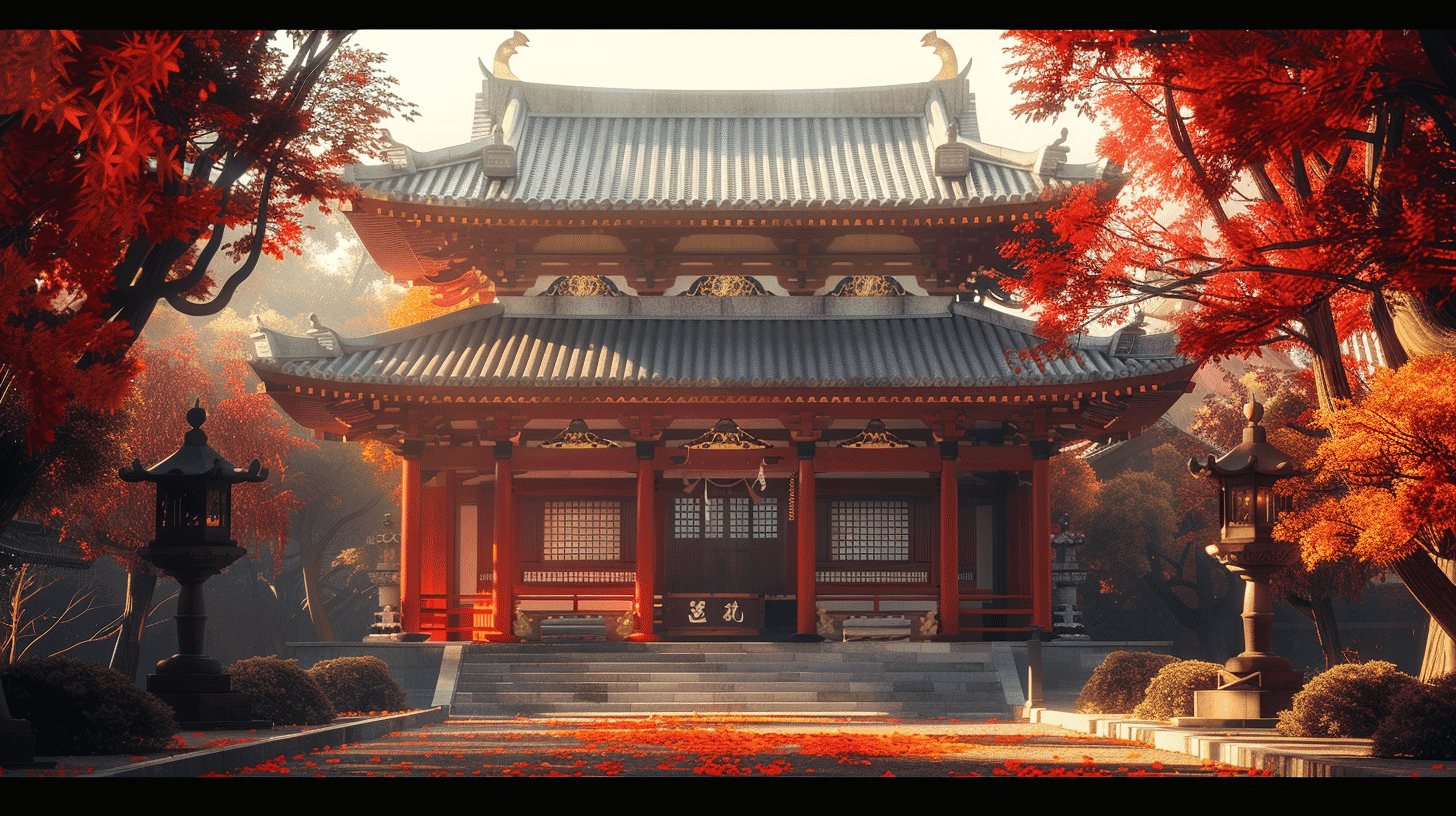
A Blend of Three Styles in One Hall
The Kanshinji Temple Golden Hall (観心寺金堂) is an Esoteric Buddhist main hall of the early Muromachi period in Teramoto, Kawachinagano City, Osaka Prefecture, and was designated a National Treasure on March 29, 1952 (Agency for Cultural Affairs).
The Agency records seven bays by seven, single-storey, hip-and-gable with a three-bay porch, roofed in full tiles, designated together with one ridge tag; designation number 00054.
The Agency record also gives an earlier designation date of December 28, 1897, the date of its designation under the former law.
Rebuilt before 1378
The Agency's commentary says Kanshinji is traditionally held to have been founded in the 820s or early 830s by Jichie, a disciple of Kukai, and that the present Golden Hall was rebuilt before 1378 and belongs to the early Muromachi period. It was repaired again and again, from 1439 to 1728.
According to the temple, after the Kenmu Restoration, around 1334, Emperor Go-Daigo ordered the outer sanctuary of the Golden Hall built with Kusunoki Masashige in charge, and the present hall resulted. A major Showa-era restoration was completed in 1984.
Why It Is a National Treasure
The Agency notes that the hall is basically in the Japanese style, with Japanese-style three-block bracketing, but takes in features of the Zen and Great Buddha styles throughout: paired blocks between the brackets, stone bases under the porch columns, bottle-shaped struts and curved beams inside. It is important as a leading example of the so-called eclectic style.
A Firmly Divided Sanctuary
The hall is seven bays square with a three-bay porch at the front, and inside it is divided into inner and outer sanctuaries (Agency for Cultural Affairs). The divide is marked by diamond-lattice transoms and sliding lattice doors, and board walls painted with the mandalas of the Two Worlds stand on either side before the altar. So strict a separation is typical of the main halls of Esoteric Buddhism.
What to Look For
Look for the bracketing that mixes the three styles, and the mandala-painted board walls in the sanctuary (Agency for Cultural Affairs). The temple says its principal image, a seated Nyoirin Kannon that is also a National Treasure, is a hidden image shown each year on April 17 and 18.
Visiting
It is owned by Kanshinji Temple (Agency for Cultural Affairs). The five buildings, visiting and access are covered on the Kanshinji Temple page. According to the temple, it is open from 9:00 to 17:00 (last entry 16:30), and admission is 300 yen for adults. On April 17 and 18, when the principal image is shown (10:00-16:00), a special fee of 1,000 yen applies.
Q&A
- When was the Golden Hall built?
- It was rebuilt before 1378, in the early Muromachi period (Agency for Cultural Affairs).
- What is distinctive about its style?
- It blends the Japanese, Zen and Great Buddha styles, a leading eclectic-style hall.
- What is the interior like?
- Inner and outer sanctuaries are strictly divided, as in Esoteric halls.
- What is its link with Kusunoki Masashige?
- The temple says Emperor Go-Daigo put him in charge of building the outer sanctuary.
- When was the Kanshinji Temple Golden Hall designated a National Treasure?
- On March 29, 1952 (Agency for Cultural Affairs).
Basic Information
| Name | Kanshinji Temple Golden Hall (観心寺金堂) |
|---|---|
| Location | Teramoto, Kawachinagano City, Osaka Prefecture |
| Designation | National Treasure (Structure) |
| Year Designated | Designated National Treasure 1952/03/29 (Showa 27) |
| Quantity | 1 building (with 1 ridge tag) |
| Dimensions | 7 × 7 bays, single storey, hip-and-gable, 3-bay porch, full-tile roof |
| Owner | Kanshinji Temple |
| Public Access | Open 9:00-17:00, adults 300 yen (Kanshinji) |
References
- Kanshinji Temple Golden Hall (Database of National Cultural Properties, Agency for Cultural Affairs)
- https://kunishitei.bunka.go.jp/heritage/detail/102/2185
- Visiting information (Kanshinji official site, Japanese)
- https://www.kanshinji.com/haikan.html
- About Kanshinji (Kanshinji official site, Japanese)
- https://www.kanshinji.com/rekisi.html
Last verified: 2026.10.21
