
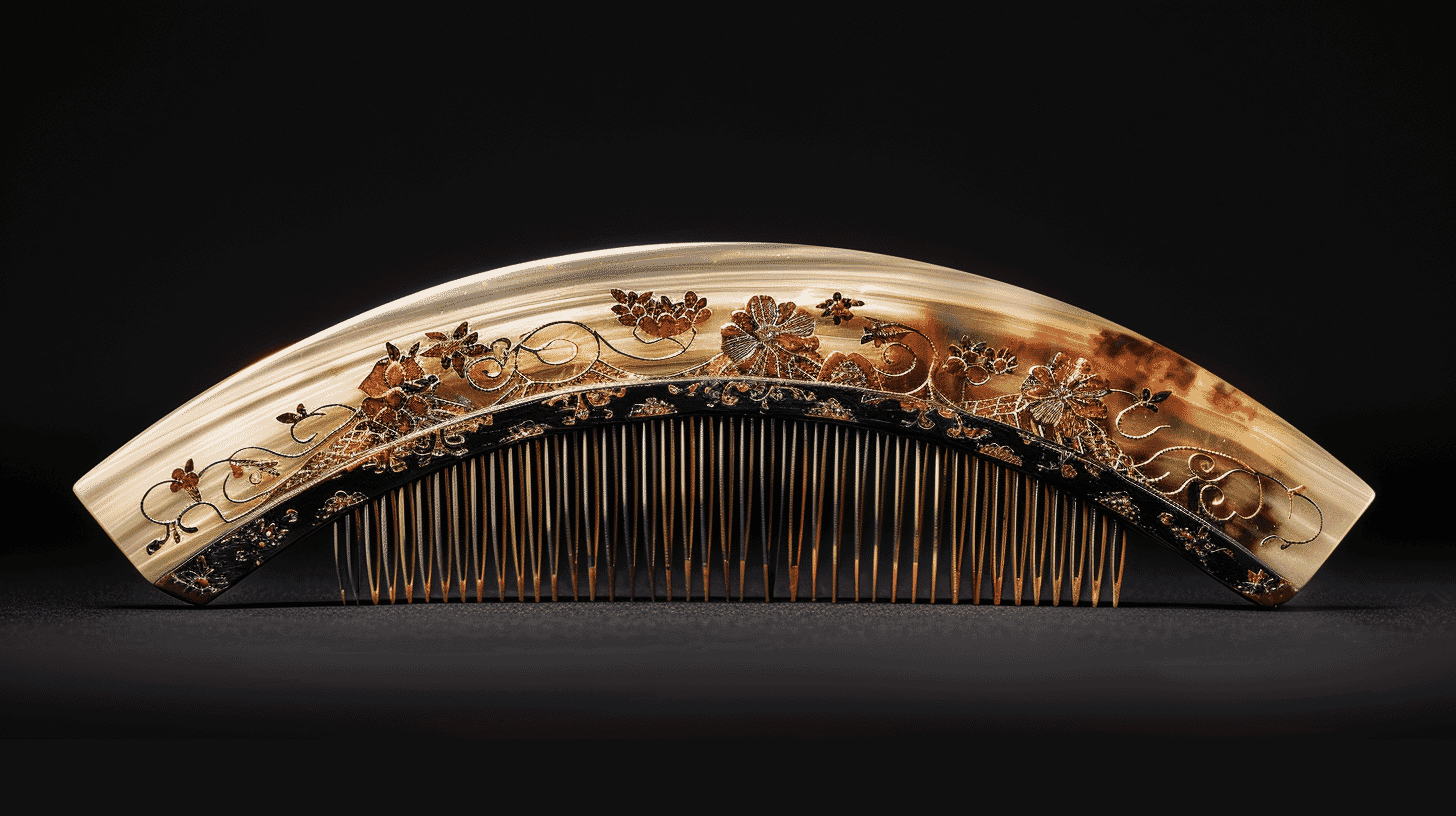
One Comb, National Treasure since 1953
Ivory Comb with Tortoiseshell Mounts (玳瑁装牙櫛, Taimai-so Ge no Kushi) is a Heian-period craft object owned by Domyoji Tenmangu in Osaka Prefecture, made an Important Cultural Property on 9 June 1951 and designated a National Treasure on 31 March 1953. The quantity is one comb.
The measure word is the one used for flat things, appearing here for the first time among the words for buildings, figures, blades, scrolls, boxes, towers, pieces, suits, hangings and mirrors met so far.
It measures 10.1 centimetres wide and 6.0 centimetres high. The address field in the Agency's database is blank, the thirteenth such case.
Colour Laid Beneath the Shell and Seen Through It
The order of the decoration is inverted.
The Agency records that tortoiseshell is inlaid into the flowers along the upper band, with red and green colouring laid beneath it and showing through.
Tortoiseshell comes from the shell of a sea turtle and is translucent.
Red and green were placed underneath, the shell laid over them, and the colour shows through. What the eye sees lies not on top but below.
With the Hosoge sutra box, the pattern reached the underside of the lid. With the Tsurugaoka inkstone box, lacquer reached the floor beneath a tray. Both extend decoration into places hard to see.
Here colour was placed where it cannot be seen directly and is shown through a covering. It is hidden and displayed at once.
Five Materials, One of Them Falling Away
A small comb holds several materials.
The body is ivory. Tortoiseshell is inlaid along the upper band and the crest, and the tendrils are inlaid in fine copper wire.
Bead patterns are drawn in black lacquer mixed with gold filings. Further beads were added with dyed horn.
Ivory, tortoiseshell, copper, gold and dyed horn: five, used across a width of 10.1 centimetres.
With the Hosoge sutra box, gold and silver divided by part. With the plover chest, gold and green gold divided within one metal.
Here five distinct materials appear, and the record closes on the note that parts have now fallen away. One of the five is being lost.
Both Listings Fall on the Same Days as the Knife
An object of the same provenance shares both dates exactly.
This comb became an Important Cultural Property on 9 June 1951 and a National Treasure on 31 March 1953. The rhinoceros-horn knife carries those same two dates.
Both belong to Domyoji Tenmangu, and both records share the commentary written for six objects together.
The red-laced and white-laced armours also shared both dates. Those are two suits at one shrine.
The Senjuji Nyorai hall and founder's hall shared both dates too. Those are two buildings at one temple.
This comb and the knife are two of a group handed down as one man's belongings. The grouping shows in the dates of designation.
Seeing It
The comb belongs to Domyoji Tenmangu. The field for prefecture gives Osaka and the address field is blank.
The form is recorded: a rounded profile, narrow in width, with the end teeth made thicker.
Provenance comes in the text shared by the six objects: after the death of Sugawara no Michizane they are said to have passed to Kakuju-ni, abbess of the family temple Hajidera, and to have come down to the shrine that succeeded it.
That text adds that of the six objects some were carried over from Tang China and some made in Japan, and that all preserve the manner of the Tang period, of which few examples remain.
Related entries are a mirror, an ivory sceptre and the rhinoceros-horn knife, all from the same group. It is a shrine holding, not kept on permanent display. Check before travelling.
Q&A
- When was the comb designated?
- It became an Important Cultural Property on 9 June 1951 and a National Treasure on 31 March 1953. The rhinoceros-horn knife of the same provenance carries both of those dates.
- What is tortoiseshell here?
- Material from the shell of a sea turtle, which is translucent. On this comb, red and green colouring was laid beneath it and shows through from below.
- What materials were used?
- Five: ivory for the body, tortoiseshell inlaid, fine copper wire for the tendrils, black lacquer mixed with gold filings for the beads, and dyed horn for further beads.
- Is anything missing?
- Yes. Of the beads added in dyed horn, the Agency notes that parts have now fallen away. One of the five materials is being lost.
- How did it come down?
- The Agency records that after the death of Sugawara no Michizane the objects passed to Kakuju-ni, abbess of the family temple Hajidera, and came down to the shrine that succeeded it.
Basic Information
| Name | Ivory Comb with Tortoiseshell Mounts (玳瑁装牙櫛, Taimai-so Ge no Kushi); six objects of one provenance share a commentary |
|---|---|
| Location | The field for prefecture gives Osaka; the address field is blank and the owner is given as Domyoji Tenmangu |
| Designation | National Treasure (craft) |
| Year Designated | 1951 (9 June), Important Cultural Property; 1953 (31 March), National Treasure |
| Quantity | 1 comb |
| Dimensions | 10.1 centimetres wide and 6.0 centimetres high. The body is ivory, rounded in profile, narrow in width, with the end teeth made thicker. Tortoiseshell is inlaid along the upper band and the crest, with red and green colouring beneath it showing through. The tendrils are in fine copper wire and the beads in black lacquer with gold filings and in dyed horn. The period is Heian |
| Owner | Domyoji Tenmangu |
| Public Access | A shrine holding, not on permanent display |
References
- Cultural Heritage Online: the ivory comb with tortoiseshell
- https://bunka.nii.ac.jp/db/heritages/detail/197440
- Fujiidera City: nationally designated cultural properties
- https://www.city.fujiidera.lg.jp/soshiki/kyoikuiinkai/bunkazaihogo/fuziiderasinositeibunnkazai/kunifusiteibunkazai/1387694428536.html
- Domyoji Tenmangu official site
- https://www.domyojitenmangu.com/
- Agency for Cultural Affairs, National Cultural Properties Database
- https://kunishitei.bunka.go.jp/
Last verified: 2026.09.06