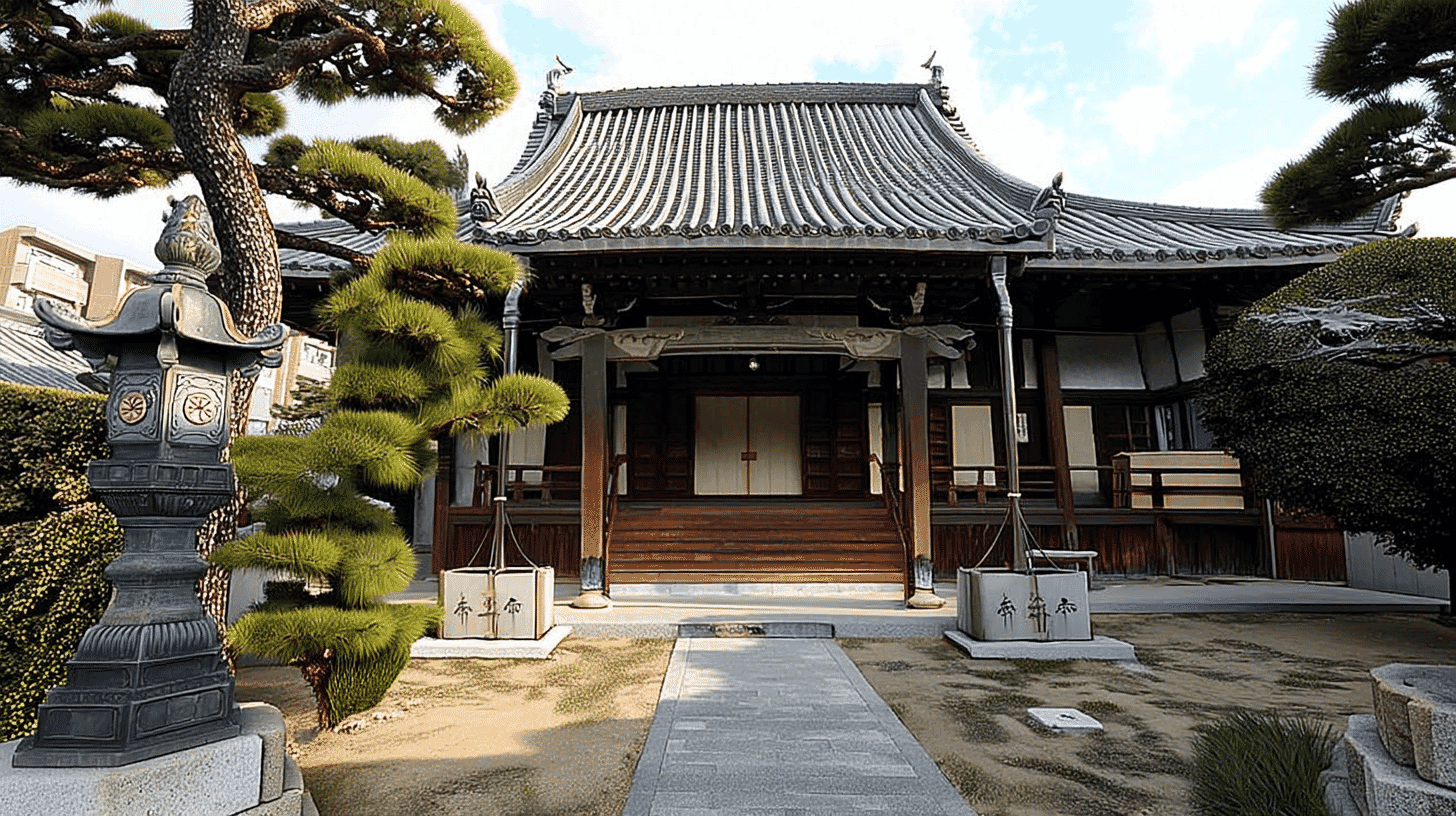
Raigo-ji Temple Main Hall: Discover an Edo-Period Buddhist Sanctuary in Osaka's Historic Tannan District

Explore Raigo-ji Temple's 1732 main hall in Matsubara City, Osaka. This hidden gem of the Yuzu Nembutsu sect features Edo-period architecture, a 500-year-old sacred tree, and connections to samurai lords and Japanese royalty. A perfect off-the-beaten-path destination for cultural travelers.

Raigo-ji Temple Main Hall: A Hidden Treasure of Edo-Period Buddhist Architecture

Nestled in the historic Tannan district of Matsubara City, Osaka Prefecture, Raigo-ji Temple stands as a remarkable testament to Japan's rich Buddhist heritage. While millions of visitors flock to famous temples in Kyoto and Nara, this serene sanctuary offers an equally profound cultural experience without the crowds. The temple's main hall, rebuilt in 1732, represents one of the finest surviving examples of Edo-period religious architecture in the Kawachi region.

What makes Raigo-ji particularly special is its connection to Japan's first indigenous Buddhist sect, the Yuzu Nembutsu sect, and its fascinating ties to both samurai lords and the modern Japanese Imperial family. For travelers seeking authentic cultural experiences beyond typical tourist destinations, Raigo-ji offers an unforgettable journey into Japan's spiritual and historical past.

The Yuzu Nembutsu Sect: Japan's First Homegrown Buddhist School

To fully appreciate Raigo-ji Temple, one must understand the remarkable Buddhist tradition it represents. The Yuzu Nembutsu sect holds a unique place in Japanese religious history as the first Buddhist school to originate entirely within Japan. While earlier Buddhist traditions such as Tendai and Shingon were imported from China, Yuzu Nembutsu emerged from the spiritual insights of a Japanese monk named Ryonin in 1117.

Ryonin taught that the merit of one person's nembutsu (recitation of Amitabha Buddha's name) could be shared with all beings, and conversely, everyone's collective nembutsu would benefit each individual. This concept of "mutual interpenetration" (yuzu) of spiritual practice was revolutionary and later influenced the development of other Pure Land schools, including Jodo-shu and Jodo Shinshu.

Raigo-ji serves as one of the six important branch headquarters (Rokubetsuji) of the Yuzu Nembutsu sect, making it a significant pilgrimage destination for adherents of this tradition. The temple's formal name, Shobutsuzan Gonenin Raigo-ji, reflects its prestigious status within the sect's hierarchical structure.

Historical Journey: From Medieval Origins to Edo Reconstruction

The history of Raigo-ji is a compelling narrative of destruction, resilience, and revival. According to historical records, the temple was originally known as Amida-ji and was founded in 1131 when the sect's founder Ryonin established a hall to enshrine Amitabha Buddha in the Tannan area. The temple received its current name in 1324 when Hōmyō, the seventh abbot of Dainenbutsuji (the sect's head temple), revived the Yuzu Nembutsu movement after a 139-year period of decline.

The temple faced numerous challenges throughout its history, reportedly being destroyed by fire an astonishing 26 times before settling in its present location. The most devastating destruction came during the Summer Siege of Osaka in 1615, when the forces of Sanada Yukimura—the legendary samurai warrior—burned the entire Tannan region to the ground. Following this devastation, Raigo-ji was rebuilt under the patronage of the newly appointed domain lord.

The current main hall was reconstructed in 1732 (Kyoho 17) during the tenure of the temple's tenth abbot, Taijun. This magnificent structure has survived for nearly 300 years and stands today as a precious example of mid-Edo period religious architecture.

Architectural Features: The Main Hall's Elegant Design

The main hall of Raigo-ji exemplifies the refined architectural sensibilities of the Edo period. Built in the irimoya-zukuri style (a hip-and-gable roof design), the structure features a magnificent main tile roof (hongawarabuki) that gives the building its distinctive silhouette against the Osaka sky.

The hall measures approximately 17.03 meters in width (between pillars) and 16.99 meters in depth, creating an almost perfectly square footprint that is characteristic of Buddhist main halls. The central worship space is surrounded by a one-ken (approximately 1.8 meter) wide veranda with protective eaves (engawa) that encircles the entire structure, allowing visitors to walk around the building while remaining sheltered from the elements.

Inside, the hall is divided into distinct functional zones. The front three bays serve as the outer sanctuary (gejin), where lay worshippers can gather for services and ceremonies. The inner sanctuary (naijin) at the rear houses the main altar and sacred images, creating a gradual progression from the secular world to the sacred realm—a spatial arrangement deeply rooted in Japanese Buddhist architectural tradition.

The Tannan Domain Lords: Samurai Patrons and Imperial Connections

One of Raigo-ji's most fascinating aspects is its connection to the Takagi family, who served as lords of the Tannan Domain (worth 10,000 koku) from 1623 until the Meiji Restoration in 1871. When Takagi Masatsugu received his domain in the Kawachi region, he designated Raigo-ji as his family's ancestral temple (bodaiji), beginning a relationship that would span over 250 years.

Within the temple grounds, visitors can still see the five-ring pagoda (gorintō) grave markers of Masatsugu, the first lord, and Masamasa, the eleventh lord. A stone monument bearing the inscription "Former Tannan Domain Lord Takagi Mondō-no-shō Jinya Site," erected in 1937 by Viscount Takagi Masaetsu (the fourteenth-generation head of the family), stands before the temple's main gate.

The temple's connection to Japanese royalty came through Princess Yuriko, wife of Prince Mikasa (the younger brother of Emperor Showa). Born as the second daughter of Viscount Takagi Masaetsu, she married into the Imperial family in 1941. In 1990, Princess Yuriko visited Raigo-ji to pay respects at her ancestors' graves, adding another distinguished chapter to the temple's illustrious history.

The Sacred Ibuki Tree: A 500-Year Living Monument

In the guest hall garden stands one of Raigo-ji's most impressive natural treasures: a magnificent juniper tree (Ibuki) estimated to be over 500 years old. Designated as an Osaka Prefecture Natural Monument in 1981, this venerable tree measures 15 meters in height, with a trunk diameter of 1.27 meters and a circumference of 4.1 meters. Its branches spread an impressive 12 meters wide.

The Ibuki (also known as Byakushin) is a conifer of the cypress family, native to Japan, Korea, and China. While these trees typically remain small, the specimen at Raigo-ji has grown to exceptional proportions. As is characteristic of ancient Ibuki trees, its trunk has developed a distinctive twisted pattern—a natural phenomenon that occurs as these trees mature over centuries.

According to historical records, this tree has witnessed the temple's entire history since the Kamakura period revival in 1324. Standing silently through fires, wars, and rebuilding, the Ibuki serves as a living connection to the centuries of spiritual practice and human stories that have unfolded within these temple grounds.

Temple Treasures: Art and Artifacts Spanning Centuries

Beyond its architectural significance, Raigo-ji houses an impressive collection of cultural artifacts that illuminate various aspects of Japanese religious and artistic history. Among the most notable is the Yuzu Nembutsu Engi Emaki, a picture scroll dating to 1502 that depicts the origins and spread of the Yuzu Nembutsu tradition. Created under the direction of the Shingon monk Gyōkei, this scroll represents an important document for understanding medieval Japanese Buddhist art and religious history.

The temple also preserves a wooden standing statue of Amitabha Buddha dating to the mid-Heian period (10th century), which was designated as a Matsubara City Cultural Property in 2022. Originally enshrined at Saifukuji Temple in the Mihara district of Sakai City, this statue was transferred to Raigo-ji when its original temple was closed. The statue's artistic style and physical characteristics suggest it may have originally depicted Yakushi Nyorai (the Medicine Buddha) before being reinterpreted as Amitabha.

Other treasures include items connected to the Takagi lords, relics reportedly captured from the Sanada clan during the Summer Siege of Osaka, and an extensive archive of historical documents that provide invaluable insights into the organization and practices of Yuzu Nembutsu temples during the Edo period.

The Tannan Archaeological Site: Ancient Layers Beneath the Temple

The temple grounds occupy a corner of the Tannan Archaeological Site, one of the most significant multi-period sites in southern Osaka. Archaeological excavations have revealed continuous human activity in this area spanning from the Jomon period (prehistoric Japan) through the Edo period, a remarkable sequence covering thousands of years.

Particularly noteworthy are the remains of large-scale government administrative buildings (kanga) from the Asuka and Nara periods (7th-8th centuries), suggesting that this area once served as an important regional center. Excavations have also uncovered evidence of Kawachi imoji (metal casters), who were renowned throughout medieval Japan for their bronze casting skills. The Tannan area was historically located at the intersection of the ancient Takeuchi Kaido road and the Nakakoya Kaido, making it a crossroads of commerce and culture.

Exploring the Surroundings: Nearby Attractions

A visit to Raigo-ji can be combined with exploration of several other significant cultural sites in the area. The Takeuchi Kaido, one of Japan's oldest official roads dating to the 7th century, passes nearby and has been designated as a Japan Heritage site. This ancient route connected the capital at Naniwa (modern-day Osaka) with Asuka, the political center of ancient Japan.

For those interested in the Yuzu Nembutsu tradition, the sect's head temple, Dainenbutsuji, is located approximately 7 kilometers north in Osaka's Hirano district. Founded in 1127, Dainenbutsuji offers a wealth of religious art and hosts the spectacular Manbu Oneri ceremony each May, featuring costumed bodhisattvas in a dramatic recreation of Amitabha's welcoming descent from paradise.

History enthusiasts might also visit the nearby Kurohime-yama Kofun in Sakai City's Mihara district, a keyhole-shaped burial mound from the 5th century that offers insights into the era of Japan's great tomb builders.

Planning Your Visit: Practical Information

Raigo-ji welcomes visitors throughout the year, though the temple maintains the contemplative atmosphere of an active religious institution. The grounds are particularly beautiful in spring when cherry blossoms bloom, and in autumn when the surrounding trees display their fall colors.

As with many traditional Japanese temples, visitors are expected to observe proper etiquette: remove shoes when entering buildings, maintain a respectful silence, and refrain from photography in areas where it is prohibited. The temple's caretakers are generally happy to share information about the temple's history and treasures with interested visitors.

For those seeking to understand a less-visited but historically significant aspect of Japanese Buddhism, Raigo-ji offers an authentic and enriching experience. The temple embodies the enduring spirit of Japanese religious practice—surviving through centuries of change while continuing to serve as a living center of faith and community.

📍 Plan Your Visit to Osaka
Find tours, activities & transport passes near Raigoji Temple Main Hall
[ USJ Tickets Osaka Castle & Dotonbori Food Tours ]

Q&A

QWhat Buddhist sect does Raigo-ji Temple belong to?
ARaigo-ji belongs to the Yuzu Nembutsu sect, Japan's first indigenous Buddhist school founded in 1117. The temple serves as one of the six important branch headquarters (Rokubetsuji) of this tradition, which emphasizes the mutual sharing of spiritual merit through nembutsu recitation.
QHow can I reach Raigo-ji Temple by public transportation?
AFrom Kintetsu Minami-Osaka Line's Kawachi-Matsubara Station, you can take a Kintetsu Bus and get off at the "Oka" stop, then walk approximately 5 minutes southwest. Alternatively, the temple is about a 30-minute walk from Kawachi-Matsubara Station.
QWhat is the significance of the Ibuki tree at the temple?
AThe Ibuki (juniper) tree is over 500 years old and has been designated as an Osaka Prefecture Natural Monument since 1981. Standing 15 meters tall with a distinctively twisted trunk, it has witnessed the temple's entire history since its revival in 1324 and represents an exceptional specimen of this species.
QIs there a connection between Raigo-ji and Japanese royalty?
AYes, Princess Yuriko, wife of Prince Mikasa (brother of Emperor Showa), is a direct descendant of the Takagi family who were the lords of Tannan Domain and patrons of Raigo-ji. In 1990, she visited the temple to pay respects at her ancestors' graves.
QWhat nearby attractions can I combine with a visit to Raigo-ji?
ANearby attractions include the ancient Takeuchi Kaido road (a Japan Heritage site), Dainenbutsuji Temple (the head temple of the Yuzu Nembutsu sect, about 7km north in Hirano), and Kurohime-yama Kofun (a 5th-century keyhole-shaped burial mound in Sakai City's Mihara district).

Basic Information

Official Name Shobutsuzan Gonenin Raigo-ji (諸仏山護念院来迎寺)
Buddhist Sect Yuzu Nembutsu sect (融通念仏宗)
Main Hall Construction 1732 (Kyoho 17)
Architectural Style Irimoya-zukuri with main tile roof
Dimensions Width: 17.03m, Depth: 16.99m
Address 3-1-22 Tannan, Matsubara City, Osaka Prefecture 580-0013, Japan
Access 30-minute walk from Kintetsu Kawachi-Matsubara Station, or Kintetsu Bus to "Oka" stop then 5-minute walk
Cultural Designations Ibuki tree: Osaka Prefecture Natural Monument (1981)

References

来迎寺 本堂 - 文化遺産オンライン
https://bunka.nii.ac.jp/heritages/detail/598989
来迎寺 (松原市) - Wikipedia
https://ja.wikipedia.org/wiki/来迎寺_(松原市)
34 来迎寺と法明上人 - 松原市
https://www.city.matsubara.lg.jp/docs/page4615.html
大阪府指定天然記念物 来迎寺のいぶき - 松原市
https://www.city.matsubara.lg.jp/docs/page3009.html
61 高木氏と丹南藩一万石 - 松原市
https://www.city.matsubara.lg.jp/docs/page4645.html
松原市内所在の文化財総合調査1-丹南・来迎寺- - 松原市
https://www.city.matsubara.lg.jp/docs/page13513.html
融通念佛宗のあゆみ - 融通念佛宗総本山 大念佛寺
https://www.dainenbutsuji.com/guide/history/
丹南遺跡 - 松原市
https://www.city.matsubara.lg.jp/docs/page2684.html

Last verified: 2026.01.02

Nearby heritages