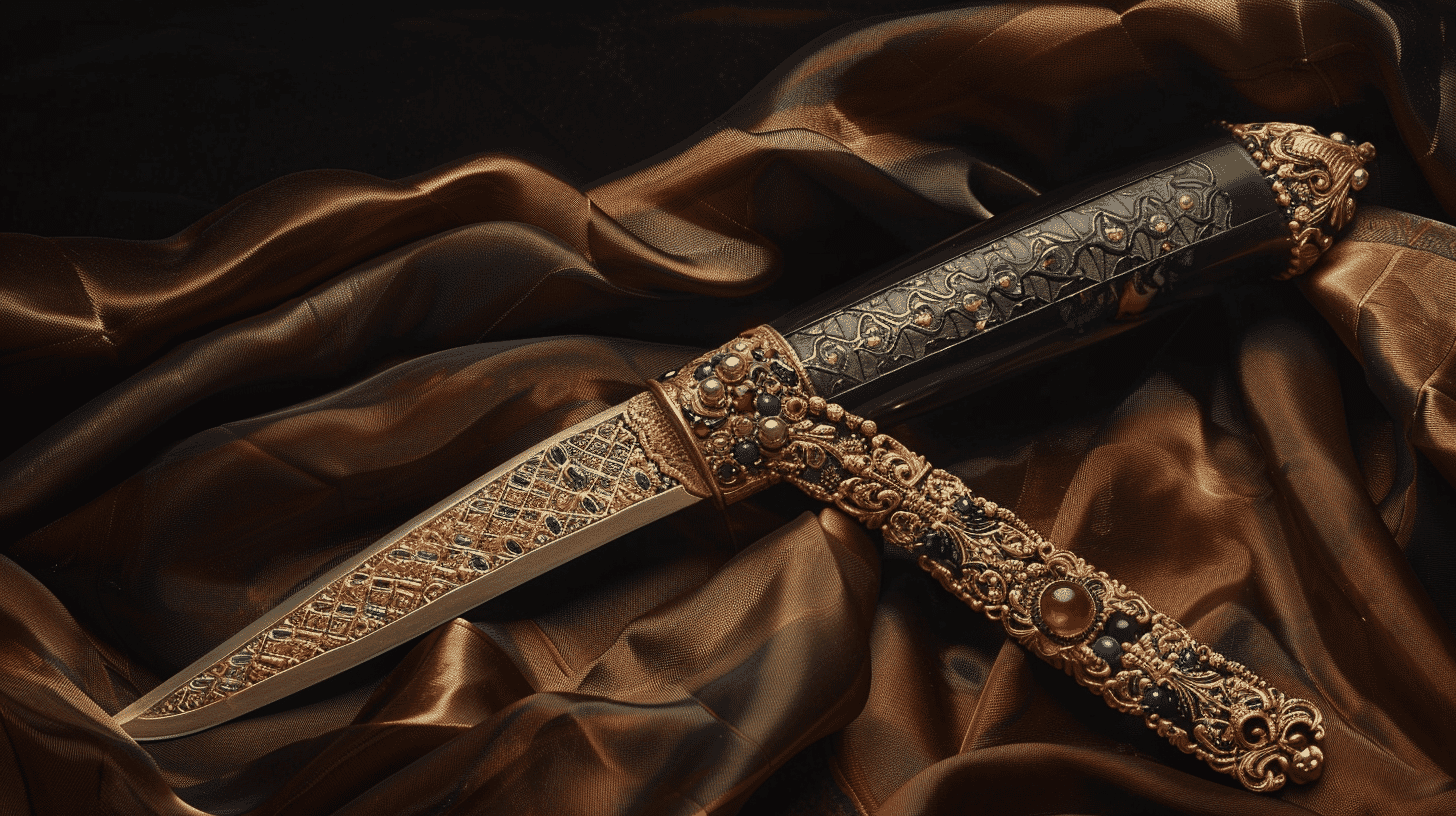
Journey to an Imperial Treasure: The Rhinoceros Horn Handle Knife
Japan's most prestigious cultural artifacts are only viewable 17 days each year—and this Nara period masterpiece tells the story of an ancient emperor's refined taste and the Silk Road's eastern terminus.
The Rhinoceros Horn Handle Knife (犀角柄刀子, Saikaku-e Tosu) represents the pinnacle of 8th-century Japanese craftsmanship—a small knife that was simultaneously a practical writing tool and luxurious status symbol for Nara period aristocrats. This extraordinary artifact, part of the legendary Shosoin treasure house, combines materials from across Asia: black rhinoceros horn from Southeast Asia, gold fittings with Tang Chinese arabesque motifs, blue glass beads possibly from Persia, and red crystals with traditional Japanese lacquerwork.
But here's the catch: you can only see it during a brief window each autumn, and even then, only if it's selected for that year's exhibition. The knife belonged to Emperor Shomu (701-756), one of Japan's most significant Buddhist monarchs, and after his death, Empress Komyo donated it to the Great Buddha at Todaiji Temple—where it has remained under imperial seal for 1,260 years. This isn't just viewing an artifact; it's connecting with an unbroken chain of cultural preservation stretching back to the height of Silk Road exchange.
What Makes This Artifact Extraordinary
The rhinoceros horn handle knife is actually part of a collection of 67 tosu (small knives) preserved in the Shosoin Repository, but the examples featuring rhinoceros horn handles represent the most elaborate and prestigious tier. These weren't ceremonial objects gathering dust—blade wear shows they were actually used by aristocrats for their intended purpose: scraping characters from wooden writing tablets (mokkan) and cutting paper. Yet they were crafted with a level of luxury that seems almost extravagant for a stationery tool.
The knife's construction demonstrates masterful integration of multiple materials and techniques. The handle is carved from black rhinoceros horn (usaikaku), prized for its deep black color with natural mottled patterns. This material was extraordinarily rare and expensive in 8th-century Japan, imported via Silk Road trade routes and ground into powder for medicine when not fashioned into luxury objects.
The scabbard features a black lacquer finish over wood, wrapped at five locations with birch bark strips (kabamaki)—a traditional Japanese technique. Between these wrapped sections, craftsmen embedded alternating blue glass beads and red crystals with fukesaishiki (red overglaze) decoration, creating a rhythmic visual pattern along the scabbard's length.
The metal fittings—both the pommel and scabbard end—are fashioned from pure gold with intricate openwork arabesque patterns (karakusa-mon sukashibori). These vine and flower motifs demonstrate Tang Dynasty artistic influence and were worked with exceptional precision to create delicate pierced designs. The blade itself shows characteristic Nara period construction with a fine straight temper line and narrowing from repeated careful sharpening—evidence of actual use despite the elaborate decoration.
An Emperor's Stationery Drawer Becomes National Treasure
To understand this knife's significance, you must understand Emperor Shomu and the extraordinary moment in Japanese history when it was created. The Tempyo era (天平時代) of the 8th century represented a peak period of cultural exchange with Tang Dynasty China. Buddhism flourished under state sponsorship, international trade brought exotic materials across the Silk Road, and the imperial court at Nara became a cosmopolitan center where Japanese, Chinese, and Central Asian influences merged.
Emperor Shomu commissioned the construction of Todaiji Temple and the casting of the Great Buddha—one of the most ambitious religious projects in Japanese history. When he died in 756, Empress Komyo donated over 600 of his personal treasures to the Great Buddha in an act of Buddhist devotion and love. These items were meticulously inventoried in the Kokka Chinpo-cho (Record of National Treasures)—an original document from 756 CE that still exists today, providing unbroken provenance for these artifacts.
The rhinoceros horn handle knives were stored in the North Repository (Hokuso) of the Shosoin, the most strictly guarded section reserved exclusively for imperial treasures. This section operated under chokufū—imperial seal requiring the Emperor's personal permission to open. For over 1,200 years, these treasures remained sealed under this imperial protection, a privilege that continues today under the Imperial Household Agency's jurisdiction.
This is why Shosoin treasures aren't technically designated "National Treasures" (kokuho) in the formal legal sense—they're imperial property (gyobutsu) managed by the Imperial Household Agency rather than the Agency for Cultural Affairs. However, they're universally regarded as among Japan's most precious cultural assets, and the Shosoin building itself is both a designated National Treasure and a UNESCO World Heritage Site as part of the "Historic Monuments of Ancient Nara."
Where Is It, and How Can You See It?
Here's the crucial information every visitor needs to know: The Shosoin treasures are NOT on permanent display. The rhinoceros horn handle knife is kept under imperial seal in the Shosoin Repository at Todaiji Temple in Nara, in modern climate-controlled facilities adjacent to the original 8th-century storehouse building. The repository is closed to the public.
Your only opportunity to view these treasures is during the Annual Shosoin Exhibition at the Nara National Museum, held every autumn for just 17 days. For 2025, the 77th Annual Exhibition runs October 25 through November 10. During this brief period, approximately 60 treasures from the 9,000-item collection are selected for display—and the selection varies each year. This means there's no guarantee the specific rhinoceros horn handle knife will be included in any given year's exhibition.
To confirm whether this artifact will be displayed, check the official exhibition website (shosoin-ten.jp/en) around August-September when the list of exhibited treasures is published. The exhibition catalog is typically released about one month before opening. Previous years have featured rhinoceros horn handle knives—the 72nd exhibition in 2020 and 75th exhibition in 2023 both included examples—so there's good precedent for their inclusion.
The exhibition is held at Nara National Museum (奈良国立博物館), located at 50 Noboriōji-chō, Nara City, Nara Prefecture 630-8213. The museum sits in the heart of Nara Park, surrounded by ancient temples, sacred deer, and World Heritage Sites—making it easy to combine your visit with other major attractions.
Essential Planning: Tickets, Timing, and Practical Details
This exhibition requires advance planning. The Shosoin Exhibition is one of Japan's most popular cultural events, attracting over 200,000 visitors during its 17-day run.
Tickets are timed-entry and must be purchased in advance—they're not sold at the museum. Sales open October 5, 2025 at 10:00 AM, and tickets typically sell out quickly, especially for weekends. Purchase through the official e-ticket system at e-tix.jp/shosoin-ten/en (English available), through Lawson Ticket at Lawson or Ministop convenience stores (L-Code: 59600), or via the Art Exhibition Japan app (Japanese only).
Admission fees are Adults ¥2,000, University Students ¥1,400, High School Students ¥1,000, with free entry for junior high school students and below, seniors 70+, and visitors with disabilities. Your ticket assigns you a specific one-hour entry window—arrive on time, as no changes or refunds are possible.
Exhibition hours during the Shosoin Exhibition are 8:00 AM to 6:00 PM daily (last entry 5:00 PM), with extended hours until 8:00 PM on Fridays, Saturdays, Sundays, and holidays. To avoid the most intense crowds, book the earliest morning time slot on a weekday—8:00-9:00 AM entries see significantly lighter traffic than afternoon or weekend slots.
Getting to Nara: Surprisingly Easy from Anywhere in Kansai
Nara's central location in the Kansai region makes it remarkably accessible for a day trip or overnight visit. The city sits between Osaka and Kyoto, with frequent train connections to both.
From Kyoto (35-50 minutes): Take the Kintetsu Railway from Kyoto Station to Kintetsu Nara Station. The Limited Express takes just 35 minutes for ¥1,280, while the regular Express takes 45 minutes for ¥760. Trains run every 15-30 minutes. Kintetsu Nara Station is closer to the museum—just a 15-minute walk through Nara Park.
From Osaka (30-50 minutes): From Osaka-Namba Station, take the Kintetsu Nara Line Limited Express to Kintetsu Nara Station (30 minutes, ¥1,200) or Express (36 minutes, ¥680). From Osaka Station or Tennoji, take the JR Yamatoji Rapid to JR Nara Station (50 minutes from Osaka, ¥810; 36 minutes from Tennoji, ¥560). JR routes are covered by JR Pass.
From Tokyo (3.5 hours total): Take the Tokaido Shinkansen from Tokyo Station to Kyoto Station—Nozomi trains take 2 hours 15 minutes (¥13,320), Hikari trains take 2 hours 40 minutes (JR Pass valid). From Kyoto, transfer to Kintetsu as described above.
A Day in Nara: Combining the Exhibition with World Heritage Sites
The Nara National Museum's location in Nara Park makes it easy to visit multiple World Heritage Sites in a single day. All of these attractions are within walking distance:
Todaiji Temple (5-10 minute walk): The spiritual home of the Shosoin treasures, Todaiji houses the Great Buddha (Daibutsu)—at 15 meters tall, the world's largest bronze Buddha statue. The Daibutsuden Hall that contains it is the world's largest wooden building. This is where Empress Komyo originally dedicated her husband's treasures in 756.
Kofukuji Temple (5 minute walk): Features a five-story pagoda that's become an iconic symbol of Nara, along with a National Treasure Hall displaying exceptional Buddhist sculpture.
Kasuga Taisha Shrine (15 minute walk): A Shinto shrine famous for 3,000 stone and bronze lanterns lining its pathways. The shrine's vermillion buildings and primeval forest trails offer a striking contrast to the Buddhist temples.
Nara Park itself is home to approximately 1,200 semi-wild deer considered sacred messengers of the Shinto gods. These deer roam freely and will bow to request deer crackers (shika-senbei), available for ¥200 from vendors.
- 📍 Plan Your Visit to Osaka
- Find tours, activities & transport passes near Rhino Horn Handle Sword
- [ USJ Tickets Osaka Castle & Dotonbori Food Tours ]
Q&A
- Can I see the rhinoceros horn handle knife every year at the Shosoin Exhibition?
- No, the exhibited items change annually. About 60 treasures are selected from the 9,000-item collection each year, so you need to check the exhibition list published in August-September to confirm if this specific artifact will be displayed.
- Why is the exhibition only open for 17 days per year?
- The Shosoin treasures are imperial property under strict conservation protocols. The limited exhibition period minimizes exposure to environmental changes, helping preserve these 1,260-year-old artifacts, including organic materials, for future generations.
- Is photography allowed in the exhibition?
- No, photography is strictly prohibited inside the exhibition halls to protect the artifacts and ensure a respectful viewing environment for all visitors. Official catalogs and postcards are available at the museum shop.
- Are English explanations available?
- Yes, English audio guides are available for ¥650. Exhibition labels include English text, and an English exhibition catalog is sold at the museum shop. The official website (shosoin-ten.jp/en) also provides English information.
- How much time should I plan for Nara if combining with the exhibition?
- Allow 1-2 hours for the Shosoin Exhibition, 1 hour for Todaiji Temple, 1 hour for Kasuga Shrine, plus time for Nara Park exploration—minimum 4-5 hours total. For a relaxed experience, plan a full day.
References
- Shosoin Exhibition Glossary - Nara National Museum
- https://shosointen-glossary.narahaku.go.jp/saikaku/
- The 77th Annual Exhibition of Shōsō-in Treasures
- https://shosoin-ten.jp/en/
- Nara National Museum Official Website
- https://www.narahaku.go.jp/english/
- Heritage of Japan - Treasures of the Shosoin
- https://heritageofjapan.wordpress.com/
- Smarthistory - The Shōsōin Repository
- https://smarthistory.org/the-shosoin-repository/
Basic Information
| Name | Rhinoceros Horn Handle Knife (Saikaku-e Tosu / 犀角柄刀子) |
|---|---|
| Period | Nara Period, 8th century |
| Materials | Rhinoceros horn (handle), steel (blade), gold (fittings), glass and crystal (decoration), birch bark (wrapping) |
| Dimensions | Blade length: 35-40 cm, Scabbard: 15-17 cm, Handle: 9-10 cm (typical sizes) |
| Collection | Imperial Household Agency, Shosoin Office |
| Storage | North Repository (Hokuso), Shosoin |
| Dedication | 756 CE, donated by Empress Komyo to Todaiji Temple |
| Exhibition | Annual Shosoin Exhibition (17 days in October-November) |
| Venue | Nara National Museum |
Last verified: 2025.10.07