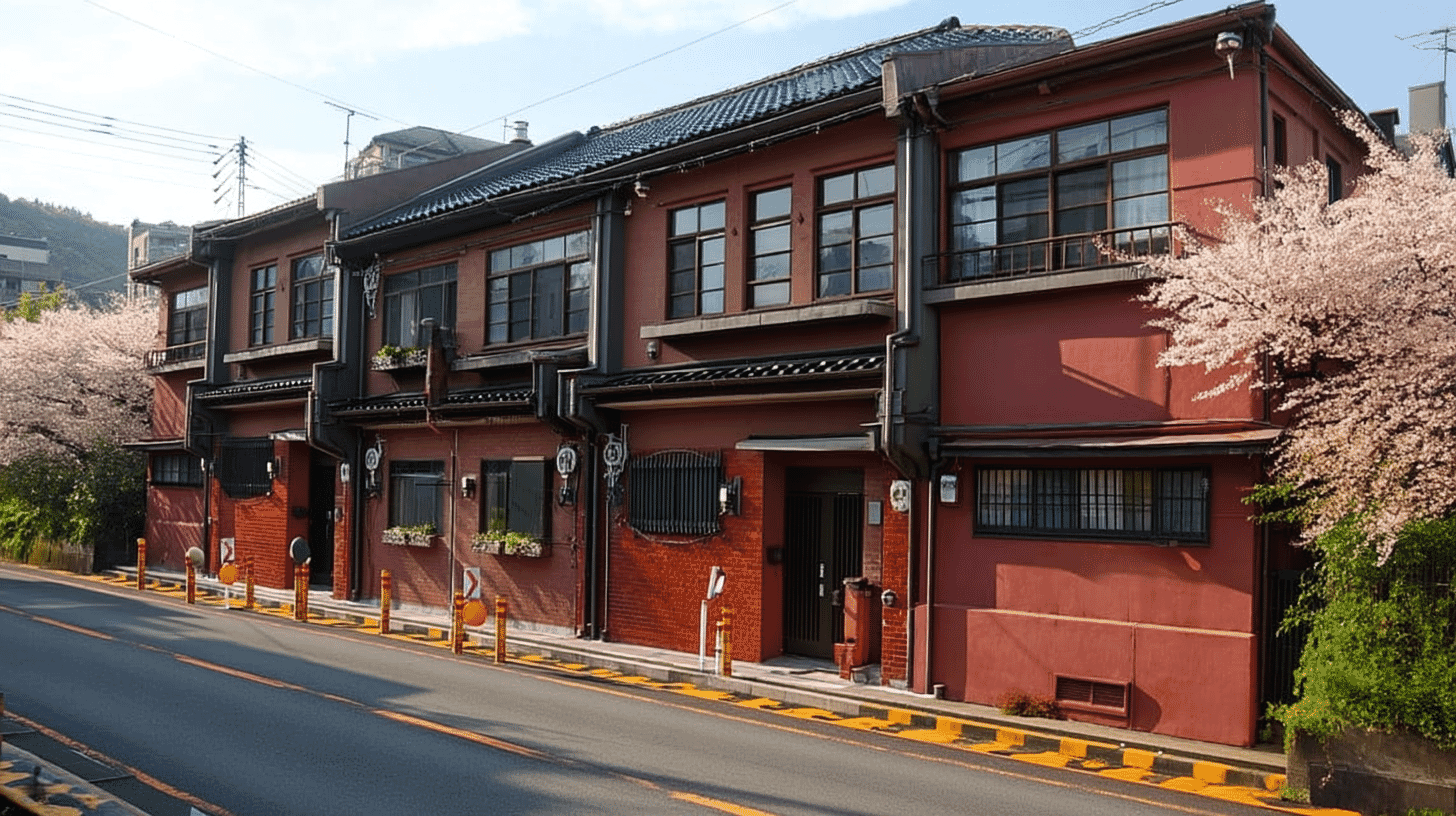
Hazama House: A 1932 Luxury Nagaya Row House on Osaka's Okawa River – Japan's Living Architectural Heritage

Discover Hazama House, a beautifully preserved 1932 luxury nagaya row house in Osaka's Miyakojima district. This Registered Tangible Cultural Property features a unique hybrid design with reinforced concrete basement and wooden upper floors along the scenic Okawa River.

Hazama House: A Living Treasure of Osaka's Nagaya Heritage

Along the banks of Osaka's Okawa River, where cherry blossoms paint the riverside pink each spring, stands a remarkable survivor of prewar Japan. Hazama House (狹間ハウス) is a six-unit luxury row house that has witnessed nine decades of history, survived wartime bombing, and continues to serve as a vibrant residential community today. Designated as a Registered Tangible Cultural Property of Japan in 2021, this architectural gem offers visitors a rare glimpse into the sophisticated urban housing that once defined Osaka's golden age of development.

A Cotton Merchant's Vision: The Origins of Hazama House

Hazama House was commissioned by Mansuke Hazama (狹間萬助), a prosperous cotton thread merchant based in Semba, Osaka's historic commercial district. In 1932 (Showa 7), at a time when Japan was experiencing rapid modernization and urban growth, Hazama sought to create an exceptional residential property that would combine Western building techniques with traditional Japanese craftsmanship.

The location he chose was nothing short of spectacular: a sloped embankment along the Okawa River in Amijima-cho, Miyakojima Ward. This prime riverside setting, adjacent to what would become Kema Sakuranomiya Park and neighboring the grand Fujita Estate, made the property one of the most desirable addresses in Osaka. Historical records suggest that the rent for units in Hazama House was more than twice the average for comparable nagaya properties – a testament to its status as a true luxury development.

Architectural Innovation: A Hybrid Structure

What makes Hazama House architecturally significant is its innovative hybrid construction that masterfully adapted to the challenging terrain. The building cleverly utilizes the natural slope of the river embankment through a three-level design:

  • Basement Level (B1): Constructed of reinforced concrete, this level houses water facilities and storage areas. It opens directly onto the riverside park, creating a unique connection between domestic space and public green space.
  • Ground Floor: Built in traditional wood-frame construction, this level contains kitchens and daily living spaces. The main entrances face the road atop the embankment.
  • Upper Floor: Also wooden construction, featuring Western-style rooms that were considered highly fashionable during the Showa era.

This maisonette-style arrangement was remarkably progressive for its time, offering residents the privacy and spatial organization typically found only in single-family homes. The total building area spans 323 square meters, with the six units stretching approximately 30 meters along the north-south axis.

The Distinctive Firewall Design

Perhaps the most striking visual feature of Hazama House is its series of firewall partitions (防火壁) that project prominently above the roofline. These masonry walls separate each of the six units and were designed to prevent the spread of fire – a critical concern in densely built urban Japan where catastrophic fires had historically devastated entire neighborhoods.

The rhythmic repetition of these vertical elements creates a distinctive silhouette that sets Hazama House apart from typical nagaya architecture. Combined with the deep burgundy (えんじ色) exterior paint that has been carefully maintained through recent restoration work, the building presents a commanding presence that draws the attention of passersby.

Why Hazama House Became a Registered Cultural Property

In June 2021, Japan's Agency for Cultural Affairs officially registered Hazama House as a Tangible Cultural Property under the criterion of "contributing to the historical landscape of the nation" (国土の歴史的景観に寄与しているもの). This designation recognized several key aspects of the property:

  • Architectural Rarity: The hybrid construction combining reinforced concrete and wood-frame techniques represents an innovative response to site conditions that was uncommon in residential architecture of the period.
  • Historical Continuity: Having survived the devastating air raids of World War II that destroyed much of Osaka, Hazama House stands as a rare example of prewar luxury housing in the city.
  • Living Heritage: Unlike many preserved buildings that serve only as museums, Hazama House continues its original purpose as a residential property, with all six units actively occupied. This "living cultural property" status adds tremendous value to its heritage significance.
  • Urban Landscape Contribution: The building's prominent position along the Okawa River and its distinctive architectural features contribute meaningfully to the scenic quality of the area.

Recent Restoration: Preserving Authenticity

In 2021, coinciding with its cultural property registration, Hazama House underwent comprehensive restoration work supported by Osaka City's Regional Charm Creation Building Restoration Program. The careful restoration addressed several elements:

  • Repainting of exterior walls in the traditional burgundy color, unifying the appearance across all units
  • Restoration of the northern unit's roof eaves from metal sheeting back to traditional tile
  • Repair of firewall sections that had been altered with tile cladding, returning them to the original mortar finish
  • Restoration of damaged wooden fittings, railings, and rain gutters
  • Reorganization of visible electrical wiring to restore the building's clean lines

These restoration efforts successfully balanced historical authenticity with the practical needs of a functioning residential building, ensuring that Hazama House can continue serving its community for generations to come.

A New Generation Embraces Nagaya Living

One of the most encouraging aspects of Hazama House's story is its appeal to younger residents who have discovered the unique qualities of nagaya living. In recent years, several units have undergone thoughtful renovations that respect the building's heritage while introducing contemporary amenities and design sensibilities.

Hazama House has participated in "Open Nagaya Osaka" (オープンナガヤ大阪), an annual event organized by Osaka Metropolitan University that opens selected nagaya properties to the public. This event allows visitors to experience the charm of nagaya architecture firsthand and learn about the creative ways these historic buildings are being adapted for modern life.

Surrounding Attractions: A Cultural Enclave

Hazama House's location places visitors at the heart of one of Osaka's most culturally rich neighborhoods. The area offers numerous attractions that complement a visit to this historic property:

Kema Sakuranomiya Park (毛馬桜之宮公園): This 4.2-kilometer riverside park stretches along the Okawa River and is famous for its approximately 4,800 cherry trees. During hanami season (late March to mid-April), the park transforms into one of Osaka's premier cherry blossom viewing destinations.

Former Fujita Residence Garden (旧藤田邸庭園): Immediately adjacent to Hazama House, this beautifully preserved Japanese garden was once part of the vast estate of Fujita Densaburo, one of the Meiji era's most prominent industrialists. The garden is open to the public free of charge and features a historic pagoda and traditional tea house elements.

Fujita Museum of Art (藤田美術館): Reopened in 2022 after extensive renovations, this museum houses the remarkable art collection of the Fujita family, including several National Treasures and Important Cultural Properties.

Osaka Castle (大阪城): Just a short walk to the south, Osaka's iconic castle and its surrounding park offer visitors a chance to experience Japan's samurai heritage.

Visiting Hazama House

As a private residential property, Hazama House is not generally open to the public for interior visits. However, visitors can appreciate its distinctive exterior architecture and historical significance from the public areas of Kema Sakuranomiya Park. The building is best viewed from the riverside walking path, where the full scale of its 30-meter facade and characteristic firewall silhouette can be appreciated.

For those particularly interested in nagaya architecture, the annual Open Nagaya Osaka event (typically held in November) occasionally features Hazama House or similar properties, providing rare opportunities for interior visits.

The surrounding neighborhood is ideal for a leisurely half-day exploration, combining appreciation of Hazama House's architecture with visits to the neighboring gardens, parks, and museums.

The Enduring Legacy of Nagaya Culture

Hazama House represents more than just an architectural curiosity – it embodies the resilience and adaptability of Osaka's nagaya culture. These row houses, which once formed the backbone of the city's residential fabric, are increasingly rare survivors of urban development and wartime destruction.

The building's continued use as housing, rather than its conversion to a museum or commercial space, speaks to the fundamental livability of thoughtfully designed traditional architecture. As cities worldwide grapple with questions of sustainability and community, Hazama House offers valuable lessons about building lasting, human-scale housing that can serve communities across generations.

For international visitors seeking to understand Osaka beyond its famous food culture and modern attractions, a visit to the Hazama House neighborhood provides an authentic window into the city's architectural heritage and the enduring appeal of traditional Japanese urban living.

📍 Plan Your Visit to Osaka
Find tours, activities & transport passes near Sama House
[ USJ Tickets Osaka Castle & Dotonbori Food Tours ]

Q&A

QCan I go inside Hazama House?
AHazama House is a private residential property with all six units actively occupied, so general interior visits are not available. However, the building's distinctive exterior can be viewed from Kema Sakuranomiya Park. Occasionally, units may open during the annual "Open Nagaya Osaka" event held each November – check the event website for participating properties.
QWhat is the best season to visit the Hazama House area?
ASpring (late March to mid-April) is spectacular when the cherry blossoms along the Okawa River are in full bloom. Autumn offers pleasant weather and beautiful foliage in the nearby Former Fujita Residence Garden. The riverside walking paths are enjoyable year-round.
QHow do I get to Hazama House?
AThe nearest station is JR Tozai Line "Osakajo-Kitazume" Station (1-minute walk). Alternatively, take the Keihan Line to "Kyobashi" Station (7-minute walk) or the Osaka Metro Nagahori Tsurumi-ryokuchi Line to "Kyobashi" Station (5-minute walk).
QWhat is a "nagaya" and why are they significant?
ANagaya (長屋) are traditional Japanese row houses where multiple dwelling units share common walls under a continuous roofline. They were the predominant form of urban housing in prewar Japan. Today, surviving nagaya are valued as cultural assets that embody traditional craftsmanship, community-oriented design, and sustainable living principles.
QAre there other cultural properties nearby worth visiting?
AYes! The Former Fujita Residence Garden (free entry, 10:00-16:00) is immediately adjacent. The Fujita Museum of Art houses National Treasures including famous tea ceremony items. A short walk south takes you to Osaka Castle and its extensive grounds.

Basic Information

Name Hazama House (狹間ハウス / はざまはうす)
Cultural Property Designation Registered Tangible Cultural Property of Japan (Registered June 24, 2021)
Registration Number 27-0818
Year Built 1932 (Showa 7)
Structure Wood-frame 2 stories with reinforced concrete basement, tile roof, Building area: 323㎡
Building Type Six-unit nagaya row house (residential)
Original Builder Mansuke Hazama (Cotton thread merchant from Semba, Osaka)
Location 92-3 Amijima-cho, Miyakojima-ku, Osaka City, Osaka Prefecture
Nearest Station JR Tozai Line "Osakajo-Kitazume" Station (1-minute walk)
Public Access Private residence – exterior viewing only from public areas
Current Owner Asset Sea Co., Ltd.

References

Agency for Cultural Affairs - National Cultural Properties Database
https://kunishitei.bunka.go.jp/heritage/detail/101/00013834
Cultural Heritage Online - Hazama House
https://bunka.nii.ac.jp/heritages/detail/583026
Osaka City - Restoration Case Study: Hazama House
https://www.city.osaka.lg.jp/toshiseibi/page/0000565342.html
Wikipedia - Hazama House (Japanese)
https://ja.wikipedia.org/wiki/狭間ハウス
Open Nagaya Osaka Official Website
https://www.omu.ac.jp/life/opennagaya/
Fujita Estate Park - Wikipedia
https://ja.wikipedia.org/wiki/藤田邸跡公園
Omokage Soshi Blog - Hazama House
https://zuboradou.hatenablog.com/entry/65f968ada1dcd543b7941b8a60c20dcc

Last verified: 2026.01.14

Nearby heritages