
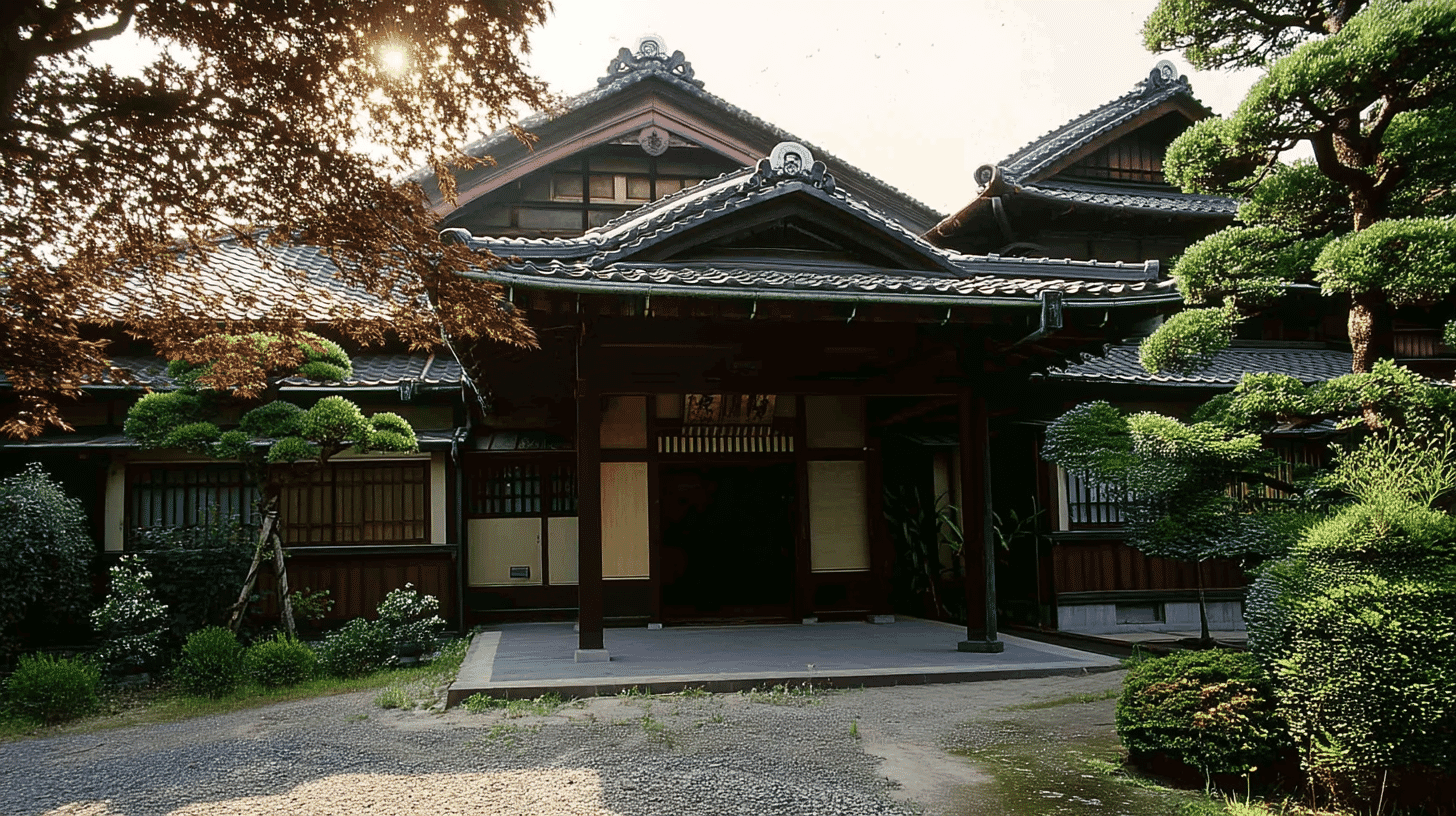
Shotokukan: Where a Timber Merchant's Dream Became Architectural Poetry
Tucked away in a quiet residential neighborhood of Higashiosaka, just a short walk from Kintetsu Nagase Station, stands a remarkable testament to Japanese craftsmanship and one man's unwavering passion for wood. Shotokukan is not merely a building; it is the crystallization of a timber merchant's lifetime of expertise, a love letter written in rare woods from across Japan.
Unlike the famous machiya townhouses of Kyoto or the grand villas of Nara, Shotokukan remains largely unknown to international visitors. Yet for those who appreciate fine architecture and the artistry of traditional Japanese woodworking elevated to its highest form, this Showa-era mansion offers an experience unlike any other in the Kansai region.
The Vision of Mori Heizō: From Apprentice to Architectural Patron
The story of Shotokukan is inseparable from the remarkable life of its creator, Mori Heizō (1875-1960). Born in rural Hyogo Prefecture, Mori left home at just sixteen to become an apprentice at a timber merchant in Osaka's Nagahori district. Through exceptional talent and relentless determination, he established his own timber business by age twenty-six, eventually expanding into maritime shipping and becoming one of Osaka's wealthiest businessmen.
But Mori was no ordinary industrialist. Deeply committed to social contribution, he founded Shoin Girls' High School (now Osaka Shoin Women's University) in 1918, dedicating his fortune to women's education. When he decided to build his private residence in his mid-sixties, he brought the same perfectionist spirit that had made him successful in business.
Construction began around 1932, but this was no ordinary building project. Mori spent approximately seven years—from initial conception to completion in 1939—creating what would become known as "the finest matsu-bushin (pine construction) in the Kansai region." He personally traveled to renowned timber-producing regions throughout Japan, selecting each log with the expertise of a lifetime in the trade.
Why Shotokukan Earned Cultural Property Status
In October 2000, Shotokukan was officially registered as a Tangible Cultural Property of Japan, recognized as "a standard of architectural form that would be difficult to reproduce." The designation encompasses not just the main building but six structures in total: the main house, storehouse, guardian shrine, gate, east wall, and south wall.
Several factors contributed to this prestigious recognition. First, the building represents an exceptional example of wayo-secchu (Japanese-Western fusion) residential architecture from the early Showa period, when Japan was actively experimenting with blending traditional aesthetics with Western influences. The exterior maintains a purely Japanese appearance with its elegant irimoya (hipped-gable) roof and traditional tile work, while the interior seamlessly integrates Western elements.
Second, the quality of materials is simply extraordinary. The main structural timber—primarily matsu (pine)—was sourced from Sanriku, Kiso, Yoshino, and Hyuga, Japan's most prestigious timber-producing regions. The Buddhist altar room features sugi (cedar) and hinoki (Japanese cypress), while the reception room ceiling is crafted from a single massive plank of kusunoki (camphor wood). Such materials would be virtually impossible to obtain today.
Third, master craftsmen from across Japan were assembled for the construction, essentially competing to demonstrate their finest techniques. This concentration of traditional building skills created an unparalleled showcase of Showa-era craftsmanship.
Architectural Highlights: A Journey Through Timeless Elegance
The Grand Entrance and Reception Room
Visitors enter through an impressive kuruma-yose (carriage porch) that immediately signals the building's status. The entrance is centrally positioned, with a single-story reception wing to the left and a two-story residential wing to the right, creating a balanced asymmetrical composition.
The reception room is perhaps Shotokukan's most stunning space. Look upward, and you will see a ceiling crafted from a single plank of kusunoki—imagine the size of the original tree required to produce such a piece. The walls are covered with Nishijin tsuzure-ori (tapestry weave), the same luxury textile traditionally used for obi sashes and imperial garments. Curved kato-mado (flower-top windows) filter soft light, while stained glass panels cast colorful patterns across the room.
The Western-Style Living Spaces
Moving deeper into the residence reveals rooms that showcase Mori's embrace of Western aesthetics. The Western-style living room features yosegi-bari (parquet) flooring in geometric patterns, with zogun (inlay work) decorations using persimmon wood at each corner—subtle details that reward careful observation.
The engawa (veranda corridor) connecting these spaces uses teak flooring, an unusual choice for the time that demonstrates both Mori's international business connections and his understanding of wood properties. Teak's resistance to sunlight means these floors have only grown more beautiful with age, developing a deep patina over nearly ninety years.
Art Deco Meets Japanese Tradition
Throughout Shotokukan, Art Deco influences appear in unexpected places: geometric pendant lights in the dining room, ceramic-tiled fireplaces, and custom-designed furniture. These Western elements never overwhelm the Japanese foundation but instead engage in a sophisticated dialogue with traditional design. The effect is distinctly Taisho-Showa modern—a brief, fascinating period when Japan confidently synthesized global influences into something uniquely its own.
A Cinematic Legacy: From Private Home to National Recognition
After Mori Heizō passed away in 1960 at age eighty-five, he bequeathed the property to Shoin Gakuen, the educational institution he had founded decades earlier. The building was renamed "Shotokukan"—combining "Sho" from Shoin with "toku" (virtue)—honoring both the school and its founder's character.
In recent years, Shotokukan has gained recognition as a filming location for period dramas. The NHK morning drama series "Asa ga Kita" (2015-2016) and "Carnation" (2011-2012) both used Shotokukan as a setting, introducing millions of Japanese viewers to its beauty. For international visitors familiar with these productions, seeing the actual spaces brings an additional layer of appreciation.
Visiting Information: The Four-Year Tradition
Shotokukan opens to the public once every four years, traditionally during the second weekend of November in Olympic years. This rare access—just two days every four years—makes each public viewing a special event that draws architecture enthusiasts, local residents, and curious visitors from across Japan.
The most recent public opening was held in November 2024 (November 9-10), marking an eight-year gap since the previous opening due to COVID-19 cancellations. The next scheduled public viewing is expected in autumn 2028.
During public openings, guided explanation sessions titled "The Charms of Shotokukan" are offered twice daily (10:30 and 13:30), providing valuable context for understanding the building's architectural and historical significance.
Getting There: Access from Major Cities
Shotokukan is located approximately five minutes on foot from Kintetsu Nagase Station, following the scenic Nagase River northward. From Kintetsu Nara Line's Kawachi-Kosaka Station, allow approximately twenty minutes walking south along the river.
From central Osaka (Namba), take the Kintetsu Osaka Line to Nagase Station (approximately 15 minutes, local train). From Osaka-Uehommachi Station, the journey takes about 10 minutes. No parking facilities are available; visitors are requested to use public transportation.
Nearby Attractions: Making the Most of Your Visit
The Nagase area offers several opportunities to extend your cultural exploration. Osaka Shoin Women's University campus, a short walk from Shotokukan, features the Shoin Gakuen Memorial Hall, another registered cultural property. The university's Tanabe Seiko Literary Museum, dedicated to the renowned author and Shoin alumna, is also worth visiting.
The Nagase River promenade offers a pleasant walking route, particularly beautiful during cherry blossom season when sakura trees line both banks. The nearby Kindai-dori (Kinki University Street) provides diverse dining options, from traditional Japanese restaurants to the ramen shops that have made this student district famous.
For those interested in Japanese film history, the site of Shotokukan holds additional significance: before Mori built his mansion, this land housed the Imperial Kinema Nagase Studio, once called "the largest in the East" before it burned down in 1930 and relocated to Kyoto's Uzumasa district.
- 📍 Plan Your Visit to Osaka
- Find tours, activities & transport passes near Shotokukan Main Building
- [ USJ Tickets Osaka Castle & Dotonbori Food Tours ]
Q&A
- When can I visit Shotokukan?
- Shotokukan opens to the public once every four years, typically on the second weekend of November during Olympic years. The next scheduled public opening is expected in autumn 2028. Admission during public openings is free.
- Is there an English guide or audio guide available?
- Currently, guided explanations are offered in Japanese only. International visitors are recommended to research the building beforehand or visit with a Japanese-speaking companion. The architectural beauty can be appreciated regardless of language.
- Can I take photographs inside the building?
- Photography policies may vary during public openings. Generally, interior photography for personal use is permitted, but flash photography and tripods are typically restricted. Please confirm current rules upon arrival.
- Is the building accessible for visitors with mobility limitations?
- As a preserved historical building from 1939, Shotokukan has traditional Japanese architectural features including steps and raised floors. Visitors are also requested not to wear high heels to protect the historic flooring. Please contact Shoin Gakuen in advance regarding specific accessibility needs.
- What makes Shotokukan different from other historical Japanese buildings?
- Unlike most preserved historical buildings which were temples, shrines, or samurai residences, Shotokukan is the private home of a successful Osaka merchant. It uniquely showcases how Japan's business class interpreted and blended Western modernity with Japanese tradition during the early Showa period—a perspective rarely seen in heritage architecture.
Basic Information
| Name | Shotokukan Main Building (樟徳館主屋 / Shōtokukan Shuoku) |
|---|---|
| Cultural Property Status | National Registered Tangible Cultural Property (Registered: October 18, 2000) |
| Construction | 1939 (Showa 14) |
| Structure | Wooden, 2-story building with tile roof |
| Building Area | 1,169 m² (main building) |
| Original Owner | Mori Heizō (Timber merchant, Founder of Shoin Gakuen) |
| Current Owner | Shoin Gakuen Educational Corporation |
| Address | 2-4-12 Hishiya-nishi, Higashiosaka City, Osaka Prefecture |
| Access | 5-minute walk north along Nagase River from Kintetsu Nagase Station |
| Public Opening | Once every 4 years (November, Olympic years); Next expected: Autumn 2028 |
| Admission | Free during public openings |
| Contact | Shoin Gakuen PR Office: TEL 06-6723-8152 |
References
- Shotokukan Main Building - Cultural Heritage Online (Agency for Cultural Affairs)
- https://bunka.nii.ac.jp/heritages/detail/167242
- Shotokukan - Wikipedia (Japanese)
- https://ja.wikipedia.org/wiki/樟徳館
- Shoin Gakuen Official Website - Shotokukan Information
- https://www.osaka-shoin.ac.jp/culture/shoutoku_images/
- Registered Cultural Property "Shotokukan" Public Opening Announcement - Shoin Gakuen
- https://www.osaka-shoin.ac.jp/news/2024/10151116/
- Exploring Shotokukan: Japanese-Western Fusion Architecture - Hotozero University
- https://hotozero.com/enjoyment/learning-report/osaka-shoin_shoutokukan/
- Shotokukan (Former Mori Residence) - Osaka Museum
- https://www.osaka-museum.com/spot/search/?act=detail&id=439
- Shoin Gakuen Founder Mori Heizō - Shoin Gakuen Official
- https://www.osaka-shoin.ac.jp/history/establish/mori_heizou/
Last verified: 2026.01.14