The Discovery at Oura Cathedral: How Hidden Christians Emerged After 250 Years
The Moment That Changed History — March 17, 1865
On a quiet spring afternoon in Nagasaki, something extraordinary happened inside a newly built church. A small group of Japanese villagers approached a French priest, and one woman whispered words that had been forbidden for over two centuries: "We share the same heart as you. Where is the statue of Santa Maria?"
This moment, known as the "Discovery of Hidden Christians" (信徒発見, Shinto Hakken), represents one of the most remarkable examples of faith preservation in world history. For 250 years, communities in the Nagasaki region had maintained their Christian beliefs in complete secrecy, despite severe persecution and isolation from the global Church.
Understanding the Historical Context
The Prohibition Era (1614–1873)
Christianity arrived in Japan in 1549 with the Jesuit missionary Francis Xavier. By the early 1600s, an estimated 300,000–400,000 Christians lived in Japan. However, the Tokugawa shogunate viewed Christianity as a political threat and issued a nationwide ban in 1614.
The persecution intensified after the Shimabara Rebellion (1637–1638), a peasant uprising in which many Christians participated. Following its brutal suppression, the shogunate implemented systematic methods to detect and eliminate Christianity:
- Fumi-e (踏絵): Annual ceremonies requiring villagers to step on Christian images
- Temple registration system: All families were required to register with a Buddhist temple
- Neighbor surveillance groups: Five-household units (gonin-gumi) monitored each other
- Severe punishments: Torture, execution, or exile for discovered Christians
Under these conditions, practicing Christianity openly became impossible. Those who refused to renounce their faith were forced underground.
The Hidden Christians' Survival Strategy
What makes the Nagasaki hidden Christians unique is not merely their survival, but how they adapted their faith across eight generations without clergy, liturgical texts, or contact with Rome. They developed a syncretic practice that blended Christian elements with Buddhist and Shinto appearances:
- Praying to Buddhist statues that secretly represented the Virgin Mary (Maria Kannon)
- Disguising Christian calendars as almanacs
- Passing down Latin prayers orally, though the meanings were often lost over time
- Organizing secret baptisms and communal worship in remote villages
Primary sources indicate that by 1865, these communities had diverged significantly from mainstream Catholic doctrine. Yet the core of their faith—devotion to Christ and the Virgin Mary—remained intact.
Oura Cathedral: Japan's Oldest Gothic Church
Construction and Purpose (1864–1865)
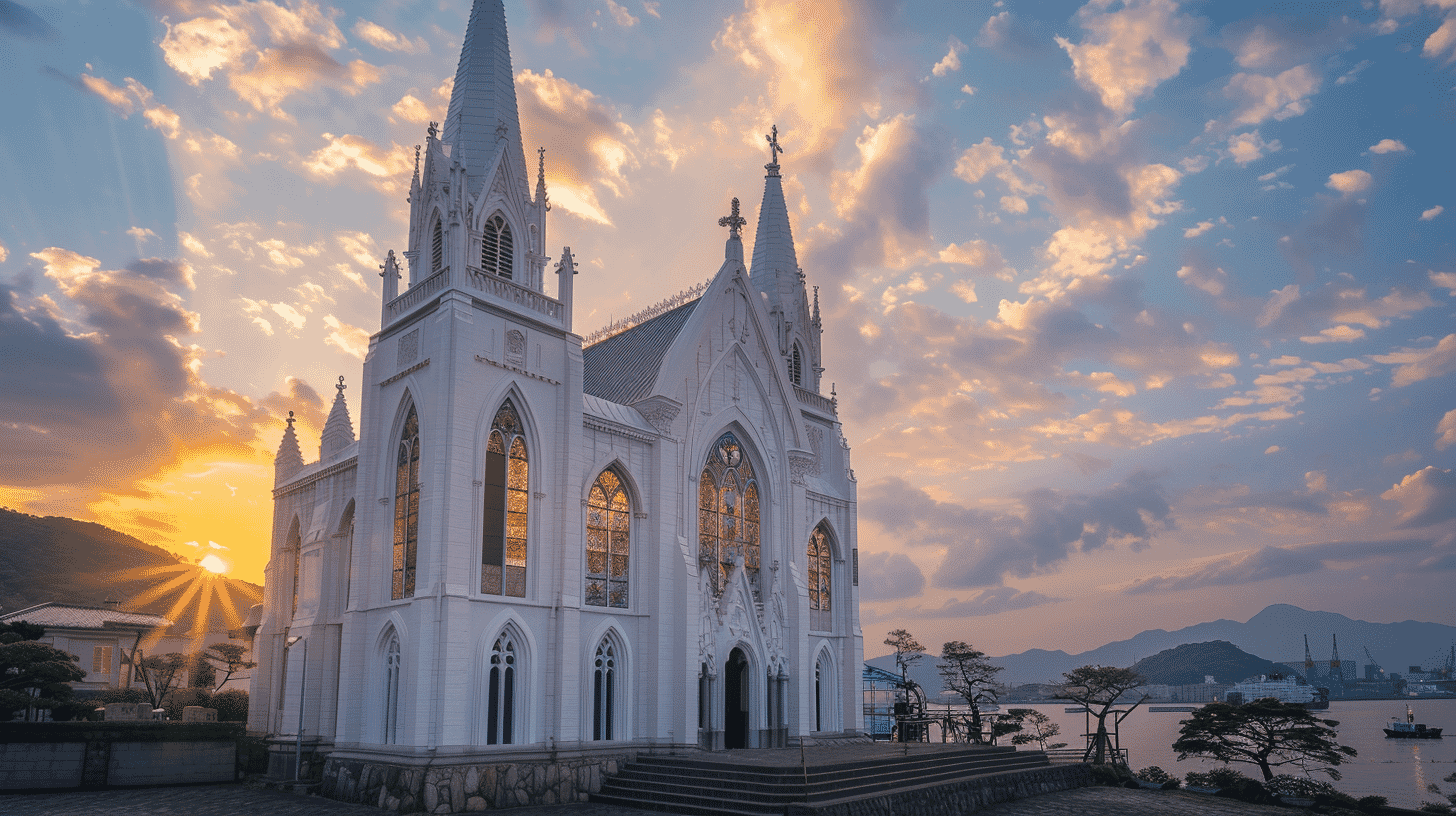
Oura Cathedral (大浦天主堂, Ōura Tenshudō) was built to serve the foreign residents in Nagasaki's international settlement. Following Japan's gradual reopening in the 1850s, the Tokugawa shogunate reluctantly permitted foreign residents to practice Christianity within their designated areas.
The cathedral was designed by French missionaries Father Bernard Petitjean and Father Louis Furet, with construction supervised by master carpenter Koyama Hidenoshin (小山秀之進). The building was completed on February 19, 1865, and officially dedicated to the Twenty-Six Martyrs of Japan—Christians crucified in Nagasaki in 1597.
Architectural features:
- Style: Gothic Revival with Japanese construction techniques
- Structure: Wooden frame with ribbed vaulting
- Stained glass: Original panels imported from France (partially preserved)
- Orientation: Facing the martyrdom site on Nishizaka Hill
The cathedral received National Treasure designation in 1933, making it the oldest church in Japan to hold this status.
The Discovery — A Detailed Account
The First Encounter
According to Father Petitjean's letter dated March 23, 1865 (preserved in the Paris Foreign Missions Society archives), the discovery unfolded as follows:
On March 17, about one month after the cathedral's completion, a group of 12–15 people from Urakami village (浦上) gathered near the church entrance during afternoon prayers. Father Petitjean, noticing their hesitation, invited them inside.
Once inside, they approached the altar quietly. An elderly woman stepped forward and whispered to Father Petitjean in Japanese: "We all have the same heart as you." She then asked, "Where is the statue of Santa Maria?"
Father Petitjean led them to a side altar featuring a statue of the Virgin Mary holding the infant Jesus. The group immediately fell to their knees in prayer, some weeping. They revealed that they had been waiting for the return of priests from Rome, believing that true priests would know the devotion to Mary.
The Three Questions
To confirm their Christian identity, the hidden believers asked Father Petitjean three questions that their ancestors had taught them to ask returning missionaries:
- "Do you revere Santa Maria?" (サンタ・マリアを崇めますか)
- "Are you celibate?" (独身ですか) — a way to verify he was a Catholic priest
- "Do you obey the Pope in Rome?" (ローマの法王に従いますか)
These questions, passed down orally for seven generations, demonstrated both their remarkable retention of Catholic distinctives and their awareness that a true connection to Rome was essential.
The Aftermath and Continued Persecution
Initial Expansion (1865–1867)
Following the discovery, Father Petitjean discreetly made contact with other hidden Christian communities in the Nagasaki region. Within two years, approximately 20,000 hidden Christians had revealed themselves to Catholic missionaries.
However, the Tokugawa shogunate's prohibition remained in force. The missionaries had to operate carefully to avoid triggering another crackdown.
The Urakami Persecution (1867–1873)
In 1867, authorities discovered that thousands of Urakami villagers had openly declared their Christianity. This led to the "Urakami Yonban Kuzure" (浦上四番崩れ), the fourth and final mass persecution of Christians in the region.
Between 1868 and 1873, approximately 3,400 Urakami Christians were arrested, tortured, and exiled to various domains across Japan. An estimated 660 died during this ordeal. International pressure from Western nations, particularly after the Iwakura Mission, finally convinced the new Meiji government to end the persecution.
On February 24, 1873, the signboards prohibiting Christianity were quietly removed, marking the de facto end of Japan's 259-year ban.
Visiting Oura Cathedral Today
Practical Information
Location:
5-3 Minamiyamate-machi, Nagasaki City, Nagasaki Prefecture
Access: 5-minute walk from Oura Cathedral tram stop
Hours:
8:00–18:00 (last entry 17:45)
Admission:
Adults: ¥1,000
High school students: ¥400
Elementary/Junior high students: ¥300
Photography:
- Exterior: Permitted
- Interior: Prohibited (respect this strictly as it is an active place of worship)
Time needed:
30–45 minutes for the cathedral; add 20–30 minutes if visiting the adjacent museum
What to See — A Recommended Route
1. Approach the main entrance
Observe the Gothic pointed arch and the French-influenced facade. The stone foundation and wooden upper structure represent a fusion of Western design with Japanese carpentry.
2. Interior — The central nave
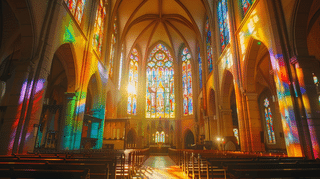
Upon entering, remove your hat as a sign of respect. Notice the ribbed vaulting and the way natural light filters through the stained glass, creating a contemplative atmosphere. Some of the original 1865 glass panels survive, though many were replaced after the 1945 atomic bombing.
3. The statue of the Virgin Mary
Located on the left side altar—this is the statue to which the hidden Christians were drawn in 1865. Stand quietly before it and consider the moment when, after 250 years, believers could finally pray openly to Mary.
4. The Twenty-Six Martyrs dedication
The cathedral's official name is "Church of the Twenty-Six Martyrs of Japan." Informational panels (Japanese, English) explain the connection between the 1597 martyrdoms and the 1865 discovery.
5. The adjacent museum
Displays artifacts from the hidden Christian period, including fumi-e plates, disguised religious objects, and documents related to Father Petitjean. English explanations are available.
Etiquette and Cultural Sensitivity
Oura Cathedral is a UNESCO World Heritage site and an active Catholic church. Please observe the following:
- Silence: Keep conversations quiet inside
- Dress modestly: Shoulders and knees should be covered
- No photography inside: This rule is strictly enforced
- Do not touch: Altars, religious objects, and furnishings are sacred
- Mass schedule: Sunday Mass is held at 9:00 and 10:30. Visitors may attend respectfully but should not disrupt the service
If you attend Mass, observe what regular attendees do regarding standing, sitting, and kneeling. Non-Catholics typically remain seated during Communion.
The World Heritage Recognition
In 2018, "Hidden Christian Sites in the Nagasaki Region" were inscribed on the UNESCO World Heritage List. The designation includes 12 component sites, with Oura Cathedral serving as the symbolic center where the hidden faith finally emerged.
The UNESCO committee recognized these sites not as monuments to Christianity per se, but as evidence of a unique cultural tradition born from the intersection of faith, persecution, and isolation. The hidden Christians developed a distinctive form of belief that existed nowhere else in the world.
Reflections: Why This Story Matters
The discovery at Oura Cathedral challenges simple narratives about religious persecution and survival. The hidden Christians did not merely "preserve" their faith—they transformed it into something new, adapted to their circumstances, yet still recognizable to Catholic missionaries after two and a half centuries.
For visitors today, the cathedral offers more than architectural beauty. It is a space where the invisible becomes visible: the determination of individuals who risked everything to maintain a connection to beliefs their great-great-great-grandparents once held.
When you stand before that statue of Mary, you stand where worlds collided—the covert and the open, the Japanese and the European, the past and the future. That moment in 1865 reminds us that human convictions, when held deeply enough, can bridge even the widest chasms of time and culture.
Related Sites in Nagasaki
To deepen your understanding of the hidden Christian heritage, consider visiting:
1. Urakami Cathedral (浦上天主堂)
Built by descendants of the hidden Christians; destroyed in the 1945 atomic bombing and rebuilt in 1959. Contains relics from the persecution era.
2. Twenty-Six Martyrs Museum (二十六聖人記念館)
Located on Nishizaka Hill, the site of the 1597 crucifixions. Excellent English exhibits.
3. Shitsu Settlement (外海の出津集落)
A remote coastal village that preserved hidden Christian practices. The church and village offer insight into daily life during the prohibition era.
4. Kasuga Village (春日集落)
A hillside settlement where hidden Christians lived. Walking through the terraced fields and narrow paths helps you understand the geographic isolation that protected them.
FAQ
Q1: Were the hidden Christians practicing "real" Christianity during the 250 years of prohibition?
This question has no simple answer. The hidden Christians maintained core elements—belief in Christ, devotion to Mary, baptism, and a sense of community identity as Christians. However, without priests, sacraments, or scripture, their practices evolved significantly. Some prayers became phonetic repetitions of Latin whose meanings were lost. Religious calendars and rituals blended with Buddhist and Shinto elements for disguise. When Catholic missionaries re-established contact in 1865, they found that some doctrines had diverged from official teaching. Some hidden Christian communities chose to remain separate from the Catholic Church even after religious freedom was granted, forming the Kakure Kirishitan (隠れキリシタン) tradition that persists in small numbers today.
Q2: How did the hidden Christians pass down their faith without written materials?
The transmission was primarily oral and communal. Each village had a mizukata (水方) or chokata (帳方)—lay leaders who memorized prayers, ritual procedures, and the Christian calendar. These leaders trained successors, ensuring continuity across generations. Families also used covert symbols: modified Buddhist statues (Maria Kannon), medallions hidden in daily objects, and coded almanacs. The community structure was essential—individuals alone could not have preserved the faith, but tightly-knit villages with collective memory could. This explains why hidden Christianity survived in geographically isolated settlements in the Nagasaki region but not in urban areas where surveillance was tighter and community bonds weaker.
Q3: Why did Father Petitjean build the cathedral facing the martyrdom site?
The orientation was intentional. Father Petitjean knew the history of the Twenty-Six Martyrs, who were crucified on Nishizaka Hill in 1597. By dedicating the cathedral to these martyrs and positioning it to face their execution site, he created a physical connection between Japan's first Christian witnesses and the new church. He may also have hoped that this dedication would resonate with any hidden Christians who remembered stories of the martyrdoms. Indeed, some hidden Christians later stated that the cathedral's dedication to Japanese martyrs (rather than European saints) helped them trust that these were "true" missionaries connected to the historical Japanese church.
Q4: Can I attend Mass at Oura Cathedral as a tourist?
Yes, visitors are welcome to attend Mass respectfully, but please understand that it is primarily a worship service for the Catholic community. Mass is held on Sundays at 9:00 and 10:30 in Japanese. If you attend, arrive a few minutes early and sit toward the back. Follow the congregation's lead regarding standing, sitting, and kneeling. Non-Catholics should remain seated during Communion (when attendees go forward to receive the Eucharist). Maintain silence, turn off your phone, and avoid taking photographs. If you are simply interested in observing Catholic worship as a cultural experience, this is acceptable, but approach with genuine respect rather than as mere sightseeing.
Q5: What's the difference between "hidden Christians" and "underground Christians"?
These terms are often used interchangeably, but scholars make a distinction. "Hidden Christians" (senpuku kirishitan 潜伏キリシタン) refers to those who practiced Christianity in secret during the prohibition era (1614–1873) while outwardly conforming to Buddhist requirements. "Kakure Kirishitan" (隠れキリシタン), literally "hidden Christians," refers to communities that chose to remain separate from the Catholic Church even after religious freedom was granted. These groups continued their syncretic practices and did not accept the authority of Catholic missionaries. Today, a small number of Kakure Kirishitan communities still exist in rural Nagasaki, though their numbers have dwindled significantly as younger generations convert to Catholicism or leave religious practice entirely.
References
Primary Sources and Academic Works:
- Paris Foreign Missions Society Archives (Société des Missions Étrangères de Paris) — Father Petitjean's correspondence, 1865–1884
- Nagasaki Prefectural Library — Persecution documents from the Tokugawa period
- Turnbull, Stephen. The Kakure Kirishitan of Japan: A Study of Their Development, Beliefs and Rituals to the Present Day. Routledge, 2013.
- Whelan, Christal. The Beginning of Heaven and Earth: The Sacred Book of Japan's Hidden Christians. University of Hawai'i Press, 1996.
Official Resources:
- Oura Cathedral official website: https://www.oura-church.jp (Japanese, limited English)
- Nagasaki and Amakusa Region Hidden Christian Sites UNESCO World Heritage page: https://kirishitan.jp/en/
- Agency for Cultural Affairs, Japan — National Treasure designation documentation
For Visitors:
- Nagasaki Prefecture Tourism Federation: https://www.nagasaki-tabinet.com/english/
- Nagasaki City Official Tourism Site: https://www.at-nagasaki.jp/en/
Further Reading:
- Cieslik, Hubert and Monika Schulze. The Hidden Christians of Japan: Two Centuries of Faith. Paulist Press, 1993.
- Higashibaba, Ikuo. Christianity in Early Modern Japan: Kirishitan Belief and Practice. Brill, 2001.
Note: This article is based on historical documentation and firsthand observation at Oura Cathedral. Visit information was accurate as of October 2025. Please verify current hours and admission fees before visiting.