Chikugo River Lift Bridge: Japan's Oldest Movable Bridge and an Engineering Marvel

Discover the Chikugo River Lift Bridge in Kyushu—Japan's oldest vertical lift bridge. Designated as an Important Cultural Property, this 1935 engineering masterpiece spans Fukuoka and Saga prefectures and offers stunning sunset views.

Chikugo River Lift Bridge: Where Engineering Ingenuity Meets Timeless Beauty

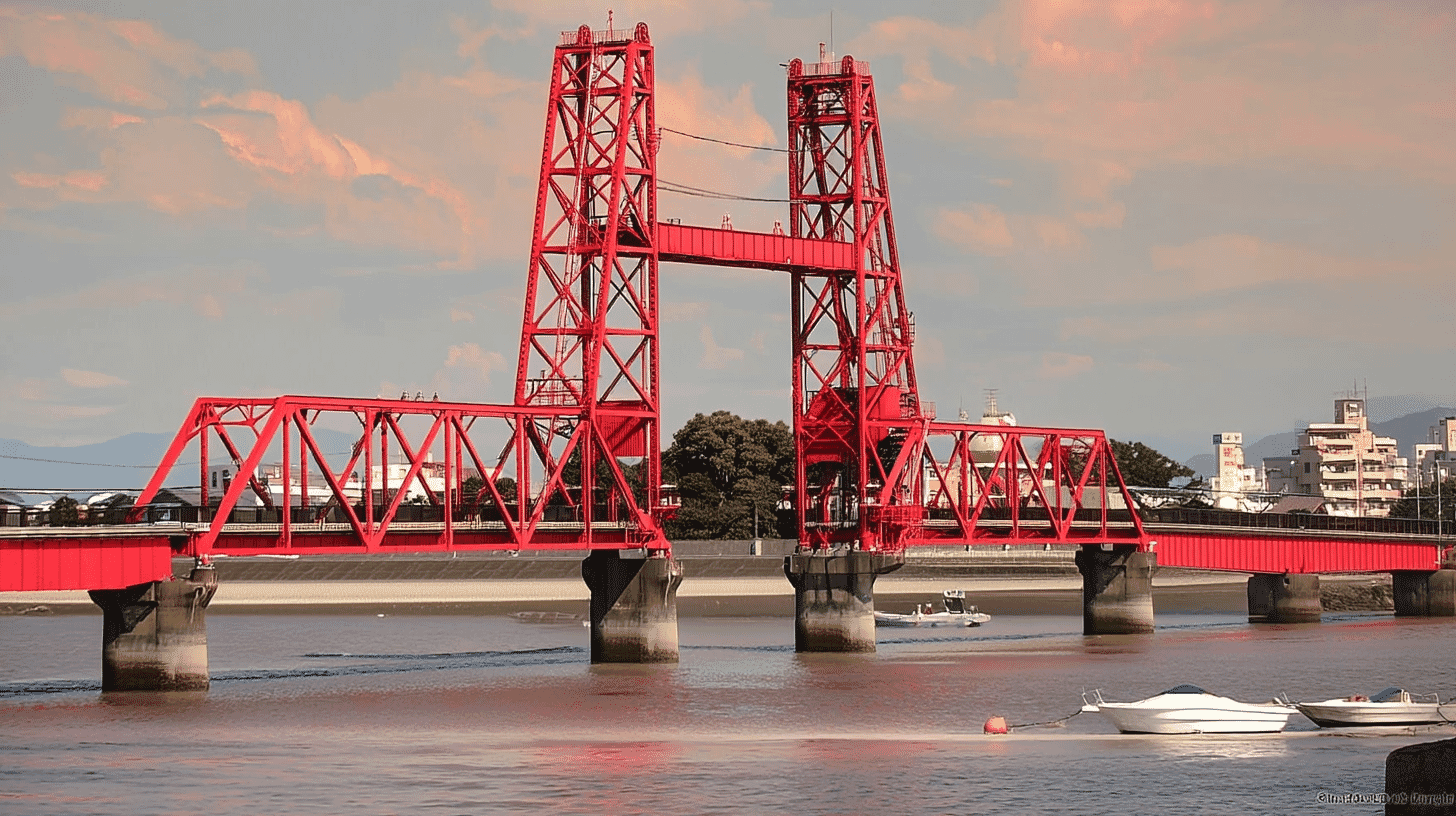
Rising dramatically above Kyushu's mightiest waterway, the Chikugo River Lift Bridge (筑後川昇開橋) stands as an iconic symbol of Japanese engineering prowess and industrial heritage. This striking vermillion structure, stretching over half a kilometer across the river, represents Japan's oldest surviving vertical lift bridge—a rare movable bridge where the central span rises vertically between two towering steel pylons to allow ships to pass beneath.

Straddling the border between Fukuoka and Saga prefectures, this magnificent structure has witnessed nearly nine decades of history, transforming from a vital railway link into a beloved pedestrian promenade that offers visitors an unforgettable journey into Japan's industrial past.

A Bridge Born from Innovation: The Story of Its Creation

The Chikugo River Lift Bridge was constructed as part of the Japanese National Railways Saga Line, completed on May 25, 1935. The project presented extraordinary challenges that pushed the boundaries of contemporary engineering. Located approximately 8.5 kilometers upstream from the river's mouth at Ariake Sea, the construction site faced extreme tidal variations of up to six meters—among the largest in Japan—while a 16-meter thick layer of clay at the riverbed made foundation work exceptionally difficult.

Adding to these complications was the river's importance as a major shipping route. The nearby Wakatsu Port served as Kyushu's largest rice distribution center, with hundreds of large vessels passing through annually. Engineers needed to create a solution that would accommodate both rail transport and maritime traffic without interruption.

The brilliant solution came from Sakamoto Taneyoshi, a railway engineer with an extraordinary double life. Sakamoto was also an accomplished magician who won the prestigious American Sphinx Award in 1938 for his original illusions. His creative mind, trained in the art of deception and mechanical marvels, conceived the innovative lift mechanism that would make this bridge possible. As Sakamoto himself later reflected, his love for surprising audiences with new tricks directly influenced his approach to bridge design.

Upon completion, the bridge earned the moniker "the First Lift Bridge in the East" and quickly became a symbol of Japanese technological achievement. A precision miniature model demonstrating its ingenious mechanism was exhibited at the 1937 Paris International Exposition, and this same model is now preserved at the Railway Museum in Saitama Prefecture.

Why It Received Cultural Property Designation

The Former Chikugo River Bridge (Chikugo River Lift Bridge) was designated as a National Important Cultural Property on May 30, 2003, recognizing its exceptional historical and technical significance. According to the Agency for Cultural Affairs, this designation was granted for two primary reasons.

First, as Japan's oldest existing vertical lift movable bridge, it represents an irreplaceable piece of the nation's industrial heritage. The bridge demonstrates the remarkable state of Japanese civil engineering technology during the early Showa period and stands as physical evidence of the sophisticated infrastructure development that supported Japan's modernization.

Second, the bridge symbolizes the establishment of railway movable bridge construction technology in Japan. Its construction required unprecedented collaboration between specialists from different engineering disciplines—structural engineers, mechanical engineers, and naval architects—working together to solve the complex challenges of building over tidal waters while maintaining shipping access. This high-level cooperative achievement is embodied in both the massive structural framework and the technically refined movable apparatus that continues to function today.

In 2007, the Japan Society of Mechanical Engineers further recognized the bridge by designating it as Mechanical Engineering Heritage No. 23, acknowledging its significance in the history of mechanical technology.

Architectural Features and Engineering Marvel

The Chikugo River Lift Bridge extends 507.2 meters in total length, making it an impressive presence on the landscape. The structure comprises multiple engineering elements: 14 reinforced concrete piers supporting steel plate girders, with the centerpiece being the vertical lift section flanked by two 30-meter tall steel towers—equivalent to a 10-story building.

The movable span itself measures 24.2 meters in length and weighs approximately 48 tons. When raised, it ascends 23 meters to allow large vessels to pass underneath. The lifting mechanism employs a sophisticated counterweight system that balances the span's weight, requiring relatively little power to operate despite its massive size.

The towers are designed to withstand strong winds from Ariake Sea while supporting the complex machinery housed in the machine rooms at their tops. The balanced wire system on both sides ensures stable operation even in adverse weather conditions. Remarkably, the original mechanical components have been maintained and continue to function, a testament to both the quality of the original construction and the dedicated preservation efforts that followed.

From Railway Bridge to Pedestrian Promenade

For over fifty years, the Chikugo River Lift Bridge faithfully served as a crucial link in the Saga Railway Line, carrying passengers and freight between Saga and Seto. However, as automobile transportation grew dominant in post-war Japan, railway usage declined precipitously. On March 27, 1987, the Saga Line was officially discontinued, and the bridge fell silent.

What followed was a pivotal moment in Japanese heritage preservation. The Ministry of Construction initially recommended demolition of the now-unused structure. However, local residents, who had grown up watching trains cross the bridge and had come to see it as an irreplaceable symbol of their communities, launched a passionate campaign for its preservation.

Their efforts succeeded. In 1992, the Japanese National Railways Settlement Corporation transferred the bridge to Okawa City free of charge. After extensive restoration work, the bridge reopened on April 29, 1996, as a pedestrian walkway officially named "Tower Bridge Walking." Today, it serves as a beloved promenade connecting Morodomi in Saga City with Okawa City in Fukuoka Prefecture, allowing visitors to walk across the same path where trains once thundered.

Visitor Experience: Walking Across History

Visiting the Chikugo River Lift Bridge offers a unique opportunity to experience living industrial heritage. The bridge operates as a pedestrian walkway between 9:00 AM and 9:00 PM from March through November (until 5:00 PM from December through February). During operating hours from 9:00 to 16:30, the center span is lowered eight times daily, allowing visitors to walk the entire 507-meter length and cross between Saga and Fukuoka prefectures.

Even when the movable span is raised, the promenade remains open, and visitors can walk to the center section to observe the impressive lift mechanism up close. Standing beneath the towering pylons as the massive span hovers overhead creates a powerful sense of the engineering achievement this bridge represents.

The sunset hour is particularly magical. As the sun descends toward Ariake Sea, the bridge's silhouette emerges against skies painted in brilliant oranges and purples. From dusk until 10:00 PM, the structure is beautifully illuminated, its warm lights reflecting off the river's surface to create a romantic atmosphere that has made this a popular destination for couples and photographers alike.

During the Etsu fishing season from May through July, special flags are raised on the bridge to celebrate this local delicacy—a species of anchovy found only in the Chikugo River. On New Year's Day, the bridge opens early for visitors wishing to view the first sunrise of the year.

Exploring the Surrounding Area

The Chikugo River Lift Bridge serves as an excellent starting point for exploring the rich cultural heritage of this region straddling two prefectures.

On the Fukuoka side, Okawa City is renowned as Japan's premier furniture production center, with approximately 200 woodworking manufacturers continuing a tradition dating back nearly 500 years. The city's craftsmen, descended from ship carpenters who once built vessels for the river trade, now create everything from traditional tansu chests to contemporary designer furniture. Visitors can explore furniture showrooms, watch artisans at work, and even participate in workshops to create traditional Okawa Kumiko (geometric woodwork patterns).

Adjacent to the bridge on the Okawa side, the Okawa TERRAZZA serves as a tourism and interior design information center, featuring a café and antenna shop showcasing local products. The nearby Bridge Station Doronpa offers fresh local seafood and vegetables from the region.

On the Saga side, a walk along the river leads to the Sano Tsunetami Memorial Museum, dedicated to the founder of the Japanese Red Cross Society. The museum stands on the site of a former naval shipyard and includes exhibits on early Japanese naval history as well as Sano's humanitarian legacy.

History enthusiasts can follow the Jofuku Cycle Road, which traces the former Saga Railway Line route from the bridge to the former Minami-Saga Station. Along the way, remnants of the railway era—signal equipment, platform markers, and bridge remnants—offer glimpses into the transportation network that once connected these communities.

Practical Information for Visitors

The Chikugo River Lift Bridge is free to visit, though donation boxes are available near the central control office for those who wish to support the bridge's ongoing maintenance. The bridge cannot accommodate motorcycles or pets, and bicycles must be walked across rather than ridden.

Weather conditions may affect operations, and timing may shift when large vessels need to pass. Visitors should note that strong winds are common on the open river, so securing hats and loose items is recommended.

Free parking is available on both sides of the bridge, with approximately 20 spaces each at the Saga side (near Bridge Station Doronpa) and Fukuoka side.

📍 Plan Your Visit to Fukuoka
Find tours, activities & transport passes near Former Chikugo River Bridge (Chikugo River Lift Bridge)
[ Dazaifu Tenmangu Shrine & Hakata Food Tours ]

Q&A

QCan I walk across the entire bridge?
AYes, when the movable span is lowered (between 9:00 and 16:30), you can walk the full 507 meters from Saga Prefecture to Fukuoka Prefecture. Even when raised, you can walk to the center section from either side.
QIs there an admission fee?
ANo, admission is completely free. Voluntary donations to support bridge maintenance are welcomed at the donation box near the central control office.
QWhat is the best time to visit?
AThe sunset hour offers the most spectacular views, with the bridge silhouetted against colorful skies. The illumination from dusk until 10:00 PM creates a romantic atmosphere with beautiful reflections on the water.
QHow do I get there by public transportation?
AFrom JR Saga Station, take the Saga City Bus bound for Hayatsue and alight at the Shoukaikyou stop (approximately 25 minutes), then walk 5 minutes. From Nishitetsu Yanagawa Station, take the Nishitetsu Bus toward Saga Station Bus Center and alight at Okawa-bashi stop.
QCan I bring my bicycle or pet?
ABicycles are permitted but must be walked across—riding is not allowed. Unfortunately, pets and motorcycles are not permitted on the bridge.

Basic Information

Official Name Former Chikugo River Bridge (Chikugo River Lift Bridge) / 旧筑後川橋梁(筑後川昇開橋)
Cultural Designation National Important Cultural Property (designated May 30, 2003); Mechanical Engineering Heritage No. 23 (designated August 7, 2007)
Completion Date May 25, 1935
Original Purpose Railway bridge for Japanese National Railways Saga Line
Key Engineers Kugimiya Iwao (Lead Engineer, Ministry of Railways Kumamoto Construction Office); Sakamoto Taneyoshi (Movable Mechanism Designer)
Total Length 507.2 meters
Movable Span Length 24.2 meters
Vertical Rise 23 meters
Tower Height 30 meters
Location Spanning Okawa City, Fukuoka Prefecture and Morodomi, Saga City, Saga Prefecture
Address (Saga side) Morodomichotameshige, Saga City, Saga 840-2102
Operating Hours Bridge operation: 9:00–16:30; Promenade: 9:00–21:00 (March–November), 9:00–17:00 (December–February)
Closed Mondays (Tuesday if Monday is a holiday); December 29 – January 3
Illumination Sunset to 22:00
Admission Free
Parking Available on both sides (approximately 20 spaces each, free)
Contact Chikugo River Lift Bridge Tourism Foundation: TEL 0944-87-9919
Official Website https://www.shoukaikyou.com/

References

国指定重要文化財 筑後川昇開橋(Official Website)
https://www.shoukaikyou.com/
筑後川昇開橋 - あそぼーさが(Saga Prefecture Tourism)
https://www.asobo-saga.jp/spots/detail/4f871ae3-8b1c-47a7-a7ed-1fa3e05f7a02
筑後川昇開橋 - Wikipedia
https://ja.wikipedia.org/wiki/筑後川昇開橋
旧筑後川橋梁(筑後川昇開橋) - 文化遺産オンライン
https://bunka.nii.ac.jp/heritages/detail/158345
手品のアイデアで設計された筑後川昇開橋 - 日本機械学会誌
https://www.jsme.or.jp/kaisi/1225-14/
Chikugo River Lift Bridge - Saga Trip Genius
https://www.saga-tripgenius.com/tourism_search/archives/37
A Walk Across Saga's Chikugo River Lift Bridge - Nippon.com
https://www.nippon.com/en/guide-to-japan/gu011023/
Chikugo River Lift Bridge - Wikipedia (English)
https://en.wikipedia.org/wiki/Chikugo_River_Lift_Bridge
大川市観光ガイド - CROSSROAD FUKUOKA
https://www.crossroadfukuoka.jp/areaguide/okawa-shi

Last verified: 2025.12.04

Nearby heritages