
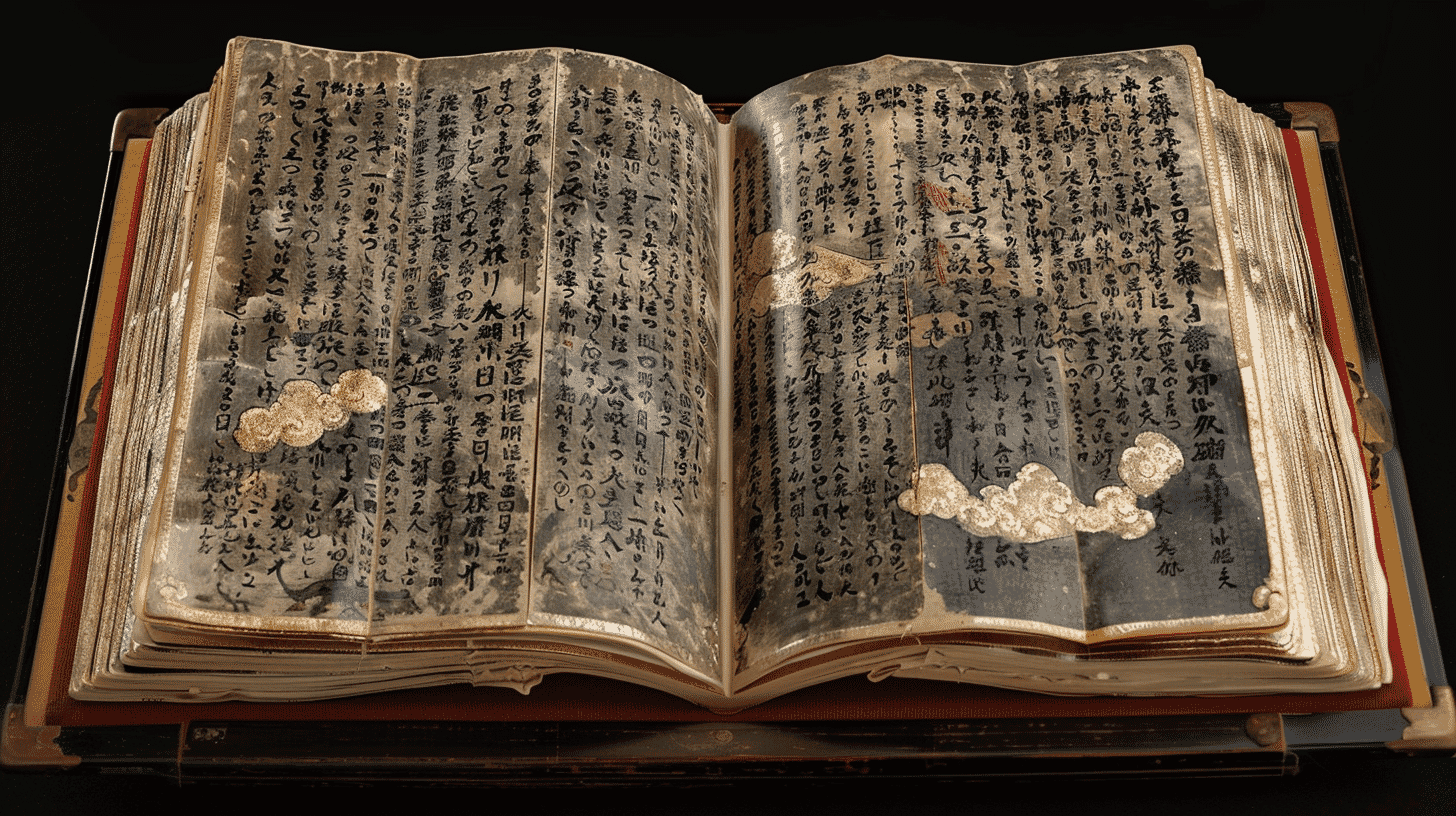
One Volume, National Treasure since 1952
Saibara-fu, Scores for Court Songs (催馬楽譜, Saibara-fu) is a Heian-period work of calligraphy at 2-5-22 Matsubara, Saga City, Saga Prefecture, designated a National Treasure on 22 November 1952. The quantity is one bound volume and the owner the Nabeshima Hokokai foundation.
The field for designation as an Important Cultural Property is blank in the Agency's database: it went to National Treasure without that earlier step, the twenty-third such case covered here.
The Agency's commentary reads: a work of the Heian period. That makes the twenty-first one-sentence commentary here. The holding museum records it as ink on paper, on fine bird's-egg paper, 25.5 centimetres high and 16.7 centimetres wide.
The Music Died Out, Then Was Revived from the Scores
Saibara-fu (催馬楽譜) carries the history of the music itself.
The museum describes saibara as a form of court song, in which songs native to Japan were set to the rhythms and melodies of music imported from China.
It continues: performance declined from the thirteenth century and ceased altogether after the Onin War, and in the seventeenth century the music was revived on the basis of old scores.
Performance stopped. Later, from old notation such as Saibara-fu, it began again.
With the Gobu Shinkan scroll, the original was lost and only a copy survived. With the Soranjo, Wang Xizhi's own hand does not survive and a copy holds the designation. Those are cases of an object being lost.
Here it is an activity that broke off. The objects survived and only the practice ceased, and from what survived the practice resumed.
The Same Title as a National Treasure and as an Important Cultural Property
Saibara-fu (催馬楽譜) is not the only property under that title.
The Tokyo National Museum holds one as well, an Important Cultural Property listed on 18 June 1957, its National Treasure field blank. Its commentary is the same single sentence: a work of the Heian period.
The quantities differ. Saibara-fu (催馬楽譜) here is one bound volume; the Tokyo piece is one scroll. One is sewn, the other rolled.
With the Himeji Castle corridor turrets, buildings of nearly the same name stood as National Treasure and as Important Cultural Property. With the Yohen Tenmoku bowls, two of one name were designated on the same day.
Here the titles match exactly, the categories differ, and the measure words differ too. A fragment mounted in an album is recorded separately again, counted in leaves.
The Traditional Writer Lived Two Centuries Too Late
The account of who wrote Saibara-fu (催馬楽譜) opens a wide gap.
The museum gives the writer as, by tradition, Prince Munetaka, who lived from 1242 to 1274: a man of the Kamakura period.
The commentary states otherwise: though handed down as the work of Prince Munetaka of the Kamakura period, it is by a fine hand of the mid-eleventh century, and is the oldest surviving old manuscript of saibara.
For Saibara-fu, tradition gives a man of the thirteenth century and inference writing of the eleventh. Some two hundred years lie between.
With the cloud-paper Wakan Roeishu, tradition named Fujiwara no Yukinari and inference Minamoto no Kaneyuki, both of the eleventh century. With the Koya cutting, tradition named Ki no Tsurayuki and inference three hands.
Here the man of tradition and the period inferred fall on opposite sides of an era.
Seeing It
Saibara-fu (催馬楽譜) is at 2-5-22 Matsubara, Saga City, owned by the Nabeshima Hokokai foundation. It is a museum holding, not kept on permanent display; work on paper is vulnerable to light and shown only briefly.
The contents of Saibara-fu are set out precisely: on paper patterned with flying clouds and ruled with impressed lines, it holds twenty-four songs in one mode and thirty-six in the other, of which three are wanting, written in a warm, well-formed hand using characters borrowed for their sound.
Of the thirty-six, three are missing. The pieces are counted, and what is absent is counted too.
The modes of court music divide into two, and Saibara-fu gathers songs of each.
Exhibition plans can change, so check the museum's information before travelling.
Q&A
- When was it designated?
- On 22 November 1952. The quantity is one bound volume, at 2-5-22 Matsubara, Saga City, owned by the Nabeshima Hokokai foundation. The field for an earlier listing as an Important Cultural Property is blank.
- What is saibara?
- A form of court song, in which songs native to Japan were set to imported rhythms and melodies. Performance declined from the thirteenth century and ceased after the Onin War, and the music was revived in the seventeenth century from old scores.
- Is there another property of the same name?
- Yes. The Tokyo National Museum holds one, listed as an Important Cultural Property on 18 June 1957 and counted as one scroll. This one is a bound volume, so title, category and measure word all differ in part.
- Who wrote it?
- The museum names Prince Munetaka by tradition, who lived from 1242 to 1274, while the commentary holds the writing to be by a fine hand of the mid-eleventh century. Some two hundred years lie between the two.
- What does it contain?
- Twenty-four songs in one mode and thirty-six in the other, three of them wanting, on paper patterned with flying clouds and ruled with impressed lines, written in characters borrowed for their sound.
Basic Information
| Name | Saibara-fu, Scores for Court Songs (催馬楽譜, Saibara-fu); the Saibara-fu at the Tokyo National Museum is a separate Important Cultural Property |
|---|---|
| Location | 2-5-22 Matsubara, Saga City, Saga Prefecture |
| Designation | National Treasure (calligraphy); designated without an earlier listing as an Important Cultural Property |
| Year Designated | 1952 (22 November), National Treasure |
| Quantity | 1 bound volume |
| Dimensions | By the museum's record, 25.5 centimetres high and 16.7 centimetres wide, in ink on fine bird's-egg paper. On sheets patterned with flying clouds and ruled with impressed lines, it holds 24 songs in one mode and 36 in the other, 3 of them wanting, written in a warm, well-formed hand. The period is the late Heian |
| Owner | Nabeshima Hokokai foundation |
| Public Access | A museum holding, not on permanent display; work on paper is vulnerable to light and shown only briefly |
References
- Cultural Heritage Online: Saibara-fu at the Chokokan
- https://bunka.nii.ac.jp/heritages/detail/224059
- Cultural Heritage Online: Saibara-fu in the national database
- https://bunka.nii.ac.jp/heritages/detail/125854
- Cultural Heritage Online: Saibara-fu at the Tokyo National Museum
- https://bunka.nii.ac.jp/heritages/detail/167295
- Nabeshima Hokokai foundation, the Chokokan
- https://www.nabeshima.or.jp/
Last verified: 2026.09.05