
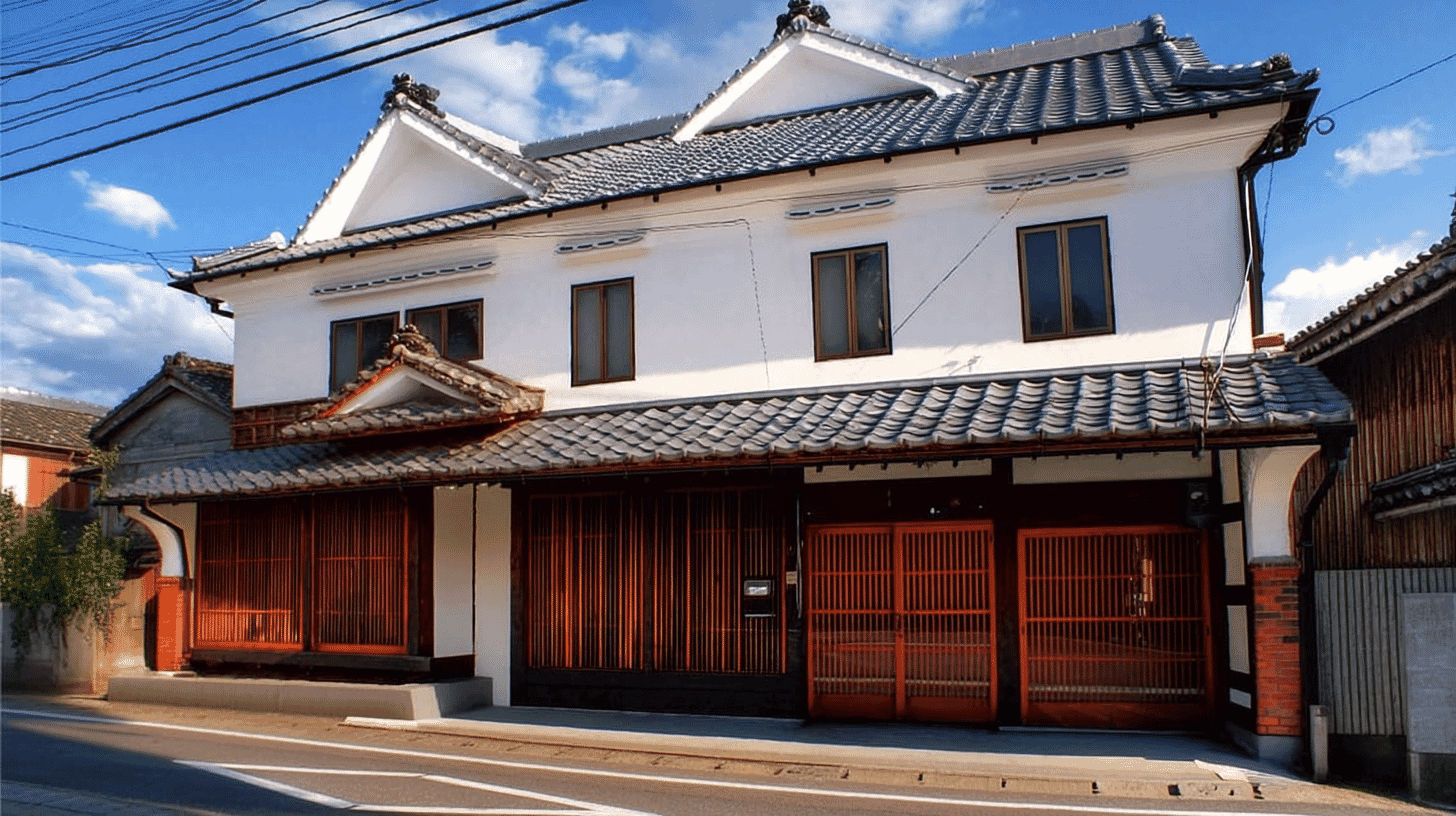
One Main House, a Registered Tangible Cultural Property since 2009
Yoshida Family Residence Main Building (吉田家住宅主屋, Yoshida-ke Jutaku Shuoku) stands at 103 Honmachi, Nakamura, Kashima City, Saga Prefecture, a Meiji-period town house entered on the register of tangible cultural properties on 8 January 2009. It is a registered property rather than a designated one.
The quantity is one building.
The structure is timber, two-storeyed, tiled, with a floor area of 228 square metres. The date field reads Meiji and the year field 1868 to 1911.
Posts Hidden, Walls Plastered White
It is a town house of thick white walls with no posts showing outside.
The Agency records outer walls plastered white with the posts concealed, and closes that it is a modern town house that conveys well the plastered-wall style of the district.
In concealed-post walls the posts are plastered over within the wall; the opposite, with posts showing on the wall face, is the exposed-post wall. In the plastered-wall style, a dwelling's walls are plastered thick like those of a storehouse.
The privy at the Tani Yutaka residence and the guard's hut at the Akagi residence are built with posts exposed.
Here the posts are hidden under a white surface. A timber-framed dwelling looks from outside like a store.
The storehouse on the same plot, by contrast, is a parlour store with rooms upstairs.
Two Hip-and-Gable Ranges Set at a Right Angle
Behind the range facing the street, another range joins at a right angle.
The Agency records it as hip-and-gabled and pantiled, with another hip-and-gabled wing thrown out at a right angle at the back.
A hip-and-gable roof is gabled above and slopes on all four sides below. The front and back ranges share that same form.
At the Ogiwara main house, a gabled entrance part and a lean-to reception part meet at a right angle: there the two roofs differ.
Here the two ranges set at a right angle have the same roof form. Nor does one range change form between its ends, as at the Akagi main house.
The Agency records a two-storeyed timber town house facing west onto an old highway. The front range faces the road, the back range runs into the depth of the plot.
Ebony in the Parlour, Brick at the Base of the Sides
Materials differ within and without.
The Agency records the interior as an earth-floored through passage on the south and living rooms on the north, with ebony and other fine timbers used in the reception room.
Fine timbers are chosen for the beauty of their grain and colour; ebony is a hard black wood from the south. It is used in the room where guests are received.
Outside, the side walls have brick laid at the base, the lower part of the wall.
The Obaraya oil storehouse finishes its front dado in tiled walling. Here brick shows below the white plastered wall.
The through passage runs with an earthen floor from front to back. Passage to the south and rooms to the north is a pattern also found at the Yoshida house in Kashiwazaki and at Araso in Tainai.
Visiting
The house stands at 103 Honmachi, Nakamura, Kashima City, Saga Prefecture, facing west onto the old highway.
At 228 square metres, it was registered on the same day as the storehouse of 49 square metres on the same plot.
There are main houses of the same name in Akiha Ward of Niigata City and in Kashiwazaki, but they are different buildings of different households.
No owner is recorded, and opening and terms follow the owner's arrangements. Check before travelling.
The old highway is a road that has long passed through this district.
Q&A
- When was the house registered?
- On 8 January 2009, as a registered tangible cultural property. It is registered rather than designated, and the quantity is one building.
- What is the plastered-wall style?
- A town-house style in which the dwelling's walls are plastered thick like a storehouse. Here the outer walls are plastered white with the posts concealed.
- What is the roof like?
- Hip-and-gabled and pantiled, with another hip-and-gabled wing at a right angle at the back.
- How is it laid out inside?
- An earth-floored through passage on the south and living rooms on the north, with ebony and other fine timbers in the reception room.
- Is it the same as the Yoshida houses in Niigata?
- No. Those in Akiha Ward and Kashiwazaki are different buildings of different households; this one stands in Kashima, Saga.
Basic Information
| Name | Yoshida Family Residence Main Building (吉田家住宅主屋, Yoshida-ke Jutaku Shuoku); the one at Nakamura, Kashima |
|---|---|
| Location | 103 Honmachi, Nakamura, Kashima City, Saga Prefecture |
| Designation | Registered tangible cultural property (structure, modern other); registered rather than designated; 2 buildings on the same plot were registered on the same day |
| Year Designated | 2009 (8 January), registered |
| Quantity | 1 building |
| Dimensions | Timber, 2-storeyed, tiled, with a floor area of 228 square metres. Hip-and-gabled and pantiled with a second hip-and-gabled wing at a right angle behind. White-plastered outer walls with posts concealed, brick at the base of the side walls. Through passage on the south and living rooms on the north; ebony and other fine timbers in the reception room. The date field reads Meiji and the year field 1868 to 1911 |
| Owner | Not stated in the record |
| Public Access | Opening and terms follow the owner's arrangements |
References
- Cultural Heritage Online: the main house at Kashima
- https://bunka.nii.ac.jp/heritages/detail/144861
- Cultural Heritage Online: the storehouse at Kashima
- https://bunka.nii.ac.jp/heritages/detail/172902
- Agency for Cultural Affairs, National Cultural Properties Database
- https://kunishitei.bunka.go.jp/
- Kashima City
- https://www.city.saga-kashima.lg.jp/
Last verified: 2026.09.22
