
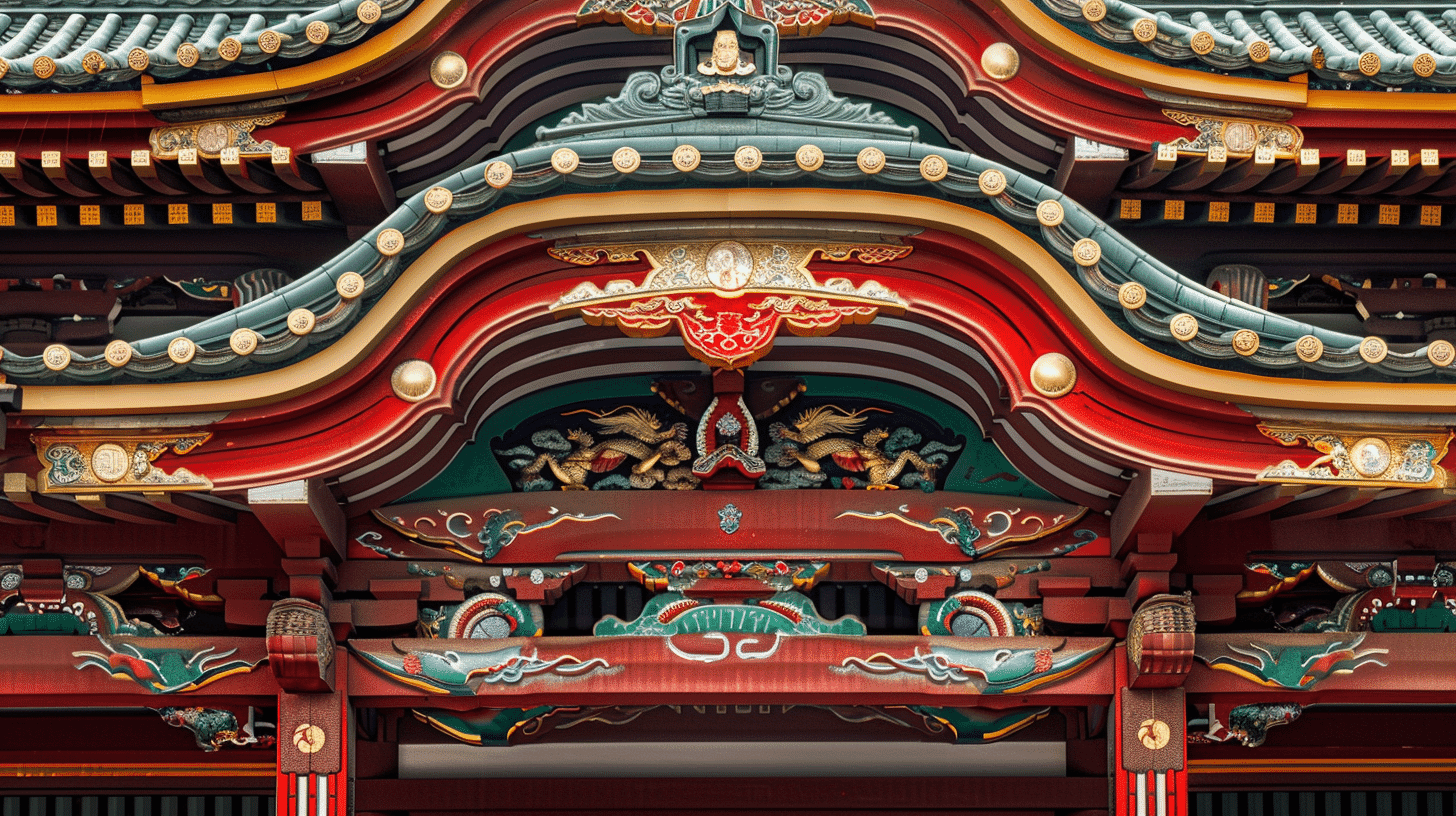
The Shodendo and the Kisomon of Kangiin
Kangiin Temple (歓喜院, Kangi-in) at Menuma Shodenzan in Menuma, Kumagaya City, Saitama Prefecture, is protected for two buildings, the mid-Edo Shodendo hall and the late-Edo Kisomon gate, both designated Important Cultural Property on 28 December 1984, with the Shodendo raised to National Treasure on 9 July 2012. The hall is read Shōdendō and the gate Kisōmon.
The Shodendo is the temple's main sanctuary, a Gongen-zukuri building that joins an inner sanctuary (okuden), a linking hall (chuden) and a worship hall (haiden) into one, roofed entirely in copper. The Kisomon is the main gate, standing about 200 meters east of the Shodendo and facing east, the first thing worshippers pass through.
A Hall Paid For by Ordinary Worshippers
According to the Agency for Cultural Affairs, the abbot Kaisan resolved to rebuild the Shodendo in 1720, raised the money from ordinary people, and had it built by the local carpenter Hayashi Hyogo Masakiyo. The inner sanctuary and part of the linking hall were finished in 1744, and the linking hall and worship hall by 1760. The Agency's record for the Kisomon gives the construction period as 1735 to 1760, which reads as the difference between the year the rebuilding was vowed and the year work began.
The Agency gives two reasons for the National Treasure designation. The hall pours in every decorative technique that developed during the Edo period and stands as one of their technical high points. And a building of that kind was made possible by popular faith, which shows how decorative culture spread through religious architecture. The worship hall's front, left open to make worship easier, is also read as a sign of how strong that popular devotion was.
The inner sanctuary measures 3 bays by 3 bays, the linking hall 3 bays by 1 bay, and the worship hall 5 bays by 3 bays. The inner sanctuary has an Irimoya-zukuri hipped-and-gabled roof with cusped eave gables on both sides and a dormer gable at the back; the worship hall is likewise hipped-and-gabled, with a front dormer gable and a porch 3 bays wide.
What to Look For
Carving and Colour on the Inner Sanctuary
The inner sanctuary of the Shodendo is worked in every carving technique available and finished in brilliant colour, with coloured lacquer and gold leaf. A guide prepared by a Kumagaya heritage committee describes large panels on the back and sides showing the Seven Gods of Fortune, scenes of children at play below them, and 12 monkeys, each with its own expression, watching from the tops of the posts. High under the eaves are scenes from Chinese classical stories.
Beasts Under the Eaves
The same guide notes the heads of real and mythical creatures projecting from rafter tails and brackets under the eaves: dragons, phoenixes, lions, elephants and baku, the creature said to eat bad dreams. The carving is attributed to Ishihara Ginpachiro of Hanawa in Joshu and his apprentices. The inner sanctuary was built first and is the most elaborate; decoration thins toward the worship hall at the front, which may mean that money ran short as the project neared its end.
The Kisomon's Triple Gable
The Kisomon is an eight-legged gate three bays wide with a single passage, two-tiered, under a Kirizuma-zukuri gabled roof of copper shaped like tile. The Agency singles out the rare and unusual form of its gable ends, where three bargeboards are stacked one above another. It is built entirely of zelkova and carved at key points in a variety of techniques, a showcase of late Edo craftsmanship completed around 1855.
Visiting
The Kisomon stands at the entrance to the precinct, which is always open and free, so you can walk through it at any time. The front of the Shodendo worship hall is visible from the precinct. To see the carved inner sanctuary up close, pay for the Shodendo viewing, 700 yen. Saitama Prefecture gives the hours as 9:30 a.m. to 4:30 p.m., last entry 4:00 p.m., but they can change with the season and temple events, so check the temple's notices.
Walk the inner sanctuary from the sides round to the back. The Seven Gods of Fortune on the panels, the children below them and the monkeys on the posts are arranged in layers, one above another.
- 📍 Plan Your Visit to Saitama
- Find tours, activities & transport passes near Kangiin Temple
- [ Kawagoe Little Edo & Moominvalley Park ]
Q&A
- When was the Kangiin Temple Shodendo designated a National Treasure?
- It was designated an Important Cultural Property on 28 December 1984 and a National Treasure on 9 July 2012. The Kisomon gate was designated an Important Cultural Property in 1984.
- How much does it cost to see the Kangiin Temple Shodendo, and when is it open?
- Admission is 700 yen. Saitama Prefecture gives the hours as 9:30 a.m. to 4:30 p.m., last entry 4:00 p.m. Entry to the precinct itself is free.
- Who built the Kangiin Temple Shodendo, and when?
- The abbot Kaisan vowed to rebuild it in 1720 and raised funds from ordinary worshippers; the local carpenter Hayashi Hyogo Masakiyo built it, and the three parts were complete by 1760.
- What carvings should you look for at the Kangiin Temple Shodendo?
- The Seven Gods of Fortune on the inner sanctuary panels, the children at play below, the 12 monkeys on the posts, and the dragons, baku and other beasts under the eaves, attributed to Ishihara Ginpachiro and his apprentices.
- What is special about the Kangiin Temple Kisomon gate?
- Its gable ends stack three bargeboards, a rare form. It is built of zelkova, richly carved, completed around 1855, and stands about 200 meters east of the Shodendo.
Basic Information
| Name | Kangiin Temple (歓喜院; Shodendo and Kisomon) |
|---|---|
| Location | 1511 Menuma, Kumagaya City, Saitama Prefecture |
| Designation | National Treasure (Shodendo), Important Cultural Property (Kisomon) |
| Year Designated | National Treasure 2012/7/9 (Heisei 24, Shodendo); Important Cultural Property 1984/12/28 (Showa 59) |
| Quantity | 2 buildings |
| Dimensions | Shodendo: inner sanctuary 3 bays by 3 bays, linking hall 3 bays by 1 bay, worship hall 5 bays by 3 bays, copper roof throughout; Kisomon: eight-legged gate 3 bays wide, two-tiered, gabled, copper roof |
| Owner | Kangiin |
| Public Access | Precinct always open and free; Shodendo viewing 700 yen, 9:30 a.m. to 4:30 p.m. |
References
- National Cultural Properties Database, Kangiin Shodendo (Agency for Cultural Affairs)
- https://kunishitei.bunka.go.jp/heritage/detail/102/463
- National Cultural Properties Database, Kangiin Kisomon (Agency for Cultural Affairs)
- https://kunishitei.bunka.go.jp/heritage/detail/102/3736
- Cultural Heritage Online, Kangiin Shodendo (Agency for Cultural Affairs)
- https://bunka.nii.ac.jp/heritages/detail/188303
- Overview of the Carvings of the Kangiin Shodendo (Japan Tourism Agency multilingual commentary database)
- https://www.mlit.go.jp/tagengo-db/R3-00044.html
- Tourism Resources of Kumagaya (Saitama Prefecture)
- https://www.pref.saitama.lg.jp/soshiki/b0110/hokubutiikinogaiyou/gunmadc-kankousozai-kumagaya.html
Last verified: 2026.10.01
Cultural Treasures in the Same Area
All are within walking distance in the same area, so we recommend visiting them together.
- Kankiin Temple Seitendo 0.00 km
- Kankiin Temple Kisomon 0.02 km
