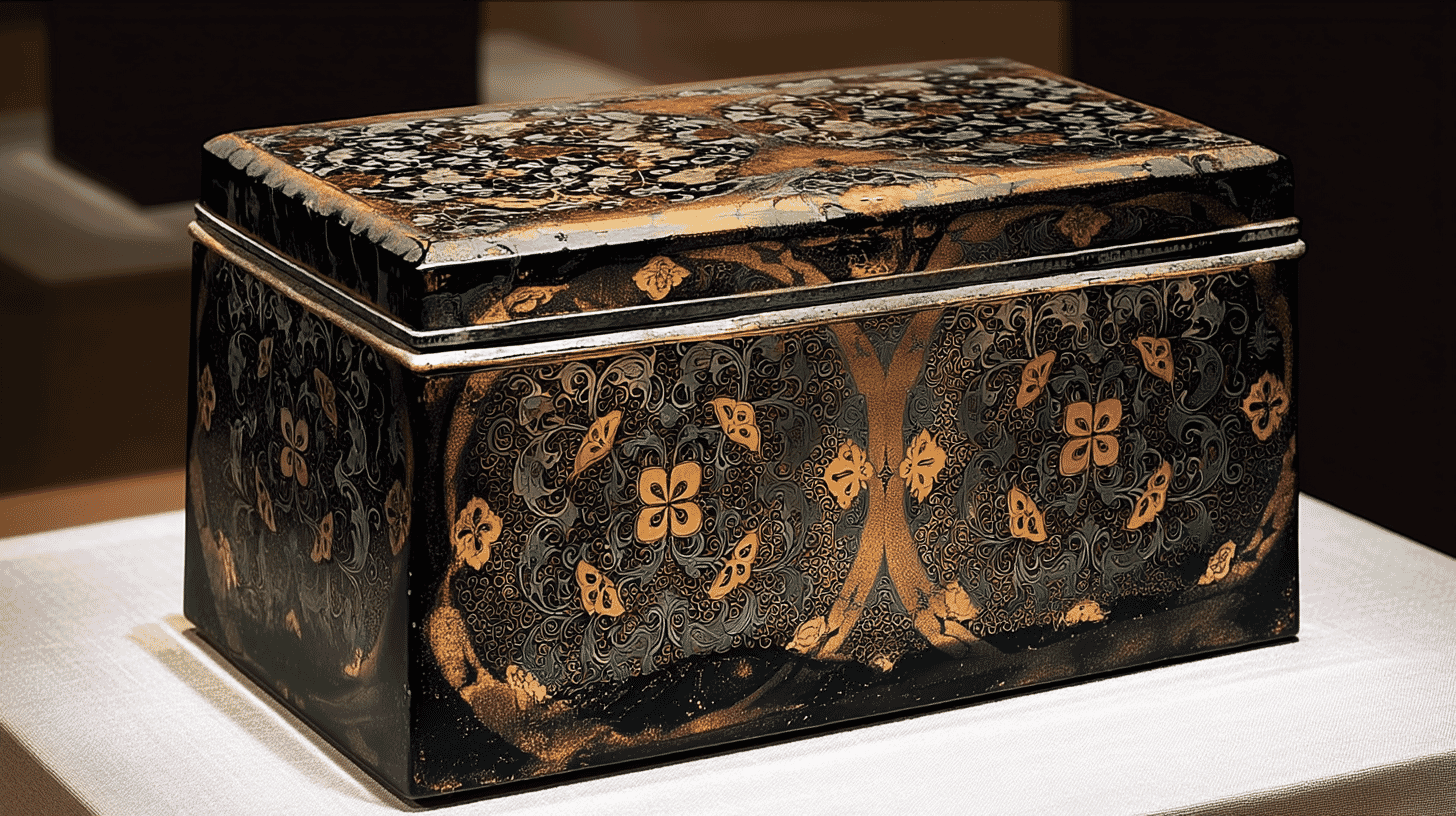
Hōsōge Maki-e Sutra Box: A National Treasure of Heian Lacquer Art at Enryaku-ji Temple

Discover the Hōsōge Maki-e Kyōbako, a National Treasure of Japan from the Heian period. This exquisite lacquered sutra box at Enryaku-ji Temple showcases the pinnacle of togidashi maki-e craftsmanship with gold and silver arabesque designs.

Hōsōge Maki-e Sutra Box — A Masterpiece of Heian Lacquer Art Preserved at Enryaku-ji Temple

Hidden within the sacred precincts of Mt. Hiei, one of the most exquisite examples of Heian-period lacquer art has been preserved for nearly a thousand years. The Hōsōge Maki-e Kyōbako (宝相華蒔絵経箱), or Sutra Box with Hōsōge Arabesque Design in Maki-e Lacquer, is a National Treasure of Japan that embodies the refined aesthetics and spiritual devotion of the Heian aristocracy. Created to house a copy of the Lotus Sutra with legendary ties to the great Chinese Buddhist master Zhiyi, this lacquered box is far more than a simple container — it is a sublime fusion of art, faith, and technical mastery that continues to captivate art lovers and historians from around the world.

What Is the Hōsōge Maki-e Sutra Box?

The Hōsōge Maki-e Kyōbako is a wooden lacquered box crafted during the late Heian period (roughly the 11th to 12th century) to hold sacred Buddhist sutras. It belongs to Enryaku-ji Temple, the head temple of Tendai Buddhism, located atop Mt. Hiei on the border of Kyoto and Shiga Prefecture. The box is currently deposited at the Kyoto National Museum for safekeeping.

Measuring 33.0 cm in length, 20.3 cm in width, and 17.0 cm in height, this is a large-format sutra box built in the inrō-buta (nested lid) style. The lid features a gentle dome-like curvature with elegantly beveled edges, and the joining rim is fitted with tin edging — a design element that recalls the stylistic conventions of the 7th and 8th centuries, lending the box a distinguished, archaic character even though it was crafted several centuries later.

According to tradition, the box was made to contain a copy of the Lotus Sutra (Hokke-kyō) said to have been written by Tendai Daishi Zhiyi (Chigi, 538–597), the revered founder of the Tiantai school of Buddhism in Sui-dynasty China. Zhiyi's teachings became the foundation upon which Saichō (767–822) established Tendai Buddhism in Japan, making this sutra box a vessel of profound religious significance that links the spiritual heritage of China and Japan.

The Art of Togidashi Maki-e: Gold and Silver on Black Lacquer

The exterior of the box is an outstanding example of togidashi maki-e, one of the oldest and most refined techniques in the Japanese lacquer tradition. In this method, a design is painted onto the lacquer surface, and fine metallic powders — in this case, gold and silver — are sprinkled over the wet lacquer. The entire surface is then sealed beneath additional layers of lacquer, and after drying, the artist painstakingly polishes the surface until the metallic design emerges, flush with and embedded in the lacquer ground. This creates a remarkably smooth and luminous finish, with the metal particles glowing softly from within.

On the Hōsōge Maki-e Sutra Box, this technique has been applied over a ground of black lacquer dusted with coarse gold particles (hirajin), creating a subtle shimmer across the entire surface. The main decorative motif consists of large circular medallions featuring hōsōge flower arabesques, distributed across every face of the box: two medallions grace the lid, two appear on each long side panel, and one adorns each short side panel. The flowers and the outlines of the circular frames are rendered in gold maki-e, while the leaves and trailing vines are depicted in silver — a deliberate contrast that creates a vivid, elegant interplay of warm and cool metallic tones.

The interior of the lid is decorated with a lighter hirajin ground, with delicate sprigs of karakusa (arabesque) design at the center and four corners, executed in silver maki-e. The inner walls are lined with a brown gold brocade featuring a peony arabesque pattern, while the bottom is covered with a purple gold brocade of similar design — both replacements added in later centuries, though they harmonize beautifully with the original lacquerwork.

Why Was It Designated a National Treasure?

The Hōsōge Maki-e Sutra Box was first recognized as an Important Cultural Property on April 7, 1900, and was elevated to National Treasure status on February 19, 1957. The official designation by Japan's Agency for Cultural Affairs praises the box for its flowing, graceful brushwork and the outstanding compositional quality of its arabesque designs, describing it as one of the most representative maki-e sutra boxes of the Heian period.

Several factors contribute to this extraordinary assessment. First, the togidashi maki-e technique used here represents the pinnacle of Heian lacquerwork, a period when this particular method was the dominant and most prestigious form of lacquer decoration. Second, the bold yet harmonious use of gold and silver to differentiate between floral elements and foliage demonstrates a sophisticated understanding of color and visual rhythm. Third, the intentional incorporation of archaic design elements — particularly the beveled upper edges typical of 7th- and 8th-century craftsmanship — reflects a conscious dialogue between contemporary artistry and venerated tradition. Finally, the rarity of surviving Heian-period lacquerware of this quality makes the box an irreplaceable document of Japan's cultural history.

The Hōsōge Motif: An Imaginary Flower of Buddhist Beauty

The hōsōge (宝相華) is one of the most iconic decorative motifs in East Asian Buddhist art. The name can be translated as "precious appearance flower" — a reference to the radiant countenance of the Buddha himself. This is not a depiction of any real blossom; rather, it is an imaginary composite flower that blends the most beautiful elements of the lotus, peony, pomegranate, chrysanthemum, and palmette into a single idealized form.

The motif originated in Central and South Asia, traveled along the Silk Road, and flourished in Tang-dynasty China (7th–10th century) before being transmitted to Japan during the Nara and Heian periods. In Japan, it became deeply woven into the visual vocabulary of Buddhist temple decoration, textile design, metalwork, and lacquerware. Magnificent examples of the hōsōge can be found among the treasures of the Shōsō-in in Nara and in the ornamental programs of the Byōdō-in in Uji.

On this sutra box, the hōsōge motifs are arranged within circular frames and interlaced with karakusa arabesques — flowing, rhythmic vine patterns that evoke the endless cycles of Buddhist cosmology. The combination of these two motifs creates a visual meditation on spiritual beauty and the eternal nature of the dharma.

Highlights and Points of Interest

For visitors fortunate enough to see the Hōsōge Maki-e Sutra Box on display, there are several remarkable details to observe. The seamless smoothness of the togidashi maki-e surface, where gold and silver emerge from the lacquer as if radiating from within, is a testament to the extraordinary patience and skill of the anonymous Heian-period artisan who created it. Notice how the circular medallions are slightly different on each face of the box, with subtle variations in the arrangement of flowers, leaves, and vines — no two are identical, yet all maintain perfect harmony.

Pay particular attention to the contrast between the warm glow of gold flowers and the cool shimmer of silver leaves, a color strategy that was characteristic of the finest Heian lacquerwork. The tin rim fittings along the lid's edge add a tactile and visual accent that complements the metallic decoration. Even the lid's interior, with its quieter silver arabesques on a lighter ground, rewards close inspection.

This sutra box is displayed alongside other National Treasures from Enryaku-ji's collection during special exhibitions, offering an unparalleled opportunity to appreciate the breadth and depth of Japan's Buddhist artistic heritage. Among Enryaku-ji's ten National Treasures (including the famed Root Hall, or Konpon Chū-dō), several are lacquerwork and metalwork objects of similar refinement.

Where and When Can You See It?

Because of its age and the need for careful conservation, the Hōsōge Maki-e Sutra Box is not on permanent display. It is shown only on rare occasions — typically during special exhibitions at Enryaku-ji's Kokuhoden (National Treasure Hall) on Mt. Hiei, or when it is lent to major exhibitions at national museums. Checking the exhibition schedules of Enryaku-ji and the Kyoto National Museum before your visit is strongly recommended.

Even when this specific object is not on view, a visit to Mt. Hiei and Enryaku-ji Temple is deeply rewarding. The Kokuhoden houses a rotating selection of the temple's remarkable Buddhist art, including sculptures, paintings, manuscripts, and lacquerware, many of which are designated as Important Cultural Properties or National Treasures.

Visiting Enryaku-ji Temple and Mt. Hiei

Enryaku-ji Temple, a UNESCO World Heritage Site, occupies a vast sacred domain across the summit of Mt. Hiei, straddling the border between Kyoto and Shiga Prefecture. The temple complex is divided into three main areas: Tō-dō (East Pagoda), Sai-tō (West Pagoda), and Yokawa. The Kokuhoden and the iconic Konpon Chū-dō (Root Hall) are located in the Tō-dō area, the spiritual heart of the complex.

The mountain setting itself is breathtaking, with towering cedar forests, panoramic views of Lake Biwa — Japan's largest lake — and the cityscape of Kyoto in the distance. The atmosphere of deep quiet and spiritual gravitas that pervades the temple grounds has been cultivated over more than 1,200 years. Visitors can experience zazen (seated meditation), shakyō (sutra copying), and attend morning services at the temple's lodging facility, the Enryaku-ji Kaikan.

Access

From the Shiga (east) side, take the JR Kosei Line to Hieizansakamoto Station, then transfer to the Ejako bus to Cable Sakamoto Station, and ride the Sakamoto Cable Car (Japan's longest at 2,025 meters) up to Cable Enryaku-ji Station. The Tō-dō area is a 10-minute walk from there. From the Kyoto (west) side, take the Eizan Railway from Demachiyanagi Station to Yase-Hieizanguchi, then transfer to the Eizan Cable Car and Ropeway to reach the summit.

Surrounding Attractions

At the foot of Mt. Hiei on the Shiga side lies the historic Sakamoto district, famous for its stone walls built by the master stonemasons known as Anō-shū. The Hiyoshi Taisha Grand Shrine, Enryaku-ji's guardian shrine and a center of the Sannō Shinto tradition, is located here. From the summit, visitors enjoy magnificent views of Lake Biwa and can explore the Garden Museum Hiei. The nearby city of Ōtsu offers hot springs, the scenic lakeside promenade, and access to the Mii-dera temple complex, another important center of Tendai Buddhism.

📍 Plan Your Visit to Shiga
Find tours, activities & transport passes near Hosohana Makie Sutra Box
[ Hikone Castle & Lake Biwa Cruise Experiences ]

Q&A

QIs the Hōsōge Maki-e Sutra Box always on display?
ANo, it is shown only during special exhibitions. The box is typically displayed at Enryaku-ji's Kokuhoden (National Treasure Hall) during autumn special exhibitions, or at major exhibitions in national museums such as the Kyoto National Museum. Please check official exhibition schedules in advance.
QWhat is togidashi maki-e?
ATogidashi maki-e (burnished maki-e) is the oldest form of Japanese maki-e lacquer decoration. The technique involves painting a design in lacquer, sprinkling gold or silver powder over it, sealing the design under additional lacquer layers, and then polishing the surface until the metallic pattern emerges flush with the surrounding lacquer. The result is a smooth, luminous finish that is extremely durable.
QWhat is a hōsōge flower?
AHōsōge (宝相華, "precious appearance flower") is an imaginary composite flower motif used widely in Buddhist art. It combines the beautiful features of the lotus, peony, pomegranate, and other flowers into a single idealized form. The motif originated along the Silk Road, flourished in Tang-dynasty China, and became a beloved decorative element in Japanese Buddhist art from the Nara period onward.
QHow do I get to Enryaku-ji Temple?
AFrom Kyoto, take the Eizan Railway from Demachiyanagi Station, then transfer to the Eizan Cable Car and Ropeway. From the Shiga side, take the JR Kosei Line to Hieizansakamoto Station, then the bus to Cable Sakamoto Station and the Sakamoto Cable Car. By car, the Hiei-zan Drive Way provides access. Temple admission is ¥1,000 for adults, with an additional ¥500 for the Kokuhoden.
QAre there English guides or information available at Enryaku-ji?
AEnryaku-ji provides English pamphlets and signage at major buildings. Audio guides and English-language information panels are available in some areas. The temple's official website also offers English-language content. For a deeper experience, consider joining a guided tour offered through local tourism organizations in Kyoto or Ōtsu.

Basic Information

Official Name 宝相華蒔絵経箱 (Hōsōge Maki-e Kyōbako / Sutra Box with Hōsōge Arabesque Design in Maki-e Lacquer)
Designation National Treasure of Japan (Crafts / Lacquerware)
National Treasure Designated February 19, 1957 (Important Cultural Property since April 7, 1900)
Period Heian period (late 11th–12th century)
Technique Togidashi maki-e (burnished gold and silver maki-e on black lacquer with hirajin ground)
Dimensions Length 33.0 cm × Width 20.3 cm × Height 17.0 cm
Quantity 1 box
Owner Enryaku-ji Temple (延暦寺), Ōtsu City, Shiga Prefecture
Depository Kyoto National Museum (on deposit)
Viewing Venue Enryaku-ji Kokuhoden (National Treasure Hall), Mt. Hiei, Ōtsu City / Special exhibitions at national museums
Temple Admission Adults ¥1,000 / High school & junior high ¥600 / Elementary ¥300; Kokuhoden additional ¥500
Temple Hours 9:00–16:00 (varies seasonally; winter hours may differ for Sai-tō and Yokawa areas)
Access JR Kosei Line to Hieizansakamoto Sta. → bus to Cable Sakamoto Sta. → Sakamoto Cable Car; or Eizan Railway from Demachiyanagi Sta. → Eizan Cable Car & Ropeway

References

宝相華蒔絵経箱 — Cultural Heritage Online (Agency for Cultural Affairs)
https://bunka.nii.ac.jp/heritages/detail/150091
National Treasure: Hōsōge Maki-e Kyōbako [Enryaku-ji / Shiga] — WANDER National Treasures
https://wanderkokuho.com/201-00506/
Reference Cooperative Database — National Diet Library (Overview of the Sutra Box)
https://crd.ndl.go.jp/reference/entry/index.php?id=1000102488&page=ref_view
Kokuhoden (National Treasure Hall) — Enryaku-ji Temple Official Website
https://www.hieizan.or.jp/keidai/kokuhoden
Enryaku-ji Temple — Official Website
https://www.hieizan.or.jp/
Hōsōge — Shōsō-in Exhibition Glossary (Nara National Museum)
https://shosointen-glossary.narahaku.go.jp/hosoge/
Maki-e — Wikipedia
https://en.wikipedia.org/wiki/Maki-e
Enryaku-ji Temple — Shiga Prefecture Official Tourism Website
https://www.biwako-visitors.jp/spot/detail/58/

Last verified: 2026.02.17