A Classic of Shoin-Zukuri at Mii-dera
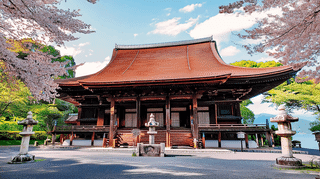
The Kojoin Guest Hall (光浄院客殿, Kojoin kyakuden) is a reception hall built in 1601 at Kojoin, a subtemple of Onjoji (Mii-dera) in Onjoji-cho, Otsu City, Shiga Prefecture, and it was designated a National Treasure on November 22, 1952. It had first been designated under earlier law in 1901.
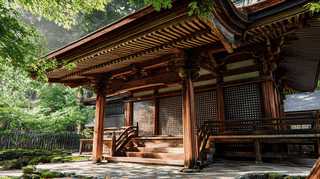
The Agency for Cultural Affairs records it as 7 ken by 6 ken, a single storey under a hip-and-gable roof entered from the gable end, with a cusped karahafu gable on the front eave. A gabled middle gate (chumon) of 1 ken by 1 ken is attached, and all the roofs are covered in wooden shingles. Mii-dera attributes it to Yamaoka Doami, a warrior in the service of Toyotomi Hideyoshi who was also a monk of the temple.
According to the Agency, Kojoin began in the Muromachi period when Yamaoka Sukehiro built it on the site of a former cloister (十円坊) within Onjoji, and the date of the present hall is recorded in a document on the founding of Kojoin.
Why It Is a National Treasure
Mii-dera presents the Kojoin Guest Hall as a representative surviving example of shoin-zukuri, the residential style that emerged in the Muromachi period. The Agency notes that it is in the same style as the nearby Kangakuin Guest Hall and the Gekkoden of Gokokuji (formerly the guest hall of Nikkoin), which once stood on the temple grounds.
What the Agency singles out is its deliberately old-fashioned composition. Although it closely resembles the Kangakuin Guest Hall, it has no rooms for living or sleeping, it adds a projecting raised room (jodan-no-ma), and it lines the north side of the east carriage porch with top-hinged shutters, all features that resemble the plan of a shuden in the Shomei, a carpentry treatise of the early Edo period. At the same time, setting the alcove and staggered shelves of the main room inside the structural posts is a newer technique, so medieval form and early modern technique meet in one building.
According to Mii-dera, the main room has an oshiita alcove and staggered shelves (chigaidana) on its front, a chodaigamae doorway on the north, and in the raised room projecting onto the southern veranda a built-in desk (tsukeshoin) and another oshiita. These zashiki decorations became fixed features of shoin-zukuri and passed into the formal rooms of Japanese houses, making the hall a source for the Japanese reception room itself.
What to Look For
The interior is arranged in two rows running north to south. According to the Agency, the southern row runs from the west with the 18-mat main room, the 18-mat second room and the 6-mat carriage porch room, while the northern row has rooms of 6, 8, 12 and 4 mats. An alcove and shelves line the west side of the main room, and at the west end of the south side a 2-mat raised room projects onto the veranda, with its own alcove and built-in desk.
Mii-dera says the main room and second room are decorated with wall and door paintings by Kano Sanraku and other Kano school painters, designated as an Important Cultural Property for showing the character of the late Momoyama Kano school well. The alcove of the main room shows a landscape with a waterfall around a spreading pine.
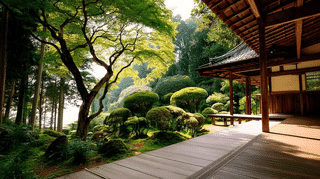
The southern veranda is left open, with only a single outer post supporting the eaves. Beyond it lies a garden made in the late Muromachi period, its pond reaching right up to the edge of the lower veranda. Mii-dera highlights the sense that the painted landscapes inside continue out into the garden.
Visiting the Kojoin Guest Hall
The Kojoin Guest Hall is not open to the general public, but special viewings can be arranged by application in advance, according to Mii-dera, and a member of the temple guides visitors on the day. The special viewing offering is ¥1,000 per person, with the temple entrance fee charged separately, and viewings run from 9:30 a.m. to 3:30 p.m.
Applications must arrive at least one week before the desired date and are accepted only for groups of 4 or more. Viewings may be unavailable because of temple services. Temple hours, entrance fees and access are on the Onjoji Temple page.
Q&A
- Can visitors see the Kojoin Guest Hall?
- It is not open to the general public, but special viewings are available by advance application: ¥1,000 per person plus the temple entrance fee, applications arriving a week ahead, for groups of 4 or more.
- When was the Kojoin Guest Hall built, and by whom?
- It was built in 1601. Mii-dera attributes it to Yamaoka Doami, a warrior who served Toyotomi Hideyoshi and was also a monk of the temple.
- When was the Kojoin Guest Hall designated a National Treasure?
- On November 22, 1952. It had been designated under earlier law in 1901.
- Why is the Kojoin Guest Hall considered a model of shoin-zukuri?
- It has the full set of zashiki decorations, the alcove, staggered shelves, chodaigamae and built-in desk, that passed into Japanese houses, and the Agency notes its resemblance to the shuden plan in the early Edo treatise Shomei.
- Who painted the Kojoin Guest Hall's wall and door paintings?
- According to Mii-dera, Kano Sanraku and other Kano school painters. The paintings are designated as an Important Cultural Property.
Basic Information
| Name | Kojoin Guest Hall (光浄院客殿) |
|---|---|
| Location | 246 Onjoji-cho, Otsu City, Shiga Prefecture (Onjoji) |
| Designation | National Treasure (Structure) |
| Year Designated | National Treasure 1952/11/22 (Showa 27); earlier designation 1901/3/27 (Meiji 34) |
| Quantity | 1 building |
| Dimensions | 7 ken by 6 ken, single storey, hip-and-gable roof, gable-end entrance, karahafu on the front eave; middle gate 1 ken by 1 ken, gabled; wooden shingles throughout |
| Owner | Onjoji |
| Public Access | Not open to the public. Special viewing by advance application (¥1,000 per person, groups of 4 or more, 9:30 a.m. to 3:30 p.m.) |
References
- 光浄院客殿 (Database of National Cultural Properties, Agency for Cultural Affairs)
- https://kunishitei.bunka.go.jp/bsys/maindetails/102/1332
- Kojoin Guest Hall, National Treasure special admission (Mii-dera)
- https://miidera1200.jp/kojo-in/
- Visitor information (Mii-dera)
- https://miidera1200.jp/information
Last verified: 2026.10.04