Shimizuyama Castle Ruins: A Hidden Samurai Stronghold on the Shores of Lake Biwa

Discover Shimizuyama Castle Ruins, a designated National Historic Site in Shiga Prefecture. Explore the 13th-century mountain fortress of the Sasaki clan, featuring rare defensive structures and panoramic views of Lake Biwa.

A Mountain Fortress Frozen in Time

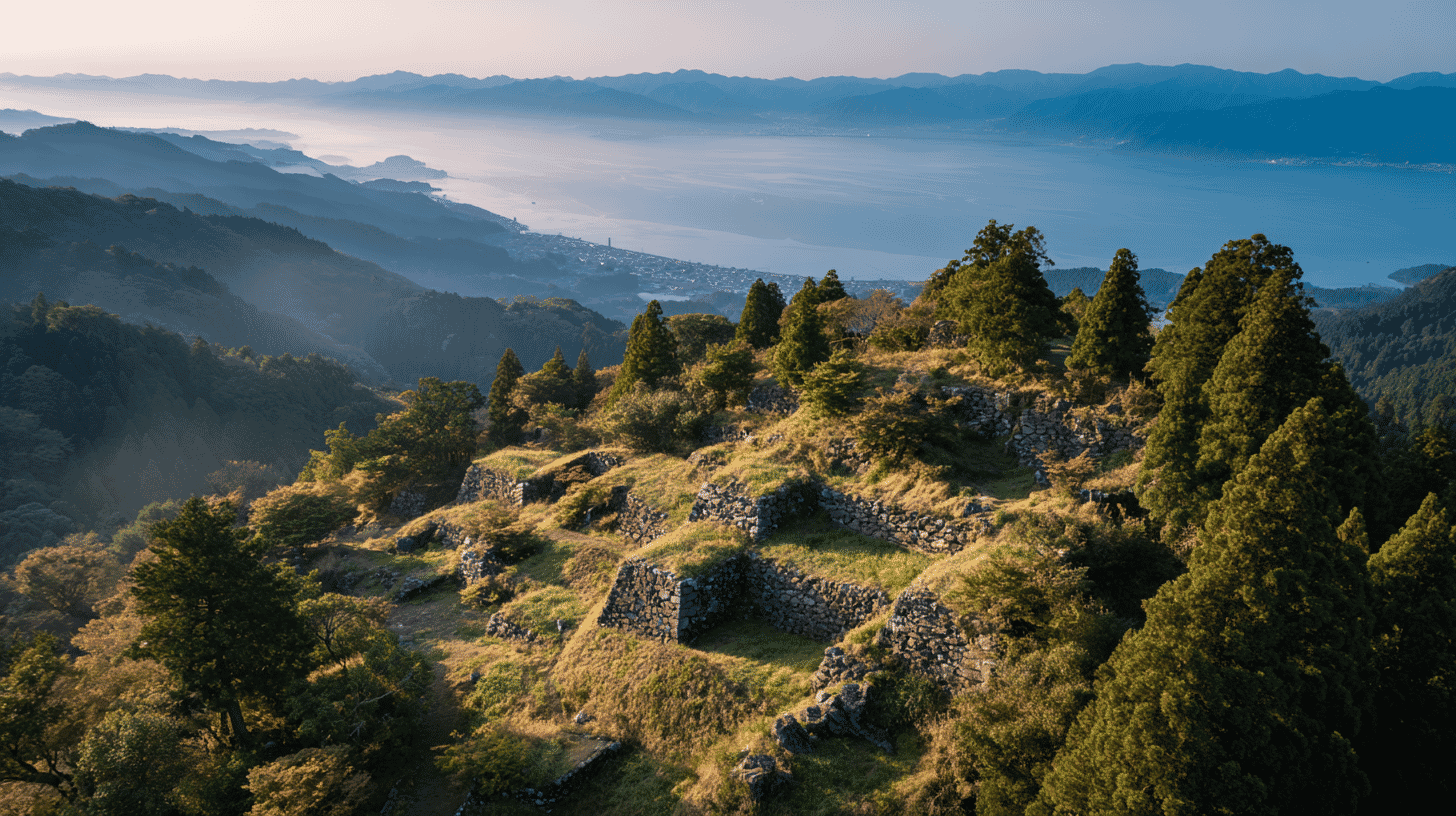
Rising from the forested slopes overlooking the western shores of Lake Biwa, Shimizuyama Castle Ruins (清水山城館跡) stands as one of Japan's most remarkably preserved medieval castle complexes. Designated as a National Historic Site in 2004, this sprawling archaeological treasure invites visitors to walk through seven centuries of samurai history, where moss-covered stone foundations and earthen ramparts whisper tales of the powerful Sasaki clan who once commanded these highlands.

Unlike the reconstructed towers and whitewashed walls of more famous castles, Shimizuyama offers something increasingly rare: authenticity. Here, the original defensive structures remain untouched, allowing visitors to experience a genuine Sengoku-period mountain fortress exactly as it was left when the fires of war finally fell silent.

The Legacy of the Sasaki Clan

The story of Shimizuyama Castle begins in 1235, when Sasaki Takanobu, second son of the renowned Sasaki Nobuzuna, was appointed as the land steward of Tanaka-go in Takashima County. Takanobu established his headquarters on this strategic mountain, founding what would become the seat of power for one of western Omi Province's most influential warrior families.

The Takashima branch of the Sasaki clan, also known as the Sasaki Etchu family (after the hereditary title of Etchu-no-kami bestowed upon them by the imperial court), grew to dominate the region. They became the head family of the "Takashima Seven Heads" (高島七頭), a coalition of seven branch families including the Kutsuki, Nagata, Tanaka, Yokoyama, and others, who collectively controlled the strategic Adogawa River basin and the vital western lake shore trade routes.

For over three centuries, the Sasaki Etchu lords presided over their domain from Shimizuyama, their influence extending across the waterways and mountain passes that connected the capital region to the Japan Sea coast. Their castle was not merely a military installation but the administrative and cultural heart of a flourishing medieval domain.

The Fall of a Fortress

The fate of Shimizuyama Castle was sealed during the tumultuous final decades of the Sengoku period. According to the "Shincho Koki," the chronicle of Oda Nobunaga's campaigns, the warlord attacked Kido Castle and Tanaka Castle in Takashima County in 1573 during his deadly struggle against the Asai-Asakura alliance. Historical research suggests that "Kido Castle" mentioned in this record was likely Shimizuyama Castle itself.

The Sasaki Etchu lords had allied themselves with the Asai clan against Nobunaga's expansion, a decision that would prove fatal to their ancient domain. When Nobunaga's forces swept through the region, they brought fire and destruction to the temples and strongholds that had stood for generations. The castle fell, the domain collapsed, and the Sasaki Etchu line faded from the stage of history.

Yet this violent end paradoxically preserved Shimizuyama for posterity. Unlike castles that continued to be modified through the peaceful Edo period, this fortress was abandoned at the height of Sengoku-era military architecture, its sophisticated defenses captured in a moment of historical amber.

Why Shimizuyama Castle Was Designated a National Historic Site

The Japanese government designated Shimizuyama Castle Ruins as a National Historic Site on February 27, 2004, recognizing its exceptional value for understanding medieval Japanese castle construction and regional governance. Several factors contributed to this prestigious designation.

First, the site's remarkable state of preservation is extraordinary among Japanese castle ruins. The complex encompasses not only the mountain fortress itself but also the residential quarters, temple grounds, and warrior estates that comprised the full castle town. This completeness allows researchers to study the entire ecosystem of a medieval lord's domain rather than just isolated fortifications.

Second, Shimizuyama exhibits architectural features that reveal the complex web of political alliances during the Sengoku period. The castle's distinctive "une-jo karabori-gun" (ridge-shaped dry moat groups) are rarely seen in Omi Province and are believed to have been introduced through contact with the Asai and Asakura clans to the north. These defensive innovations mark a specific moment of technological transfer during the mid-16th century.

Third, archaeological excavations since 1996 have uncovered a wealth of artifacts including Echizen ware, imported Chinese ceramics, metal implements, and inkstones dating primarily to the second and third quarters of the 16th century. A large foundation-stone building discovered in the main keep area is believed to have served as both a lord's residence and an assembly hall, providing valuable insight into medieval governance practices.

Exploring the Castle Complex

Shimizuyama Castle Ruins comprises three distinct archaeological zones, each offering unique perspectives on medieval life in the Takashima domain.

The Mountain Castle (山城跡) crowns the southeastern portion of the Aibano Plateau at an elevation of approximately 210 meters. The main keep area measures roughly 55 meters east to west and 60 meters north to south, forming an L-shaped enclosure. From this central position, defensive baileys radiate outward along three ridges to the northwest, southwest, and southeast, creating a distinctive radial fortification pattern. The ridge-shaped dry moat groups on the south face of the main keep and among the northern bailey complex represent some of the finest surviving examples of this defensive technique in the region.

The Shimizuyama Site (清水山遺跡), spread across the mountainside between 130 and 170 meters elevation, contains the residential quarters of the warrior elite. A 10-meter-wide processional road runs north to south through this zone, flanked by earthen walls and clearly defined rectangular residential plots arranged in a grid pattern. Each plot contains its own well, indicating these were self-sufficient living units. Local place names such as "Nishi-Yashiki" (West Residence), "Higashi-Yashiki" (East Residence), "Etchu-dono" (Lord Etchu), and "Kaga-dono" (Lord Kaga) preserve the memory of the noble families who once dwelt here. This area is believed to have repurposed the temple buildings of Shimizu-dera, a Tendai Buddhist temple that once stood on the mountain.

The Hondotani Site (本堂谷遺跡), located at approximately 130 meters elevation to the west of the Shimizuyama Site, features a double ring of moats and earthen walls with interior divisions. Adjacent to the Oarashiko Shrine, which tradition holds was founded by Sasaki Takanobu to enshrine his clan's guardian deity, this zone is associated with Daiho-ji, another Tendai temple whose remains may have been adapted for residential use. A seated Buddha statue now preserved at Hofuku-ji Temple in the nearby Inokuchi village is said to have been rescued from Daiho-ji when Nobunaga's forces put the temple to the torch.

What to See: Highlights for Visitors

The main keep area rewards climbers with not only archaeological wonders but also breathtaking panoramas. From this vantage point, the lords of Shimizuyama surveyed their domain: the fertile Adogawa River plain stretching to the shores of Lake Biwa, the sacred Chikubu Island floating in the blue distance, and on clear days, the mountains of the opposite shore. Standing where the Sasaki lords once stood, contemplating the same view they contemplated five centuries ago, creates a profound connection with history.

The stone steps and foundation stones of the main keep building remain clearly visible, inviting visitors to imagine the imposing six-by-five bay structure that once rose here. Archaeologists believe this building served the dual functions of lord's residence and council hall, where the Sasaki Etchu held audiences and administered their domain.

The ridge-shaped dry moat groups demonstrate the sophisticated military engineering of the late Sengoku period. These parallel ridges carved into the steep hillside would have slowed attacking forces while exposing them to fire from above, a technique borrowed from the northern domains that reveals the complex alliances of the era.

Throughout the residential areas, visitors can trace the outlines of individual compounds, their wells still visible, and contemplate the daily lives of the samurai families who called this mountain home. The processional road, though now a forest path, retains its impressive width and the ghost of its former grandeur.

Cultural Connections: Living Heritage

The legacy of Shimizuyama Castle lives on in the traditions of the surrounding communities. The Nanakawa Festival at Oarashiko Shrine, featuring the distinctive "yakko-buri" procession (designated an Intangible Folk Cultural Property of Shiga Prefecture), traces its origins to the Sasaki clan's dedication of twelve mounted archers and twelve targets before military campaigns.

In the Imaichi district at the northern edge of the former castle town, Sasaki Shrine still hosts the Takeuma Festival, where children ride bamboo horses in a ceremony commemorating the castle's defense. According to local tradition, when the men departed to face Nobunaga's army, the women and children rode bamboo horses in circles to make the castle appear fully garrisoned, a poignant testament to the community's solidarity in times of crisis.

Since 2009, the Shimizuyama Castle Enjoyment Club has worked to preserve and promote the site, organizing hiking events, maintenance activities, and seasonal programs including "Ikusasaizu" battle experience events each autumn. Their efforts ensure that this remarkable historical site remains accessible and appreciated by new generations.

Nearby Attractions

A visit to Shimizuyama Castle can be combined with several other outstanding attractions in the Takashima area to create a full day of exploration.

Harie Shozu no Sato, the "Village of Living Water," lies just a short distance from Shin-Asahi Station. This remarkable community has maintained a traditional water system called "kabata" for centuries, using naturally-springing groundwater for cooking, cooling, and daily life. The crystalline springs, which maintain a constant temperature of about 14°C year-round, were featured in the NHK documentary "Satoyama" and have been designated one of Japan's 100 Best Waters of the Heisei Era. Guided tours allow visitors to experience this sustainable lifestyle firsthand.

The famous Metasequoia Avenue in the Makino district, approximately 30 minutes north by car, offers one of Japan's most spectacular tree-lined roads. Some 500 metasequoia trees form a 2.4-kilometer corridor that transforms with the seasons: fresh green in spring, deep emerald in summer, burnished gold in autumn, and bare branches dusted with snow in winter. Selected as one of Japan's 100 Best New Roadside Tree Rows, this photogenic avenue has become an essential destination for visitors to the Lake Biwa region.

For those interested in spiritual sites, the ancient Shirahige Shrine, standing with its distinctive torii gate rising from the lake waters, and the sacred Chikubu Island, accessible by ferry from Imazu Port, offer additional opportunities to explore the rich cultural heritage of Lake Biwa's western shore.

Practical Information for Visitors

Shimizuyama Castle Ruins is freely accessible to the public year-round. The hiking trail to the main keep takes approximately 30 minutes from the Shin-Asahi Forest Sports Park, following a well-maintained path through cedar forest. Visitors should wear sturdy footwear and bring water, as the terrain is uneven and there are no facilities within the historic site itself.

The Shin-Asahi Forest Sports Park provides parking, restrooms, and information brochures about the castle ruins. Staff at the park office can offer guidance on current trail conditions and points of interest.

Spring and autumn are ideal seasons for visiting, when the forest is either awakening with fresh growth or ablaze with fall colors, and temperatures are comfortable for hiking. Summer visits are possible but can be hot and humid, while winter may see snow accumulation at higher elevations.

📍 Plan Your Visit to Shiga
Find tours, activities & transport passes near Shimizuyama Castle Ruins
[ Hikone Castle & Lake Biwa Cruise Experiences ]

Q&A

QHow long does it take to explore Shimizuyama Castle Ruins?
AA basic visit to the main keep area takes approximately 2 hours round trip from Shin-Asahi Forest Sports Park, including hiking time and exploration. Those wishing to thoroughly investigate the residential areas and Hondotani Site should allow 3-4 hours. The entire complex spans roughly one square kilometer, so a comprehensive exploration can fill a full half-day.
QIs there an English guide or English signage at the site?
ACurrently, most on-site signage is in Japanese only. The Shin-Asahi Forest Sports Park offers pamphlets with basic information, primarily in Japanese. Visitors who cannot read Japanese may benefit from downloading translation apps or researching the site beforehand. The Shimizuyama Castle Enjoyment Club occasionally organizes guided tours, though these are typically conducted in Japanese.
QIs the castle ruins suitable for families with children?
AThe hiking trail involves moderate elevation gain and some uneven terrain, making it suitable for older children and active families. Young children may find the climb challenging. The forest setting and sense of adventure can be highly engaging for kids interested in samurai history. The adjacent Shin-Asahi Forest Sports Park offers additional recreational facilities that may appeal to families.
QCan I visit Shimizuyama Castle Ruins and Harie Shozu no Sato in the same day?
AYes, the two sites are both accessible from Shin-Asahi Station and can be combined into a full-day excursion. Note that Harie Shozu no Sato requires advance reservations for guided tours, which are offered at 10:00 AM and 2:00 PM daily (closed Mondays). Planning your castle visit around the Harie tour schedule is recommended.
QWhat is the best season to visit?
AAutumn (mid-October to mid-November) is particularly beautiful, when the deciduous forest surrounding the ruins displays brilliant fall colors. Spring (late March to early May) offers pleasant hiking weather and new greenery. Summer can be hot and humid with mosquitoes, while winter may see snow at higher elevations. Each season offers a different perspective on this atmospheric site.

Basic Information

Official Name Shimizuyama Castle Ruins (清水山城館跡 / しみずやまじょうかんあと)
Designation National Historic Site (designated February 27, 2004)
Location Kumanomoto and Yasuigawa, Shin-Asahi-cho, Takashima City, Shiga Prefecture, Japan
Construction Period Originally built 1235 (Katei 1); major expansion during Eiroku era (1558-1570)
Historical Lords Sasaki Etchu clan (Takashima clan), head family of the "Takashima Seven Heads"
Castle Type Mountain castle (yamashiro) with radial fortification layout
Elevation Main keep approximately 210 meters above sea level
Access 15-minute walk from JR Shin-Asahi Station to Shin-Asahi Forest Sports Park; additional 30-minute hike to main keep
Admission Free
Facilities Parking and restrooms available at Shin-Asahi Forest Sports Park (no facilities within historic site)
Contact Biwako Takashima Tourism Association: 0740-33-7101

References

清水山城館跡 | びわ湖高島観光ガイド
https://takashima-kanko.jp/spot/2018/06/post_99.html
清水山城館跡 | 文化遺産オンライン
https://bunka.nii.ac.jp/heritages/detail/207253
清水山城館跡(しみずやまじょうかんあと) | 高島市
https://www.city.takashima.lg.jp/soshiki/kyoikusomubu/bunkazaika/1/1/669.html
清水山城 | 近江の城めぐり - 出張!お城EXPO in 滋賀・びわ湖
https://shiroexpo-shiga.jp/column/no12/
清水山城 (近江国) - Wikipedia
https://ja.wikipedia.org/wiki/清水山城_(近江国)
清水山城館跡 — 山城を楽しむ — | 滋賀県教育委員会
https://www.pref.shiga.lg.jp/file/attachment/2042773.pdf

Last verified: 2026.01.28

Nearby heritages