The Hall of 1744: The Largest Taisha-zukuri Standing
Izumo Taisha Main Shrine (出雲大社本殿, Izumo Taisha Honden) at Kizuki-higashi, Taisha-cho, Izumo City, Shimane Prefecture, was built in 1744, designated an Important Cultural Property on 7 April 1900, and raised to National Treasure status on 29 March 1952. The designation number is 00073 and the quantity is one building. The Agency for Cultural Affairs records its structure in a single line: taisha-zukuri, cypress bark roof.
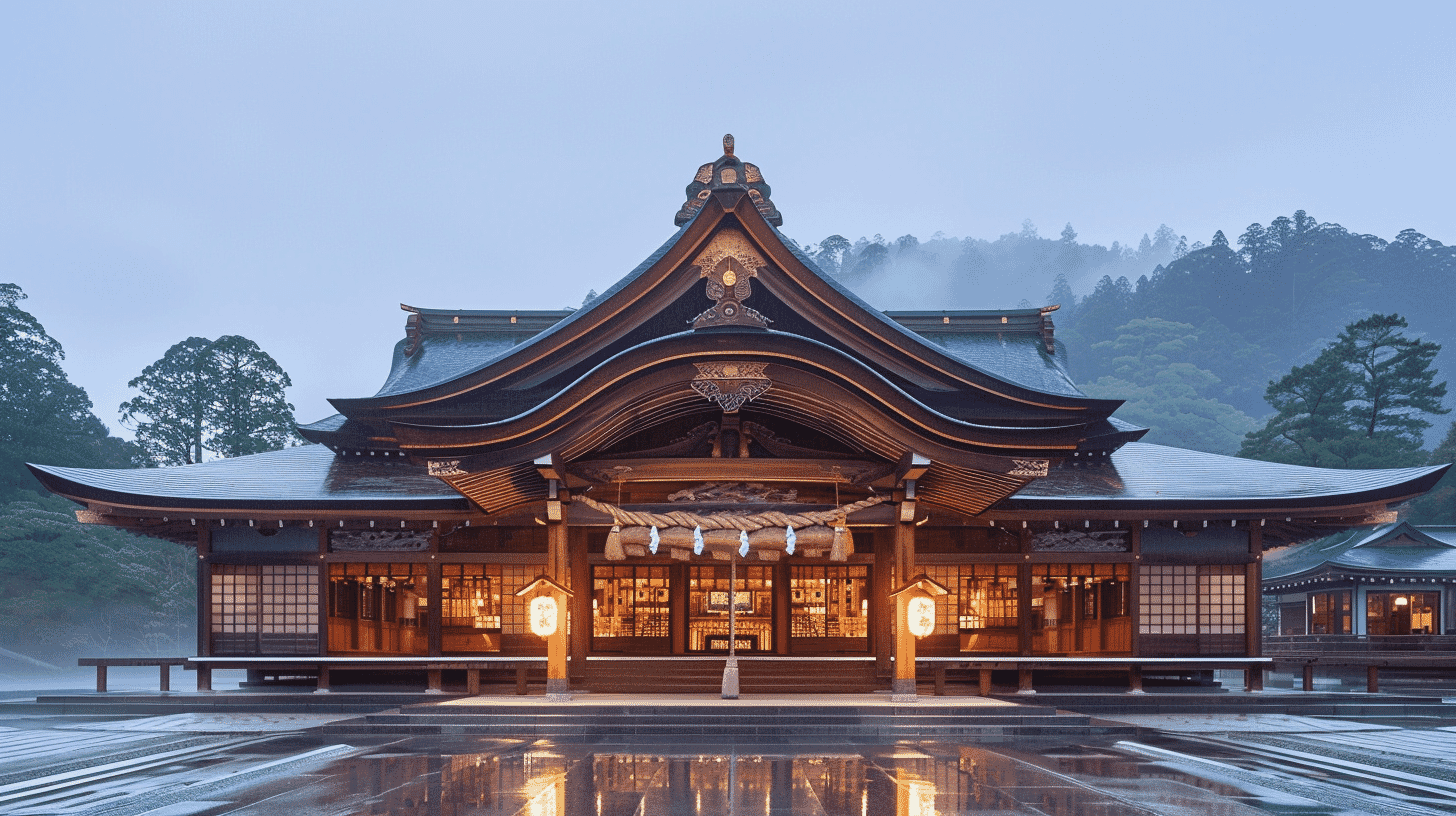
Taisha-zukuri is regarded as the oldest form of Shinto shrine architecture in Japan, keeping much of the character of the raised-floor dwelling. The Agency describes the present hall as taisha-zukuri on a square plan, gabled and entered at the gable end, and calls it decidedly grand on the strength of its scale, its high floor and the thickness of its timbers. It is the largest taisha-zukuri sanctuary standing.
The height is eight jo, about 24 metres, and the column grid measures roughly 10.9 metres square. Where the shinmei-zukuri of Ise keeps a straight profile, the taisha-zukuri roof sweeps gently upward. Set the two side by side and the difference is immediate.
Nine Columns in a Grid, and a Deity Facing West
The interior is not open to the public, but its plan is published. Nine columns stand three by three on the square floor, dividing the space into a grid that maps onto the character for rice field. The thick column at the centre is the shin-no-mihashira, the sacred central pillar.
Between that pillar and the side column to the right as you face the building runs a plank wall, and behind it sits the inner sanctuary where the deity is seated. The building itself faces south; the seat of Okuninushi-no-Okami faces west. Two explanations are handed down, one citing the structural logic of the hall and one citing the guarding of the western quarter. Neither can be stated as settled.
An antechamber before the inner sanctuary holds the seats of five further deities against the plank wall: Ame-no-Tokotachi, Umashiashikabihikoji, Kamimusubi, Takamimusubi and Ame-no-Minakanushi. Near the central pillar stands the seat of Wakafutsunushi, a child deity of Okuninushi. The arrangement of the seats is inseparable from the structure of the building itself.
The Excavated Columns, and What the Records Claim
The Agency for Cultural Affairs closes its commentary with a careful sentence: according to historical records and tradition, the hall was taller still in antiquity.
Behind that line lies the excavation of the precinct carried out in 2000 and 2001. Archaeologists found the remains of a column formed from three great timbers bound with iron hoops, roughly 3 metres across. The arrangement matches the columns drawn in the Kanawa no Gozoei Sashizu, a plan of the ancient hall handed down in the Senge family, the hereditary priestly house of the shrine.
That drawing describes a hall of sixteen jo, about 48 metres. The excavation made the picture harder to dismiss as legend. It did not, however, prove that a 48-metre hall stood here, and the Agency has not dropped its qualifier. This article does not go further than the record does.
The excavated column remains are displayed at the Shimane Museum of Ancient Izumo next to the shrine, together with a reconstruction based on the drawing. Visiting after seeing the hall makes the distance between the 24 metres in front of you and the 48 metres of tradition easier to feel.
Reading It from the Yatsuashi Gate
Fences enclose the hall, and an ordinary visit reaches only as far as the Yatsuashi gate. There is still plenty to read from there.
Start with the roof. The cypress bark surface curves gently toward the ridge, and from its ends the chigi finials cross and reach upward, over 7 metres long. Three katsuogi billets lie across the ridge, their copper sheathing catching the light.
Then the floor height. Taisha-zukuri descends from the raised-floor dwelling, and the floor sits well above the ground. Even from the gate the length of the stair is clear. Thick timbers and a high floor are exactly the features the Agency cites in calling the hall grand.
Look down at the paving in front of the gate. Circles set into the stone mark where the excavated columns stood, three circles clustered together reproducing the section of a bound column on the ground. They are easy to walk past, so check underfoot once you are square with the gate.
Auxiliary shrines and storehouses stand around the hall. These belong to a separate designation made on 6 July 2004 and include the tower gate, the Yatsuashi gate and the enclosing fences. They are not covered here.
Visiting
Entering the precinct is free. The main hall area is generally open from 6:00 a.m. to 7:00 p.m., or to 8:00 p.m. from March to October. The office issuing amulets and seals runs from 8:30 a.m. to 4:30 p.m., and the Soga-no-yashiro area behind the hall also closes at 4:30 p.m. Times shift with the season and with events, so check the shrine's official site before travelling.
The interior of the hall is not open. Going inside the Yatsuashi gate requires arranging a formal visit. The treasure hall charges admission; consult the official site for the current fee and hours.
Photography in the precinct is not generally restricted, though it is worth asking at the shrine office about the area inside the fences and during rituals. Paved ramps serve wheelchair users, and the shrine office lends wheelchairs.
From JR Izumoshi Station the Ichibata bus reaches the Seimon-mae stop in around half an hour. From Izumo Taisha-mae Station on the Ichibata Electric Railway it is a ten-minute walk. The quietest time is the hour after opening at 6:00 a.m.; the precinct is busiest during Kamiarizuki in the tenth lunar month, Golden Week and the New Year period.
Q&A
- When was Izumo Taisha Main Shrine built and designated a National Treasure?
- The present hall was built in 1744. It became an Important Cultural Property on 7 April 1900 and a National Treasure on 29 March 1952, under designation number 00073, as one building.
- What is the taisha-zukuri form of Izumo Taisha Main Shrine?
- It is regarded as the oldest form of Shinto shrine architecture in Japan and keeps the character of the raised-floor dwelling. The Agency for Cultural Affairs describes the hall as taisha-zukuri on a square plan, gabled and entered at the gable end, and records the structure as taisha-zukuri with a cypress bark roof. It is the largest such sanctuary standing.
- Why does the deity in Izumo Taisha Main Shrine face west?
- The building faces south while the seat of the deity faces west. Two explanations are handed down, one citing the structural logic of the hall and one citing the guarding of the western quarter; neither is settled. The arrangement follows from the inner sanctuary sitting behind a plank wall between the central pillar and the right-hand side column.
- Was Izumo Taisha Main Shrine once 48 metres tall?
- A plan handed down in the Senge priestly family describes a hall of sixteen jo, about 48 metres. Excavation in 2000 and 2001 uncovered a bound column about 3 metres across matching the drawing. That does not prove such a hall stood here, and the Agency for Cultural Affairs still qualifies the claim as resting on records and tradition.
- Can Izumo Taisha Main Shrine be visited, and what are the hours?
- Entering the precinct is free, and the main hall area is generally open from 6:00 a.m. to 7:00 p.m., or to 8:00 p.m. from March to October. The interior of the hall is not open and an ordinary visit reaches the Yatsuashi gate. The amulet office and the area behind the hall close at 4:30 p.m.
Basic Information
| Name | Izumo Taisha Main Shrine (出雲大社本殿, Izumo Taisha Honden) |
|---|---|
| Location | Kizuki-higashi, Taisha-cho, Izumo City, Shimane Prefecture |
| Designation | National Treasure (structure), designation no. 00073, category pre-modern shrine |
| Year Designated | 1900 (7 April), Important Cultural Property; 1952 (29 March), National Treasure |
| Quantity | 1 building |
| Dimensions | Taisha-zukuri with cypress bark roof; square plan, gabled, entered at the gable end; about 24 m high, column grid about 10.9 m square. Middle Edo period, 1744 |
| Owner | Izumo Taisha |
| Public Access | Precinct free. Main hall area generally 6:00 a.m. to 7:00 p.m. (to 8:00 p.m. March to October). The interior is closed; an ordinary visit reaches the Yatsuashi gate. Amulet office and the area behind the hall close at 4:30 p.m. |
References
- Agency for Cultural Affairs, National Cultural Properties Database: Izumo Taisha Main Shrine
- https://kunishitei.bunka.go.jp/heritage/detail/102/2971
- Cultural Heritage Online: Izumo Taisha Main Shrine
- https://online.bunka.go.jp/heritages/detail/146668
- Izumo Taisha: the main hall
- https://izumooyashiro.or.jp/precinct/keidai-index/gohonden
- Izumo Taisha official site
- https://izumooyashiro.or.jp/
- Shimane Museum of Ancient Izumo
- https://www.izm.ed.jp/
Last verified: 2026.09.28