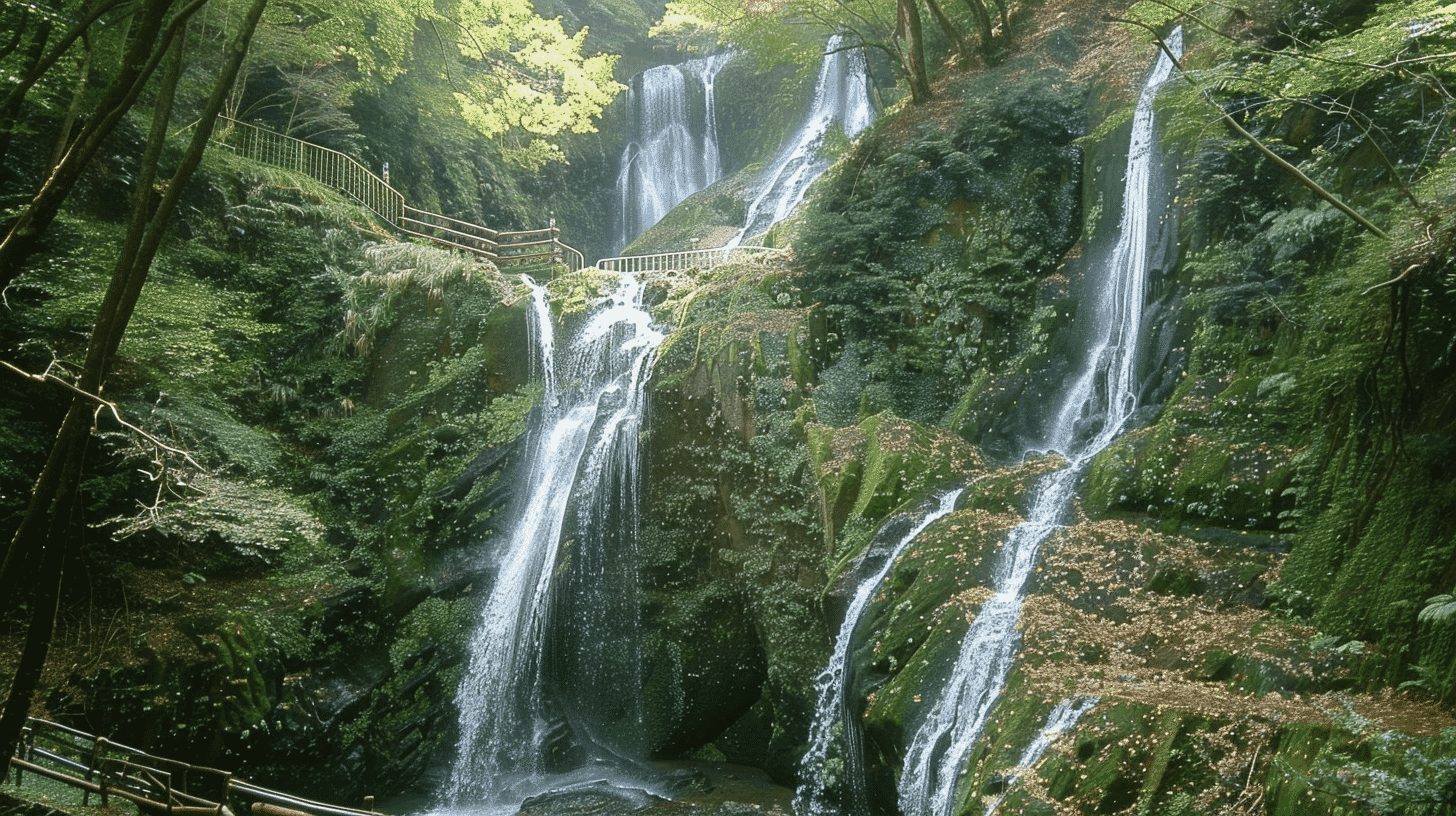
A Sacred Cascade Where Ancient Legends Flow
Hidden in the mountainous eastern region of Aichi Prefecture, the Atera Seven Falls (阿寺の七滝, Atera no Nanataki) stands as one of Japan's most spiritually significant waterfalls. This magnificent 62-meter cascade, flowing through seven distinct tiers of ancient conglomerate rock, has been designated as both a National Scenic Beauty and Natural Monument since 1934, and was selected as one of Japan's Top 100 Waterfalls in 1990.
More than just a natural wonder, these falls carry the weight of over a millennium of spiritual significance. Legend speaks of the great onmyoji (court magician) Abe no Seimei, who chose these very waters for his ascetic training in the early Heian period. Today, visitors from around the world come to experience the mystical energy that still permeates this sacred site.
The Geological Marvel: Why It Became a National Natural Monument
The Atera Seven Falls represents a remarkable geological phenomenon that earned its designation as a National Natural Monument. The waterfall was formed where the Atera River encounters a fault scarp of conglomerate rock layers, creating seven distinct cascades that give the falls its name. This conglomerate formation, composed of rounded pebbles from sandstone, mudstone, and granite dating back to the Mesozoic and Paleozoic eras, tells a story millions of years in the making.
What makes this site particularly extraordinary from a scientific perspective is the presence of massive potholes (called "ouketsui" in Japanese) carved into the rock by centuries of water erosion. The most impressive of these natural sculptures reaches depths of 7 meters—a testament to the incredible power of water over geological time. These potholes, found particularly at the second and fifth tiers, are considered among the finest examples of their kind in Japan.
The falls' proximity to Japan's Median Tectonic Line, the country's longest fault system, adds another layer of geological significance. This location along one of Earth's major tectonic boundaries contributes to the site's reputation as a powerful energy spot, where visitors can literally stand at the intersection of massive geological forces.
Seven Sacred Tiers: Each with Its Own Name and Character
Unlike typical waterfalls, each of the seven tiers at Atera has been given its own poetic name, reflecting centuries of cultural appreciation. From bottom to top, these are:
Hekireki Falls (霹靂滝) - The thunderbolt fall, the lowest tier at 9 meters, greets visitors with its powerful presence.
Kosho Falls (虎嘯滝) - The tiger's roar fall, 13 meters high with a 4-meter deep basin, creates a sound reminiscent of its fierce namesake.
Ryujo Falls (龍攘滝) - The dragon's rage fall, 7 meters high, embodies the mythical creature's dynamic energy.
Chogei Falls (長霓滝) - The long rainbow fall, the tallest at 25 meters, often creates stunning rainbow effects in its mist.
Yuhi Falls (雄飛滝) - The soaring fall, though only 2 meters high, features the deepest pothole at 7 meters.
Soren Falls (素練滝) - The pure silk fall, 4 meters high, flows with an elegant, fabric-like appearance.
Koko Falls (敲壺滝) - The echoing pot fall, the uppermost tier at 2 meters, completes the sacred sequence.
From the viewing platform at the base, visitors can see the first four tiers, while a side stairway provides access to a higher vantage point for viewing the upper sections.
Legends and Spiritual Significance
The spiritual atmosphere of Atera Seven Falls is palpable from the moment you enter the forest path. According to ancient tradition, the legendary onmyoji Abe no Seimei (921-1005), Japan's most famous practitioner of divination and magic, underwent rigorous training beneath these waters during his youth. A well believed to have been used by Seimei still exists near the falls, adding tangible connection to this mystical past.
The conglomerate rocks at the base of the falls, known as "Kodakaraishi" (Child-Embracing Stones), have been venerated for centuries as having the power to bless couples with children. Many visitors still come to pray at these sacred stones, leaving small offerings in hope of fertility blessings.
The dragon deity of the waterfall has long been worshipped as a rain-bringing god, crucial for the agricultural communities of the region. During times of drought, elaborate ceremonies were performed here to petition for rainfall. This connection between the falls and life-giving water has made it a pilgrimage site for those seeking purification and renewal.
The Healing Power of Nature: A Modern Power Spot
In recent years, Atera Seven Falls has gained recognition as one of Japan's premier "power spots"—locations believed to emit special spiritual or healing energy. This reputation stems from several factors: the abundant negative ions produced by the cascading water, known to have calming effects on the human nervous system; the site's location near the Median Tectonic Line, believed to generate unique electromagnetic fields; and the pristine natural environment that has remained largely unchanged for centuries.
The 15-minute walk from the parking area to the falls itself becomes part of the therapeutic experience. The path winds through a primeval forest where the sounds of modern life fade away, replaced by birdsong, rustling leaves, and the growing roar of the falls. Many visitors report feeling a profound sense of peace and rejuvenation after spending time in this sacred space.
Seasonal Beauty Throughout the Year
Each season brings its own magic to Atera Seven Falls. Spring arrives with fresh green leaves and blooming mountain flowers, creating a verdant paradise. Summer offers relief from the heat, with the cool mist from the falls and the shade of the forest providing natural air conditioning. The falls are particularly popular during the summer months when visitors can wade in the crystal-clear pools.
Autumn transforms the landscape into a canvas of red and gold, with Japanese maples creating stunning frames for the white cascade. This is considered by many to be the most photogenic season. Winter, while cold, offers its own austere beauty, with ice formations on the rocks and occasional snow dustings creating an otherworldly atmosphere.
The last Sunday of July features the annual Atera Seven Falls Festival, where visitors can enjoy rainbow trout fishing, local food stalls, and traditional performances—a perfect opportunity to experience local culture alongside natural beauty.
Gateway to Okumikawa: Exploring the Surrounding Area
Atera Seven Falls serves as an ideal starting point for exploring the Okumikawa region, often called the "Tibet of Aichi" for its mountainous terrain and spiritual atmosphere. Just a short drive away, Yuya Onsen hot spring resort has been welcoming weary travelers for over 1,300 years. According to legend, it was discovered by the same monk who founded nearby Horaiji Temple.
The Horai Gorge, with its unique Itajiki River (literally "board-floor river") where the riverbed looks like wooden planks, offers stunning scenery and excellent hiking. The gorge is particularly beautiful during autumn when the maple trees create a tunnel of fire-colored leaves over the water.
Mount Horaiji and its temple, one of the three great mountain temples of Japan, lies about 30 minutes away. The entire mountain is considered sacred, home to the rare Japanese scops owl (the prefectural bird of Aichi), and offers spectacular views of the surrounding peaks. The temple's connection to the Tokugawa shogunate adds historical significance to its spiritual importance.
For those interested in more adventure, Forest Adventure Shinshiro provides zip-lining and tree-climbing courses through the forest canopy, while the Shinshiro Comprehensive Park offers family-friendly activities and sports facilities.
Planning Your Visit: Practical Information
The journey to Atera Seven Falls is part of its charm, taking you deep into rural Japan. The falls are accessible year-round, with free admission, making it an affordable destination for all travelers. The 150-space parking lot accommodates both cars and tour buses, with a small fee for parking.
The walk from the parking area to the falls takes approximately 15 minutes along a well-maintained path. While generally easy, the trail does include some uphill sections and can be slippery after rain, so proper walking shoes are recommended. The path is not wheelchair accessible due to natural terrain.
Facilities at the site include restrooms at the parking area and a small shop (open weekends from April to November) selling local products and refreshments. Vending machines provide drinks year-round. For those wanting to extend their visit, several hiking trails branch off from the main path, offering opportunities to explore deeper into the forest.
The best times to visit are weekday mornings when crowds are minimal, allowing for a more meditative experience. Photography enthusiasts should note that the falls face east, making morning light ideal for capturing the cascades.
- 📍 Plan Your Visit to Aichi
- Find tours, activities & transport passes near Atera Seven Waterfalls
- [ Nagoya Castle & Atsuta Shrine History Tours ]
Frequently Asked Questions
- Is Atera Seven Falls suitable for families with young children?
- Yes, the main trail to the falls is suitable for families, though young children should be supervised carefully near the water. The 15-minute walk is manageable for most children over 5 years old. During summer, the shallow areas near the parking lot offer safe water play opportunities. However, the trail can be slippery when wet, and baby strollers cannot navigate the natural path.
- What is the best way to reach Atera Seven Falls using public transportation?
- Take the JR Tokaido Line from Nagoya to Toyohashi Station, then transfer to the JR Iida Line to Mikawa-Ono Station (about 2 hours total). From there, take the municipal circular bus to "Nanataki-guchi" bus stop, then walk 15 minutes to the falls. Note that bus service is limited, so check schedules in advance. Many visitors find renting a car more convenient for exploring the wider Okumikawa region.
- Can visitors swim in the waterfall pools?
- While swimming directly under the falls is prohibited for safety reasons, visitors can wade and cool off in designated areas during summer months. The water is quite cold even in summer, typically around 15°C (59°F). Always exercise caution around the slippery rocks and respect any posted safety signs.
- What should I combine with a visit to Atera Seven Falls?
- Most visitors combine the falls with a stay at nearby Yuya Onsen hot springs (15 minutes by car) for the complete relaxation experience. History enthusiasts should visit Horaiji Temple (30 minutes), while nature lovers might enjoy the Horai Gorge scenic walk. Plan for at least a half-day to fully appreciate the falls and surrounding area, or a full day if including other attractions.
- Is there any special etiquette for visiting this sacred site?
- While no specific religious observances are required, visitors should maintain respectful behavior befitting a site of spiritual significance. This includes keeping voices moderate, not littering, and being respectful if others are praying or meditating. If you wish to pray at the Kodakaraishi (child-blessing stones), a small monetary offering is customary but not required.
Essential Information
| Location | Shimoyoshida, Shinshiro City, Aichi Prefecture |
|---|---|
| Total Height | 62 meters (203 feet) |
| Number of Tiers | Seven distinct cascades |
| Designation | National Scenic Beauty and Natural Monument (1934) |
| Recognition | Japan's Top 100 Waterfalls (1990) |
| Access | 25 minutes from Shinshiro IC (Shin-Tomei Expressway) |
| Parking | 150 spaces available (fee required) |
| Admission | Free (parking fee applies) |
| Best Season | Spring (fresh green) and Autumn (fall colors) |
| Walking Time | 15 minutes from parking to falls |
| Contact | Shinshiro Tourism Association: +81-536-29-0829 |
References
- Aichi Prefecture Official Tourism Site - Atera Seven Falls
- https://aichinow.pref.aichi.jp/spots/detail/138/
- Shinshiro City Official Site - Atera no Nanataki
- https://www.city.shinshiro.lg.jp/kanko/meisyo/ateranonanataki.html
- Visit Okumikawa - Atera no Nanataki Waterfall
- https://intl.okuminavi.jp/en/spot/detail/6/
- Wikipedia - Atera Seven Falls
- https://en.wikipedia.org/wiki/Atera_Seven_Falls
- AichiNow English - Seven Atera Waterfalls
- https://aichinow.pref.aichi.jp/en/spots/detail/138/
Last verified: 2025.11.08
Nearby heritages
- Umasoeiwa
- Shinshiro City
- Former Ono Bank (Onojuku Houraikan) Main Building
- 17-2 Ueno, Ono, Shinshiro City, Aichi Prefecture
- Former Ohno Bank (Ohnojuku Houraikan) Storehouse
- 17-2 Ueno, Ono, Shinshiro City, Aichi Prefecture
- Former Restaurant Kikusui
- 17-7 Ueno, Ono, Shinshiro City, Aichi Prefecture
- Triumph Memorial Gate
- Shibukawa, Inasa-cho, Kita-ku, Hamamatsu City, Shizuoka Prefecture
- Toshogu Shrine
- Kadoya, Shinshiro City, Aichi Prefecture
- Horaiji Temple Niomon Gate
- Kadoya, Shinshiro City, Aichi Prefecture
- Old Huangliu Bridge
- Kamibayashi and Kawamukae, Norimoto, Shinshiro City, Aichi Prefecture
- Mount Horaiji
- Shinshiro City
- Suzuki Family Residence (Inasa Cho, Kita Ku, Hamamatsu City,
- 742 Matoba, Inasa-cho, Kita-ku, Hamamatsu City, Shizuoka Prefecture