
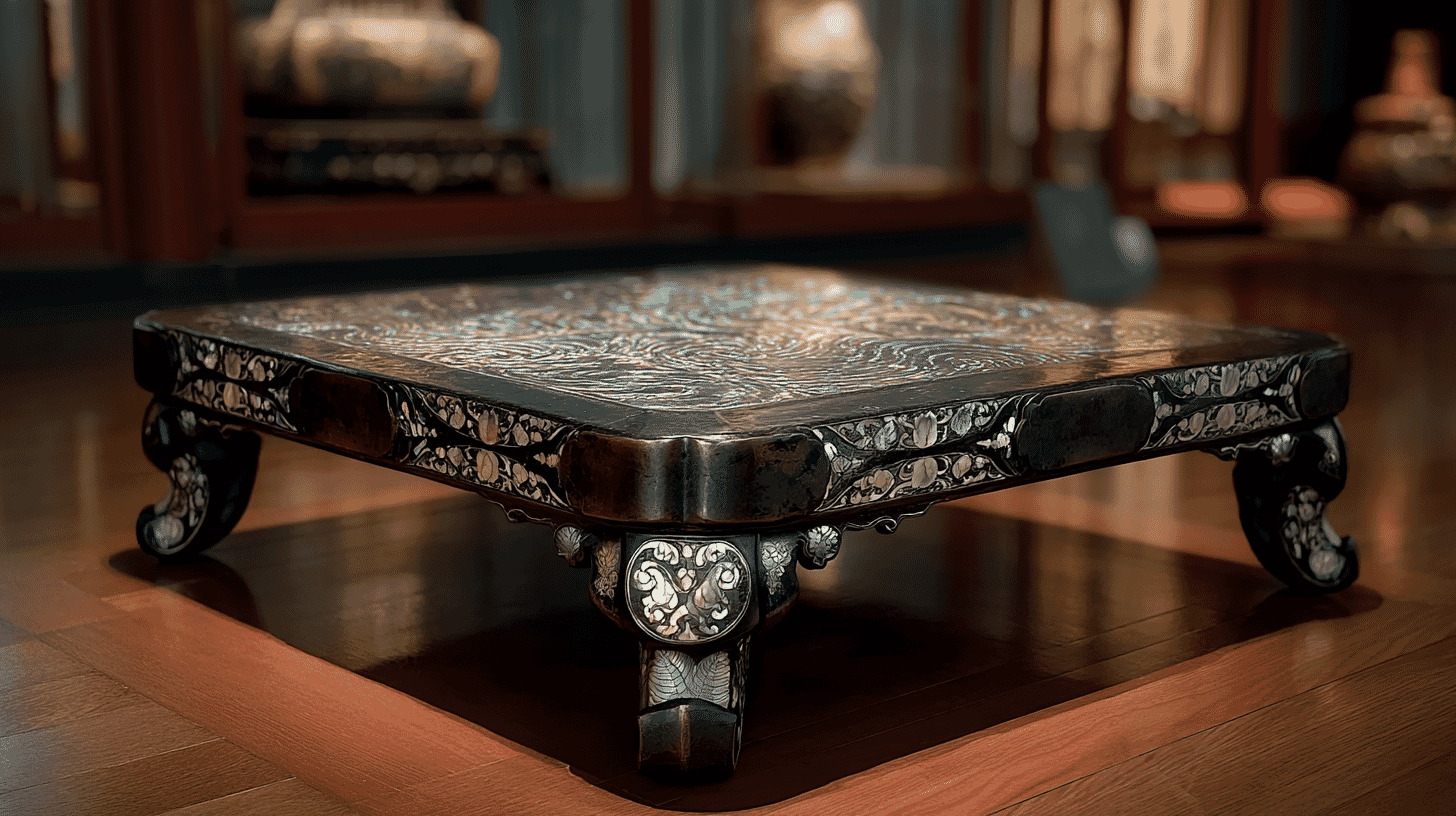
One Dais, an Important Cultural Property since 1924
Raiban Dais in Black Lacquer with Mother-of-Pearl Inlay (黒漆螺鈿礼盤, Kokushitsu Raden Raiban) is a Kamakura-period craft object held at the MOA Museum of Art, 26-2 Momoyama-cho, Atami City, Shizuoka Prefecture, listed as an Important Cultural Property on 15 April 1924. The listing is as an Important Cultural Property, not a National Treasure, and the owner is the religious body Sekai Kyusei Kyo.
The quantity is one, the same measure word used for the Myooin pagoda, the crystal stupas and the iron pagoda. Those are towers; this is a dais.
A raiban is a dais from which a priest worships. Shizuoka Prefecture records that the cabriole legs and the proportions of the whole give a sense of stability, fitting for a dais made for the worship of the Buddha.
Length and Width Given as a Single Figure
The dimensions are written differently from the usual.
Shizuoka Prefecture gives them as 64.9 for length and width together, by 17.0 centimetres in height.
Length and width are bracketed together and assigned one figure, 64.9. Two directions receive the same value.
With the tsujigahana haori, front and back both measured 36.5 centimetres, and sleeve width and opening both 22.0 centimetres, but each was written out separately.
Here two directions are gathered into one entry. The manner of writing itself differs.
With the gilt bronze ritual implements, the tray measured 21.8 one way and 28.6 the other. There the two directions differ.
Fitness for Its Purpose Given as the Value
The object is judged against what it was made to do.
Shizuoka Prefecture closes that the cabriole legs and the proportions of the whole give a sense of stability, fitting for a dais made for the worship of the Buddha.
Fitting, in that word. That the form suits the use is the reason for the assessment.
At the Myooin main hall the word was standard; at the Osasahara main hall, among the finest; at the Senjuji founder's hall, an index. All compare with others.
At Kitaguchi Hongu Fuji Sengen Shrine it was regional character, and at Otonashi Shrine the scarcity of cultural property nearby: circumstances around the object.
Here the reason lies in the relation between the object and its use. As a way of stating value this is the sixth form met.
The Two Records Differ Greatly in Detail
Two accounts of the same object are far apart in length.
The Agency's commentary is one sentence: a work of the Kamakura period. Its fields for dimensions and for form carry nothing.
Shizuoka Prefecture, by contrast, sets out the dimensions, the technique of the inlay, the pattern, the shape of the legs and an assessment.
Of the inlay: thin pieces of shell are set into lacquer, and further lacquer is applied and ground back. The shell is turban or abalone, and the rainbow lustre of pearl appears as pattern on the lacquer surface.
With the gilded mirror, the Agency's commentary was likewise one sentence. There nothing else was available.
Here the prefecture's record fills the gap. Its source is given as a photographic volume compiled and published by the prefectural board of education.
Seeing It
The museum holds the dais and a religious body owns it. With the gilded mirror, holder and owner were both the Gotoh Museum. Here they differ.
The fields on public access divide as well. Shizuoka Prefecture records that the object is open to the public, and separately that it is not on permanent display.
It may be seen at times, but it is not always out. The two fields draw that distinction.
Of the ornament: the sides and legs carry lotus scrollwork in thick mother-of-pearl, with metal plates engraved in fine scrollwork added.
Shell and metal both decorate it. With the Hosoge sutra box it was gold and silver lacquer; with the lion-motif sword, gilding and silvering. Here the materials themselves divide into shell and metal. Check the exhibition schedule before travelling.
Q&A
- When was the dais listed?
- On 15 April 1924, as an Important Cultural Property rather than a National Treasure. The quantity is one and the owner the religious body Sekai Kyusei Kyo.
- What is a raiban?
- A dais from which a priest worships. Shizuoka Prefecture writes that the cabriole legs and the proportions give a sense of stability, fitting for a dais made for the worship of the Buddha.
- What are its dimensions?
- Shizuoka Prefecture gives 64.9 for length and width together, by 17.0 centimetres in height. The two directions are bracketed and assigned a single figure.
- What is mother-of-pearl inlay?
- Thin pieces of shell set into lacquer, with further lacquer applied and ground back. Turban or abalone shell is used, and its rainbow lustre appears as pattern on the lacquer.
- Can it be seen?
- Shizuoka Prefecture records that it is open to the public and, separately, that it is not on permanent display. It may be seen at times but is not always out.
Basic Information
| Name | Raiban Dais in Black Lacquer with Mother-of-Pearl Inlay (黒漆螺鈿礼盤); a raiban is a dais for the worship of the Buddha |
|---|---|
| Location | MOA Museum of Art, 26-2 Momoyama-cho, Atami City, Shizuoka Prefecture |
| Designation | Important Cultural Property (fine arts, craft); not a National Treasure |
| Year Designated | 1924 (15 April), Important Cultural Property |
| Quantity | 1 dais |
| Dimensions | Shizuoka Prefecture gives 64.9 for length and width together by 17.0 centimetres in height. The sides and legs carry lotus scrollwork in thick mother-of-pearl with engraved metal plates added, and the legs are cabriole. The Agency's fields for dimensions and form are empty and its commentary is one sentence |
| Owner | Sekai Kyusei Kyo |
| Public Access | Shizuoka Prefecture records it as open to the public and, separately, as not on permanent display |
References
- Shizuoka Cultural Property Navigator: the lacquered dais
- https://www.pref.shizuoka.jp/kankosports/bunkageijutsu/bunkazai/1002825/1041003/1041884/1004983/1021348.html
- Cultural Heritage Online: the same dais
- https://bunka.nii.ac.jp/db/heritages/detail/197503
- MOA Museum of Art official site
- https://www.moaart.or.jp/
- Agency for Cultural Affairs, National Cultural Properties Database
- https://kunishitei.bunka.go.jp/
Last verified: 2026.09.06