
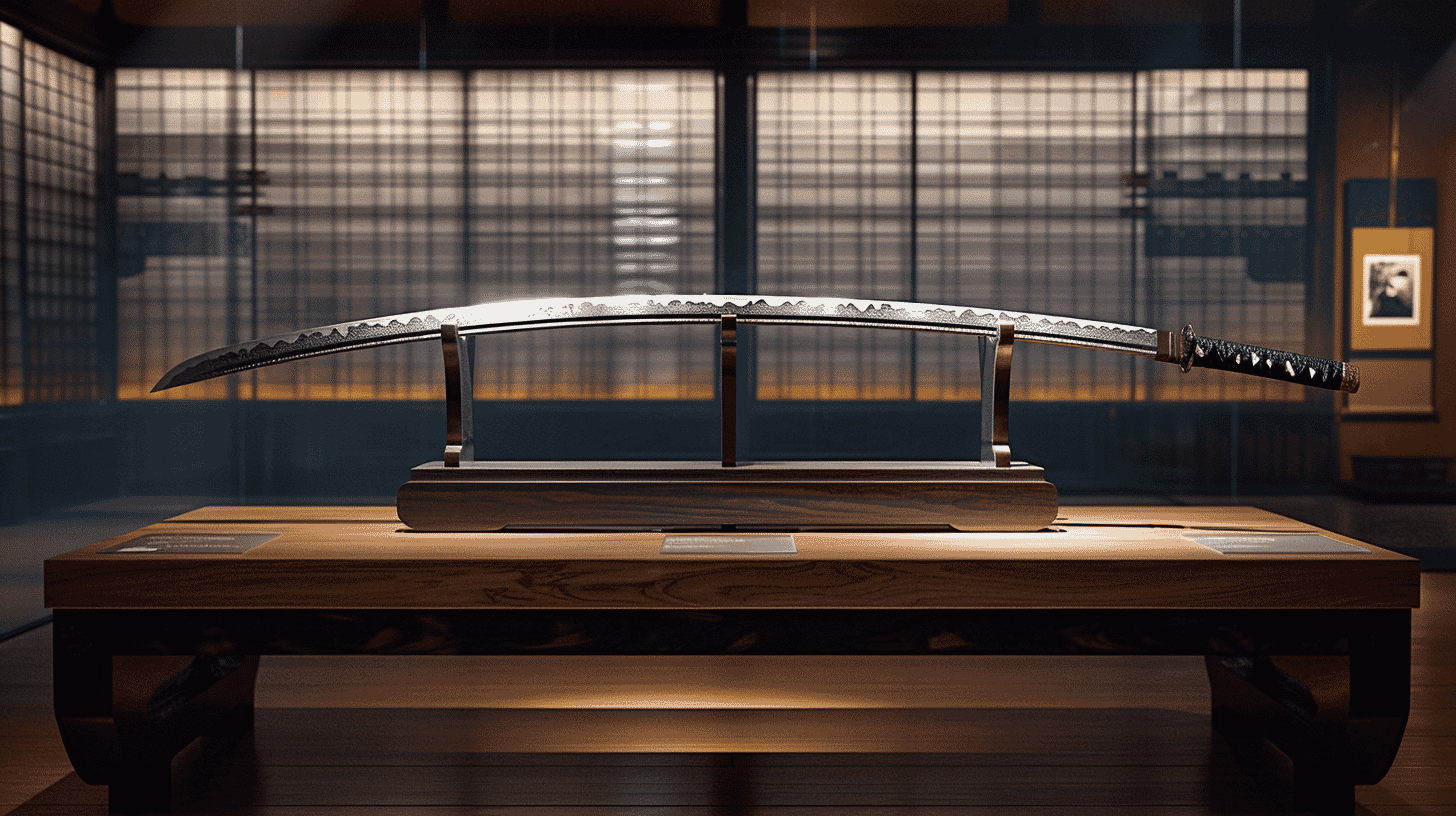
One Blade, National Treasure since 1957
Naginata (signed made by Nagamitsu, resident of Osafune in Bizen Province) (薙刀, Naginata) is a Kamakura-period craft object at the Sano Art Museum, 1-43 Nakata-cho, Mishima City, Shizuoka Prefecture, made an Important Cultural Property on 25 May 1937 and designated a National Treasure on 19 February 1957. The quantity is one blade and the owner the Sano Art Museum foundation.
19 February 1957 is the day on which the butterfly hand box and the Odenta tachi were also designated: a third property listed on that date.
The maker's field reads Nagamitsu, resident of Osafune in Bizen Province, taking the signature itself as the maker's name.
The Tang Is Twenty Centimetres Longer Than the Blade
One figure among the dimensions stands out.
The blade is 43.3 centimetres, the curvature 1.8, the width at the base 3.2, and the tang 63.6 centimetres.
The blade length measures the cutting part; the tang is what enters the shaft. Against 43.3 centimetres of blade stand 63.6 centimetres of tang.
What is hidden in the shaft is some twenty centimetres longer than what is not.
The Masamune katana has a blade of 67.0 centimetres; the Goto Toshiro dagger 27.7 centimetres of blade against 11.4 centimetres of tang. On swords and daggers the tang is the shorter part.
A naginata sets its blade at the end of a long shaft. The tang runs deep into that shaft, so it grows long. The numbers show the construction.
Being Expendable Is the Reason for Its Rarity
Why so few survive is set down.
The museum records that from the Kamakura into the Muromachi period the naginata was a weapon used in actual fighting and expended, so a piece in this condition is very rare.
It was a thing used up. Few in good condition remain.
The Agency agrees: surviving naginata of the Kamakura period are extremely few, not only by this smith. It adds that a piece with such fine steel and temper, sound, with an untouched tang and a signature, is exceptional.
The Inariyama material claimed the oldest surviving writing; the Hirabaru finds a quantity surpassing all others; the armed warrior haniwa the finest of its kind. Those speak of age, number or quality.
Here the record explains why such things do not survive, and makes survival itself the value.
The Museum's Record Gives the Prefecture as Okayama
The location does not agree across records.
The Agency gives the address as 1-43 Nakata-cho, Mishima City, Shizuoka Prefecture. The Sano Art Museum stands in Mishima City.
Another record from the museum, however, gives the prefecture as Okayama. Nagamitsu worked at Osafune in the old province of Bizen, in what is now Okayama Prefecture.
The place of making appears to have been entered in the field for prefecture. The category differs too: craft in the Agency's record, metalwork in the museum's.
With the butterfly hand box, the prefecture field read Chiba while the address was in Tokyo. With the Yohen Tenmoku bowl, two records gave Marunouchi and Setagaya.
Here it is the maker's province that has entered a field for location. This article follows the address and gives Mishima City, Shizuoka.
Seeing It
The blade is at the Sano Art Museum, owned by its foundation. It is a museum holding, not kept on permanent display.
The tang is described closely: untouched, ending in a shallow chestnut curve, with shallow slanting file marks, three peg holes, Sanskrit letters cut below the peg holes on both faces, and a long signature below those on the front as worn.
Three peg holes. The Masatsune tachi has one original hole, the Mikazuki Munechika and the Odenta two each, the Goto Toshiro dagger four.
Sanskrit letters have not appeared before. The carving is recorded as well: a groove of the naginata type with a paired narrow groove alongside on both faces, each run out at the end.
Accounts elsewhere state that only two naginata hold National Treasure status. The Agency's record gives no such count, and a naginata signed Nagamitsu at the Tokyo National Museum is an Important Cultural Property of 1949. Exhibition plans can change, so check before travelling.
Q&A
- When was the blade designated?
- It became an Important Cultural Property on 25 May 1937 and a National Treasure on 19 February 1957. The quantity is one blade, at the Sano Art Museum, owned by the museum's foundation.
- What are its dimensions?
- Blade 43.3 centimetres, curvature 1.8, width at the base 3.2, tang 63.6 centimetres. The tang hidden in the shaft is some twenty centimetres longer than the blade itself.
- Why is it rare?
- The museum records that the naginata was a weapon used in fighting and expended, so a piece in this condition is very rare. The Agency adds that surviving Kamakura-period naginata are extremely few.
- What is cut into the tang?
- The Agency records three peg holes, Sanskrit letters cut below them on both faces, and a long signature below those on the front as worn.
- Are there only two National Treasure naginata?
- The Agency's record gives no count. Accounts elsewhere make that claim, but this article does not repeat it. A naginata signed Nagamitsu at the Tokyo National Museum is an Important Cultural Property of 1949.
Basic Information
| Name | Naginata, signed made by Nagamitsu, resident of Osafune in Bizen Province (薙刀, Naginata) |
|---|---|
| Location | 1-43 Nakata-cho, Mishima City, Shizuoka Prefecture. Another record from the museum gives the prefecture as Okayama, which is the maker's province |
| Designation | National Treasure (craft); the museum's record gives the category as metalwork |
| Year Designated | 1937 (25 May), Important Cultural Property; 1957 (19 February), National Treasure |
| Quantity | 1 blade |
| Dimensions | Blade 43.3 centimetres, curvature 1.8 centimetres, width at the base 3.2 centimetres, tang 63.6 centimetres. Naginata form with a three-faceted back; the tang is untouched with 3 peg holes and Sanskrit letters cut below them. The maker is Nagamitsu of Osafune and the period Kamakura |
| Owner | Sano Art Museum foundation |
| Public Access | A museum holding, not on permanent display |
References
- Cultural Heritage Online: naginata signed by Nagamitsu of Osafune
- https://bunka.nii.ac.jp/heritages/detail/197550
- Cultural Heritage Online: the same blade in the museum's record
- https://bunka.nii.ac.jp/heritages/detail/140834
- Cultural Heritage Online: naginata signed Nagamitsu at the Tokyo National Museum
- https://bunka.nii.ac.jp/heritages/detail/183612
- Sano Art Museum official site
- https://sanobi.or.jp/
Last verified: 2026.09.05