
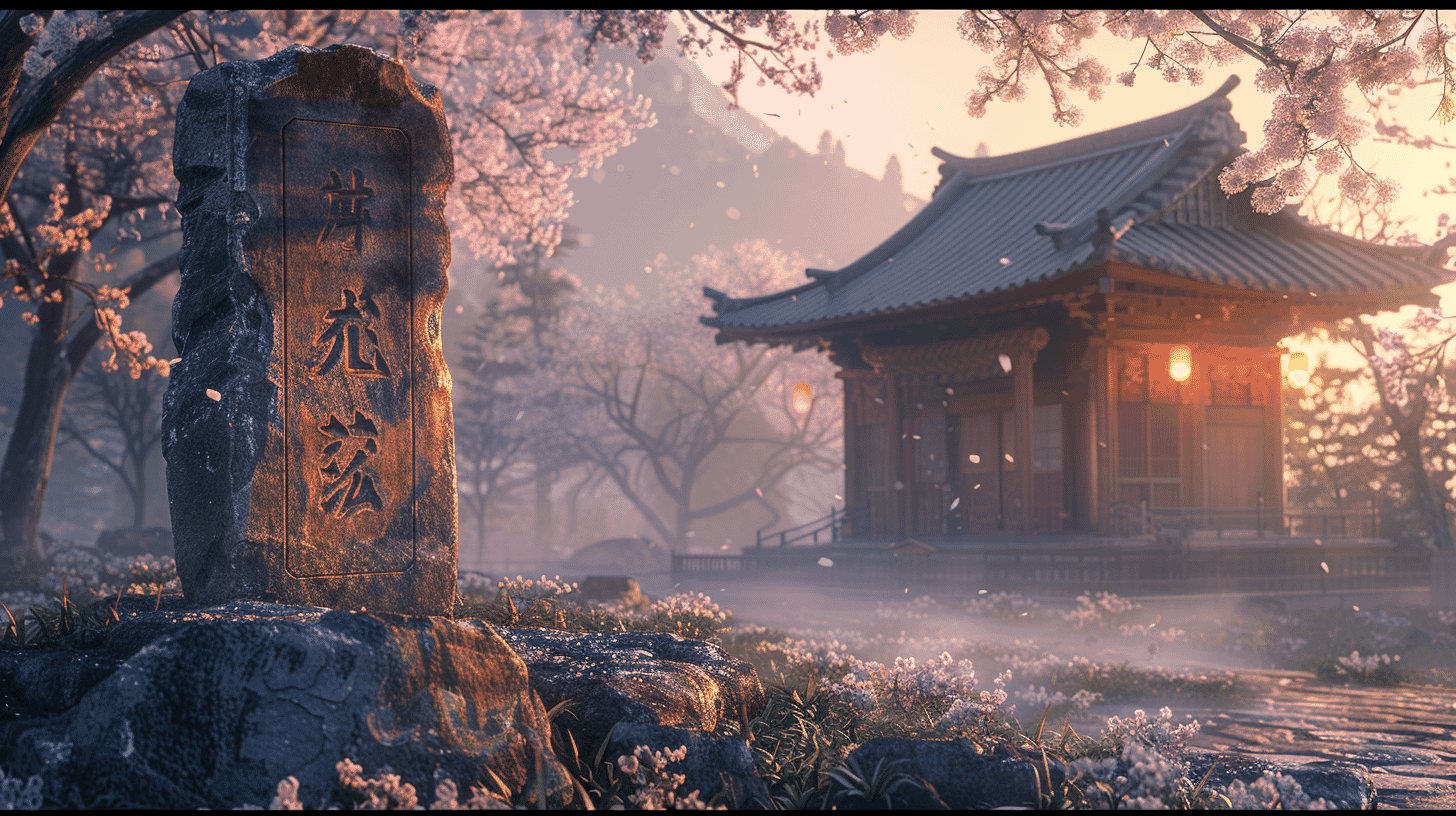
One Stele, National Treasure since 1952
Stele of the Nasu no Kuni no Miyatsuko (那須国造碑, Nasu no Kuni no Miyatsuko no Hi) stands at Yuzukami, Otawara City, Tochigi Prefecture, designated a National Treasure on 22 November 1952. The owner is Kasaishi Shrine.
The field for designation as an Important Cultural Property is blank in the Agency's database: it went to National Treasure without that earlier step, the twenty-seventh such case covered here.
Tochigi Prefecture classes it among tangible cultural properties as an old document. Something cut in stone is filed as a document.
A Chinese Era Name Cut into a Stele in Japan
The year in the inscription is not a Japanese one.
The prefecture records that in the fourth month of the first year of Yongchang, corresponding to 689, Nasu no Atai Ide received the office of district governor.
It adds that Yongchang was the era name of Wu Zetian, who founded the Zhou during the Tang period in China.
A stele raised on Japanese ground carries a Chinese era name.
With the biography of Huineng, the notes field carried a Tang era name. That property, however, has China in its country field and was made there.
This stele was raised in Japan. Of the writing, the prefecture notes that the characters follow the Six Dynasties manner developed in ancient China, and concludes that the stele draws attention as material closely bound up with immigrants from the continent.
Nineteen Characters by Eight Lines, Exactly 152
The extent of the inscription is given as a number.
The text runs nineteen characters to a line over eight lines, 152 characters in all.
Nineteen times eight is 152. Lines, characters per line and total agree without remainder.
With the Shirataki finds, scale came as round figures: some 6.69 million pieces, about twelve tonnes. With the gilt bronze ritual implements, three vajras fell within 0.9 centimetres.
Here every character cut in the stone is counted, with none left over.
The height carries a qualification too: measured above the base stone set in place during the Edo period, it stands about 148 centimetres. The later base is excluded from the measurement.
A Stone People Kept Away From
Before it was honoured, the stone was feared.
The prefecture records that in 1676 a monk named Enjun, formerly a masterless samurai of Iwaki in the north, passed through the village of Yuzukami.
He heard tell of a strange stone: villagers who came near it were said to be injured, horses tethered to it to twist a leg, and people to vomit blood.
Enjun passed this on to Ogane Shigesada, headman of a neighbouring village, who copied out the inscription; from there the stone came to be honoured through the efforts of Tokugawa Mitsukuni and local people.
With the engraved mirror at Suijinja, an object dug up during work was enshrined at once, and a shrine came into being for it.
Here the reverse. What had long been shunned reached the ear of a passing monk, and from that its value was established.
Seeing It
The stele stands at Yuzukami, Otawara City, Tochigi Prefecture, owned by Kasaishi Shrine.
Its by-name is explained: a stone rests on top of the inscribed stone like a hat, and from this it is also called the hat stone.
With the lion-motif sword at Kasuga Taisha, the type was named for the shape of an ornament at the centre of the grip. Here the name comes from the stone that sits on top.
The material is granite. The inscription also records that Nasu no Atai Ide died on the second day of the first month of the year 700, and that Oshimaro and others of the Nasu governor's house raised the stele.
It is enshrined at the shrine, and access follows the shrine's own arrangements. Check before travelling.
Q&A
- When was the stele designated?
- On 22 November 1952. The field for an earlier listing as an Important Cultural Property is blank. It stands at Otawara City, Tochigi Prefecture, owned by Kasaishi Shrine.
- Is the year in the inscription Japanese?
- No. The prefecture records that Yongchang was the era name of Wu Zetian in China. A stele raised in Japan carries a Chinese era name.
- How long is the inscription?
- Nineteen characters to a line over eight lines, 152 in all. The three figures agree exactly, with no character left over.
- How tall is it?
- About 148 centimetres above the base stone, which was set in place during the Edo period. The later base is excluded from the measurement.
- How did it come to be known?
- The prefecture records that in 1676 a monk named Enjun heard tell of a strange stone people were injured by, and passed word to a village headman, who copied out the inscription.
Basic Information
| Name | Stele of the Nasu no Kuni no Miyatsuko (那須国造碑); also called the hat stone, for the stone resting on top |
|---|---|
| Location | Yuzukami, Otawara City, Tochigi Prefecture |
| Designation | National Treasure; Tochigi Prefecture classes it as an old document among tangible cultural properties; designated without an earlier listing as an Important Cultural Property |
| Year Designated | 1952 (22 November), National Treasure |
| Quantity | 1 stele |
| Dimensions | Granite, standing about 148 centimetres above the base stone set in place during the Edo period. The inscription runs 19 characters to a line over 8 lines, 152 characters in all, and records events of 689 and 700 |
| Owner | Kasaishi Shrine |
| Public Access | Enshrined at the shrine; access follows the shrine's own arrangements |
References
- Cultural Properties of Tochigi: the Nasu stele
- https://bunkazai.pref.tochigi.lg.jp/
- Otawara City: cultural properties
- https://www.city.ohtawara.tochigi.jp/docs/2013082778383/
- Agency for Cultural Affairs, National Cultural Properties Database
- https://kunishitei.bunka.go.jp/
- Cultural Heritage Online
- https://bunka.nii.ac.jp/
Last verified: 2026.09.06