
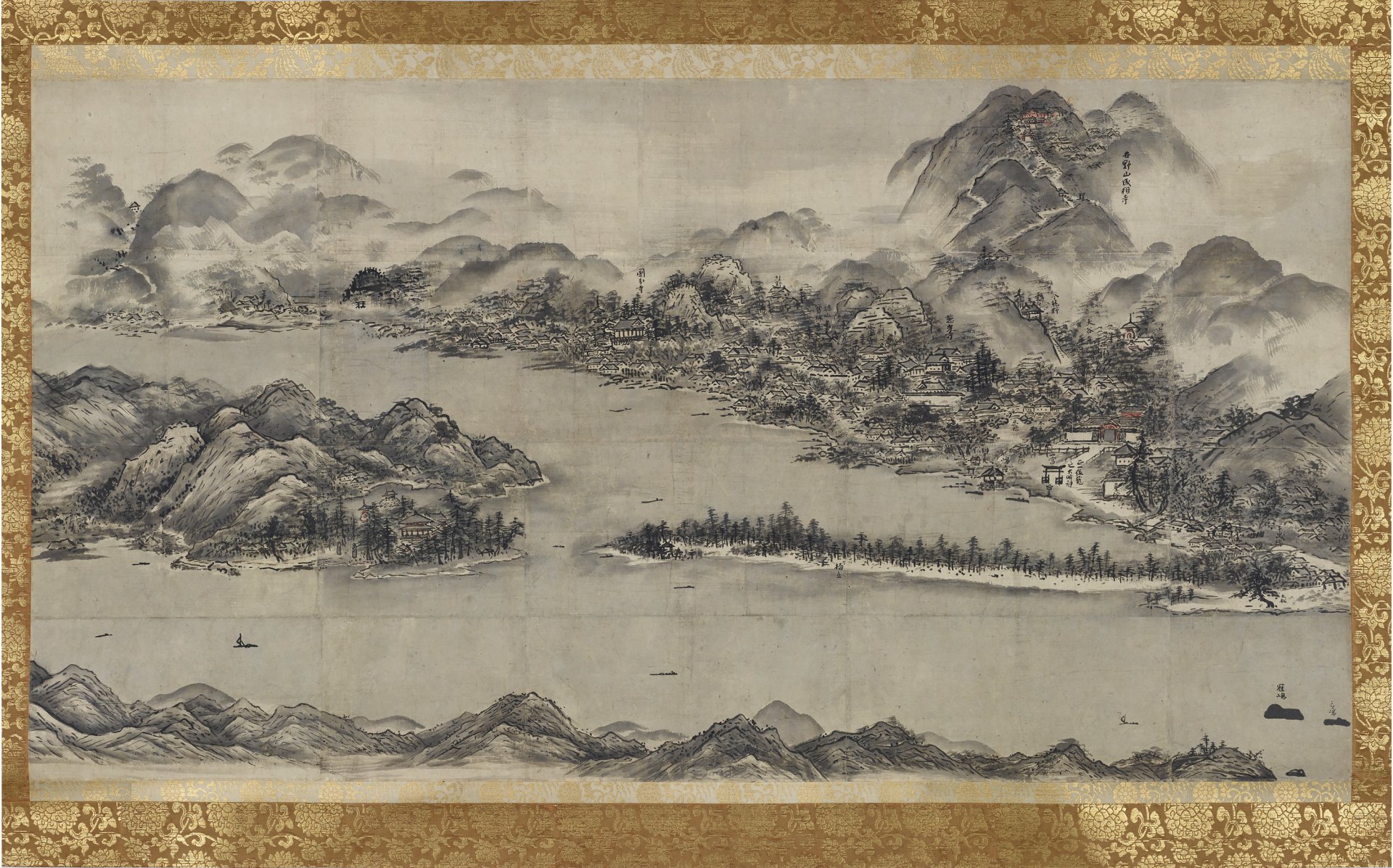
View of Amanohashidate: A Landscape Painted from a Point in the Sky
The paper itself tells you something is unusual. Roughly twenty small sheets of mismatched sizes, pasted together into a surface about 89.4 centimeters high and 168.5 centimeters wide, carry one of the most celebrated images in Japanese art: Sesshu's ink painting of Amanohashidate, the pine-covered sandbar on the Tango coast of northern Kyoto Prefecture.
Known formally as Shihon Bokuga Tansai Amanohashidate-zu (View of Amanohashidate, ink and light color on paper), the work was designated a National Treasure on March 29, 1952. It belongs to the Kyoto National Museum, where it is catalogued as A-ko 228 and shown only on special occasions.
The painting bears no signature and no seal. Attribution to Sesshu Toyo (1420 to around 1506), the Zen monk-painter who brought Chinese ink landscape technique back from Ming China and reshaped it into something distinctly Japanese, rests on the brushwork, the commanding composition, and even the calligraphy of the place names written across the scene. Few scholars doubt it. The sheer density and control of the drawing point to a master working at full strength.
A Painter in His Eighties on the Tango Coast
One small building inside the picture dates the whole thing. Near the base of the sandbar, Sesshu drew the temple of Chionji with its tahoto, a two-storied pagoda of a distinctive rounded form. That pagoda was rebuilt in 1501, the first year of the Bunki era, and the rebuilt structure still stands today as an Important Cultural Property. Since the painting shows it, the work must date from 1501 or later.
Sesshu died around 1506. The arithmetic is striking: the painter was past eighty when he made this picture, and the prevailing view places it in the very last years of his life.
He appears to have traveled to Tango in person. The painting records the region in remarkable detail, naming temples, shrines, and landmarks in small inscriptions. For a man of his age, the journey from his base in western Japan to this remote stretch of the Sea of Japan coast would have been no small undertaking. What drew him there remains a matter of speculation, but the result suggests sustained, attentive looking at an actual place.
Reading the Landscape
The composition spreads the entire bay before you as if seen from high in the air. At center runs the white sand and green pine of Amanohashidate itself, with Chionji at its southern end. Beyond the sandbar lies the Aso Sea, and on its far shore the old provincial town of Fuchu, its temples and shrines drawn one by one: Kono Shrine, the provincial temple Kokubunji with its five-storied pagoda, and others. Behind the town a great mountain mass rises, crowned by the halls of Nariaiji, a temple on the Saigoku pilgrimage route. In the foreground spreads Miyazu Bay, framed by the low hills of the Kunda Peninsula.
Here is the curious part. No such viewpoint exists.
You can climb to Kasamatsu Park on the northern slope or to the viewland on the southern hill, and either will give you a fine prospect of the sandbar, but nothing resembling the sweeping aerial command of Sesshu's picture. Comparison with the actual terrain shows deliberate manipulation: the mountain bearing Nariaiji is far steeper in the painting than in reality, and the Fuchu townscape has been stretched horizontally to display its buildings. Scholars have argued that Sesshu reorganized the real scenery using compositional methods he had absorbed from Chinese landscape painting, in particular the bird's-eye conventions of pictures depicting scenic sites such as West Lake. He likely made multiple sketches on the ground, then synthesized them into a single view no human eye could ever take in.
A Working Drawing That Outranks Finished Paintings
The evidence suggests this National Treasure is not a finished painting at all. The patched-together paper support, the visible corrections and redrawn passages, and the absence of any signature all point to its being a shita-e, a preparatory study for a formal work that may once have existed, though no trace of such a finished version survives.
One detail clinches the argument. Look closely at the sky, the mountains, the water, and you find small smudges of vermilion in places where no painter would put red. The explanation is disarmingly physical: Sesshu had touched red pigment onto the buildings of Kono Shrine, Nariaiji, and Chionji, and the sheet was folded in half down the middle before the vermilion had dried. The wet color offset onto the facing surface. A finished presentation piece would never have been folded that way; a working drawing might be folded for carrying without a second thought.
That such a study holds National Treasure status says a great deal. The rough, rapid handling of the brush, far from diminishing the picture, gives it an energy and immediacy that more polished works rarely achieve. It also preserves, almost uniquely for the Muromachi period, a direct record of how a great painter confronted an actual Japanese landscape rather than an imagined Chinese one. Sesshu holds more National Treasure designations than any other Japanese painter, and this sheet of pieced paper stands among them on equal terms with his most formal masterpieces.
Seeing the Painting, and Seeing the Place
The painting is not on permanent display. Like most ink paintings on paper, it is light-sensitive and appears only during special exhibitions, chiefly at the Kyoto National Museum. Recent showings include the museum's major Sesshu retrospective in 2024 and exhibitions in Osaka and Kyoto in 2025. Checking the Kyoto National Museum's exhibition schedule before a trip is essential if the painting itself is your goal.
The landscape, on the other hand, is open every day of the year. Amanohashidate lies in Miyazu City, about two hours from Kyoto Station by limited express train to Amanohashidate Station on the Kyoto Tango Railway. Walking or cycling the 3.6-kilometer sandbar under its thousands of pines takes you straight through the center of Sesshu's composition. Chionji stands a few minutes from the station, and its 1501 pagoda, the very building that dates the painting, can be seen up close.
Across the water, the Fuchu district preserves Kono Shrine, one of the oldest Shinto sanctuaries in the region, and a cable car climbs from there to Kasamatsu Park. A further bus ride reaches Nariaiji on the mountain above. Standing at these spots with a reproduction of the painting in hand, comparing what Sesshu drew with what you see, turns a scenic excursion into something closer to detective work.
Around Amanohashidate
The southern side of the sandbar, around Amanohashidate Station, holds the densest cluster of sights: Chionji and its pagoda, the revolving bridge called Kaisenkyo that swings open for passing boats, and Amanohashidate View Land on the hill behind, reached by chairlift or monorail. The local custom of viewing the sandbar upside down through your own legs, called matanozoki, makes the strip of land appear to float across the sky like a bridge between heaven and earth, which is precisely what the name Amanohashidate means.
Sightseeing boats cross the Aso Sea between the southern side and Ichinomiya pier on the northern shore, passing close to the pines. The northern Fuchu side rewards a slower visit: Kono Shrine, Kasamatsu Park, and Nariaiji, whose main hall dates from 1774 and whose mountainside setting Sesshu exaggerated so memorably. Further afield, the fishing village of Ine with its boathouses built directly over the water lies about thirty minutes north by bus, and Miyazu's town center retains merchant houses and a Meiji-era Catholic church.
Q&A
- Can I see the View of Amanohashidate painting at any time?
- No. The painting is shown only during special exhibitions, mainly at the Kyoto National Museum, which owns it. Because works on paper are fragile, display periods are short and infrequent. Check the museum's official exhibition schedule before planning a visit.
- Why is an unsigned preparatory sketch a National Treasure?
- The attribution to Sesshu is considered secure on grounds of brushwork, composition, and the handwriting of the place names. As a large-scale true-view landscape by Japan's most honored ink painter, made in his final years, it has documentary and artistic value that few finished paintings can match.
- Can I see the actual viewpoint Sesshu painted from?
- No single viewpoint exists; the aerial perspective was constructed in the studio from multiple sketches. The closest experiences are Kasamatsu Park on the northern slope and Amanohashidate View Land on the southern hill, both offering elevated views of the sandbar.
- How do I get to Amanohashidate from Kyoto?
- Direct limited express trains run from Kyoto Station to Amanohashidate Station in about two hours. By car, the route via the Kyoto Jukan Expressway takes roughly the same time. The sandbar, Chionji, and the boat piers are all within walking distance of the station.
- Which buildings in the painting still exist?
- The tahoto pagoda of Chionji, completed in 1501 and shown in the painting, still stands and is an Important Cultural Property. Kono Shrine and Nariaiji also continue at their depicted locations, though most of their present buildings postdate Sesshu. The Kokubunji provincial temple survives only as foundation stones.
Basic Information
| Name | View of Amanohashidate, ink and light color on paper, by Sesshu (Shihon Bokuga Tansai Amanohashidate-zu) |
|---|---|
| Designation | National Treasure (painting), designated March 29, 1952 (designation no. 00031) |
| Artist | Sesshu Toyo (1420 to around 1506), attributed; no signature or seal |
| Period | Muromachi period, believed after 1501 |
| Quantity / Format | 1 scroll; ink and light color on paper |
| Dimensions | 89.4 x 168.5 cm (per e-Museum; the Kyoto National Museum's masterpieces page gives 89.5 x 169.5 cm) |
| Owner | National Institutes for Cultural Heritage (Kyoto National Museum, accession A-ko 228) |
| Location | Kyoto National Museum, 527 Chayamachi, Higashiyama-ku, Kyoto City, Kyoto Prefecture |
| Public display | Special exhibitions only; not on permanent view |
| Depicted site | Amanohashidate, Miyazu City, Kyoto Prefecture (one of the Three Views of Japan) |
References
- 国指定文化財等データベース(文化庁)紙本墨画淡彩天橋立図〈雪舟筆/〉
- https://kunishitei.bunka.go.jp/bsys/maindetails/201/34
- 京都国立博物館 名品紹介 天橋立図
- https://www.kyohaku.go.jp/jp/collection/meihin/suibokuga/item01/
- 京都国立博物館 博物館ディクショナリー 天橋立図
- https://www.kyohaku.go.jp/jp/learn/home/dictio/kaiga/187/
- 文化遺産オンライン 天橋立図
- https://bunka.nii.ac.jp/heritages/detail/538131
Last verified: 2026.06.11