
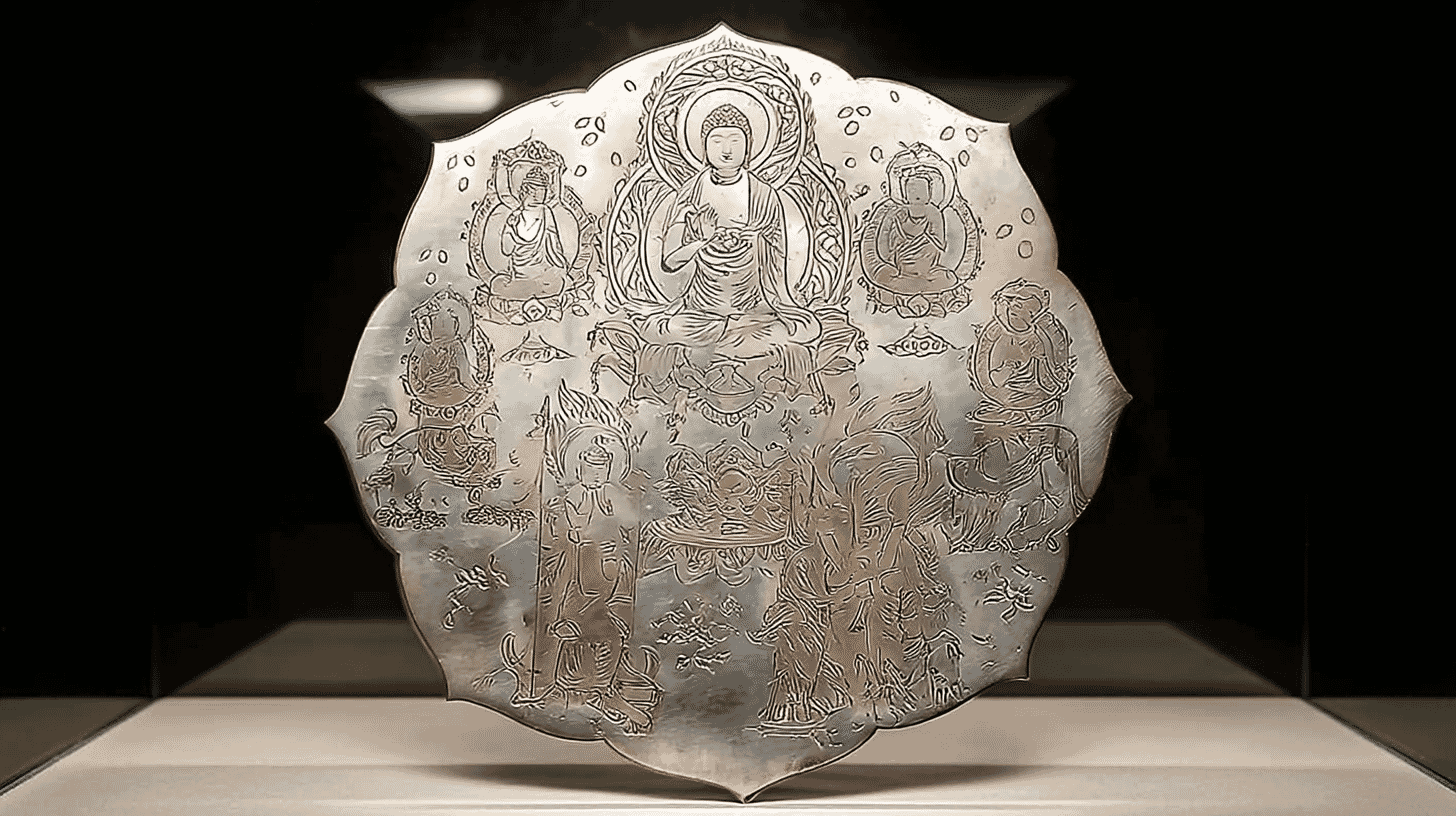
One Mirror, National Treasure since 1954
Carved Mirror Images of the Shaka Triad and Other Statues (線刻釈迦三尊等鏡像, Senkoku Shaka Sanzon To Kyozo) is a Heian-period craft object at 50 Noborioji-cho, Nara City, Nara Prefecture, made an Important Cultural Property on 14 November 1953 and designated a National Treasure on 20 March 1954. The quantity is one mirror and the owner the Sen-oku Hakukokan, a public-interest foundation.
It is an eight-lobed mirror of white bronze, 15.1 centimetres across and 1.2 centimetres thick at the rim: a piece that sits in the palm, with an eight-sided edge.
The address at 50 Noborioji-cho is that of the Nara National Museum. The owner is a museum in Kyoto, so ownership and keeping are divided.
Four Months from Important Cultural Property to National Treasure
The interval is strikingly short.
Important Cultural Property on 14 November 1953, National Treasure on 20 March 1954: about four months.
Among the properties covered here the longest gap was a hundred and nine years, for the Five Wisdom Buddhas. The Inariyama finds took two years, the Fujinoki finds sixteen. Four months is shorter than any of these.
The Taihi Tenmoku bowl took twenty-two years, the Yohen Tenmoku forty-three, the Taima Mandara Engi forty-seven. An interval not even measured in years is new here.
The Agency records no reason. What the record shows is simply that the two dates fall four months apart.
The Two Faces Carry Wholly Different Subjects
What is cut into this mirror differs from face to face.
The mirror face carries Buddhist figures. The Agency records Shakyamuni at the upper centre, with Fugen and Monju to either side, further bodhisattvas flanking him, and below, somewhat larger, Fudo with two attendant boys on the left and Bishamonten on the right.
The figures are worked in hairline engraving, cut with a fine line.
The back is another matter. Ring lines divide it into an inner and an outer zone: within, auspicious flowers and mandarin ducks alternate around a floral boss; without, butterflies and small birds are set among linking scrollwork.
The front is a Buddhist world, the back flowers and birds. On the Taihi Tenmoku bowl, inside and outside were made by opposite means. Here it is not the means but the subject itself that differs.
Nine Figures Recorded One by One
The Agency's description follows each figure in turn.
Shakyamuni sits on a pedestal built up of lotus petals, a cushion moulding, a flower plate and a reversed lotus, with a double halo cut with floral scrollwork and edged in flame.
Fugen sits with palms joined on a lotus throne borne by a white elephant. Monju sits on a lotus throne borne by a lion, holding a sword in the right hand and, in the left, a lotus bearing what appears to be a sutra box.
Fudo Myoo stands on a rock base with a wrathful face and bared fangs, a sword in the right hand and a rope in the left, backed by flames over the whole body. Bishamonten stands on a rock base in armour, a pagoda in the left hand and a trident in the right.
The assessment closes: nine figures large and small are skilfully arranged and rendered in fine, flowing engraved line, the pattern on the back is well cast, and among mirrors of this kind it is a work of rare quality.
Nine figures fit inside a circle 15.1 centimetres across. Of Monju's attribute the record says what appears to be, so the limits of reading the detail are shown as well.
Seeing It
The mirror is at 50 Noborioji-cho, Nara City, owned by the Sen-oku Hakukokan. It is a museum holding, not kept on permanent display.
Related entries name an engraved mirror with twelve deities and an engraved mirror with the thousand-armed Kannon. Mirrors of this kind are recorded more than once.
Being a single mirror, the whole of it can be seen when shown, though front and back cannot be seen at the same time.
Exhibition plans can change, so check before travelling.
Q&A
- When was the mirror designated?
- It became an Important Cultural Property on 14 November 1953 and a National Treasure on 20 March 1954, about four months apart. That is the shortest interval among the properties covered here.
- How large is it?
- An eight-lobed white bronze mirror 15.1 centimetres across and 1.2 centimetres thick at the rim, a piece that sits in the palm.
- What is cut into the two faces?
- The face carries nine Buddhist figures in hairline engraving, including Shakyamuni, Fugen, Monju, Fudo with two attendants and Bishamonten. The back is divided by ring lines, with auspicious flowers and mandarin ducks within and butterflies and small birds without.
- What is valued in it?
- The Agency writes that nine figures large and small are skilfully arranged in fine, flowing engraved line, that the pattern on the back is well cast, and that among mirrors of this kind it is of rare quality.
- Are there other mirrors like it?
- Yes. Related entries name an engraved mirror with twelve deities and one with the thousand-armed Kannon, so mirrors of this kind are recorded more than once.
Basic Information
| Name | Carved Mirror Images of the Shaka Triad and Other Statues (線刻釈迦三尊等鏡像, Senkoku Shaka Sanzon To Kyozo) |
|---|---|
| Location | 50 Noborioji-cho, Nara City, Nara Prefecture |
| Designation | National Treasure (craft) |
| Year Designated | 1953 (14 November), Important Cultural Property; 1954 (20 March), National Treasure |
| Quantity | 1 mirror |
| Dimensions | 15.1 centimetres across, 1.2 centimetres thick at the rim. An eight-lobed white bronze mirror, its face engraved with 9 Buddhist figures in hairline work and its back set with auspicious flowers, mandarin ducks, butterflies and small birds linked by scrollwork. The period is Heian |
| Owner | Sen-oku Hakukokan |
| Public Access | A museum holding, not on permanent display; front and back cannot be seen at once |
References
- Cultural Heritage Online: engraved mirror with the Shaka triad and other figures
- https://bunka.nii.ac.jp/db/heritages/detail/148528
- Sen-oku Hakukokan
- https://sen-oku.or.jp/kyoto/
- Agency for Cultural Affairs, National Cultural Properties Database
- https://kunishitei.bunka.go.jp/
- Agency for Cultural Affairs: introduction to fine arts and crafts
- https://www.bunka.go.jp/seisaku/bunkazai/shokai/bijutsu_kogei/
Last verified: 2026.09.05