
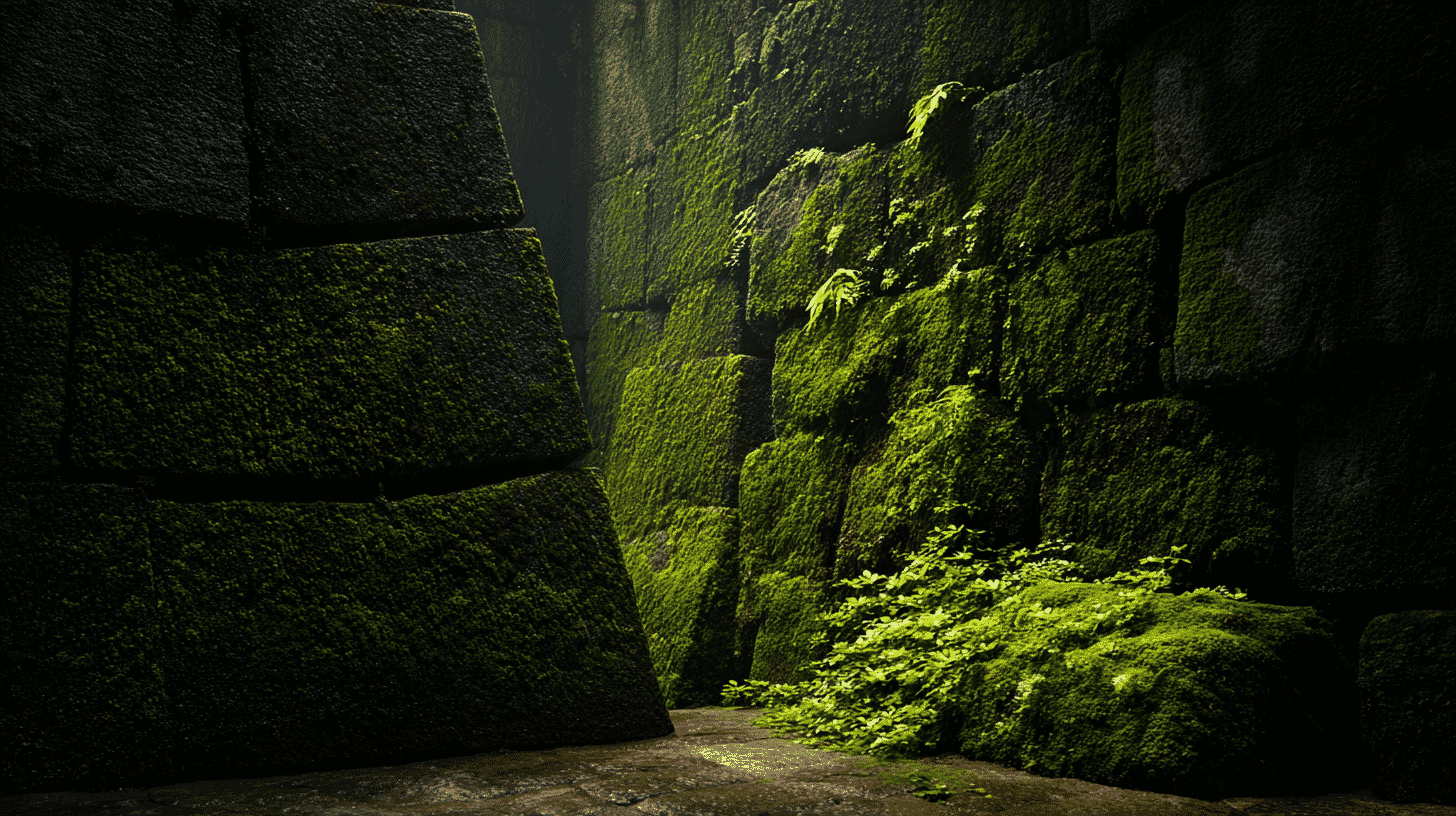
Growing in the Joints of a Castle Wall
Luminous Moss Habitat at the Edo Castle Ruins is a wild colony of luminous moss in Kitanomaru Park, Chiyoda Ward, Tokyo, designated a national Natural Monument on 14 June 1972. It grows in the gaps between the stones of the wall facing the moat, within the Edo Castle Ruins, which are themselves a Special Historic Site.
Luminous moss is a small moss of caves and stone crevices, places where direct sunlight barely reaches. It needs a particular combination of humidity, temperature and very weak light, and in Japan it grows mostly in the centre of the country and north. Luminous Moss Habitat at the Edo Castle Ruins was designated because that combination somehow holds in the middle of the capital.
Why It Was Designated
It was found in May 1969, when a local resident, Kohachiro Ishikawa, noticed something glowing in the joints of the wall. The national record names him.
Until then only two luminous moss sites had been designated national Natural Monuments: the Iwamurada site in Saku, Nagano Prefecture, listed in 1921, and the Yoshimi Hyakuana site in Saitama Prefecture, listed in November 1928. Both are caves or cut tunnels, the sort of place the moss normally chooses. This colony sits on flat ground in central Tokyo with heavy traffic passing close by. The Agency for Cultural Affairs records that growth in such a setting is an extremely rare case, even by the standards of the city.
The designation criterion applied was plant communities growing wild in caves. The wall is not a cave, but the interior of the stonework produces something close enough to one.
How the Moss Appears to Glow
The moss does not generate light. As the Ministry of the Environment explains, its protonema is made of lens-shaped cells linked together, and these refract and reflect whatever light reaches them, so the colony shines pale yellow in the dark. The source is the faint light from outside; the moss simply gathers it and sends it back.
Its usual habitats are caves in cool, clean-aired places such as the Shiretoko Peninsula in Hokkaido, Shibu Onsen in Nagano Prefecture and Nikko Yumoto in Tochigi Prefecture. At Luminous Moss Habitat at the Edo Castle Ruins, on flat ground in the middle of Tokyo, the inside of the stone wall is thought to work something like an air conditioner, holding the conditions steady. The balance is delicate, and the moss dies if it breaks.
Visiting
Luminous Moss Habitat at the Edo Castle Ruins is not open to the public. The Ministry of the Environment's Imperial Palace Outer Garden office gives two reasons: the protection of a vulnerable organism, and the safety of park users. The national record likewise states that entry is prohibited.
This Natural Monument therefore cannot be seen on site. There are no opening hours and no admission fee, and no sign marks the point on the wall where the moss grows. Kitanomaru Park itself is open to anyone, but the colony cannot be approached.
Anyone hoping to see luminous moss in person has to visit one of the cave sites elsewhere that do admit visitors. Enquiries go to the Imperial Palace Outer Garden Administration Office of the Ministry of the Environment, at 1-1 Kokyo Gaien, Chiyoda Ward, Tokyo.
- 📍 Plan Your Visit to Tokyo
- Find tours, activities & transport passes near Luminous Moss Habitat at the Edo Castle Ruins
- [ Tokyo Skytree Asakusa & teamLab Experiences ]
Q&A
- Can I visit Luminous Moss Habitat at the Edo Castle Ruins?
- No. The Ministry of the Environment keeps it closed to the public to protect a vulnerable organism and for the safety of park users, and the national record states that entry is prohibited.
- When was the colony discovered?
- In May 1969, by a local resident who noticed it in the joints of the stone wall in Kitanomaru Park. The Natural Monument designation followed three years later, on 14 June 1972.
- Does luminous moss produce its own light?
- No. Lens-shaped cells in its protonema refract and reflect the small amount of light that reaches them, which makes the colony appear to shine pale yellow in the dark.
- Why does it survive on a wall in central Tokyo?
- The interior of the stonework is thought to act rather like an air conditioner, holding humidity, temperature and light at the levels the moss needs. Its natural habitat is caves in cool regions.
- Are there other designated luminous moss sites?
- Two were designated earlier: the Iwamurada site in Saku, Nagano Prefecture, and the Yoshimi Hyakuana site in Saitama Prefecture. Both are caves or cut tunnels.
Basic Information
| Name | Luminous Moss Habitat at the Edo Castle Ruins |
|---|---|
| Location | Kitanomaru Park, Chiyoda Ward, Tokyo |
| Designation | Natural Monument |
| Year Designated | Designated 1972/06/14 (Showa 47) |
| Quantity | 1 designated habitat |
| Dimensions | Not recorded in the national register |
| Owner | National government, managed by the Ministry of the Environment |
| Public Access | Closed to the public; entry prohibited |
References
- Agency for Cultural Affairs, National Cultural Properties Database
- https://kunishitei.bunka.go.jp/bsys/maindetails/401/726
- Cultural Heritage Online: Luminous Moss Habitat at the Edo Castle Ruins
- https://online.bunka.go.jp/db/heritages/detail/201386
- Ministry of the Environment, Imperial Palace Outer Garden: The Year at the Outer Garden, August
- https://www.env.go.jp/garden/kokyogaien/1_intro/08_aug.html
Last verified: 2026.09.19