
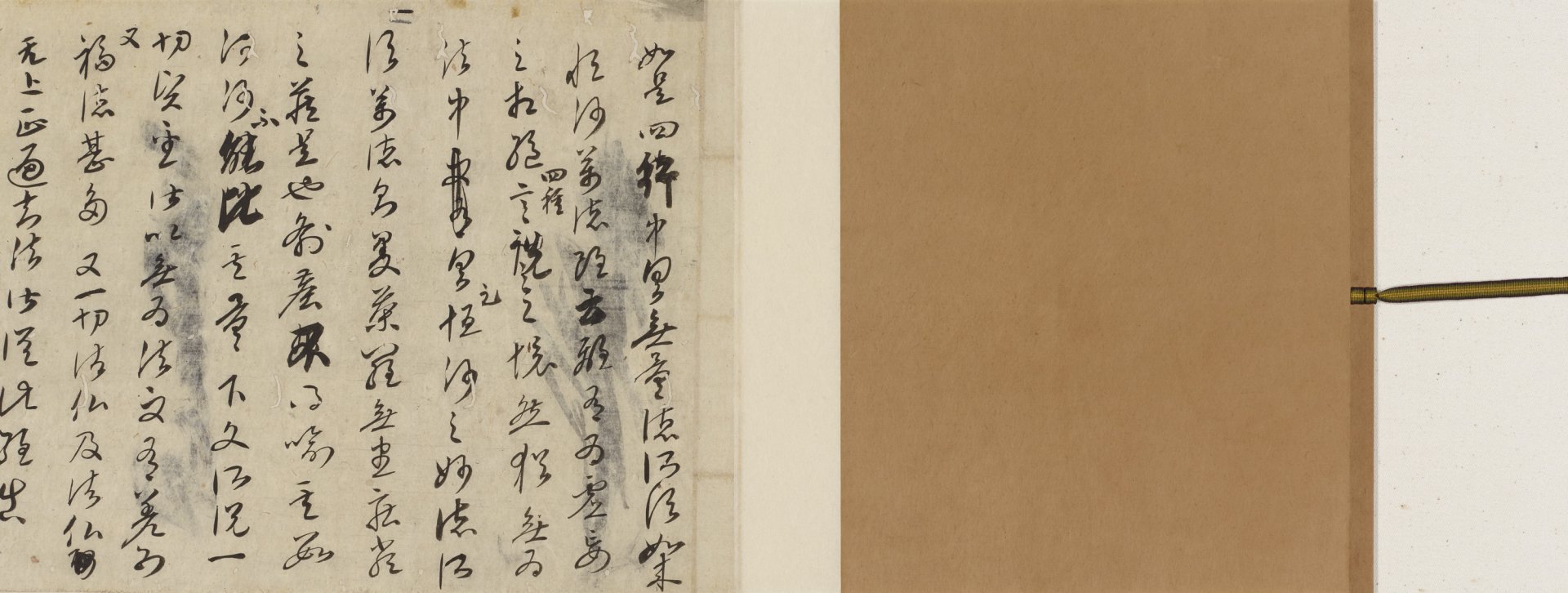
A working draft, corrections and all
Run your eye across this paper scroll, a little over two metres long, and the brush of a ninth-century monk moves quick and sure. Then it stops. A character is struck through. Another is squeezed into the narrow space between two columns of text. These second thoughts, left standing in ink rather than copied out clean, are exactly why the fragment is treasured.
The piece is part of the Kongō Hannyakyō Kaidai, an exegetical preface to the Diamond Sutra written by the monk Kūkai (774–835), better known by his posthumous title Kōbō Daishi. A kaidai is a particular kind of Buddhist commentary: it unpacks the title of a scripture and lays out its essential meaning before a reader turns to the text itself. Kūkai based his preface on the version of the sutra translated into Chinese by the Tang pilgrim-monk Yijing, and he read its title from two angles that belong to esoteric, or mikkyō, thought: a plain, abbreviated reading (kenryaku) and a deeper, hidden one (jinpi).
What survives at the Kyoto National Museum is sixty-three lines, measuring 27.6 centimetres tall and 202.4 centimetres wide. The characters run in cursive script mixed with a steadier semi-cursive hand, sharp in places and light in others. Because the deletions and insertions are still visible, scholars read this not as a finished presentation copy but as Kūkai's own draft, caught mid-thought.
Why it counts among the National Treasures
The scroll was designated a National Treasure on 29 March 1952. Its value rests on a simple, rare fact: it is written in Kūkai's own hand. Autograph works by him are few, and a draft is rarer still. A fair copy shows a calligrapher at his most composed. A draft shows the writing as it actually happened, with the hesitations and revisions left in. For a figure as central to Japanese religious and cultural history as Kūkai, that candour is unusually valuable.
Kūkai's standing as a calligrapher adds to the weight. He is counted among the sanpitsu, the "Three Brushes" of the early Heian court, alongside Emperor Saga and Tachibana no Hayanari. The three were regarded as the finest writers of their age, and Kūkai had absorbed the latest continental styles during his years of study in Tang China. Seeing that trained hand at work in an unguarded moment is part of what makes the fragment compelling.
The object also carries a long and slightly bruising history. The complete manuscript appears to have been kept at Sanbō-in, a subtemple of Daigo-ji in Kyoto, before it was cut apart at some early date. Only about 150 lines are thought to survive today, scattered into separate pieces. The sixty-three-line section now in Kyoto once belonged to the temple Jinkō-in. A companion fragment of thirty-eight lines, also a National Treasure, is held by the Nara National Museum. A further eighty-six lines were lost to fire in the Great Kantō Earthquake of 1923. One scholarly suggestion ties the original writing to the year 813, when the courtier Fujiwara no Kadonomaro sponsored a copying and dedication of 187 scrolls of the Diamond Sutra and Kūkai composed the dedicatory prayer, though this dating is proposed rather than settled.
Reading the brush
If you have the chance to stand in front of it, look first at the corrections. A struck-out character, a small word added above the line, a phrase reworked: each is a decision frozen in place. Few documents let you watch a thinker of Kūkai's stature choose his words, and the appeal of this scroll lies less in its beauty than in that intimacy.
Then watch how the script changes pace. Cursive forms loosen and accelerate where the brush moved fast; the firmer semi-cursive characters slow the rhythm back down. The line is described as both keen and nimble, and the contrast between the two hands gives the surface its energy. A presentation copy would smooth all of this away. Here the variation is the point.
It helps to remember what the text is doing. This is not the sutra itself but a commentary on how to interpret its very title, written by a thinker building the framework of esoteric Buddhism in Japan. The brush and the argument were forming at the same time, on the same sheet.
Seeing it, and what lies nearby
The scroll is not on permanent display. Like most light-sensitive works on paper, it appears only for limited runs, in the Kyoto National Museum's collection galleries or in special exhibitions, and in recent years it has travelled to shows devoted to Kūkai and to East Asian calligraphy. Check the museum's current schedule before planning a visit specifically to see it.
The museum sits in the Higashiyama district of Kyoto, at 527 Chayamachi. Directly across the street stands Sanjūsangen-dō, the long wooden hall famous for its rows of more than a thousand Kannon statues, which makes an easy pairing for an afternoon. From Kyoto Station the museum is a short bus ride, and it is also within walking distance of Keihan Shichijō Station.
Visitors drawn to Kūkai himself have other options in and beyond the city. Tō-ji, the temple in southern Kyoto that he was given charge of, preserves a celebrated three-dimensional mandala of esoteric sculpture. Farther afield, the monastic complex he founded on Mount Kōya in Wakayama remains the spiritual centre of his Shingon school and a place of pilgrimage to this day.
Q&A
- Can I see this scroll whenever I visit the museum?
- No. As a fragile paper work it is shown only occasionally, during rotations in the collection galleries or in special exhibitions. Confirm the current display schedule with the Kyoto National Museum before you go.
- Who actually wrote it?
- The monk Kūkai (774–835), founder of the Shingon school of esoteric Buddhism in Japan and one of the three most admired calligraphers of his era. The scroll is his autograph draft, not a later copy.
- What is a "kaidai"?
- It is a commentary that explains the title of a Buddhist scripture and sets out its core meaning. Here Kūkai interprets the title of the Diamond Sutra from both a plain and a hidden, esoteric standpoint.
- Why does it have only sixty-three lines?
- The original manuscript was cut into pieces long ago. Roughly 150 lines survive in all, split between this fragment and others, including a thirty-eight-line section at the Nara National Museum. A further portion was destroyed by fire in 1923.
- What should I look at closely?
- The deletions and inserted characters, and the shift between fast cursive and steadier semi-cursive writing. These reveal a working mind rather than a polished display, which is the scroll's chief fascination.
Basic Information
| Name | Kongō Hannyakyō Kaidai Zankan (fragment of the exegetical preface to the Diamond Sutra), by Kōbō Daishi, 63 lines |
|---|---|
| Designation | National Treasure (designated 29 March 1952) |
| Category | Calligraphy and classical texts |
| Author | Kūkai (Kōbō Daishi, 774–835) |
| Period | Heian period, 9th century |
| Format and size | One handscroll; 27.6 cm high, 202.4 cm wide |
| Location | Kyoto National Museum, 527 Chayamachi, Higashiyama-ku, Kyoto |
| Owner | National Institutes for Cultural Heritage |
| Viewing | Not permanently displayed; shown on rotation or in special exhibitions |
References
- Database of National Cultural Properties, Agency for Cultural Affairs
- https://kunishitei.bunka.go.jp/bsys/maindetails/201/618
- e-Museum, National Institutes for Cultural Heritage: Kongō Hannyakyō Kaidai Zankan
- https://emuseum.nich.go.jp/detail?content_base_id=101058
- Nara National Museum collection: Kongō Hannyakyō Kaidai Zankan (38 lines), companion fragment
- https://www.narahaku.go.jp/collection/649-0.html
- Kyoto National Museum
- https://www.kyohaku.go.jp/eng/
Last verified: 2026.06.11