
Silver and Bronze Hirumaki Tachi Sword Mounting: A Heian Sword Fitting of Niutsuhime Shrine
The Silver and Bronze Hirumaki Tachi Sword Mounting (銀銅蛭巻太刀拵, gindo hirumaki tachi koshirae) is a Heian-period set of fittings for a tachi sword handed down at Niutsuhime Shrine in Katsuragi Town, Ito District, Wakayama Prefecture, and was designated a National Treasure in 1955.
A koshirae is the complete outer furniture of a sword: scabbard, hilt, guard and metal fittings. The blade that belonged to this one is lost, so only the mounting survives. It belongs to Niutsuhime Shrine and has long been entrusted to the Tokyo National Museum for care.
It was first protected on 18 December 1897, the date that stands as its designation as an Important Cultural Property, and became a National Treasure on 2 February 1955.
History and Why It Is a National Treasure
Niutsuhime Shrine relates that, just before the second Mongol invasion of 1281, court and shogunate records noted an oracle from its deity, and that after the victory the Kamakura shogunate donated estates and presented swords and bows. The shrine holds that the Silver and Bronze Hirumaki Tachi Sword Mounting, together with five tachi designated as Important Cultural Properties, was given at that time.
The mounting itself, however, has been dated to the late Heian period on the evidence of its shape: the large pommel, the strong curve near the hanger fittings and the shallower curve toward the tip all match Heian tachi. Researchers also note that the form of the hanger fittings is more common in the Kamakura period, and argue for allowing a range of dates. When it was presented and when it was made are two separate questions.
It is the only National Treasure among the sword mountings handed down at the shrine, and it preserves the sturdy yet graceful form of a Heian tachi mounting. That is the core of its value.
What to Look For
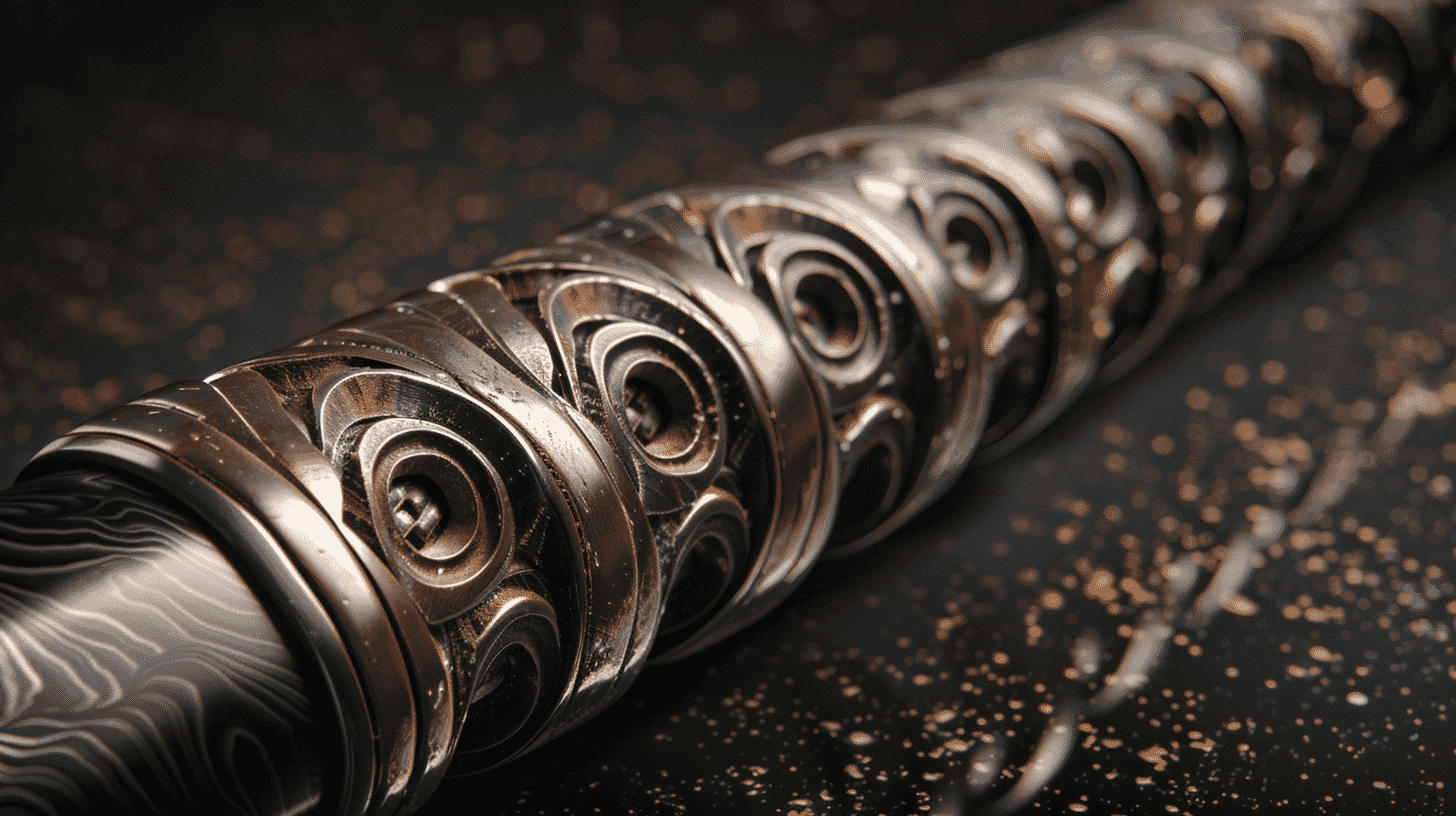
Hirumaki, literally leech-wrapping, is the technique of winding a thin metal strip in a spiral around a hilt or scabbard, both to strengthen and to decorate it. Here, strips of silver-plated yamagane copper are wound around both scabbard and hilt, with the gaps filled in black lacquer.
Every metal fitting, from the pommel cap and hanger mounts to the bands, chape and rivets, is carved in relief with a pattern of flowered lozenges in a tortoiseshell lattice and gilded. The guard, also gilt and quatrefoil in shape, carries the same pattern at its rim. The silver has since darkened to black, so the piece now reads as black and gold, but when new the whole mounting would have shone in gold and silver.
If you have the chance to see the Silver and Bronze Hirumaki Tachi Sword Mounting, look at the size of the pommel and at how the curve of the scabbard changes along its length. The original belt hangers are missing; like the shrine's other swords, it probably once hung from chain hangers. The shrine's treasures page also shows a reconstruction made by a specialist in medieval crafts.
Viewing Opportunities
The mounting is not on permanent display. Whether it appears at the Tokyo National Museum depends on the exhibition programme, so check the museum's schedule if you hope to see it.
Its owner, Niutsuhime Shrine, stands in the Amano basin at Kami-Amano, Katsuragi, Wakayama. The shrine's treasures page features a reconstruction of the mounting; whether the reconstruction or related material is shown at the shrine may vary, so check with the shrine before visiting.
When the mounting is on display, follow the venue's rules on photography.
- 📍 Plan Your Visit to Tokyo
- Find tours, activities & transport passes near Silver and Bronze Hirumaki Tachi Sword Mounting
- [ Tokyo Skytree Asakusa & teamLab Experiences ]
Q&A
- Where can I see the Silver and Bronze Hirumaki Tachi Sword Mounting?
- It is not on permanent display. It has long been in the care of the Tokyo National Museum, and whether it is shown depends on the exhibition programme.
- What does hirumaki mean?
- It is the technique of winding a thin metal strip in a spiral around a hilt or scabbard. Here, silver-plated copper strips are wound on, with black lacquer filling the gaps.
- When was the Silver and Bronze Hirumaki Tachi Sword Mounting made?
- Its shape points to the late Heian period, though some features suggest allowing a wider range of dates. The shrine holds that it was presented by the Kamakura shogunate after the Mongol invasion of 1281.
- Does the mounting still have its blade?
- No. The blade is lost; only the mounting survives.
- When was it designated a National Treasure?
- On 2 February 1955. Its date of designation as an Important Cultural Property is 18 December 1897.
Basic Information
| Name | Silver and Bronze Hirumaki Tachi Sword Mounting |
|---|---|
| Location | Tokyo National Museum, 13-9 Ueno Park, Taito City, Tokyo |
| Designation | National Treasure (Craft) |
| Year Designated | Designated National Treasure 1955/02/02 (Showa 30); Important Cultural Property 1897/12/18 (Meiji 30) |
| Quantity | 1 mounting |
| Dimensions | Unknown (not confirmed in the Agency for Cultural Affairs database) |
| Owner | Niutsuhime Shrine |
| Public Access | Not on permanent display. Check the Tokyo National Museum's exhibition schedule |
References
- Niutsuhime Shrine: Sacred Treasures (Japanese)
- https://niutsuhime.or.jp/about/shahou/
- Niutsuhime Shrine: Traditions of the Shrine (Japanese)
- https://niutsuhime.or.jp/about/tradition/
- Hoshino et al., reconstruction study of the National Treasure mounting (JFE 21st Century Foundation, Japanese)
- https://www.jfe-21st-cf.or.jp/furtherance/pdf_hokoku/2013/07.pdf
- Agency for Cultural Affairs, Database of National Cultural Properties
- https://kunishitei.bunka.go.jp/
Last verified: 2026.09.27