Nakatsukasa Masamune: The Legendary Blade of an Invincible Warrior
Among the many masterpieces forged by the greatest swordsmith in Japanese history, one katana carries a story that intertwines the art of the sword with the valor of one of Japan's most celebrated warriors. The Nakatsukasa Masamune — designated a National Treasure of Japan — is a blade that passed through the hands of Honda Tadakatsu, an undefeated samurai general who fought in 57 battles without receiving a single wound, then through the Tokugawa shoguns who unified and ruled Japan for over 250 years. Today, this extraordinary sword resides at the Tokyo National Museum, where visitors can witness a living testament to the pinnacle of Japanese swordsmithing and the warrior spirit of the samurai age.
The Master Behind the Blade: Gorō Nyūdō Masamune
Masamune, whose full name is Gorō Nyūdō Masamune, is widely regarded as the greatest swordsmith in the history of Japan. Active during the late Kamakura period (late 13th to early 14th century) in Sagami Province — present-day Kanagawa Prefecture — he perfected the Sōshū-den, or Sagami tradition of swordmaking. This revolutionary forging technique produced blades that were thin yet remarkably strong, sharp yet resilient — an innovation that fundamentally transformed the Japanese sword.
Masamune's blades are celebrated for their distinctive nie — brilliant crystalline particles of martensite that appear like scattered stars within the steel. Combined with bold, sweeping hamon (temper patterns) and deeply textured jihada (surface grain), his swords possess an aesthetic power that transcends mere weaponry. So prized were his works that, alongside Awataguchi Yoshimitsu and Gō no Yoshihiro, Masamune was honored as one of the Tenka Sansaku — the Three Greatest Swordsmiths Under Heaven. His influence was so profound that ten master swordsmiths inspired by his methods became known as the Masamune Juttetsu (Ten Great Students of Masamune), spreading the Sōshū tradition across Japan.
Curiously, nearly all of Masamune's surviving works are unsigned. This has led to centuries of scholarly debate and even a famous controversy during the Meiji era known as the "Masamune Obliteration Theory," which questioned his very existence. However, research into historical records and the stylistic consistency of attributed blades has firmly established both his existence and his unparalleled mastery.
The Sword: Form and Beauty of the Nakatsukasa Masamune
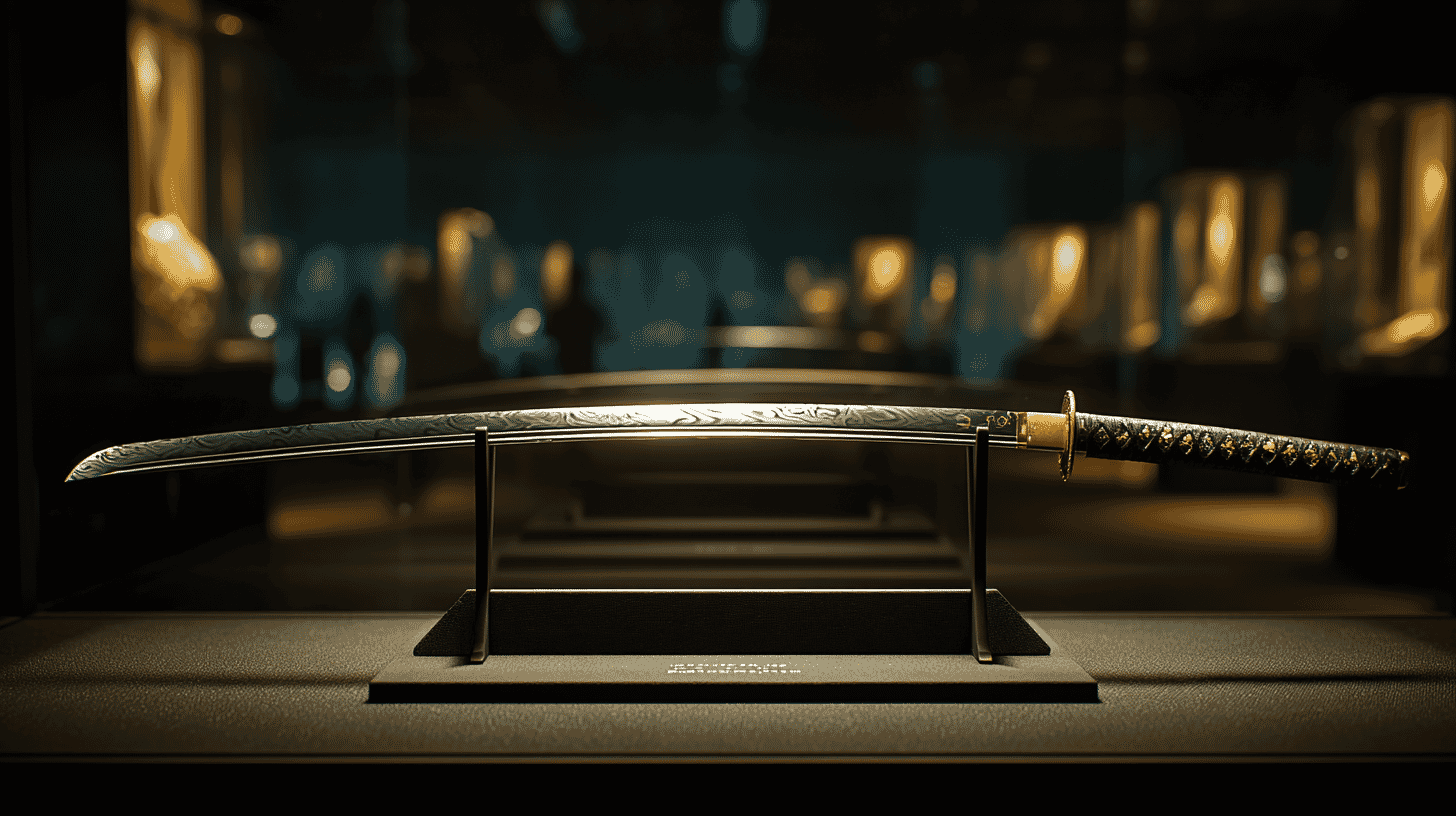
The Nakatsukasa Masamune is a katana of the shinogi-zukuri construction — the classic ridged form — with an iori-mune (gabled back). Its blade is relatively wide with a gentle, shallow curvature and a slightly extended medium-length kissaki (tip), giving it a commanding yet elegant profile. The blade bears bo-hi (straight grooves) carved through both sides, adding both visual refinement and a lighter feel when the sword is wielded.
The forging of this blade exemplifies the zenith of the Sōshū tradition. The jihada (grain pattern) is an itame (wood grain) that stands slightly proud, with thick ji-nie (crystalline particles on the surface), chikei (dark lines in the steel), and yubashiri (areas where the tempering effect spreads into the body of the blade). These features create a living, luminous surface that seems to shift and breathe under light.
The hamon (temper pattern) is a flowing notare (undulating) style mixed with gunome-midare (irregular clove shapes) and ko-midare (small irregular waves). Ashi and yō (legs and leaves — bright lines extending into the temper pattern) appear abundantly, while the nie is thick and the nioiguchi (boundary of the temper line) is deep and vivid. Kinsuji (golden lines) and sunagashi (streaming sand patterns) cascade through the hardened edge, lending the blade an almost painterly quality. The bōshi (temper pattern at the tip) sweeps in with a gentle curve before nearly reaching the edge in a yakizume finish, with a faint trace of a sweeping return.
The tang (nakago) has been greatly shortened through ō-suriage — a common practice when longer tachi-style swords were converted into the shorter katana form for easier carry. One mekugi-ana (peg hole) remains, and the file marks (yasurime) run in a katte-sagari (downward right) pattern with a kuri-jiri (chestnut-shaped) tip.
The Gold Inlay Inscription: A Story Written in Metal
Because Masamune's works are almost universally unsigned, this blade originally bore no inscription. Its attribution to Masamune came through Hon'ami Kōtoku, a member of the illustrious Hon'ami family that had served for generations as the foremost sword appraisers in Japan. Kōtoku examined this blade and authenticated it as a genuine Masamune — a judgment of the highest authority.
In 1606, the celebrated metalworker Umetada Myōju (also known as Umetada Juzai) applied gold inlay inscriptions (kinzōgan-mei) to the tang. On the front side, the inscription reads "Masamune, Hon'a (kaō)" — confirming the attribution by the Hon'ami family with their official cipher. On the reverse, "Honda Nakatsukasa shoji" — "Owned by Honda Nakatsukasa" — records the name of the sword's famous owner. These golden characters, inlaid directly into the steel of the tang, are themselves works of art, and they serve as an indelible record linking this blade to two of the most important figures in Japanese sword history: the greatest swordsmith and the greatest warrior of his age.
Honda Tadakatsu: The Warrior Who Surpassed Death
The "Nakatsukasa" in the sword's name derives from the official court title — Nakatsukasa-no-tayū — held by its most famous owner, Honda Tadakatsu (1548–1610). Tadakatsu is one of the most legendary samurai in all of Japanese history. As one of the Tokugawa Shitennō — the Four Heavenly Kings of the Tokugawa clan — he served Tokugawa Ieyasu from childhood and fought in an astonishing 57 battles over the course of his life without receiving a single wound. This extraordinary record earned him the epithet "The Warrior Who Surpassed Death Itself."
Tadakatsu's prowess was recognized even by his lord's rivals. Oda Nobunaga, the great unifier, called him "a samurai among samurai." Toyotomi Hideyoshi, who would succeed Nobunaga, declared him "the greatest warrior in Japan." Even the formidable Takeda Shingen is said to have remarked that Tadakatsu was "a luxury that Ieyasu does not deserve." After the decisive Battle of Sekigahara in 1600, Tadakatsu was rewarded with the domain of Kuwana in Ise Province (present-day Kuwana City, Mie Prefecture), becoming its first lord. For this reason, the sword is also known as Kuwana Masamune.
Tadakatsu acquired this blade through the mediation of Hon'ami Kōtoku during his years as lord of Kuwana. He later presented the sword to his liege lord, Tokugawa Ieyasu — a gesture of loyalty from the greatest warrior to the man who would become the founder of the Tokugawa Shogunate.
A Journey Through the Halls of Power
After being presented to Tokugawa Ieyasu, the Nakatsukasa Masamune embarked on a centuries-long journey through Japan's most powerful families. Following Ieyasu's death in 1616, the sword was distributed as part of his estate to the Mito branch of the Tokugawa family, headed by Tokugawa Yorifusa, Ieyasu's eleventh son.
In 1661, Tokugawa Mitsukuni — the famous "Mito Kōmon" known to generations of Japanese through popular television dramas — presented the blade to the fourth Tokugawa shogun, Ietsuna. At that time, the sword was valued at 300 gold ōban coins — an extraordinary sum reflecting its status as one of the finest swords in existence. The blade was also recorded in the Kyōhō Meibutsu-chō, the authoritative Edo-period catalogue of the most distinguished named swords in Japan.
When Shogun Ietsuna passed away in 1680, the sword was bequeathed to Tokugawa Tsunatoyo, lord of the Kōfu domain, who later became the sixth Tokugawa shogun under the name Ienobu. Thus, the Nakatsukasa Masamune returned to the possession of the ruling shogunal house, where it would remain as a treasured heirloom for generations.
In the Meiji era, the Tokugawa family commissioned a new han-dachi (half-tachi style) mounting for the blade and presented it to Ōkubo Ichiō, a prominent statesman. It was later returned to the Tokugawa family and designated as Important Art Object in 1935 and as a National Treasure (under the former system) in 1941. After passing through several private collections in the postwar period, the sword was acquired by the Agency for Cultural Affairs in 2003 and designated a National Treasure under the current Cultural Properties Protection Law. It is now permanently housed at the Tokyo National Museum.
Why This Sword Is a National Treasure
The Nakatsukasa Masamune was designated a National Treasure for several compelling reasons. First, it is a supreme example of the art of Gorō Nyūdō Masamune — widely regarded as the greatest swordsmith in Japanese history. The blade displays all the hallmark characteristics of the Sōshū tradition at its most accomplished: a rich, luminous jihada alive with nie and chikei, a hamon of extraordinary depth and complexity, and a form that balances power with refinement.
Second, the sword carries exceptional historical significance. Its gold inlay inscriptions, applied by the renowned metalworker Umetada Juzai and authenticated by the Hon'ami family, connect the blade to Honda Tadakatsu — one of the most celebrated warriors in samurai history — and to the Tokugawa shogunal dynasty that ruled Japan for over two and a half centuries. Recorded in the prestigious Kyōhō Meibutsu-chō, this is a "named sword" whose provenance reads like a chronicle of Japanese history itself.
Third, the condition of the blade remains remarkably fine after more than seven hundred years, allowing viewers to appreciate the subtleties of Masamune's forging technique in person — a rare and precious opportunity.
Highlights and What to Look For
When viewing the Nakatsukasa Masamune, visitors should pay special attention to the following features:
- The nie — brilliant crystalline particles scattered across the steel surface like stars in a night sky. Masamune's mastery of nie is unmatched, and this blade is a superb showcase.
- The hamon — the flowing, undulating temper pattern that blends notare and gunome shapes. Look for the kinsuji (golden lines) and sunagashi (sand-flow patterns) within the hardened edge.
- The jihada — the rich wood-grain texture of the steel, alive with chikei (dark lines) and yubashiri (scattered tempering effects). This surface texture is a signature of the Sōshū tradition.
- The gold inlay inscription (kinzōgan-mei) on the tang — the characters "Masamune" and "Honda Nakatsukasa" gleaming in gold against the dark steel, a tangible connection to the sword's storied past.
- The overall form — the wide, gently curving blade with its slightly extended tip conveys both power and grace, characteristic of the finest Kamakura-period swords.
Museum lighting is typically arranged to highlight these features. Take your time and observe the blade from different angles; the play of light on the steel reveals different aspects of the forging and tempering at each viewing position.
Visiting the Tokyo National Museum
The Nakatsukasa Masamune is housed at the Tokyo National Museum (Tōhaku) in Ueno Park, one of Japan's oldest and most comprehensive museums. The museum's Japanese Gallery (Honkan) features dedicated sword exhibition rooms where National Treasure blades are displayed in carefully controlled environments with specialized lighting designed to reveal the beauty of each blade's hamon, jihada, and nie.
As the sword is owned by the Agency for Cultural Affairs and entrusted to the museum, it is exhibited on a rotating basis. It has also been loaned to other institutions for special exhibitions. Visitors planning to see this specific blade should check the museum's current exhibition schedule in advance.
The Tokyo National Museum is located a short walk from JR Ueno Station (Park Exit) or Tokyo Metro Ueno Station. The surrounding Ueno Park area is home to numerous other museums, temples, and gardens, making it an ideal destination for a full day of cultural exploration.
Surrounding Attractions
A visit to see the Nakatsukasa Masamune at the Tokyo National Museum can easily be combined with exploration of other cultural treasures in the area:
- Ueno Park — One of Tokyo's largest public parks, famous for cherry blossoms in spring and home to multiple museums, a zoo, and historic temples.
- Kiyomizu Kannon-dō — A temple within Ueno Park modeled after the famous Kiyomizu-dera in Kyoto, built in 1631.
- Tōshō-gū Shrine — A shrine within Ueno Park dedicated to Tokugawa Ieyasu, the very lord whom Honda Tadakatsu served. Visiting this shrine adds a meaningful connection to the story of the Nakatsukasa Masamune.
- The National Museum of Western Art — A UNESCO World Heritage Site designed by Le Corbusier, located adjacent to the Tokyo National Museum.
- Yanaka District — A charming old-town neighborhood just north of Ueno, perfect for a leisurely stroll through traditional shops and temples.
- Asakusa and Sensō-ji — Tokyo's oldest temple, easily reached by a short train ride from Ueno.
For those inspired to explore more of Honda Tadakatsu's legacy, a visit to Kuwana in Mie Prefecture — where Tadakatsu served as lord — offers Kuwana Castle ruins, historical monuments, and a statue of the great warrior himself.
- 📍 Plan Your Visit to Tokyo
- Find tours, activities & transport passes near Sword (Gold Inlaid Masamune Hon a Ou Seal / Owned by Honda
- [ Tokyo Skytree Asakusa & teamLab Experiences ]
Q&A
- Where can I see the Nakatsukasa Masamune?
- The sword is housed at the Tokyo National Museum in Ueno Park, Tokyo. It is owned by the Agency for Cultural Affairs and is exhibited on a rotating basis. It is also occasionally loaned to other museums for special exhibitions. Check the Tokyo National Museum's website or exhibition schedule to confirm current display status before your visit.
- Why is this sword called "Nakatsukasa Masamune"?
- The name derives from the court title "Nakatsukasa-no-tayū" (Vice-Minister of Central Affairs) held by its most famous owner, Honda Tadakatsu, one of the legendary Tokugawa Four Heavenly Kings. The sword is also known as "Kuwana Masamune" after the domain that Tadakatsu governed.
- Is the sword signed by Masamune himself?
- No. Like most of Masamune's surviving works, the blade itself is unsigned. Its attribution to Masamune was certified by Hon'ami Kōtoku, the renowned sword appraiser, and this authentication is recorded through gold inlay inscriptions (kinzōgan-mei) applied to the tang in 1606 by metalworker Umetada Juzai.
- Is photography allowed when the sword is on display?
- Photography policies vary by exhibition. The Tokyo National Museum's permanent collection galleries generally permit non-flash photography, but special exhibitions may have different rules. Always check the posted guidelines at each exhibition room.
- What makes Masamune's swords so special compared to other Japanese swordsmiths?
- Masamune perfected the Sōshū-den tradition, creating blades that combined exceptional strength with remarkable beauty. His hallmark is the abundant use of nie — brilliant crystalline particles in the steel — along with bold hamon patterns and richly textured grain. His innovation of producing thin yet incredibly strong blades revolutionized Japanese swordmaking and influenced all subsequent generations of swordsmiths.
Basic Information
| Official Name | Katana, with gold inlay inscription "Masamune, Hon'a (kaō) / Honda Nakatsukasa shoji" (Meibutsu Nakatsukasa Masamune) |
|---|---|
| Japanese Name | 刀〈金象嵌銘正宗本阿花押/本多中務所持〉(名物中務正宗) |
| Alternative Names | Kuwana Masamune (桑名正宗), Chūsho Masamune (中書正宗) |
| Designation | National Treasure (designated February 19, 1957) |
| Category | Craft (Sword) |
| Period | Kamakura period (late 13th – early 14th century) |
| Swordsmith | Gorō Nyūdō Masamune (Sōshū tradition) |
| Blade Length | 67.0 cm |
| Curvature | 1.7 cm |
| Base Width | 2.9 cm |
| Tip Width | 2.1 cm |
| Tang Length | 15.5 cm |
| Construction | Shinogi-zukuri, iori-mune, ō-suriage nakago |
| Owner | Agency for Cultural Affairs (Government of Japan) |
| Location | Tokyo National Museum, 13-9 Ueno Park, Taito-ku, Tokyo 110-8712 |
| Access | 10-minute walk from JR Ueno Station (Park Exit); 15-minute walk from Tokyo Metro Ueno Station |
| Admission | General collection: 1,000 yen (adults). Free for those under 18 and over 70 with ID. |
References
- Cultural Heritage Online — Katana (Meibutsu Nakatsukasa Masamune)
- https://bunka.nii.ac.jp/heritages/detail/189046
- WANDER Kokuhō — National Treasure: Katana (Meibutsu Nakatsukasa Masamune)
- https://wanderkokuho.com/201-00511/
- Meitō Gensō Jiten — Nakatsukasa Masamune
- https://meitou.info/index.php/%E4%B8%AD%E5%8B%99%E6%AD%A3%E5%AE%97
- Tsurugi no Ya — Nakatsukasa Masamune
- https://www.tsuruginoya.net/stories/nakatsukasamasamune/
- Touken World — Masamune (Swordsmith)
- https://www.touken-world.jp/sword-artisan-directory/masamune/
- Meihaku — Honda Tadakatsu and His Beloved Sword
- https://www.meihaku.jp/sengoku-sword/favoriteswords-hondatadakatsu/
- Wikipedia — Masamune
- https://en.wikipedia.org/wiki/Masamune
- Wikipedia — Honda Tadakatsu
- https://en.wikipedia.org/wiki/Honda_Tadakatsu
- National Designated Cultural Properties Database
- https://kunishitei.bunka.go.jp/bsys/maindetails/201/511
Last verified: 2026.02.17
Nearby heritages
- Light Coloured Painting of the Wonders of Land (by Ike
- 7-2 Ishizaka 4-chome, Dazaifu City, Fukuoka Prefecture
- Tachi (inscribed Masatsune)
- 13-9 Ueno Park, Taito-ku, Tokyo
- Bugaku Costumes (handed Down from Amano Shrine)
- 13-9 Ueno Park, Taito-ku, Tokyo
- Wooden Seated Statue of Amida Buddha
- 85-4 Yabunouchicho, Shimochojamachi-dori Shinmachi Nishiiru, Kamigyo-ku, Kyoto City, Kyoto Prefecture
- Ink on Silk Painting of a Calf
- Tokyo National Museum, 13-9 Ueno Park, Taito-ku, Tokyo
- Celadon Turnip Vase
- 2855-1 Kanai, Shibukawa City, Gunma Prefecture
- Money Register Written in Ink on Paper
- 527 Chayamachi, Higashiyama Ward, Kyoto City
- Paper Copy of the Sutras in Ink and Paper
- 527 Chayamachi, Higashiyama Ward, Kyoto City
- Ink Written Certificate of Land Reclamation on Paper (10th
- 527 Chayamachi, Higashiyama Ward, Kyoto City
- Ink-Written Proofreading Book on Paper (eight Sheets)
- 527 Chayamachi, Higashiyama Ward, Kyoto City