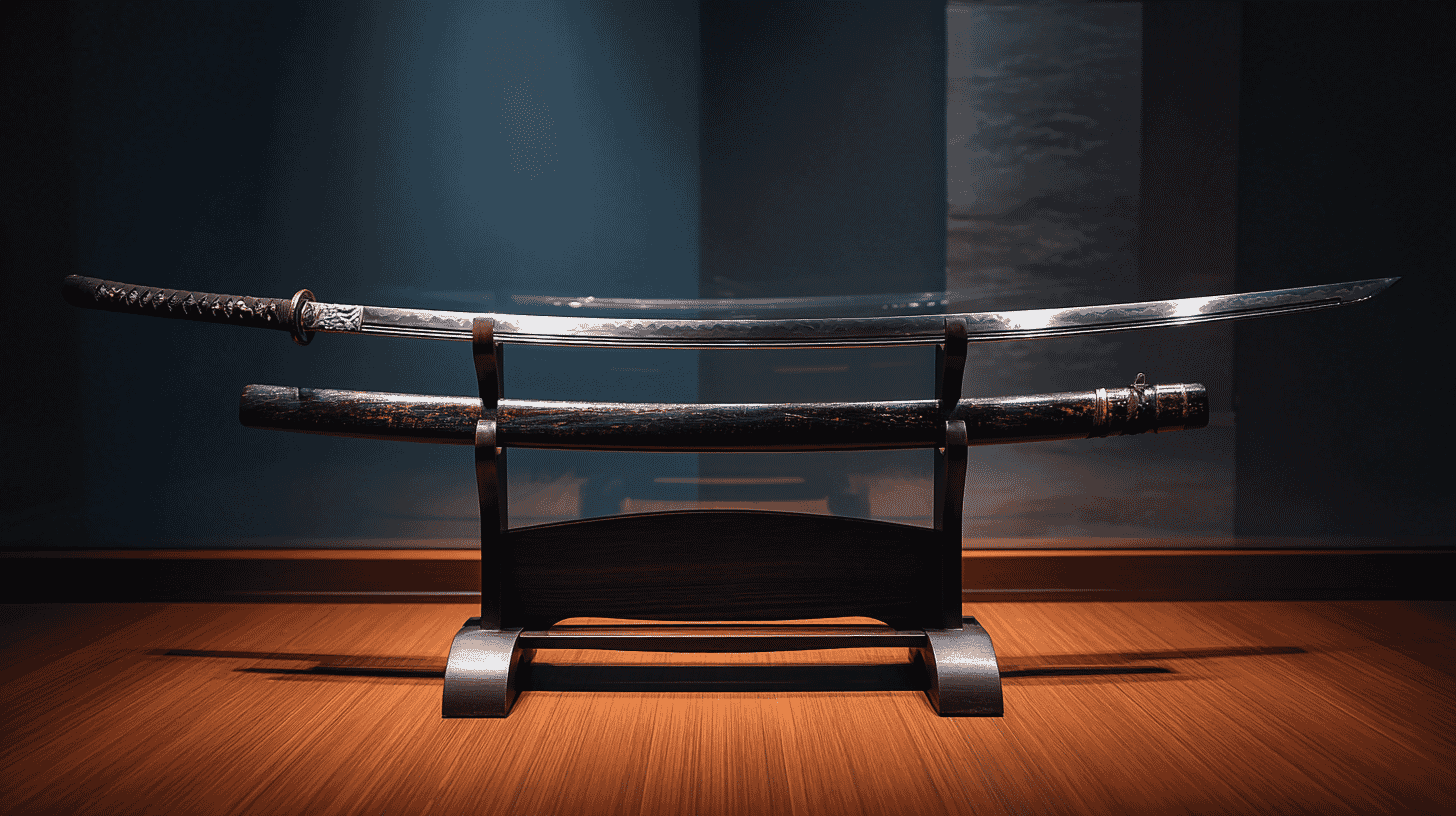
Tachi Signed Hisakuni: A Kamakura-Period Masterpiece by an Imperial Swordsmith
Among Japan's designated National Treasures, the category of swords boasts more entries than any other type of fine art — a testament to the profound reverence the Japanese have long held for the art of the blade. Within this illustrious company, the Tachi signed "Hisakuni" occupies a place of singular importance. Forged by Awataguchi Hisakuni, who served as master instructor to the swordsmiths of a retired emperor, this elegant long sword has survived for roughly eight centuries in an almost perfectly original condition. It stands as one of the finest and rarest surviving examples of Kyoto's celebrated Awataguchi school, and a window into the golden age of Japanese swordmaking.
The Awataguchi School: Kyoto's Supreme Swordsmiths
To appreciate this tachi, one must first understand the world from which it emerged. The Awataguchi school takes its name from the Awataguchi district of Kyoto, located near the eastern gateway of the capital close to the Sanjō Bridge. During the early Kamakura period (late 12th to 13th century), this neighborhood was home to an extraordinary family of swordsmiths who set the standard for elegance and refinement in Japanese blade-making.
The school was founded by Kuniye (also read Kuniie), whose six sons — Kunitomo, Hisakuni, Kuniyasu, Kunikiyo, Arikuni, and Kunitsuna — are collectively known as the "Six Brothers of Awataguchi." Together, they elevated the family workshop into what was considered the most prestigious sword-making lineage in the capital. A later member of the school, Tōshirō Yoshimitsu, would go on to become one of the three greatest swordsmiths in all of Japanese history.
What set the Awataguchi school apart was an almost preternatural refinement of technique. Their blades are renowned for a distinctive grain pattern known as nashiji-hada — an extremely fine, tightly packed wood-grain texture resembling the skin of a Japanese pear. This luminous surface quality, combined with graceful proportions and restrained temper lines, gave Awataguchi swords an air of courtly sophistication that was especially prized by Kyoto's aristocracy.
Awataguchi Hisakuni: The Emperor's Master Swordsmith
Hisakuni, the second of the six brothers, was born Hayashi Tōjirō, though his exact dates of birth and death are unknown. He lived and worked during the early Kamakura period — a time of tremendous cultural achievement in Japan. His skill was so exceptional that it caught the attention of the most powerful patron a swordsmith could hope for: Retired Emperor Go-Toba.
Go-Toba was an avid devotee of sword-making who summoned the finest smiths from across Japan to forge blades at his palace on a rotating monthly basis. These honored craftsmen were known as goban kaji, or "rotating smiths." Among them, Hisakuni was singled out for the extraordinary honor of shitoku kaji — the "master instructor" who guided the other smiths. He was also the first swordsmith in history to receive an official court title (Ōsumi no Gon no Kami), a remarkable distinction that speaks to the esteem in which his abilities were held.
In the Edo-period reference work Kaihō Kenjaku, published in 1830, Hisakuni's blades were ranked in the highest category of artistic excellence among all antique swords. However, even by the Edo period, his works were already exceedingly rare, and none had ever been subjected to a cutting test — they were simply too valuable to risk.
Why This Tachi Is Designated a National Treasure
The Tachi signed "Hisakuni" was designated as an Important Cultural Property on December 14, 1931, and elevated to National Treasure status on June 9, 1951 — one of the first works recognized under Japan's modern cultural protection law. Several factors make this blade uniquely significant.
First, it is the only National Treasure among Hisakuni's surviving works. Of his known authenticated pieces, only three others carry Important Cultural Property designation, and two of those are currently unaccounted for. Signed works by this master are extraordinarily rare.
Second, and perhaps most remarkably, the sword preserves its original tang (nakago) in an almost completely unaltered state — a condition known as ubu. Over the centuries, most Japanese swords have been shortened or modified to suit changing combat styles and tastes. That this blade survives in essentially the form in which Hisakuni created it, with his two-character signature ("久国") still clearly inscribed in fine chisel strokes on the tang, makes it an invaluable document of early Kamakura sword-making.
Third, the blade itself exemplifies the highest ideals of the Awataguchi school. Its graceful profile, meticulous forging, and luminous surface stand as a benchmark against which other works of the tradition are measured.
A Closer Look: The Artistry of the Blade
For those unfamiliar with Japanese sword appreciation, the beauty of a tachi lies not only in its overall shape but in subtle details visible only upon careful inspection. This blade, measuring approximately 80.5 centimeters in length with a curvature of about 3 centimeters, is constructed in shinogi-zukuri form — the classic ridged profile of the Japanese long sword — with an iori-mune (angled back ridge).
The overall silhouette is slender and deeply curved with a strong funbari — a pronounced tapering from base to tip that gives the sword a sense of dynamic stability. The kissaki (point) is small, known as ko-kissaki, lending the blade an air of refined elegance characteristic of the early Kamakura aesthetic. These proportions reflect the aristocratic tastes of the era, when swords were valued as much for their beauty as for their martial utility.
The surface of the blade reveals the Awataguchi school's signature mastery of metalwork. The jigane (surface steel) displays a tightly forged ko-itame pattern — a fine, closely packed wood-grain texture — with a deep, luminous quality enhanced by dense ji-nie (sparkling crystalline particles) and clearly visible utsuri (a misty, reflective pattern that appears on the surface). These features speak to the extraordinary purity and quality of the steel and the skill with which it was folded and hammered.
The hamon, or temper pattern along the cutting edge, is primarily a chū-suguha (medium-width straight line) interspersed with small irregular patterns (ko-midare). Fine details such as ko-ashi (small legs extending into the temper), uchino-ke (scattered activity), and sunagashi (flowing sand-like lines) add visual complexity. The bōshi (temper pattern at the tip) turns in a gentle, shallow curve with a slight return — another hallmark of understated refinement.
Provenance and Journey Through History
This tachi was transmitted through the Matsudaira family of the Iyo-Saijō domain, in what is now Ehime Prefecture on the island of Shikoku. The Saijō Matsudaira were a branch of the Tokugawa clan — the second son of the first lord of the powerful Kishū (Wakayama) domain established the Saijō domain in 1668. As a domain closely connected to the ruling Tokugawa shogunate, the family possessed the means and the cultural awareness to safeguard a treasure of this caliber.
The sword is now owned by the Agency for Cultural Affairs of Japan and housed at the Tokyo National Museum, where it is periodically displayed. In recent years, it has been featured in several major exhibitions, including the "Swords of Kyoto" exhibition at the Kyoto National Museum in 2018, and the 150th anniversary exhibition "All the National Treasures of the Tokyo National Museum" in 2022. It is also scheduled to appear at the "National Treasures of Japan" exhibition at the Osaka City Museum of Fine Arts in 2025.
Experiencing the Tachi at the Tokyo National Museum
The Tokyo National Museum, Japan's oldest and largest museum, is the primary venue where visitors may encounter this National Treasure. Located in the heart of Ueno Park in central Tokyo, the museum's Japanese Gallery (Honkan) features rotating exhibitions of swords in Room 13, where blades from the national collection are displayed on a changing schedule throughout the year.
Because National Treasure swords are shown on a rotating basis to preserve them from light exposure and environmental damage, the Hisakuni tachi is not always on view. It typically appears once every few years, either in the regular galleries or as part of a special exhibition. Visitors planning a trip specifically to see this sword should check the museum's exhibition schedule in advance on its official website.
The museum itself is a treasure worth visiting regardless. Its collection of nearly 120,000 objects includes 89 National Treasures and 653 Important Cultural Properties, making it one of the richest repositories of Japanese and Asian art in the world. English-language audio guides are available, and explanatory labels throughout the galleries include English text.
Surrounding Area: Exploring Ueno
A visit to the Tokyo National Museum naturally pairs with exploration of the surrounding Ueno district, one of Tokyo's most culturally rich neighborhoods. Ueno Park itself is home to several other major museums, including the National Museum of Western Art (a UNESCO World Heritage site designed by Le Corbusier), the National Museum of Nature and Science, and the Tokyo Metropolitan Art Museum.
Nearby, the venerable Ueno Tōshō-gū Shrine — dedicated to Tokugawa Ieyasu — features spectacular gold-leaf decorations, while the sprawling Ueno Zoo is one of Japan's oldest zoological gardens. The lively Ameyoko market street, stretching from Ueno Station toward Okachimachi, offers a bustling atmosphere of food stalls, fresh seafood vendors, and bargain shops that has remained essentially unchanged since the postwar era.
Ueno is also just a short train ride from the historic Asakusa district, home to the iconic Sensō-ji temple and its atmospheric Nakamise shopping street. Together, Ueno and Asakusa offer an ideal day of cultural immersion combining world-class museum experiences with the living traditions of old Tokyo.
- 📍 Plan Your Visit to Tokyo
- Find tours, activities & transport passes near Sword〈Meikunokuni〉
- [ Tokyo Skytree Asakusa & teamLab Experiences ]
Q&A
- Is the Tachi signed Hisakuni always on display at the Tokyo National Museum?
- No. As a National Treasure, this sword is displayed on a rotating basis to protect it from light damage and environmental wear. It typically appears once every few years, either in the museum's regular sword gallery (Room 13 of the Honkan) or as part of a special exhibition. Please check the museum's official website or exhibition schedule before your visit if you wish to see this specific blade.
- What makes this sword different from other Japanese swords I might see?
- This tachi is exceptional for several reasons: it was made by Hisakuni, one of the most revered swordsmiths in Japanese history who served as master instructor to an emperor's forge. It survives in an almost completely original condition — extremely rare for a sword over 800 years old. And it represents the pinnacle of the Awataguchi school, known for producing the most refined and elegant blades in Kyoto. Only one National Treasure bears Hisakuni's signature, making this blade irreplaceable.
- Is the Tokyo National Museum accessible for English-speaking visitors?
- Yes. The museum provides English-language explanatory labels throughout its galleries, and audio guides in English are available for rent. The museum's website also has a comprehensive English-language section with exhibition information, access directions, and online ticket purchasing. Staff at the information desk can assist in English as well.
- How do I get to the Tokyo National Museum?
- The museum is located in Ueno Park and is about a 10-minute walk from JR Ueno Station (Park Exit). It is also accessible from Ueno Station on the Tokyo Metro Ginza and Hibiya lines (about 15 minutes' walk), and from Nezu Station on the Chiyoda line (about 15 minutes' walk). There is no parking on-site, so public transportation is strongly recommended.
- Can I take photographs of the sword if it is on display?
- Photography policies vary by exhibition. In the museum's regular collection galleries, photography for personal, non-commercial use is generally permitted without flash or tripods. However, certain special exhibitions may restrict photography entirely. Always check the signage in the gallery and follow the instructions of museum staff.
Basic Information
| Designated Name | Tachi, signed "Hisakuni" (太刀〈銘久国/〉) |
|---|---|
| Designation | National Treasure (Craft / Sword) |
| Swordsmith | Awataguchi Hisakuni (粟田口久国), also known as Hayashi Tōjirō |
| Period | Kamakura period (early 13th century) |
| Blade Length | Approx. 80.5 cm (2 shaku 6 sun 5 bu 5 rin) |
| Curvature (Sori) | Approx. 3.0 cm (1 sun) |
| Base Width (Motohaba) | Approx. 2.7 cm (9 bu) |
| Tip Width (Sakihaba) | Approx. 1.7 cm (5 bu 5 rin) |
| Point Length (Kissaki) | Approx. 2.7 cm (9 bu) |
| Construction | Shinogi-zukuri, iori-mune, ko-kissaki |
| Important Cultural Property Designation | December 14, 1931 |
| National Treasure Designation | June 9, 1951 |
| Owner | Agency for Cultural Affairs, Government of Japan |
| Repository | Tokyo National Museum, 13-9 Ueno Park, Taito-ku, Tokyo 110-8712 |
| Museum Hours | 9:30 AM – 5:00 PM (until 7:00 PM on Fridays and Saturdays); closed Mondays |
| Admission | 1,000 yen (adults); 500 yen (university students); free for under 18 and over 70 |
| Access | 10-minute walk from JR Ueno Station (Park Exit) |
References
- 太刀〈銘久国/〉 — Cultural Heritage Online (文化遺産オンライン)
- https://bunka.nii.ac.jp/heritages/detail/149881
- 国宝-工芸|太刀 銘 久国[文化庁(国)] — WANDER 国宝
- https://wanderkokuho.com/201-00295/
- 粟田口久国 — Wikipedia (Japanese)
- https://ja.wikipedia.org/wiki/%E7%B2%9F%E7%94%B0%E5%8F%A3%E4%B9%85%E5%9B%BD
- List of National Treasures of Japan (crafts: swords) — Wikipedia (English)
- https://en.wikipedia.org/wiki/List_of_National_Treasures_of_Japan_(crafts:_swords)
- 太刀 銘 久国 — 刀剣ワールド (Touken World)
- https://www.touken-world.jp/search-noted-sword/kokuho-meito/54973/
- Awataguchi Hisakuni — Swords of Japan
- https://swordsofjapan.com/awataguchi-hisakuni-2/
- Visitor Information — Tokyo National Museum
- https://www.tnm.jp/modules/r_free_page/index.php?id=113&lang=en
- 粟田口派・綺羅星の様な名工集団 — 鋼月堂
- https://kougetsudo.info/awataguchiha/
Last verified: 2026.02.17
Nearby heritages
- Light Coloured Painting of the Wonders of Land (by Ike
- 7-2 Ishizaka 4-chome, Dazaifu City, Fukuoka Prefecture
- Tachi (inscribed Masatsune)
- 13-9 Ueno Park, Taito-ku, Tokyo
- Bugaku Costumes (handed Down from Amano Shrine)
- 13-9 Ueno Park, Taito-ku, Tokyo
- Wooden Seated Statue of Amida Buddha
- 85-4 Yabunouchicho, Shimochojamachi-dori Shinmachi Nishiiru, Kamigyo-ku, Kyoto City, Kyoto Prefecture
- Ink on Silk Painting of a Calf
- Tokyo National Museum, 13-9 Ueno Park, Taito-ku, Tokyo
- Celadon Turnip Vase
- 2855-1 Kanai, Shibukawa City, Gunma Prefecture
- Money Register Written in Ink on Paper
- 527 Chayamachi, Higashiyama Ward, Kyoto City
- Paper Copy of the Sutras in Ink and Paper
- 527 Chayamachi, Higashiyama Ward, Kyoto City
- Ink Written Certificate of Land Reclamation on Paper (10th
- 527 Chayamachi, Higashiyama Ward, Kyoto City
- Ink-Written Proofreading Book on Paper (eight Sheets)
- 527 Chayamachi, Higashiyama Ward, Kyoto City