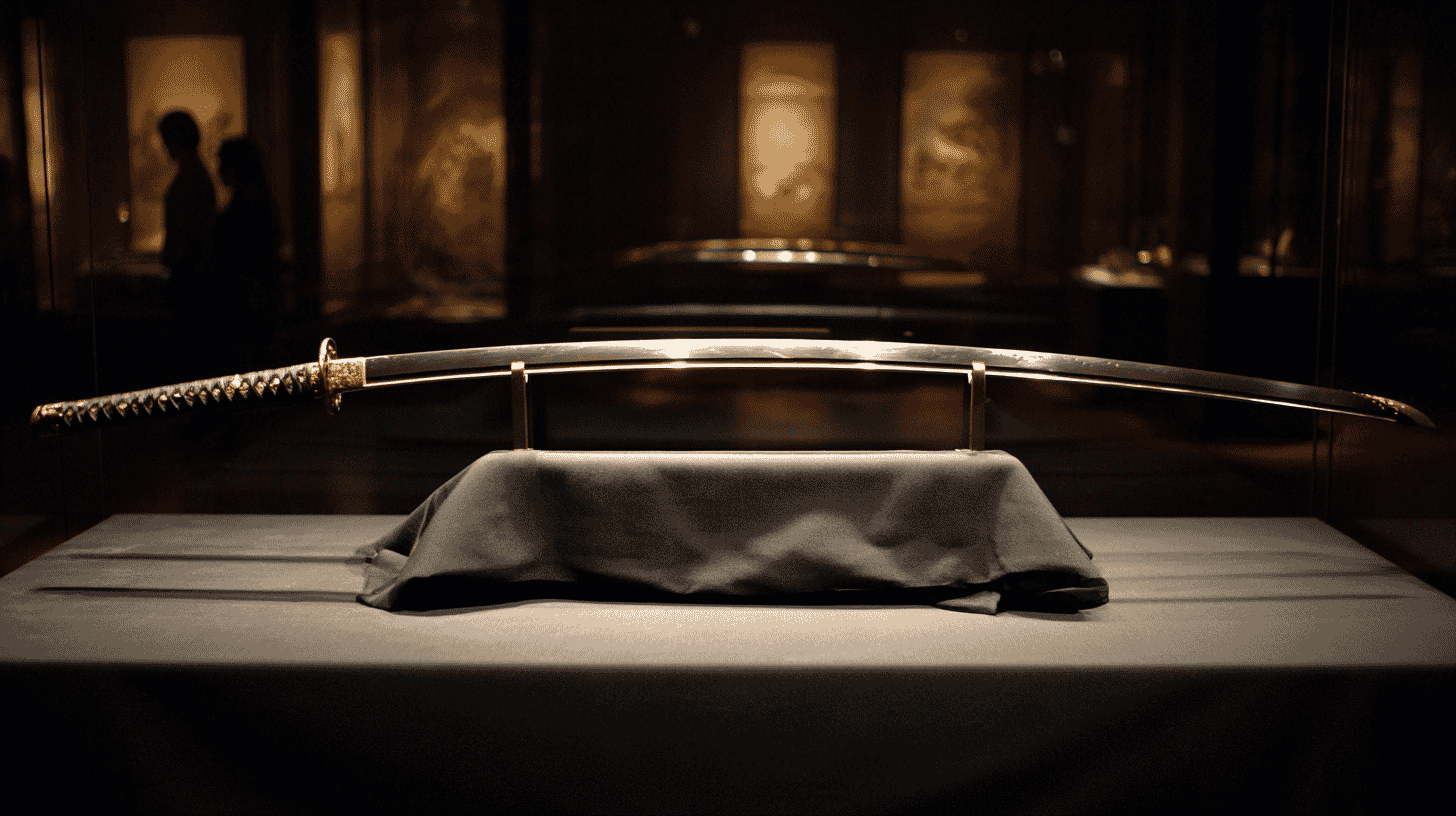
National Treasure: Tachi Signed Masatsune — The Essence of Ko-Bizen Swordsmithing
Among the many cultural treasures housed within the Tokyo National Museum in Ueno, one sword stands as a quiet yet undeniable testament to the genius of Japan's earliest swordsmiths. The Tachi signed Masatsune (太刀〈銘正恒〉), designated a National Treasure of Japan, is a Heian-period masterwork forged by the Ko-Bizen school — one of the oldest and most revered sword-making lineages in Japanese history. For anyone captivated by the artistry of the Japanese sword, this tachi offers an extraordinary window into a time when the very form of the nihontō was being defined.
What Is This National Treasure?
This tachi is a long, single-edged sword created during the late Heian period (roughly the late 10th to 11th century) by a swordsmith named Masatsune, a master of the Ko-Bizen school based in Bizen Province — present-day Okayama Prefecture. It was first designated as an Important Cultural Property on January 19, 1931, and later elevated to the status of National Treasure on March 29, 1952, in recognition of its exceptional quality and historical significance.
The sword is owned by the Agency for Cultural Affairs (Bunka-chō) of the Japanese government and is preserved at the Tokyo National Museum (Tōkyō Kokuritsu Hakubutsukan) in Ueno Park, Tokyo. It is exhibited periodically in Room 13 of the museum's Honkan (Japanese Gallery), typically once every one to three years. Because display schedules rotate, visitors are advised to check the museum's website before their visit.
The Ko-Bizen School: Where the Art of the Japanese Sword Began
To appreciate this tachi, one must understand its origins. The Ko-Bizen (Old Bizen) school represents the earliest phase of sword production in Bizen Province, a region that would go on to become the most prolific sword-making center in all of Japan. Bizen's dominance in sword-making was no accident: the province was blessed with abundant sand iron (satetsu), high-quality charcoal, clean water, and skilled artisans — all the essential ingredients for forging superior blades.
Masatsune is regarded alongside Tomonari as one of the two greatest swordsmiths of the Ko-Bizen school. He is believed to have been active around the Chōtoku era (995–999), during the height of Heian court culture. Remarkably, several swordsmiths over succeeding generations used the name Masatsune, making it sometimes difficult to attribute specific works. However, the blade housed at the Tokyo National Museum is considered one of the finest and most authentic examples, praised for its excellent form and inscription that best represents the original character of Ko-Bizen craftsmanship.
Masatsune's legacy is extraordinary. Five of his works are designated as National Treasures — an almost unparalleled honor among Japanese swordsmiths — and thirteen others are classified as Important Cultural Properties. He is also traditionally said to be the father of Norimune, who founded the famous Fukuoka Ichimonji school, one of the most influential sword-making traditions of the Kamakura period.
Why Was This Tachi Designated a National Treasure?
The official designation record describes this tachi as a work by Ko-Bizen Masatsune that, although several swordsmiths bore the same name, possesses the finest form and inscription among them, demonstrating the true character of Ko-Bizen workmanship in a sound and well-preserved state.
Several technical qualities set this blade apart. First, it retains its original tang (nakago) in an unaltered state, known as ubu. In the world of Japanese swords, where blades were frequently shortened over the centuries to accommodate changing combat styles, an unaltered tang from the Heian period is extraordinarily rare and provides invaluable information about original craftsmanship and proportions.
The blade exhibits a classic Ko-Bizen profile: shinogi-zukuri construction with an iori-mune ridge, a compact ko-kissaki tip, and a graceful koshi-zori curvature with funbari — the characteristic widening of the blade near the hilt that is a hallmark of early Japanese swords. The steel grain (jigane) shows a refined itame-hada pattern with fine ji-nie and midare-utsuri, creating subtle, cloud-like reflections in the steel. The temper line (hamon) is a chū-suguha mixed with ko-midare, rich with ashi and yō patterns, and deeply suffused with nioi and ko-nie — indicators of the highest metallurgical skill.
Highlights and What to Look For
When viewing this tachi, there are several features that reward careful observation. The overall silhouette of the sword conveys a sense of refined elegance characteristic of the Heian period. Unlike the broader, more robust swords of later eras, Heian-period tachi possess a slender grace that mirrors the aesthetic sensibility of the courtly culture that produced them.
The ubu nakago — the original, unshortened tang — is one of this sword's most remarkable features. Beneath the original mekugi-ana (peg hole), the signature "Masatsune" (正恒) is inscribed in bold, confident two-character strokes. This inscription style is widely considered the finest among all extant Masatsune signatures.
The interplay of light on the blade surface reveals the midare-utsuri, a distinctive Ko-Bizen characteristic where shadowy reflections appear in the steel between the hamon and the ridge line. Combined with the deep, luminous quality of the nioi and ko-nie in the temper line, the blade produces an almost living quality as light plays across its surface — a phenomenon that photographs alone cannot fully capture.
For visitors familiar with Japanese sword traditions, comparing this Ko-Bizen blade with other National Treasure swords in the Tokyo National Museum's collection, such as the Ō-Kanehira or the Mikazuki Munechika, offers a fascinating study in the evolution of Japanese sword aesthetics.
Visiting the Tokyo National Museum
The Tokyo National Museum is located in the heart of Ueno Park, one of Tokyo's most culturally rich districts. It is Japan's oldest and largest museum, housing over 120,000 cultural properties including 89 National Treasures. The sword collection alone comprises approximately 900 blades, with 19 designated as National Treasures.
The museum is a ten-minute walk from JR Ueno Station (Park Exit) or JR Uguisudani Station (South Exit). It is also accessible in about fifteen minutes on foot from Ueno Station on the Tokyo Metro Ginza or Hibiya Lines, or from Nezu Station on the Chiyoda Line. English-language signage, audio guides, and printed materials are available throughout the museum, making it a welcoming destination for international visitors.
Ueno Park itself offers a full day of cultural immersion. In addition to the Tokyo National Museum, the park is home to the National Museum of Nature and Science, the National Museum of Western Art (a UNESCO World Heritage Site designed by Le Corbusier), the Ueno Royal Museum, and Ueno Zoo — Japan's oldest zoological garden. The historic Kaneiji Temple and Toshogu Shrine are also located within the park grounds. During spring, Ueno Park is one of Tokyo's most celebrated cherry blossom viewing spots.
Practical Tips for International Visitors
Because the Tachi signed Masatsune is part of a rotating display schedule, it is not always on view. The museum typically exhibits this National Treasure once every one to three years in Room 13 of the Honkan. Before visiting, check the museum's official website or the "e-Museum" digital database to confirm current exhibition schedules.
When viewing Japanese swords in a museum setting, take time to observe the blade from multiple angles. The hamon and utsuri are best appreciated when viewed at a slight angle under the carefully calibrated museum lighting. Move slowly along the length of the blade and notice how the grain patterns and temper line shift as the viewing angle changes. This is one of the great joys of experiencing a Japanese sword in person — something no photograph can replicate.
If you are visiting during a period when this particular tachi is not on display, the Tokyo National Museum almost always has other National Treasure and Important Cultural Property swords available for viewing. The museum's sword gallery is considered one of the finest in the world.
- 📍 Plan Your Visit to Tokyo
- Find tours, activities & transport passes near Tachi (inscribed Masatsune)
- [ Tokyo Skytree Asakusa & teamLab Experiences ]
Q&A
- Is the Tachi signed Masatsune always on display at the Tokyo National Museum?
- No. As a National Treasure, this tachi is displayed on a rotating basis, typically once every one to three years. Check the Tokyo National Museum's official website or the e-Museum database for current exhibition schedules before visiting.
- Are there English-language explanations available for the sword exhibits?
- Yes. The Tokyo National Museum provides English-language signage for most exhibits, and audio guides in English are available for rent. The museum's website and e-Museum app also offer detailed English descriptions of major works.
- What makes Ko-Bizen swords special compared to swords from other Japanese schools?
- Ko-Bizen swords date from the very earliest period of curved Japanese sword production, the late Heian era. They are characterized by an elegant, slender form with a deep koshi-zori (curvature centered near the hilt), compact kissaki (tip), and a refined itame-hada grain with subtle utsuri (shadow reflections). They represent the foundation upon which all subsequent Japanese sword traditions were built.
- How many National Treasure swords signed by Masatsune exist?
- Five swords bearing the signature of Masatsune are designated as National Treasures of Japan. They are held by various institutions including the Tokyo National Museum, the Tokugawa Art Museum, and the Fukuyama Museum of Art. In addition, thirteen Masatsune works are classified as Important Cultural Properties.
- Can I take photographs of the sword when it is on display?
- Photography for personal, non-commercial use is generally permitted in the Tokyo National Museum's permanent galleries, but flash photography, tripods, and selfie sticks are prohibited. Some special exhibitions may have additional restrictions. Always check signage at the entrance to each gallery.
Basic Information
| Designation | National Treasure (Craft) |
|---|---|
| Official Name | Tachi, signed Masatsune (太刀〈銘正恒/〉) |
| Period | Heian period (late 10th–11th century) |
| Swordsmith | Masatsune (正恒), Ko-Bizen school |
| Blade Length | Approx. 78.9 cm (2 shaku 6 sun 4 rin) |
| Curvature (Sori) | Approx. 2.5 cm (8 bu 2 rin) |
| Base Width (Moto-haba) | Approx. 3.03 cm (1 sun) |
| Tip Width (Saki-haba) | Approx. 1.73 cm (5 bu 7 rin) |
| Kissaki Length | Approx. 2.73 cm (9 bu) |
| Construction | Shinogi-zukuri, iori-mune, ko-kissaki |
| Important Cultural Property Designation | January 19, 1931 |
| National Treasure Designation | March 29, 1952 |
| Owner | Agency for Cultural Affairs (Government of Japan) |
| Repository | Tokyo National Museum, 13-9 Ueno Park, Taitō-ku, Tokyo |
| Museum Admission | Adults: 1,000 yen / University students: 500 yen / Under 18 and over 70: Free |
| Museum Hours | 9:30–17:00 (Fri & Sat until 19:00); closed Mondays |
| Access | 10-min walk from JR Ueno Station (Park Exit); 15-min walk from Tokyo Metro Ueno or Nezu Station |
References
- 太刀〈銘正恒/〉 – Cultural Heritage Online (文化遺産オンライン)
- https://bunka.nii.ac.jp/heritages/detail/203649
- 国指定文化財等データベース – Agency for Cultural Affairs
- https://kunishitei.bunka.go.jp/bsys/maindetails/201/333
- 国宝-工芸|太刀 銘 正恒[文化庁] – WANDER 国宝
- https://wanderkokuho.com/201-00333/
- THE KO-BIZEN SCHOOL 古備前系 – NIHONTO
- https://nihonto.com/the-ko-bizen-school/
- Tokyo National Museum – Visitor Information
- https://www.tnm.jp/modules/r_free_page/index.php?id=113&lang=en
- 古備前正恒 Kobizen Masatsune – 飯田高遠堂
- https://iidakoendo.com/8607/
Last verified: 2026.02.17
Nearby heritages
- Light Coloured Painting of the Wonders of Land (by Ike
- 7-2 Ishizaka 4-chome, Dazaifu City, Fukuoka Prefecture
- Tachi (inscribed Masatsune)
- 13-9 Ueno Park, Taito-ku, Tokyo
- Bugaku Costumes (handed Down from Amano Shrine)
- 13-9 Ueno Park, Taito-ku, Tokyo
- Wooden Seated Statue of Amida Buddha
- 85-4 Yabunouchicho, Shimochojamachi-dori Shinmachi Nishiiru, Kamigyo-ku, Kyoto City, Kyoto Prefecture
- Ink on Silk Painting of a Calf
- Tokyo National Museum, 13-9 Ueno Park, Taito-ku, Tokyo
- Celadon Turnip Vase
- 2855-1 Kanai, Shibukawa City, Gunma Prefecture
- Money Register Written in Ink on Paper
- 527 Chayamachi, Higashiyama Ward, Kyoto City
- Paper Copy of the Sutras in Ink and Paper
- 527 Chayamachi, Higashiyama Ward, Kyoto City
- Ink Written Certificate of Land Reclamation on Paper (10th
- 527 Chayamachi, Higashiyama Ward, Kyoto City
- Ink-Written Proofreading Book on Paper (eight Sheets)
- 527 Chayamachi, Higashiyama Ward, Kyoto City