
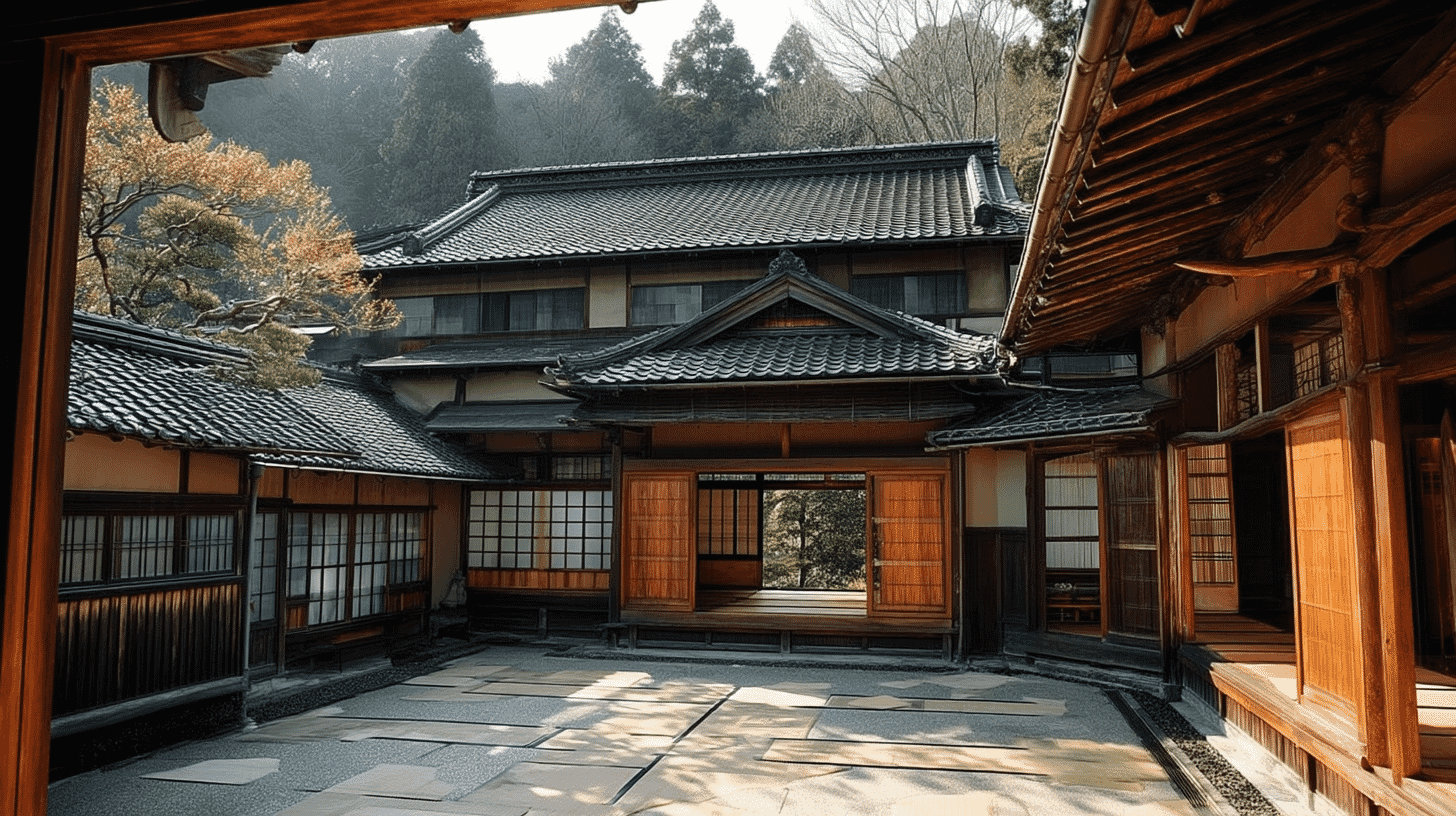
Eight Buildings, an Important Cultural Property since 2009
Ishitani Family Residence (石谷家住宅, Ishitani-ke Jutaku) stands at 396 Chizu, Chizu Town, Yazu District, Tottori Prefecture, listed as an Important Cultural Property on 8 December 2009. The listing is as an Important Cultural Property, not a National Treasure.
Eight entries are listed: the main house, the reception wing, the family wing, storehouses one and two, storehouses three and four together, storehouses five and six together, and storehouse seven. Seven storehouses stand, recorded as five entries.
The Agency records that this was the house of an old family whose main business was forestry, and that the whole estate was built between 1919 and 1929, over eleven years.
Floor Areas Written in Chinese Numerals
The figures are not in arabic numerals.
The structural field for the main house reads: timber, floor area 350.77 square metres, two storeys, hip-and-gable, pantiled.
In the record the area is written out in Chinese numerals, with a centre dot for the decimal point.
Storehouses three and four read: earthen-walled construction, floor area 62.30 square metres, two storeys, gabled. These figures are in Chinese numerals too.
At the Yoichi distillery, the date field was written in full-width characters. At the Yatsusawa power station and Kobe College, floor areas were in arabic numerals.
Here they are in Chinese numerals, and the appended record of a ridge tablet dated the tenth month of 1922 is written the same way.
The Period Field Divides from Building to Building
The time of building differs by the very division of eras.
The period field for the main house reads Showa, with a date of 1928.
For storehouses three and four it reads Taisho, with a date of 1922.
Six years apart, and the era divisions differ as well.
At the Yoichi distillery, the still house was about 1935 and the office block about 1942, but both fell in the Showa era. At Kitaguchi Hongu Fuji Sengen Shrine, all were middle Edo.
Here the buildings straddle an era boundary. The eleven years of building show in the record itself.
The Owner Is Written Differently in Different Records
The field for who holds the property does not agree between two records.
This site's record names three owners: the town of Chizu and two members of the Ishitani family.
The Cultural Heritage Online records for the main house and for storehouses three and four both name the town alone.
At the Yatsusawa power station, the first aqueduct bridge and the intake weir carried different company names. That is a variation within one set of records.
Here the difference falls between two systems of record. It is also possible that ownership differs by building.
Which reflects the present position wants checking by hand.
Visiting
The residence is at 396 Chizu, Chizu Town, Yazu District, Tottori Prefecture.
The layout is recorded: the main house stands at the centre of a wide site, completed in 1928, with reception rooms, rice stores and other buildings ranged around it.
Of material and technique: the main house uses fine timber, above all good cedar from the Chizu district, and high framing skill creates a broad earthen-floored space, with refined detailing in the reception rooms.
Local material is used. At Kitaguchi Hongu Fuji Sengen Shrine, local carpenters did the building. There it is the people; here the timber.
The assessment closes that the residence is important as a large modern building in the Japanese manner with excellent design, and of high value too for the fine storehouses, outbuildings and garden that survive, conveying a grand estate. Access follows the owner's arrangements. Check before travelling.
Q&A
- When was the residence listed?
- On 8 December 2009, as an Important Cultural Property rather than a National Treasure. Eight entries are covered, at Chizu Town, Tottori Prefecture.
- Which buildings are included?
- The main house, reception wing, family wing, storehouses one and two, three and four together, five and six together, and storehouse seven. Seven storehouses appear as five entries.
- When was it built?
- The Agency records that the whole estate was built between 1919 and 1929. The main house is 1928 in the Showa era; storehouses three and four are 1922 in the Taisho era.
- What materials were used?
- The Agency records fine timber, above all good cedar from the Chizu district, worked with high framing skill to create a broad earthen-floored space.
- What is valued in it?
- Its excellence as a large modern building in the Japanese manner, and the survival of fine storehouses, outbuildings and garden conveying a grand estate.
Basic Information
| Name | Ishitani Family Residence (石谷家住宅, Ishitani-ke Jutaku); 8 entries recorded separately, sharing one commentary |
|---|---|
| Location | 396 Chizu, Chizu Town, Yazu District, Tottori Prefecture |
| Designation | Important Cultural Property (structures, domestic architecture); not a National Treasure |
| Year Designated | 2009 (8 December), Important Cultural Property |
| Quantity | 1 building each, 8 entries in all |
| Dimensions | The main house is timber, floor area 350.77 square metres, 2 storeys, hip-and-gable, pantiled, of the Showa era and dated 1928. Storehouses three and four are earthen-walled, floor area 62.30 square metres, 2 storeys, gabled, of the Taisho era and dated 1922, with 1 ridge tablet appended. In the Agency's records these areas are written in Chinese numerals |
| Owner | This site records the town of Chizu with two members of the Ishitani family; Cultural Heritage Online records the town alone |
| Public Access | Access follows the owner's arrangements |
References
- Cultural Heritage Online: the main house
- https://bunka.nii.ac.jp/heritages/detail/140667
- Cultural Heritage Online: storehouses three and four
- https://bunka.nii.ac.jp/heritages/detail/192902
- Ishitani Residence official site
- https://www.ifs.or.jp/
- Agency for Cultural Affairs, National Cultural Properties Database
- https://kunishitei.bunka.go.jp/
Last verified: 2026.09.06
Cultural Treasures in the Same Area
All are within walking distance in the same area, so we recommend visiting them together.
- Ishitani Family Residence Tatami room building 0.00 km
- Ishitani Family Residence Main house 0.03 km
- Ishitani Family Residence Storehouse No.1 0.04 km
- Ishitani Family Residence family building 0.04 km
- Ishitani Family Residence Storehouse No. 2 0.04 km
- Ishitani Family Residence Storehouses No. 5 and No. 6 0.05 km
- Ishitani Family Residence Storehouse No. 7 0.05 km
- Ishitani Family Residence Storehouses No. 3 and No. 4 0.06 km