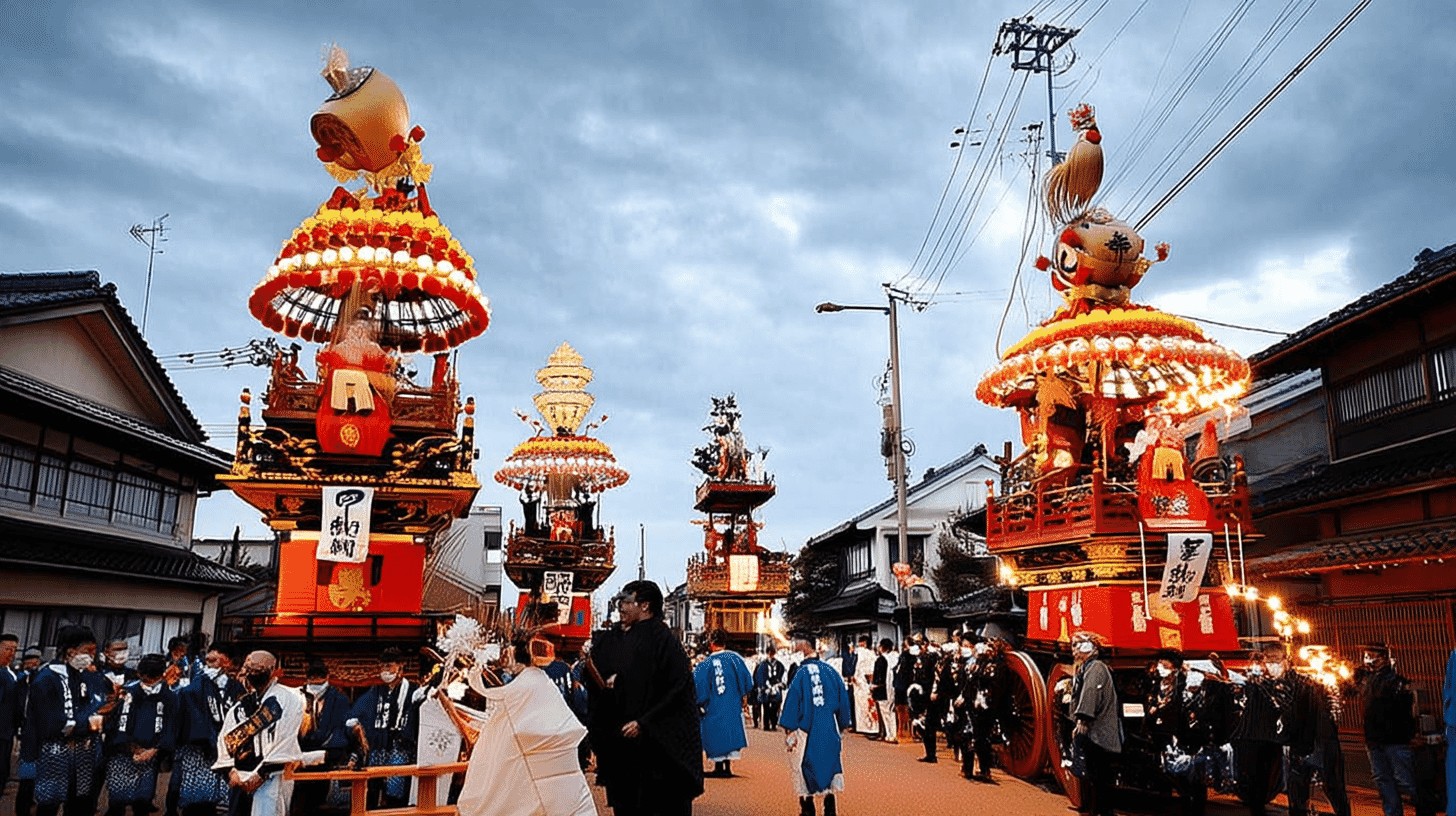
Hōjōzu Hachimangu Festival: A 370-Year-Old Celebration of Twin Mountain Rituals
In the historic port town of Shinminato in Imizu City, Toyama Prefecture, an extraordinary festival takes place every autumn that has captivated locals and visitors alike for over three and a half centuries. The Hōjōzu Hachimangu Festival, featuring both the hikiyama (float procession) and tsukiyama (sacred mountain altar) rituals, represents one of Japan's most remarkable examples of living cultural heritage—a festival so significant that it has been designated as a nationally Important Intangible Folk Cultural Property and is set to be inscribed on UNESCO's Intangible Cultural Heritage list in December 2025.
Understanding the Cultural Significance
What makes the Hōjōzu Hachimangu Festival truly exceptional is the rare combination of two distinct "mountain" rituals that have been transmitted together since the Edo period. While many Japanese communities celebrate with either float processions or stationary sacred displays, the Hōjōzu festival uniquely preserves both traditions, offering invaluable insights into the regional development of festival customs in the Hokuriku region and the evolution of Japan's famous yama-hoko-yatai (mountain, halberd, and float) festivities.
The festival was designated as a national Important Intangible Folk Cultural Property on March 11, 2021, recognizing its significance in understanding how festival rituals spread and evolved throughout Japan. The hikiyama procession is the second-oldest of its kind in Toyama Prefecture, surpassed only by the renowned Takaoka Mikurumayama Festival, and has maintained continuous traditions for approximately 370 years since 1650.
The Hikiyama Procession: Flowers by Day, Lanterns by Night
On October 1st each year, thirteen magnificent hikiyama floats emerge from their respective neighborhoods to parade through the streets of the former Shinminato town center. Each float features a distinctive central pillar called the shinbashira, crowned with an elaborate flower umbrella (hanagasa) and decorated with traditional dolls and ornaments that showcase the craftsmanship of generations.
The daytime procession, known as hanayama (flower mountain), presents the floats in their full decorative glory. Colorful flower umbrellas and meticulously crafted figures create a stunning visual display as participants in traditional happi coats pull the floats through narrow streets, chanting the distinctive call of "Iyasaa, Iyasaa!"
As twilight descends, the floats undergo a remarkable transformation. The flower decorations are removed and replaced with over 250 paper lanterns, converting each hikiyama into a glowing chōchin-yama (lantern mountain). The evening procession creates an enchanting atmosphere as these luminous towers of light wind their way through the historic streets, casting warm golden reflections on the surrounding traditional buildings.
The Tsukiyama Ritual: A Rare Spiritual Tradition
The tsukiyama ceremony represents one of Japan's rarest festival rituals—a tradition that has virtually disappeared elsewhere in the country. This sacred event begins on the evening of September 30th with the tamaukai (spirit-welcoming) ceremony, during which shrine priests ceremonially invite divine spirits from the sea to take residence in a temporary altar constructed within the shrine grounds.
The altar itself is a tiered platform designed to represent a mountain, upon which are placed sacred figures including the main deity—referred to as Ubagami (the Ancestral Mother) or Onbasama—along with the Four Heavenly Kings (Shitenno): Kōmokuten, Zōchōten, Jikokuten, and Tamonten. In front of these principal figures, kazari ningyō (decorative dolls) depicting local historical figures or scenes of regional significance are arranged, with the theme changing each year to present fresh artistic interpretations.
The tsukiyama display is open for public viewing on October 2nd during the main festival day, offering visitors a rare glimpse into ancient Japanese spiritual practices that connect the community with both its ancestral traditions and the sea that has sustained the port town for centuries.
Historical Origins and the Hōjōzu-type Float Culture
The origins of the Hōjōzu Hachimangu Shrine itself date back to 746 CE, when it is said that Ōtomo no Yakamochi, the renowned poet and governor of Etchū Province, established the shrine by inviting the deity from Usa Hachimangū in Kyushu. The current shrine buildings were reconstructed in 1863 under the supervision of master carpenter Takase Suketarō, who had previously worked on repairs to Osaka Castle's western enclosure.
The hikiyama tradition began in 1650 when the Furushinmachi neighborhood created the first float to accompany the shrine's portable mikoshi during its procession. Over time, other neighborhoods followed suit, and by the late Edo period, the distinctive Hōjōzu-type float had spread to other port towns along the Toyama Bay coast, including Fushiki, Yoho, and Himi, establishing what scholars now call the "Hōjōzu-type float cultural sphere."
A significant event known as the "Hikiyama Wheel Incident" of 1775 shaped the development of float festivals throughout the region. A dispute with Takaoka over the use of certain wheel designs led to regulations that ultimately influenced how floats were constructed across the former Kaga domain, demonstrating the political and cultural importance these festival traditions held in historical Japan.
The Festival Schedule
The Hōjōzu Hachimangu Festival takes place annually from September 30th to October 2nd (based on the traditional calendar):
- September 30th (Evening): Tamaukai ceremony—the spirit-welcoming ritual at the shore
- October 1st: Hikiyama procession—daytime "flower mountain" parade transforms into evening "lantern mountain" spectacle
- October 2nd: Main festival day with Tsukiyama public viewing and shrine ceremonies
Nearby Attractions
A visit to the Hōjōzu Hachimangu Festival can be combined with exploration of the charming Shinminato area, which offers numerous attractions:
Kaiwomaru Park: Home to the historic sailing ship Kaiwomaru, often called the "Swan of the Sea," this park offers stunning views of Toyama Bay, the Tateyama mountain range, and the impressive Shinminato Bridge. The ship is open for boarding and provides fascinating insight into Japan's maritime training history.
Uchikawa Canal: Known as the "Venice of Japan," this picturesque canal is lined with traditional fishermen's houses and features twelve uniquely designed bridges. Sightseeing boat cruises offer a relaxing way to experience the nostalgic atmosphere of this historic waterway.
Shinminato Kittokito Market: Fresh seafood lovers will delight in the local specialties available at this vibrant market, including Toyama Bay's famous white shrimp (shiro-ebi), snow crab, yellowtail, and firefly squid.
Imizu City Shinminato Museum: Learn more about the region's history, maritime culture, and festival traditions through the museum's carefully curated exhibitions.
Access Information
From Toyama Station: Take the Burikani Bus bound for Kaiwomaru Park (approximately 35 minutes). On festival days, free shuttle buses operate from Toyama Station North Exit.
From Takaoka Station: Take the Manyosen Line streetcar to Shinmachiguchi or Naka-Shinminato Station (approximately 40 minutes).
From Shin-Takaoka Station (Shinkansen): Take the Kanibus to Kaiwomaru Park (approximately 40 minutes).
By Car: From the Hokuriku Expressway, take the Kosugi IC exit and drive approximately 20 minutes toward Shinminato. On festival days, free shuttle buses operate from the Kaiwomaru Park parking area to the festival grounds.
- 📍 Plan Your Visit to Toyama
- Find tours, activities & transport passes near Hojozu Hachiman Shrine Festival Float and Artificial
- [ Kurobe Gorge Train & Tateyama Alpine Route ]
Q&A
- When is the best time to visit the Hōjōzu Hachimangu Festival?
- October 1st is the highlight, when all thirteen hikiyama floats parade through the streets. The daytime procession (hanayama) typically runs from mid-morning, while the spectacular lantern-lit evening procession (chōchin-yama) begins at dusk and continues into the night. Arriving early in the afternoon allows you to experience both transformations.
- Is there an admission fee for the festival?
- The hikiyama procession takes place on public streets and is free to watch. The tsukiyama display at the shrine grounds on October 2nd is also open to the public free of charge.
- Is the festival accessible for wheelchair users or those with mobility challenges?
- The festival takes place on public streets in the historic town center, which features some narrow passages and uneven surfaces. While there is no formal accessible viewing area, the main streets along the parade route are generally flat. The shrine grounds may have some steps. We recommend contacting the Imizu City tourism office in advance for specific accessibility information.
- Are there English information materials available?
- While most signage and announcements are in Japanese, the Imizu City tourism website offers some English information. The visual nature of the festival makes it highly enjoyable even without language comprehension. Consider joining a guided tour or arranging for interpretation services for a more in-depth experience.
- What should I bring to the festival?
- October evenings in Toyama can be cool, so bring a light jacket. Comfortable walking shoes are essential as you may be standing and walking for several hours. A camera with good low-light capabilities is recommended for capturing the stunning lantern-lit evening procession. Cash is advisable as not all festival food vendors accept cards.
Basic Information
| Official Name | Hōjōzu Hachimangu-sai no Hikiyama / Tsukiyama Gyōji (放生津八幡宮祭の曳山・築山行事) |
|---|---|
| Cultural Designation | National Important Intangible Folk Cultural Property (designated March 11, 2021) |
| UNESCO Status | Recommended for inscription to "Yama, Hoko, Yatai float festivals" (expected December 2025) |
| Festival Dates | September 30 – October 2, annually |
| Location | Hōjōzu Hachimangu Shrine and surrounding streets, Imizu City, Toyama Prefecture |
| Shrine Address | 2-2-27 Hachimanmachi, Imizu City, Toyama Prefecture 934-0025 |
| Number of Floats | 13 hikiyama floats from 13 neighborhoods |
| First Float Created | 1650 (Keian 3) by Furushinmachi neighborhood |
| Preservation Organization | Hōjōzu Hachimangu Hikiyama / Tsukiyama Preservation Society |
| Contact | Imizu City Lifelong Learning and Sports Division: 0766-51-6637 |
References
- 放生津八幡宮祭の曳山・築山行事 | 文化遺産検索 | とやまの文化遺産
- https://toyama-bunkaisan.jp/search/4347/
- 放生津八幡宮祭の曳山・築山行事 | 文化遺産オンライン
- https://bunka.nii.ac.jp/heritages/detail/589090
- 放生津曳山祭 - Wikipedia
- https://ja.wikipedia.org/wiki/放生津曳山祭
- 放生津八幡宮 - Wikipedia
- https://ja.wikipedia.org/wiki/放生津八幡宮
- 放生津八幡宮公式HP
- https://www.houjyoudu.com/
- 放生津八幡宮祭の曳山・築山行事が国指定重要無形民俗文化財に指定されました|射水市
- https://www.city.imizu.toyama.jp/event-topics/svTopiDtl.aspx?servno=20448
- 「放生津八幡宮祭の曳山・築山行事」ユネスコ無形文化遺産登録へ|射水市
- https://www.city.imizu.toyama.jp/event-topics/svTopiDtl.aspx?servno=31822
- 新湊曳山まつり|射水市公式観光サイト きららか射水観光NAVI
- https://www.imizu-kanko.jp/event/6282/
- 海王丸パーク|射水市公式観光サイト きららか射水観光NAVI
- https://www.imizu-kanko.jp/sightseeing/418/
Last verified: 2026.01.14
Nearby heritages
- Takeuchi Genzo Memorial Museum (former Kosugi Town Hall)
- 2289-1 Toba, Imizu City, Toyama Prefecture
- Kosugi Town Exhibition Hall (former Kosugi Savings Bank Head
- 4286-1 Tobara, Imizu City, Toyama Prefecture
- Kosugi Maruyama Ruins
- Imizu City
- Yoshida Family Storehouse
- 1953 Umawatari, Futakuchi, Imizu City, Toyama Prefecture, and other locations
- Materials Related to Ishiguro Nobuyoshi
- Imizu City Shinminato Museum 299 Kagamimiya, Imizu City, Toyama Prefecture
- Yoshida Family Residence Stone Storehouse
- 1953 Umawatari, Futakuchi, Imizu City, Toyama Prefecture, and other locations
- Yoshida Family Residence Wooden Fence
- 1953 Umawatari, Futakuchi, Imizu City, Toyama Prefecture, and other locations
- Yoshida Family Residence Main Building
- 1953 Umawatari, Futakuchi, Imizu City, Toyama Prefecture, and other locations
- Etchu Children's Dance
- Kushida Shin Ruins
- Imizu City