Three Buildings, National Treasure since 1997
Zuiryuji Temple (瑞龍寺, Zuiryuji) is a Soto Zen temple at Sekimoto-cho, Takaoka City, Toyama Prefecture, whose gate, Buddha hall and Dharma hall were designated National Treasures on 3 December 1997. The owner is the temple.
The Agency records that it was founded as the mortuary temple of Maeda Toshinaga, second lord of Kaga. The Buddha hall dates from 1659, the Dharma hall from 1655, and the outer gate from about the same time.
The assessment covers the whole complex: among large Soto temples, this one best preserves an ordered arrangement of halls, and the complex as a whole should be preserved.
Seventy-Three Years between Listings of Different Buildings
The date of listing as an Important Cultural Property differs from building to building.
The Buddha hall's record gives 5 April 1909. The meditation hall's record gives 11 June 1982.
Seventy-three years lie between them. The value held in the heritage database is 1982, the date for the buildings added later.
At Kankiin, hall and gate became Important Cultural Properties on one day and only one advanced. Here the reverse: the earlier listings fall on different dates, and three of the buildings advanced together on one day.
The meditation hall, the raised corridor, the cloisters, the tea hall and the outer gate remain Important Cultural Properties. The Agency notes that the former meditation hall, the raised corridor and the cloisters are important elements of the complex. Buildings that are not National Treasures are placed within the whole.
Timber Removed in Repair, Made into Something Else
One property here was made from the fabric of the buildings.
An incense container of Zuiryuji National Treasure timber is held by the Takaoka City Museum: a wooden vessel 7.1 centimetres across and 2.0 centimetres high, counted as one piece.
Its origin is recorded. Major repairs to the outer gate, the Buddha hall and the Dharma hall, then listed as National Treasures, ran from 16 November 1935 to 15 April 1938, and the container may have been made from timber removed in the course of that work.
The lid of its box is inscribed in ink with the temple's name and the words National Treasure timber, and the cloth that wrapped it bears a stamp naming the temple's timber. Where the wood came from is marked on both box and cloth.
The gilt bronze phoenix from the Phoenix Hall was taken off a building and became a craft object. This is different. From timber removed, something new was made. A part of a building has become a separate property in another form.
Postcards and a Painting Recorded under the Same Name
Records bearing this temple's name are not all buildings.
Several postcards are listed, showing the Buddha hall, the Dharma hall and other parts of the temple, each recorded separately.
A painting is listed too: an oil on canvas of the temple gate by Takakura Kazuji, painted in 1947, the canvas measuring 54.0 by 65.0 centimetres.
So the gate as a building and the gate as a painting stand under the same name.
With the tachi inscribed Masatsune, several swords shared a signature; with Sashiki Castle Ruins, two sites shared a name. Those were things of one kind. Here a building and a painting share a name.
Roof tiles are recorded on their own as well: lead tiles from the Buddha hall, both round eaves tiles and flat ones. The hall is roofed in lead tile, and those tiles have their own entries.
Visiting
The temple stands at Sekimoto-cho, Takaoka City, Toyama Prefecture, and owns the buildings. They stand in the precinct and their exteriors can be seen on a visit.
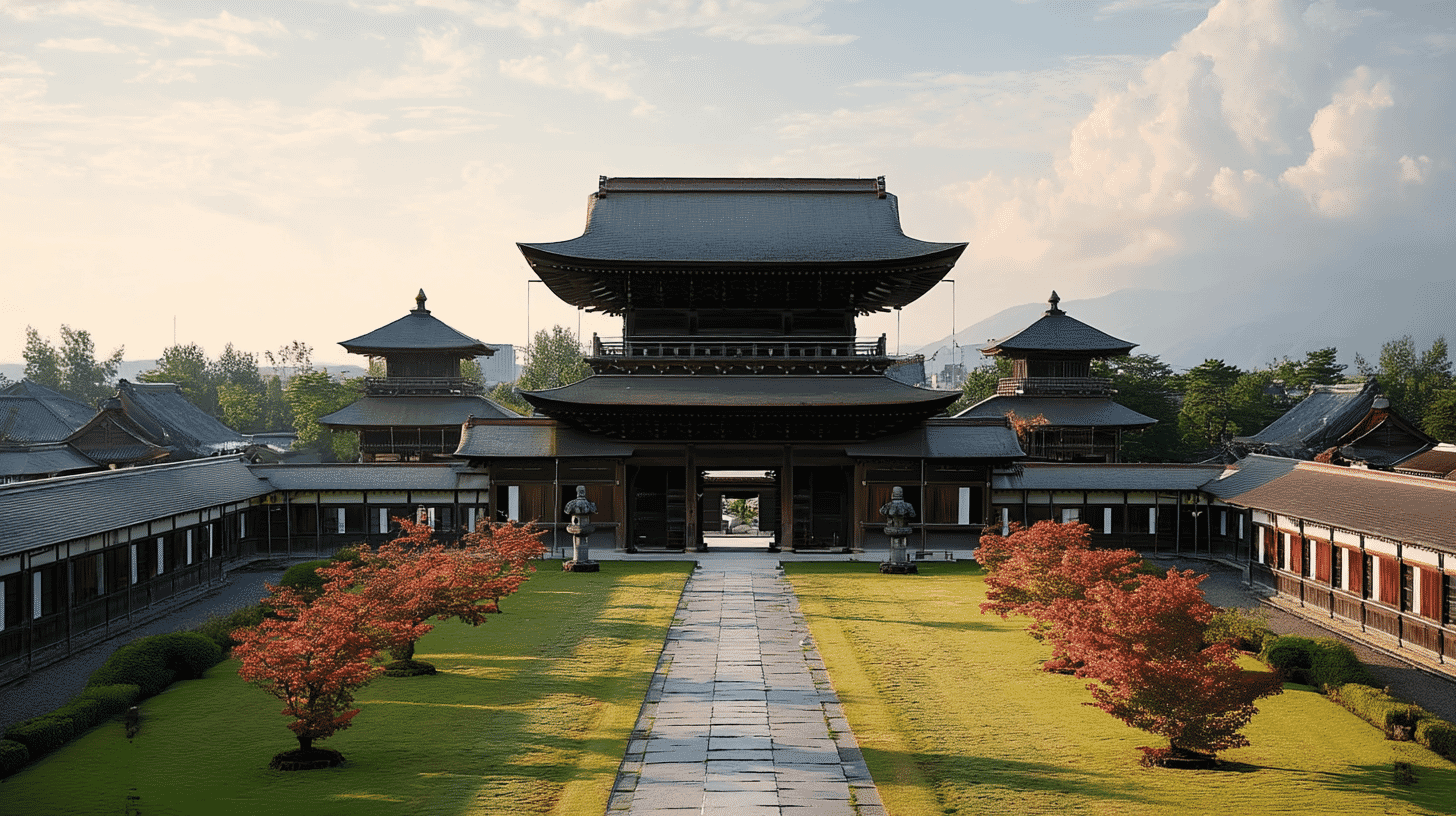
Of the gate: it was built by a carpenter descended from Yamagami Zen-emon, the master carpenter of the Kaga domain who worked on the original foundation, in a two-storeyed form of three bays with one doorway, in the Zen style, and preserves old methods.
The record continues: in 1746 fire destroyed the gate, the front part of the cloisters and the meditation hall beside them, and they were rebuilt in the later Edo period in nearly their former arrangement. A building that burned and was raised again is now a National Treasure.
The Buddha hall is three bays by three bays, single-storeyed with a skirt roof, hip-and-gable, roofed in lead tile, counted as one building.
Access to interiors follows the temple's own arrangements. Check before travelling.
Q&A
- When was the temple designated?
- On 3 December 1997. The gate, Buddha hall and Dharma hall hold the designation. The temple stands at Sekimoto-cho, Takaoka City, Toyama Prefecture, and owns them.
- Do the buildings have different earlier listings?
- Yes. The Buddha hall's record gives 5 April 1909 and the meditation hall's 11 June 1982, seventy-three years apart. The later date belongs to buildings added afterwards.
- What is the incense container of temple timber?
- A vessel made from wood removed during repairs. Major work ran from 1935 to 1938, and the container may have been made from timber taken out then. Its box is inscribed with the temple's name and the words National Treasure timber.
- Are there other records under the same name?
- Yes. Several postcards showing the buildings are recorded, along with an oil painting of the gate by Takakura Kazuji from 1947. A building and a painting share the name.
- What is valued in it?
- The Agency writes that among large Soto temples this one best preserves an ordered arrangement of halls and that the complex as a whole should be preserved. The arrangement rather than any single building is what is valued.
Basic Information
| Name | Zuiryuji Temple (瑞龍寺, Zuiryuji); the National Treasures are its gate, Buddha hall and Dharma hall |
|---|---|
| Location | Sekimoto-cho, Takaoka City, Toyama Prefecture |
| Designation | National Treasure (structure); the meditation hall, raised corridor, cloisters, tea hall and outer gate are Important Cultural Properties |
| Year Designated | 1909 (5 April), Buddha hall as Important Cultural Property; 1982 (11 June), meditation hall and others as Important Cultural Properties; 1997 (3 December), National Treasure |
| Quantity | 3 buildings: gate, Buddha hall and Dharma hall |
| Dimensions | The Buddha hall is 3 bays by 3 bays, single-storeyed with a skirt roof, hip-and-gable, roofed in lead tile, dated 1659. The Dharma hall dates from 1655. The gate is a two-storeyed structure of 3 bays with 1 doorway in the Zen style. The period is Edo |
| Owner | Zuiryuji |
| Public Access | Standing in the precinct; exteriors can be seen on a visit, while interiors follow the temple's own arrangements |
References
- Cultural Heritage Online: Zuiryuji Buddha hall, a National Treasure
- https://bunka.nii.ac.jp/heritages/detail/193370
- Cultural Heritage Online: Zuiryuji meditation hall, an Important Cultural Property
- https://bunka.nii.ac.jp/heritages/detail/121524
- Cultural Heritage Online: incense container of Zuiryuji timber
- https://bunka.nii.ac.jp/heritages/detail/377334
- Zuiryuji official site
- https://www.zuiryuji.jp/
Last verified: 2026.09.05
Cultural Treasures in the Same Area
All are within walking distance in the same area, so we recommend visiting them together.
- Zuiryuji Temple Sanmon 0.00 km
- Zuiryuji Temple Southeast Corridor 0.03 km
- Zuiryuji Temple Zendo 0.04 km
- Zuiryuji Temple Main Gate 0.06 km
- Zuiryuji Temple north corridor 0.06 km
- Zuiryuji Temple Buddhist temple 0.06 km
- Zuiryuji Temple Southwest Corridor 0.08 km
- Zuiryuji Temple high corridor 0.09 km
- Zuiryuji Temple large tea hall 0.10 km
- Zuiryuji Temple Dharma hall 0.10 km