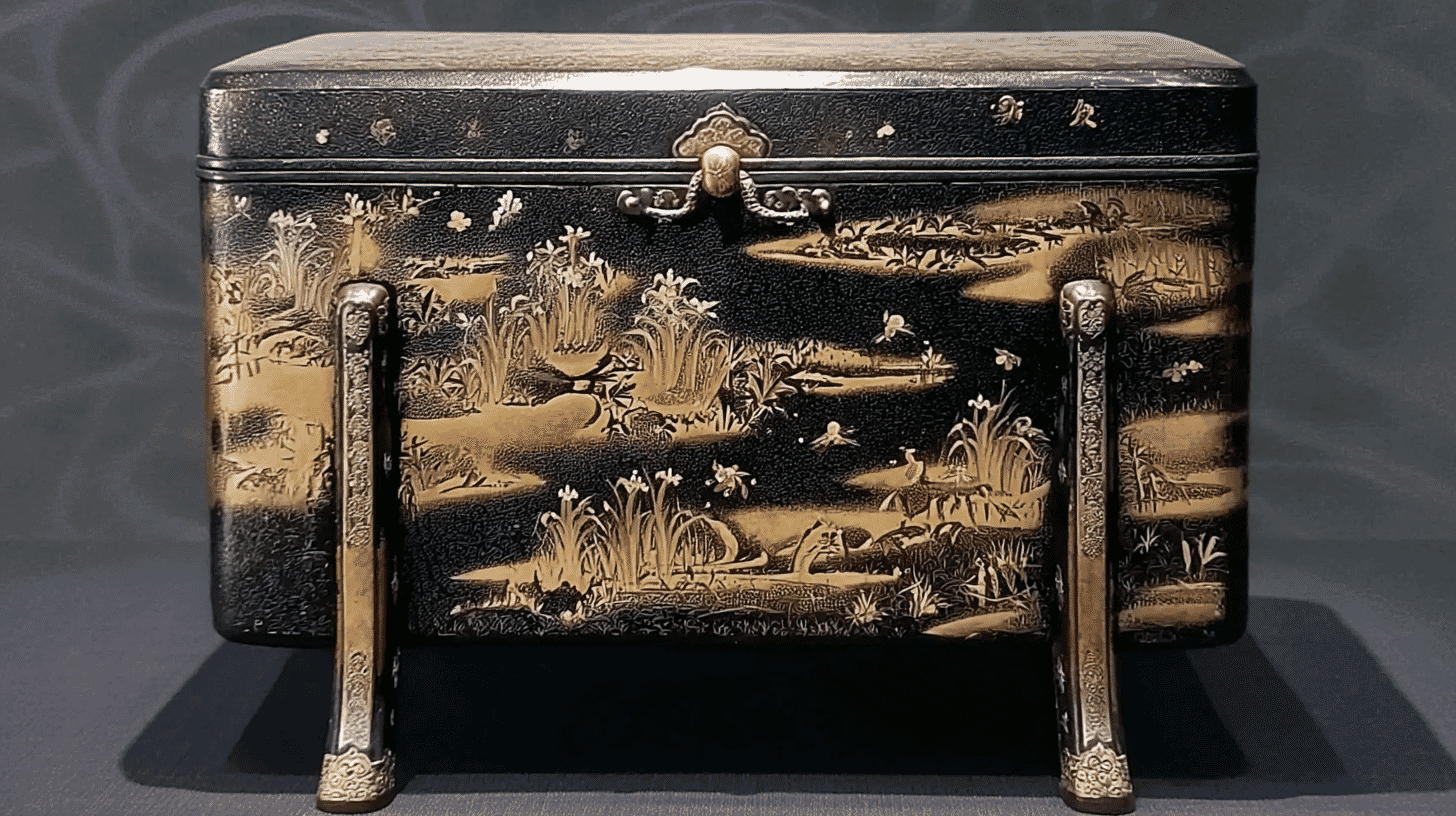
Introduction: A Treasure Box That Captures the Elegance of the Heian Court
Nestled in the sacred mountains of Mount Koya in Wakayama Prefecture lies one of Japan's most exquisite examples of lacquerware artistry. The Sawa Chidori Raden Makie Sho-Karabitsu (澤千鳥螺鈿蒔絵小唐櫃), designated as a National Treasure, is a small lacquer chest that embodies the refined aesthetic sensibilities of Heian-period aristocratic culture. Created in the early 12th century, this masterpiece combines two of Japan's most sophisticated decorative techniques—maki-e (gold powder decoration) and raden (mother-of-pearl inlay)—to create a work of breathtaking beauty.
For international visitors seeking to experience authentic Japanese cultural heritage beyond the typical tourist destinations, this National Treasure offers a window into the artistic achievements of ancient Japan. Unlike the famous temples and shrines that draw millions of visitors, encounters with works like this allow for a more intimate appreciation of the meticulous craftsmanship that defined Japanese aesthetics over a millennium ago.
What is a Karabitsu? Understanding the Form
A karabitsu (唐櫃) is a traditional Japanese storage chest with legs, derived from Chinese-style furniture that was introduced to Japan during the Nara period. The prefix "kara" (唐) indicates its Chinese origins, while "bitsu" (櫃) means chest or container. These elevated boxes were used by the aristocracy to store precious items such as clothing, documents, and religious texts, with the legs serving the practical purpose of keeping contents safe from moisture and pests.
The "sho-karabitsu" (小唐櫃), meaning "small karabitsu," indicates this particular piece's compact size. Measuring approximately 30.5 cm in length, 39.9 cm in width, and 30.0 cm in height, it is roughly the size of a modern hand-carry box. Despite its modest dimensions, the piece was likely created to hold precious Buddhist sutras, making it an important ritual object rather than mere household furniture.
The Artistry: A Masterful Fusion of Maki-e and Raden
What distinguishes this National Treasure from other lacquerware of its era is the seamless integration of two distinct decorative techniques. The togidashi maki-e (研出蒔絵), or "polished-out gold decoration," involves sprinkling gold and blue-gold powders onto lacquer designs, covering them with additional lacquer layers, and then carefully polishing to reveal the underlying patterns with a soft, luminous quality. This technique creates an effect quite different from the more commonly seen raised gold decorations.
The raden (螺鈿) technique adds another dimension to the work. Thin pieces of iridescent shell, likely from abalone or other marine mollusks, are cut into delicate shapes and inlaid into the lacquer surface. These shell pieces catch light in ways that gold cannot, creating shimmering accents that bring the depicted plovers and aquatic plants to life.
Art historians have noted that the combination of these techniques—what specialists call "makie raden" (蒔絵螺鈿)—reached its full artistic potential in the early 12th century. This chest represents one of the earliest and finest examples of this sophisticated fusion, making it an invaluable artifact for understanding the development of Japanese lacquerware.
The Design: Plovers Dancing in a Marsh
The decorative motif covering this treasure depicts a serene wetland scene. Across the lid and all four sides of the chest, the composition shows chidori (千鳥), small plovers, gathering and playing among marsh grasses in flowing streams. The water plants—including kakitsubata (iris) and omodaka (water plantain)—bloom luxuriantly, creating a landscape that evokes the poetic sensibilities of Heian literature.
This design is not merely decorative but carries deep cultural significance. The chidori, or plover, was a beloved motif in Heian poetry, often associated with longevity through its homophonic connection to "a thousand generations" (千代). The marsh setting may also hold Buddhist symbolism, with some scholars suggesting connections to the Lotus Sutra's imagery of spiritual purity rising from worldly waters.
The artisan employed a technique called makibokashi (蒔暈し), creating gradual transitions in gold powder density to suggest atmospheric depth. The sandbars and rocks appear to recede into misty distances, while the space between design elements is filled with subtle heijin (平塵), or "flat dust," giving the background a soft, ethereal quality rather than stark black lacquer.
Hidden Treasures: The Interior Design
While the exterior captures most visitors' attention, the interior of this chest reveals equal sophistication. The underside of the lid features scattered designs of wild grasses, butterflies, and birds executed in gold maki-e against a black lacquer ground—a more intimate decoration meant to be appreciated during private use.
Most remarkably, the chest contains a kakego (懸子), an inner tray or compartment. The bottom of this inner section is adorned with thirteen gilt-bronze openwork medallions featuring hōsōge (宝相華) floral patterns arranged in a diamond configuration. Between these metalwork pieces, raden karakusa (arabesque) patterns fill the spaces, creating a jewel-box effect that would have greeted anyone opening the chest to retrieve its sacred contents.
The Metal Fittings: Precision Craftsmanship
The metalwork on this treasure deserves special mention. The four legs are capped with silver-gilt fittings at both top and bottom, each decorated with intricate arabesque patterns executed in nanako (魚々子), a technique creating a surface of tiny raised dots that resembles fish roe. The lock fitting on the front and the hook fitting on the back display similarly exquisite workmanship.
These metal elements serve both functional and aesthetic purposes. The leg caps protect the wooden structure while elevating the visual elegance of the piece. The copper mounting around the lid's opening (a later addition) demonstrates that this treasure was carefully maintained throughout centuries of use.
Why This Treasure Matters: Cultural and Historical Significance
The Sawa Chidori Raden Makie Sho-Karabitsu was designated as a National Treasure on June 9, 1951, in the very first round of designations under Japan's current Cultural Properties Protection Law. This early recognition reflects the piece's exceptional importance to Japanese cultural heritage.
The chest represents the apex of Heian-period lacquer art, demonstrating mastery of multiple techniques that would influence Japanese craftwork for centuries to come. The yamato-e (Japanese-style painting) approach to its naturalistic design—the flowing water, realistic plants, and lively birds—exemplifies the native aesthetic that emerged as Japanese artists moved away from Chinese-influenced formal styles.
For scholars, this piece provides crucial evidence for dating the development of makie-raden combination techniques. Research comparing this work with the famous Katawaguruma Raden Makie Tebako (片輪車螺鈿蒔絵手箱) at the Tokyo National Museum has helped establish a chronology for Heian lacquerware evolution.
Where to See This National Treasure
The Sawa Chidori Raden Makie Sho-Karabitsu belongs to Kongōbu-ji Temple, the head temple of Shingon Buddhism on Mount Koya. However, visitors should note that this treasure is housed at the Koyasan Reihokan Museum, which serves as the repository for Mount Koya's invaluable cultural properties.
The Reihokan Museum, established in 1921, stores over 100,000 cultural artifacts, including 21 National Treasures and 148 Important Cultural Properties. The museum's historic main building, constructed in the early Showa era in a style reminiscent of Kyoto's Byodo-in Temple, is itself a Registered Tangible Cultural Property.
Please note that this National Treasure is not on permanent display. The museum rotates its exhibitions throughout the year, so visitors interested in viewing this specific piece should check the museum's official website or contact them directly before planning their visit. Special exhibitions occasionally feature this masterpiece alongside other important lacquerware from the collection.
Exploring Mount Koya: Surrounding Attractions
A visit to see this National Treasure can be combined with exploration of Mount Koya's many other cultural sites. The Danjo Garan complex, featuring the striking vermillion Konpon Daito pagoda, lies just across the road from the Reihokan Museum. The Okunoin cemetery, one of Japan's most sacred sites with over 200,000 memorial stones leading to Kobo Daishi's mausoleum, offers a profound spiritual experience.
Many visitors choose to stay overnight in one of Mount Koya's temple lodgings (shukubo), where they can experience Buddhist morning services, vegetarian cuisine (shojin ryori), and meditation practices. This immersive experience provides context for understanding the religious environment in which treasures like the Sawa Chidori chest were created and cherished.
The journey to Mount Koya itself—via the scenic Nankai Railway from Osaka, followed by a cable car ride through ancient cedar forests—sets the stage for appreciation of Japan's traditional culture far removed from modern city life.
Tips for Appreciating This Masterpiece
When viewing historical lacquerware, understanding what to look for enhances the experience immeasurably. Notice how the gold decoration appears to glow softly from within the lacquer surface rather than sitting atop it—this is the distinctive quality of togidashi maki-e. Observe how the mother-of-pearl elements change color as you shift your viewing angle, revealing the natural iridescence of the shell material.
Pay attention to the negative space in the composition. Unlike later, more densely decorated lacquerware, Heian pieces like this one use empty areas deliberately, allowing the deep black lacquer to serve as a visual rest that makes the decorative elements more impactful.
Consider the scale and intimacy of the object. This was not made for distant admiration but for close handling and personal contemplation—perhaps by a monk preparing for sutra recitation or a noble storing precious keepsakes. The quality of work on every surface, including areas rarely seen, speaks to the artisan's dedication to perfection.
- 📍 Plan Your Visit to Wakayama
- Find tours, activities & transport passes near Small Chinese Chest with Sawachidori Design and Mother of
- [ Koyasan & Kumano Kodo World Heritage Trails ]
Q&A
- When was the Sawa Chidori Raden Makie Sho-Karabitsu created?
- This National Treasure was created during the late Heian period, specifically in the early 12th century (around 1100-1120 CE). It represents the pinnacle of lacquerware craftsmanship from an era when Japanese aristocratic culture reached its aesthetic height.
- What was this lacquer chest originally used for?
- While the exact original purpose is not definitively documented, scholars believe it was most likely used as a sutra chest (kyobako) to store Buddhist scriptures. The presence of the inner tray (kakego) and the sacred context of Mount Koya support this interpretation. Some researchers suggest it may have been used specifically for the elaborate Buddhist ritual of Hokke Hakko (Lotus Sutra Eight Lectures).
- Is this treasure always on display at the Koyasan Reihokan Museum?
- No, this National Treasure is not on permanent display. The museum rotates its exhibitions throughout the year. The chest occasionally appears in special exhibitions such as "Treasures of Mount Koya" or lacquerware-focused shows. Visitors should check the museum's official website or contact them directly to confirm current exhibition schedules before planning their visit.
- What makes the "togidashi maki-e" technique special?
- Togidashi maki-e (polished-out gold lacquer) creates a distinctively soft, luminous appearance. After gold powder is applied and sealed with additional lacquer layers, the surface is carefully polished down to reveal the gold patterns flush with the surrounding lacquer. This creates a smooth surface where the gold appears to glow from within rather than sitting on top, giving the decoration a subtle, refined quality prized by Heian aristocrats.
- How do I get to Mount Koya from Osaka?
- From Osaka's Namba Station, take the Nankai Railway's limited express "Koya" to Gokurakubashi Station (approximately 80 minutes). From there, transfer to the cable car for a 5-minute ride to Koyasan Station. Finally, take the Nankai Rinkan Bus to "Reihokan-mae" stop (about 15 minutes) which is right in front of the museum, or to "Senju-in-bashi" stop (about 15 minutes) followed by a 10-minute walk.
Basic Information
| Official Name | 澤千鳥螺鈿蒔絵小唐櫃 (Sawa Chidori Raden Makie Sho-Karabitsu) |
|---|---|
| Cultural Property Designation | National Treasure (Designated June 9, 1951) |
| Category | Craft Arts (Lacquerware) |
| Period | Late Heian Period (early 12th century) |
| Dimensions | Length: 30.5 cm, Width: 39.9 cm, Height: 30.0 cm |
| Owner | Kongōbu-ji Temple |
| Repository | Koyasan Reihokan Museum |
| Museum Address | 306 Koyasan, Koya-cho, Ito-gun, Wakayama 648-0211, Japan |
| Museum Hours | May-October: 8:30-17:30 / November-April: 8:30-17:00 (Last entry 30 minutes before closing) |
| Admission | Adults: ¥1,300 / University & High School: ¥800 / Elementary & Junior High: ¥600 |
| Closed | Year-end and New Year holidays only |
| Contact | TEL: 0736-56-2029 |
| Official Website | https://www.reihokan.or.jp/ |
References
- Cultural Heritage Online - Agency for Cultural Affairs
- https://bunka.nii.ac.jp/heritages/detail/148408
- Koyasan Reihokan Museum - Official Collection Introduction
- https://www.reihokan.or.jp/syuzohin/kogei.html
- WANDER National Treasures - Sawa Chidori Raden Makie Sho-Karabitsu
- https://wanderkokuho.com/201-00322/
- Tohoku University of Art and Design - Research on the Sawa Chidori Chest
- http://blog.tuad.ac.jp/prizeworks/?p=296
- Koyasan Reihokan Museum - Official Website
- https://www.reihokan.or.jp/
- Wikipedia - Maki-e (Japanese Lacquerware Technique)
- https://ja.wikipedia.org/wiki/%E8%92%94%E7%B5%B5