
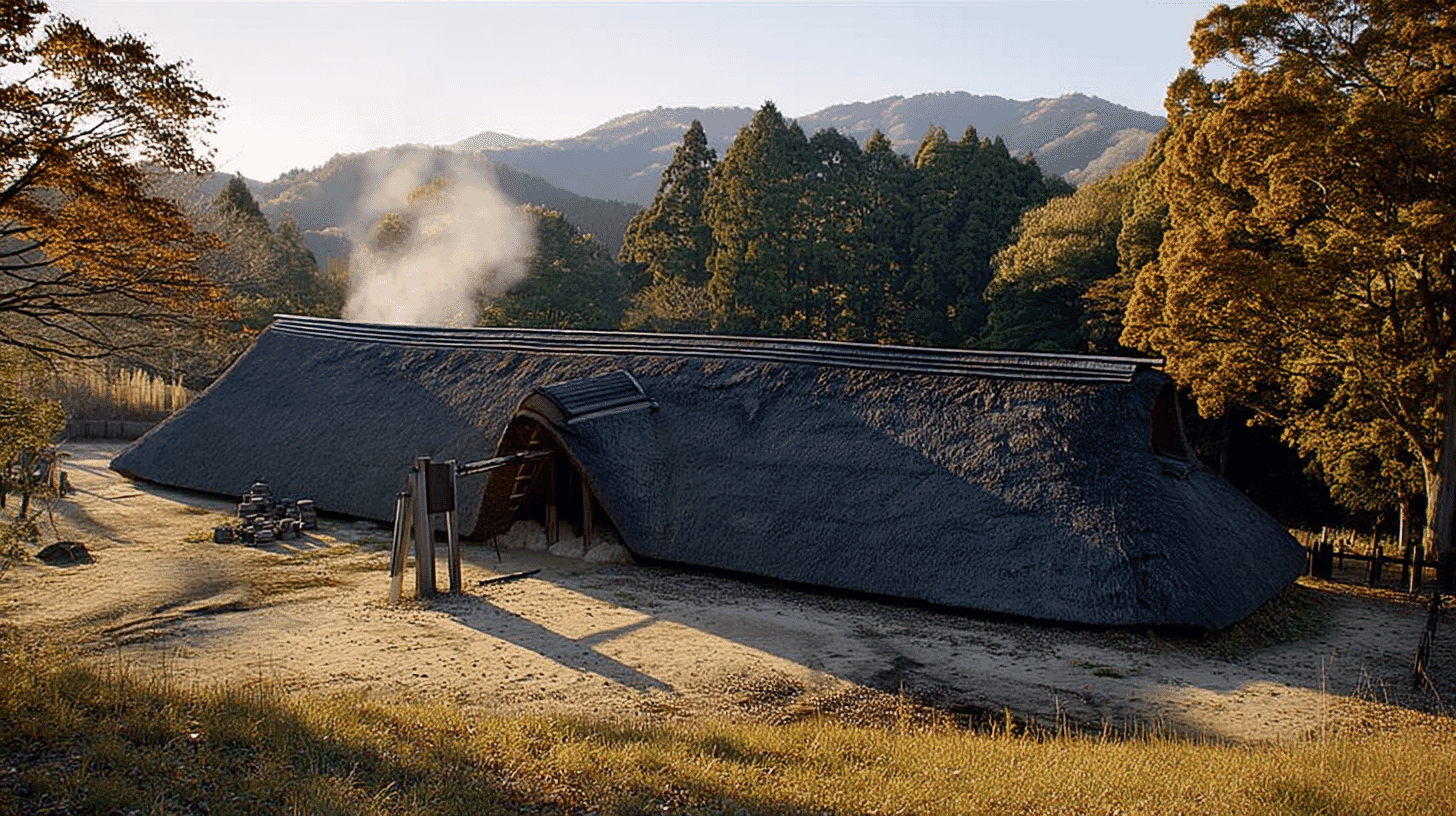
One Settlement Site, Designated by the State in 1997
Ichinosaka Ruins (一ノ坂遺跡, Ichinosaka Iseki) lie at Yarai, Yonezawa City, Yamagata Prefecture, the site of an Early Jomon settlement, designated by the state on 28 July 1997. Its category is that of historic sites.
The field for a managing body stands empty.
The Agency records it on a river terrace at the foot of hills sloping from west to east in the south-west of the Yonezawa basin. The site measures about 90 metres east to west and 80 metres north to south.
A Pit Dwelling 43.5 Metres Long, with Six Hearths
One dwelling is remarkably long and narrow.
The Agency records the discovery of a large pit dwelling 43.5 metres long, the longest in Japan.
It continues that the dwelling runs east and west, about 4 metres wide and 43.5 metres long, covering about 180 square metres, and that its plan is strikingly long and narrow. Post holes run round the floor against the wall, and it has 6 hearths.
A pit dwelling is dug down into the ground, with posts set up and a roof laid over. Against a width of 4 metres, the length of 43.5 metres is more than ten times as much.
Within, 6 hearths stand in a row: six places for fire in one building.
At Tagoyano, pit dwellings, graves and a shell mound show the typical layout of a settlement. Here the form of the dwelling itself is out of the ordinary.
Eight Dwellings 30 Centimetres Apart, Perhaps One Building
Dwellings counted separately may have been a single building.
The Agency records that 8 of the pit dwellings stand close together in an arc as one group, of the same period, set 30 to 50 centimetres apart from north to south.
Their width is constant at about 4 metres, and the group, reaching about 50 metres in all, is close in size to the large pit dwelling.
From the way they are set, the record continues, the 8 were clearly closely related, and it is thought possible that they shared roof and walls as one building.
The words thought possible hold back from asserting. Whether to count 8 or to see 1 is left open in the record.
The dwelling of 43.5 metres and the group reaching 50 metres thus face each other at almost the same size.
What Comes Out Is Unfinished Work and Flakes
Not finished goods but half-made pieces and waste come out in quantity.
The Agency records that pottery amounts to less than 1 per cent of the sherd count, that finished stone tools are few, and that unfinished pieces and flakes are overwhelmingly the most numerous.
The tools made were arrowheads and knives of shale. Most of the stone came from 3 sources within the basin, but since raw stone and cores are almost absent here, it is thought that material already worked once at the sources was brought in.
From the stone and the working, the tools made here are known to have travelled as far as southern Tohoku, the Kanto and the Chubu regions.
At Tagoyano, many unfinished shell bracelets showed that bracelets were made in the settlement.
Here too the half-made pieces and waste show a workshop. Material was carried in and the finished tools carried far away. Charred walnuts were also found in quantity, so that nuts are thought to have been worked here alongside the stone.
Visiting
The site lies at Yarai, Yonezawa City, Yamagata Prefecture.
The Agency records that in 1989 the city board of education excavated ahead of housing development and found the large pit dwelling. Further work from 1990 to 1994 made the site almost fully known.
The remains found are the large pit dwelling, 24 other pit dwellings and 6 pit graves, forming a settlement in the shape of a horseshoe. Five phases in all have been identified.
The pottery found matches a Kanto type, placing the site at the very beginning of the Early Jomon.
This is an open-air site, so whether and how it may be visited follows the arrangements of the local authority. Check before travelling.
Q&A
- When was the site designated?
- On 28 July 1997, by the state, as a historic site.
- How large is the great pit dwelling?
- About 4 metres wide, 43.5 metres long and about 180 square metres, the longest in Japan, with six hearths.
- What about the eight dwellings in a row?
- They stand in an arc 30 to 50 centimetres apart, about 50 metres in all, and may have shared roof and walls as one building.
- What has been found?
- Mostly unfinished stone tools and flakes; arrowheads and knives of shale were made here. Charred walnuts were also found in quantity.
- How was it discovered?
- In 1989, during an excavation ahead of housing development, the large pit dwelling was found, and the site was preserved.
Basic Information
| Name | Ichinosaka Ruins (一ノ坂遺跡, Ichinosaka Iseki) |
|---|---|
| Location | Yarai, Yonezawa City, Yamagata Prefecture |
| Designation | Historic site; designated as an archaeological site rather than as a building or a work of art |
| Year Designated | 1997 (28 July), designated |
| Quantity | 1 settlement site |
| Dimensions | The site measures about 90 metres east to west and 80 metres north to south. The large pit dwelling is about 4 metres wide, 43.5 metres long and about 180 square metres, with 6 hearths. There are 24 other pit dwellings and 6 pit graves, 8 of the dwellings standing in an arc |
| Owner | The field for a managing body stands empty in the record |
| Public Access | An open-air site; visiting follows the arrangements of the local authority |
References
- Cultural Heritage Online: the site
- https://bunka.nii.ac.jp/heritages/detail/215879
- Yonezawa City: the site
- https://www.city.yonezawa.yamagata.jp/soshiki/10/1034/5/5/278.html
- Yamagata Prefecture: cultural properties search, the site
- https://www.pref.yamagata.jp/cgi-bin/yamagata-takara/?m=detail&id=1139
- Agency for Cultural Affairs, National Cultural Properties Database
- https://kunishitei.bunka.go.jp/
Last verified: 2026.09.24